Claude vs ChatGPT vs Gemini vs Grok vs Perplexity: Every Big AI, Tested in One Place (2026)
After running five separate head-to-heads, here's the capstone: every big AI model in one verdict table — who wins each job, what the full lineup costs at retail, and the setup that gets you all of them at once.
Over the past two months I've run every major AI model through the same gauntlet, one matchup at a time: Grok, Perplexity, Gemini, Claude and DeepSeek, each tested against ChatGPT on the work people actually open an AI for. Every single match ended the same way: a split decision. No challenger swept ChatGPT. ChatGPT swept no challenger.
This is the post those matchups were building toward — all the big models in one place, one verdict table, no diplomatic ties. If you've been searching claude vs chatgpt vs gemini vs grok (or any shuffle of those names) hoping someone will finally rank them, I'll do something better: show you which model wins each job, what the full lineup costs, and the punchline the whole series kept pointing at — the people getting the most out of AI in 2026 stopped picking one.
The One-Table Verdict: Five Models, Seven Jobs
Here's the entire series compressed into one table — for each job, the model I'd hand it to first, the one I'd try second, and why.
| Task | First pick | Runner-up | Why |
|---|---|---|---|
| Writing & editing | Claude | ChatGPT | Most human prose of the five; takes tone direction without a fight |
| Everyday questions & speed | ChatGPT | Gemini | Widest range, fewest follow-up prompts, most polished product |
| Careful reasoning & judgment | Claude | Gemini | Keeps the caveats alive; Gemini grinds big structured problems |
| Research with sources | Perplexity | Gemini | Cites every claim from the live web; Gemini grounds in Google Search |
| Current events & breaking news | Grok | Perplexity | Plugged into X's firehose; Perplexity brings the citations |
| Math & step-by-step work | Grok | ChatGPT | Methodical solver; ChatGPT explains the steps most clearly |
| Images & multimodal | Gemini | ChatGPT | Reads and generates media natively; ChatGPT counters with voice |
Run your eye down the first-pick column: no model wins more than two rows. Five contenders, seven jobs, four different winners. That's not a scoring quirk — it's the finding. The "which AI is best" question has stopped having a one-word answer, and everything below is about what to do instead.
How I Tested This
No benchmark charts here — leaderboards measure exam technique, and the gaps between frontier models on exams are now smaller than the gaps between them on real work. Instead, each pairwise matchup got the same battery: drafting and editing passes on things meant to be read, a research brief that had to come back with sources, questions about events from the last 48 hours, a statistics problem with a trap in it, image tasks, and a week of ordinary miscellany. The table above is where those five scorecards agree; the individual posts linked throughout are the receipts, with the prompt-level detail.
One deliberate omission: version numbers. Model digits roll over every few weeks; the characters of these five have been stable for years. It's the characters you're choosing between.
The Five Contenders, One Paragraph Each
Claude (Anthropic) is the craftsman. Its prose needs the least rewriting before another human sees it, its edits sharpen without flattening your voice, and on genuinely hard judgment calls it's the one most likely to keep the "it depends" honest instead of forcing a clean verdict. It generates no images and chases no trends. Full matchup here.
ChatGPT (OpenAI) is the utility player and the default for a reason. Nothing else covers as many kinds of task with as little friction — draft this, explain that, plan the trip, take a voice call in the car. Its trap is subtler: being second-best at almost everything means it leads fewer columns than its market share suggests. It's also the fixed point of this series — the model every other contender was measured against.
Gemini (Google) is the industrial equipment. It holds more material in one conversation than anything else — reports, transcripts, stacks of PDFs — answers with Google Search grounding so its facts skew current, and treats images and charts as just more input. The writing is clear but functional. Full matchup here — or see it go directly against Claude, the one model that beats it on prose, in Claude vs Gemini.
Grok (xAI) is the live wire. Wired into X, it knows what happened an hour ago, gives you the take without three paragraphs of hedging, and turns out to be a sneaky-good methodical reasoner — it earned the math column on merit, not attitude. Full matchup here.
Perplexity is the librarian — technically an answer engine rather than a raw model, but it competes for the same jobs. Ask it anything factual and the reply comes back with numbered sources you can click and check. For research that has to survive scrutiny, that footnote habit beats eloquence. Full matchup here.
Task by Task: Who Actually Wins What
Writing and editing
Claude, with ChatGPT close behind. Claude's drafts arrive with varied rhythm and without the stock AI phrases, and it applies editing notes — warmer, tighter, less corporate — without mangling meaning. ChatGPT is faster to a usable draft and unbeatable for volume work like variants and outlines. Gemini and Grok both produce clean, serviceable copy that reads a step more mechanical; Perplexity isn't trying to win this. (The essay-specific version of this contest is in Best AI for Writing Essays.)
Everyday questions and speed
ChatGPT, comfortably. The hundred small weekly asks — summarize this, name that, plan the weekend, read this screenshot — are where its breadth and product polish compound into a real lead. It's the model least likely to need a second prompt to understand you. Gemini is the strongest second, especially when the everyday question quietly needs a current fact. The specialists all survive this category; none of them wins it.
Careful reasoning and judgment
Claude for judgment, with Gemini on the grind. On messy questions where the honest answer has moving parts — a strategy call, a tricky trade-off — Claude holds nuance the longest. Gemini is the one I hand dense, many-variable problems where sheer working memory pays off. Grok deserves its flowers here too: it's direct, methodical, and won't cushion a weak plan. The deeper three-way on this territory is Claude vs ChatGPT vs Gemini.
Research with sources
Perplexity, and it isn't subtle. When the deliverable needs to be checkable — market numbers, competitor facts, anything a skeptical reader will poke — Perplexity's cited answers change the job from trusting to verifying. Gemini runs second on the strength of Search grounding plus the capacity to digest whatever sources you feed it. The full research bake-off, including where each hands off to the other, is Perplexity vs ChatGPT vs Claude.
Current events and breaking news
Grok, with Perplexity as the fact-checker. Grok's X integration means it often knows about a story while the others are still confidently describing last month. Its weakness is the flip side: the firehose carries rumors too. My working pair: Grok for what's happening right now, Perplexity to confirm it with sources before I repeat it anywhere that matters. Narrow the field to the three models built on live sources and the ordering turns out to depend on how old the story is — that's the argument in Grok vs ChatGPT vs Gemini.
Math and step-by-step work
Grok first. It treats a hard problem the way a good student does — set up, grind, check — and it's the least likely of the five to skip a step and bluff the answer. ChatGPT is the runner-up for a different reason: when you need the solution explained rather than just produced, its walkthroughs are the clearest. The dedicated shootout (where a free challenger complicates things) is Best AI for Math.
Images and multimodal
Gemini by a nose. It reads screenshots, charts and photos fluently and generates strong images in the same breath. ChatGPT counters with the best voice conversation in AI and image tools of its own; Grok's image generation holds its own on style. Claude reads images perfectly well but generates none — the specialist for words stays in its lane.
The Wildcard: DeepSeek Plays for Free
One model keeps photobombing this comparison without paying the entry fee. DeepSeek's consumer app charges nothing — including its reasoning mode, which competes head-on with paid tiers at structured analysis and math. It's a brain without a product: no voice, no images, no memory, and real privacy caveats around the official app (though not the open-weight model itself — that story is here). It didn't earn a column in the verdict table because it only plays two events — but it plays them at frontier level for $0, which bends the value math of everything above. The full examination is DeepSeek vs ChatGPT.
So Which AI Is Best in 2026?
Asked straight, answered straight: best at what? Claude is depth. ChatGPT is breadth. Gemini is scale. Grok is pulse. Perplexity is proof. Anyone who names one overall winner is averaging away exactly the information you searched for.
If you truly must hold one subscription, ChatGPT remains the sane default — breadth carries a normal week, and the table shows it running second nearly everywhere it doesn't win. But notice what that choice costs you: the best writing, the biggest context, the live feed, and the citations. I've made the longer argument against single-model loyalty before; this table is that argument in numbers.
What the Full Lineup Costs at Retail
Here's where routing-by-task crashes into billing reality. Bought separately, the lineup runs:
- ChatGPT — $20/mo
- Claude — $20/mo
- Gemini — $20/mo
- Perplexity — $20/mo
- Grok — $30/mo
- DeepSeek — free (consumer app; API is usage-priced)
That's $110/month at sticker price — six accounts, six tabs, six conversations that can't see each other, and each specialist idle except during its own event. (If you were only ever going to pay for one ladder anyway, I broke down ChatGPT's own tiers here — and the two $20 flagships go head-to-head in ChatGPT Plus vs Claude Pro. Grok's $30 row hides a second bill most people miss, priced out in how much Grok costs — and how much Grok that $30 actually buys is a number xAI has never published.) Almost nobody should pay it, because the entire point of this post — use the right model per task — has a much cheaper implementation.
How to Actually Run All Five
This is the setup this whole series ends on. izzedo chat puts Claude, ChatGPT, Gemini, Grok, Perplexity and DeepSeek — more than twenty models in all, image models included — behind one login for $6/month, with a free plan that needs no credit card. One flat bill, no points or credits to ration; fair-use limits run quietly in the background on a short rolling window that resets within hours, plus a weekly pool for sustained heavy use, and the plan details live on the pricing page.
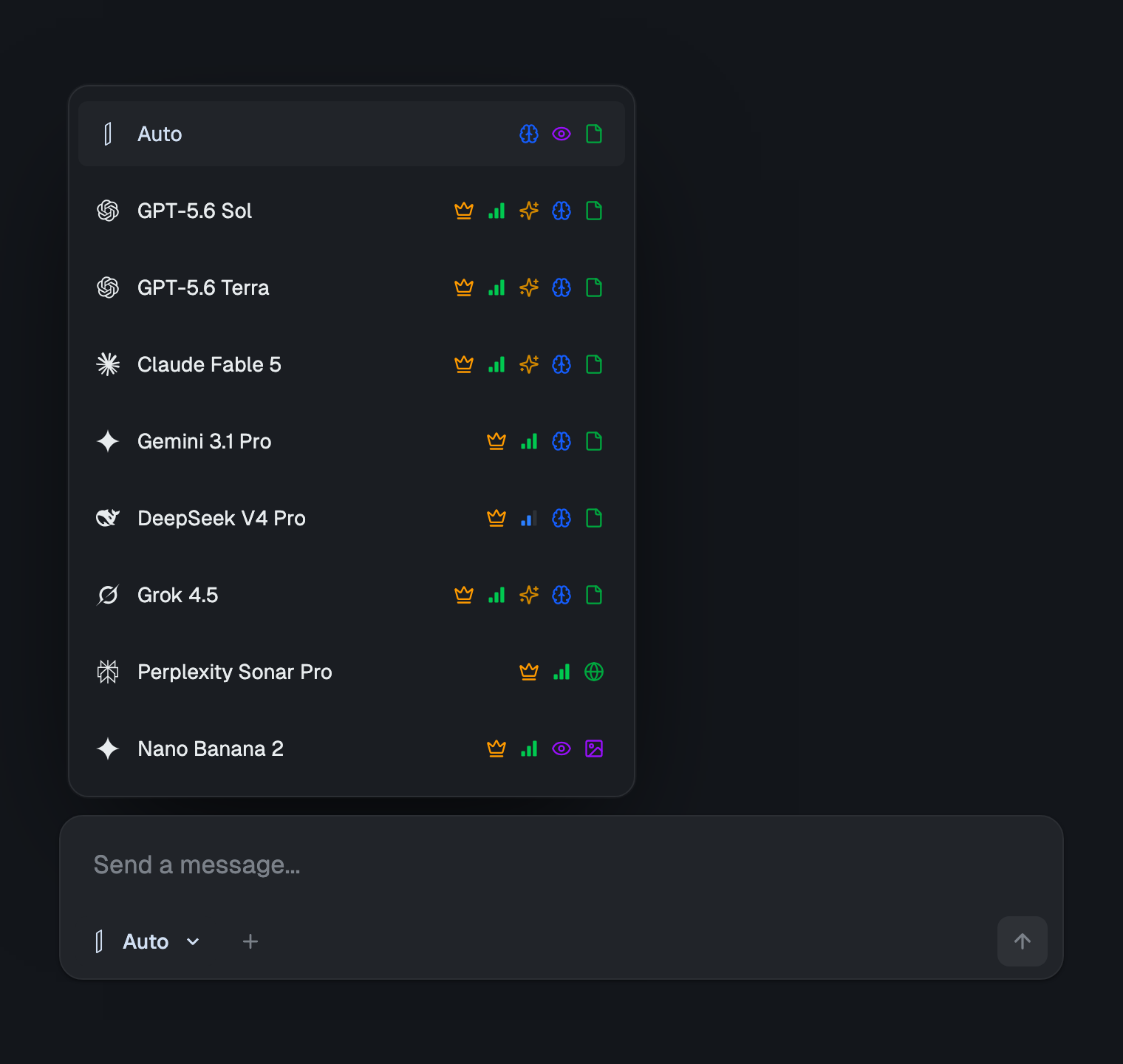
The feature that turns the verdict table into a workflow is mid-conversation model switching: every model works inside the same thread and inherits everything said so far. Route the way the table says — Perplexity gathers the sourced facts, Gemini digests the documents, Claude writes the version humans will read, Grok sanity-checks the numbers — without ever re-explaining the job, because each specialist walks in already briefed.
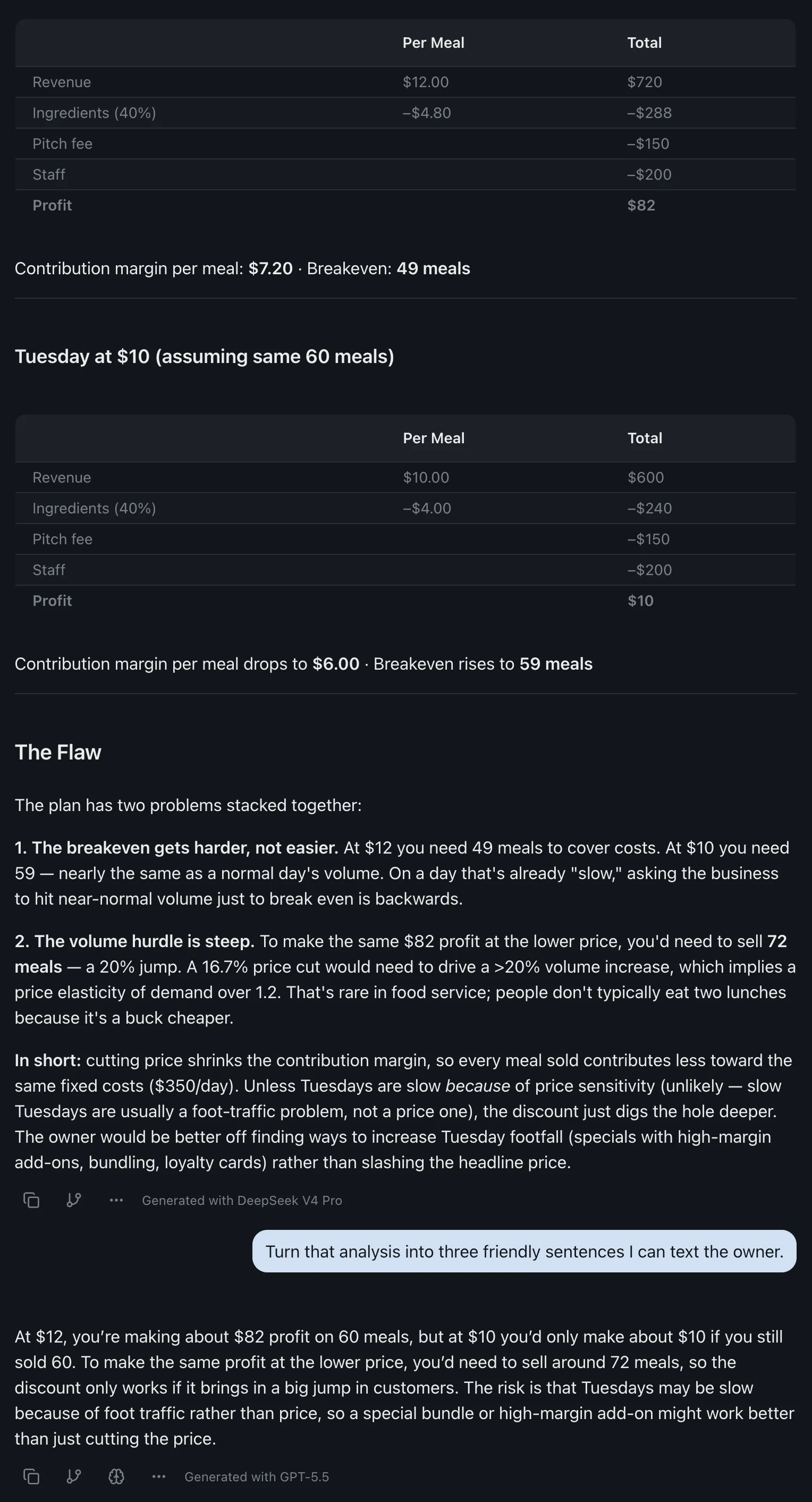
Here's what a hand-off looks like in a real thread: one model works through a pricing plan's breakeven math and flags the flaw, then the conversation switches models and the findings become a friendly, sendable note — each reply labeled with the model that wrote it:
The disagreement dividend
Owning all five unlocks one more workflow, and it might be the most valuable: the second opinion. Every model in this post is confidently wrong sometimes — that's the one column they all share. Fire the same question at two models (izzedo can put multiple models' answers side by side); where they agree, move on, and where they split, you've found precisely the claim to verify. Five specialists checking each other's work catches errors no single subscription ever will. The one-minute version of the method is here, the deeper workflows are here, and if running several models in one thread is new territory, start with this walkthrough.
The Bottom Line
Two months of head-to-heads, five models, one conclusion: the era of the single AI subscription is quietly ending. Claude writes it best. ChatGPT does the most. Gemini holds the most. Grok knows first. Perplexity proves it. Ranking them against each other misses what they actually are — a lineup, in the sports sense, where asking "which player is best" matters less than fielding all of them in the right positions.
The retail price of that lineup is $110 a month. The actual price is $6. That gap — not any single model's cleverness — is the biggest arbitrage in AI right now.
If you came here because you're thinking of leaving one vendor rather than ranking all of them, the companion piece sorts the ChatGPT alternatives by reason for switching — including what it costs you to move your history.
Want all five in one thread — switch mid-conversation, get second opinions, pay one flat bill? Try izzedo chat free — no credit card required.
Frequently asked questions
Which AI is best in 2026: Claude, ChatGPT, Gemini, Grok, or Perplexity?
None of them wins overall — each one leads a different lane. Claude produces the best writing and the most careful judgment, ChatGPT covers the widest everyday range, Gemini handles the biggest documents and multimodal work, Grok is strongest on live news and step-by-step math, and Perplexity wins any research that needs cited sources. The practical answer is to route each task to the model that leads it rather than crowning a single champion.
Is Claude better than ChatGPT and Gemini?
At specific jobs, yes. Claude writes the most natural prose of the big models and keeps the most nuance on hard judgment calls, which is why writers and analysts gravitate to it. But ChatGPT beats it on everyday breadth, voice and product polish, and Gemini beats it on giant documents and live information. Better depends entirely on which column of the job chart you spend your day in.
What is the cheapest way to use all five AI models?
Paying retail for the full lineup — ChatGPT, Claude, Gemini and Perplexity at about $20/month each, Grok at $30, with DeepSeek free — comes to roughly $110/month across six separate accounts. A multi-model workspace collapses that: izzedo chat includes all of these models in one workspace from $6/month, with a free plan that doesn't ask for a credit card.
Do I really need more than one AI model?
For casual use, no — any of the big five will handle light questions well. For real work the case gets strong fast: writing, research, current facts and analysis are led by different models, and any single model is confidently wrong just often enough to matter. Running a second model on important answers turns disagreement into a signal for what to double-check, which is the cheapest error-catching workflow in AI.
Which AI is best for research?
Perplexity, if research means finding current facts with verifiable sources — it searches the live web and cites every claim. Gemini is the strongest runner-up thanks to Google Search grounding and its huge context window for digesting source material. ChatGPT and Claude are better at reasoning over research you hand them than at fetching it. For heavy sourced work, many people pair Perplexity for gathering with Claude or ChatGPT for synthesis.
Ready to try multi-model AI workflows?
Access GPT, Claude, Gemini, Perplexity, and more — all in one place.
Start for Free →