Claude vs ChatGPT vs Gemini in 2026: Which AI to Use for What
Claude, ChatGPT or Gemini? After months with all three in daily rotation, the honest answer is a job chart, not a single winner. Here's which to use for what — and how to stop choosing.
Ask which AI deserves your money in 2026 and three names come back before anyone pauses for breath: Claude, ChatGPT, Gemini. People type the matchup into Google in every possible order — claude vs chatgpt vs gemini, chatgpt vs gemini vs claude — hoping the ranking will finally settle it. I've kept all three in daily rotation for months, and I can save you the suspense: the ranking doesn't exist. What exists is a job chart.
Claude writes and reasons with more care than anything else I've used. ChatGPT covers more ground in a day than the other two combined. Gemini digests inputs the others struggle to hold and comes back with current, linkable answers. Treat them as three hires with three different résumés and the "which is best" argument dissolves into a far more useful question: best at what?
So that's how this guide is built — task by task: who wins, who's the runner-up, where each one falls down. Then the honest math on what the trio costs, and the setup that gets you all three without juggling three subscriptions.
The Short Answer: Which AI Wins Each Job
If you only read one thing, read this. Each row is a job people actually open an AI for, the model I'd hand it to first, and the one I'd try next.
| Task | First pick | Runner-up | Why |
|---|---|---|---|
| Writing & editing | Claude | ChatGPT | Most human-sounding prose; takes tone and structure direction with the least friction |
| Everyday questions & speed | ChatGPT | Gemini | The fastest route to a useful answer on almost anything |
| Long documents & big context | Gemini | Claude | Holds enormous inputs in one pass; Claude reads a single dense text most closely |
| Research & current info | Gemini | ChatGPT | Google Search grounding keeps answers fresh and linkable |
| Careful reasoning & judgment | Claude | Gemini | Slows down, keeps the caveats; Gemini grinds through dense structured problems |
| Images, voice & multimodal | Gemini | ChatGPT | Reads and generates media natively; ChatGPT counters with voice and its toolset |
| Coding | Any of the three | — | All three are credible; the choice comes down to your stack and habits |
Scan the "first pick" column: no name sweeps it. Claude takes the craft, ChatGPT takes the breadth, Gemini takes the scale. That three-way split is the real finding of this comparison, and it's why the last third of this guide is about routing between them instead of declaring a champion.
Meet the Three
A quick character sketch of each — deliberately free of version numbers, because the digits churn every few weeks while the personalities barely move.
Claude (Anthropic) is the craftsman of the trio. It's the model whose writing you can ship with the least rewriting, the one that edits without flattening your voice, and the one most likely to answer a hard question with the caveats intact instead of a false-clean verdict. It reads material you give it with real attention. What it doesn't try to be is a hub: no image generation, fewer extras, and a cautious streak that occasionally needs a nudge.
ChatGPT (OpenAI) is the utility player — the one you can hand nearly anything and get something genuinely useful back on the first try. Drafting, explaining, planning, summarizing, a voice conversation in the car, a quick image: it does more kinds of things than either rival, wrapped in the most familiar product. The trade-off is that it leads fewer individual categories than its reputation suggests: the writing is strong but rarely the most natural, the context window generous but not the largest.
Gemini (Google) is the heavy machinery. It holds more material in working memory than the other two — whole reports, books, piles of PDFs — and because it's wired into Google Search, its answers lean current and come with links you can actually open. It treats images, charts and screenshots as just more input, and it generates images too. Its softer spot is voice-of-the-writing: clear, structured, correct, and a little flatter than Claude's or ChatGPT's until you coach it.
Claude vs ChatGPT vs Gemini, Task by Task
Same prompts, same context, three tabs side by side — here's how the trio actually splits the work.
Writing and editing
Claude first, ChatGPT close behind, Gemini third. Claude's drafts need the least de-robotizing: the rhythm varies, the stock phrases mostly don't appear, and when you say "warmer, and stop hedging" it applies the note without mangling your meaning. It's the strongest pure editor of the three as well. ChatGPT is quicker to a solid usable draft and shines on volume — subject lines, outlines, five variants of the same paragraph — it just reads a bit more assembled. Gemini's copy is organized and accurate but the most templated of the three; I treat it as a fine drafter that always wants a Claude pass afterward. (Writing an essay end-to-end? I mapped that whole workflow in Best AI for Writing Essays.)
Everyday questions, brainstorming and speed
ChatGPT, and it isn't close. The long tail of daily asks — explain this error, name this newsletter, plan a four-day Rome trip, turn these bullets into an agenda — is where ChatGPT's breadth and polish compound. It's the least likely to need a second prompt to understand what you meant, and its ecosystem (voice, tools, memory of your preferences) removes friction the others still have. Gemini is a capable second here, especially when the everyday question secretly needs fresh information. Claude answers beautifully too; it's just tuned for depth, and you feel it on quick-fire miscellany.
Long documents and big context
Gemini for sheer capacity, Claude for the closest read. Gemini's context window is the biggest working memory in the business: a 300-page report, a contract stack, four transcripts at once — it holds the lot and cross-references across all of it in one pass. If your bottleneck is volume, it's not a debate. Claude counters on depth per page: on a single dense document it's the one that catches the buried qualifier and the argument the author almost hides. ChatGPT is competent at both without being built for either. One habit worth keeping regardless of model: spot-check the quotes and numbers an AI pulls from a long document — confident misreads survive at any context size.
Research and current information
Gemini leads, ChatGPT is a strong second, Claude trails. Grounded in live Google Search, Gemini answers time-sensitive questions with current facts and links — it behaves less like a model remembering and more like one that just looked. ChatGPT's browsing is mature and it's arguably smoother when research blends into doing (find the top options, then draft the comparison email). Claude is the specialist you brief: give it the sources and its analysis is superb, but fetching the current picture is not its home turf. Swap Claude out for Grok and this row becomes its own comparison — Grok vs ChatGPT vs Gemini is the matchup between the three models wired to live sources, and they disagree because they're reading different ones. If your research must come back fully cited every time, that's really Perplexity's territory — I ranked it against these models in Perplexity vs ChatGPT vs Claude.
Careful reasoning and judgment
Claude for judgment, Gemini for grind, ChatGPT for speed. On messy questions where the right answer is "it depends, and here's on what" — a strategy trade-off, a policy call, a should-I — Claude keeps the nuance alive longest instead of collapsing into a tidy verdict. Gemini is the one I hand dense, structured, many-moving-parts problems, where its capacity to hold everything at once pays off. ChatGPT reasons well and decisively, which is exactly right when you want a fast, confident read — and exactly the thing to double-check when the question deserved a hedge. (If grind-it-out analysis is most of your day, there's also a $0 specialist for it — see DeepSeek vs ChatGPT.)
Images, voice and multimodal
Gemini by a nose over ChatGPT; Claude sits this one out. Gemini treats media as native input and output — it reads screenshots, charts and photos fluently and generates strong images. ChatGPT does all of that too, and its voice mode is still the best natural conversation of the three; on pure image generation, the better pick is genuinely taste-dependent. Claude can see — it reads images and documents fine — but it doesn't generate them, which is fitting: it's the specialist for words, not pictures.
The Pattern: Depth, Breadth, Scale
Run every verdict above through a strainer and three words are left in the mesh. Claude is depth — the best sentences, the most careful thinking. ChatGPT is breadth — the most jobs handled well per day. Gemini is scale — the most input held, the freshest facts, the most media. Search it as gemini vs chatgpt vs claude or any other order you like; the SERP changes, the shape of the answer doesn't.
That shape has a practical consequence. Whichever single model you subscribe to, you're not picking a winner — you're picking which two strengths to live without. The two-way matchups make the same point in higher resolution (Claude vs ChatGPT on the depth-versus-breadth line, Gemini vs ChatGPT on scale-versus-craft; and Claude vs Gemini for the pairing that leaves the default out of it); put three side by side and it stops being a contest at all. It's a division of labor.
What the Trio Costs
The pricing makes the "pick one" problem expensive to solve badly. Claude Pro, ChatGPT Plus and Gemini Advanced each run about $20/month — identical stickers, zero help breaking the tie. Cover the trio properly and you're at roughly $60/month, three accounts, three tabs, and three conversations that can't see each other.
And the shortlist rarely stops at three. Add the rest of the usual suspects and the full stack looks like this:
- ChatGPT — $20/mo
- Claude — $20/mo
- Gemini — $20/mo
- Perplexity — $20/mo
- Grok — $30/mo
- DeepSeek — free (consumer app; API is usage-priced)
That's $110/month if you pay retail for each, with most of them idle most of the time. For a task-routing workflow — the whole moral of this comparison — that bill shape is exactly backwards: you want access to every specialist, but you only use one at a time.
How to Use All Three Without Three Subscriptions
This is the part that changed how I work. A multi-model workspace like izzedo chat puts Claude, ChatGPT and Gemini — plus Grok, Perplexity, DeepSeek and more than twenty models in all — behind one login for $6/month, with a free plan that doesn't ask for a card. The honest fine print: fair-use limits exist here like everywhere in AI, but they run quietly in the background on a short rolling window that resets within hours, with a weekly pool underneath for sustained heavy use. The bill is a flat monthly price unless you switch on usage-based billing, which is off by default, and there are no points to ration.
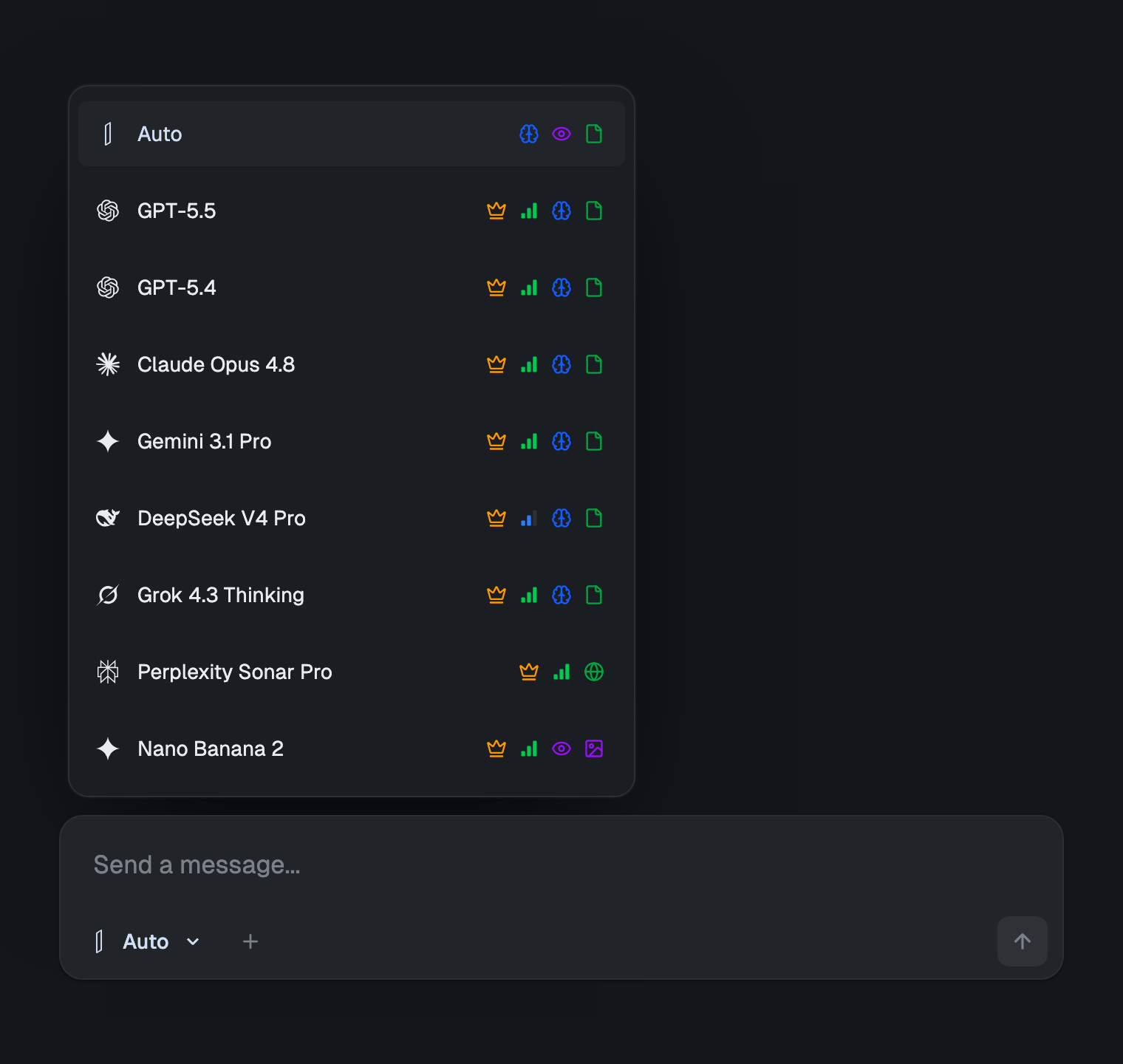
The feature that makes the job chart real is switching models mid-thread. Every model works in the same conversation and inherits everything said so far, so the routing this guide keeps recommending becomes one workflow instead of three tabs: have Gemini pull the current facts and digest the source pile, hand the thread to Claude to draft in an actual human voice, then flip to ChatGPT to spin variants, tighten for a different audience, or take the task somewhere unexpected. Nothing gets copy-pasted; each specialist walks in already briefed.
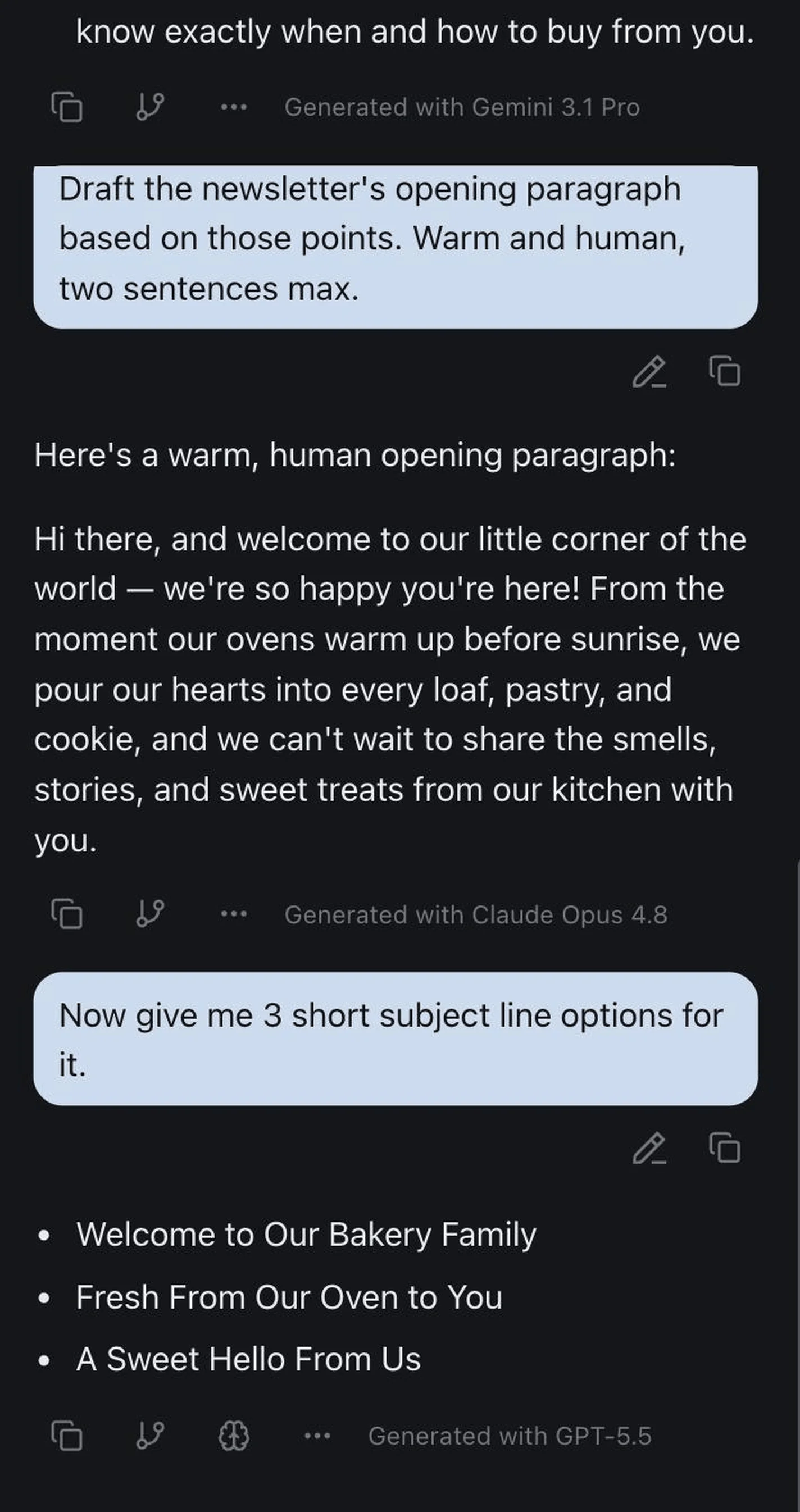
When they disagree, that's the feature
Keeping three models in one place also quietly fixes AI's biggest flaw: any single model is occasionally, confidently wrong. Ask the same question twice — once to a second model — and watch the answers. Agreement is cheap reassurance; disagreement is a flashing arrow pointing at the exact claim you need to verify before it embarrasses you. In separate apps that habit dies of friction. In one thread it's a click: re-run the question on another model, compare, move on. I keep a one-minute version of the routine here, and four deeper multi-model workflows here.
So Which Should Be Your Default?
Routing beats loyalty — but everyone still needs a default, the model that gets the first keystroke. Match it to the work you do most:
- Writers, marketers, editors: default to Claude; pull in Gemini when the piece needs today's facts, ChatGPT when you need ten variants fast.
- Analysts, consultants, document-heavy roles: default to Gemini for the intake and the current picture; hand conclusions to Claude when they have to be written like you mean them.
- Students: genuinely split — Gemini to digest the readings, Claude to draft and revise, ChatGPT for the daily explain-this grind. (Full picks by subject in Best AI for College Students.)
- A bit of everything: default to ChatGPT and enjoy the range — you'll still want Claude the day the writing matters and Gemini the day the PDF is 400 pages.
Notice every bullet smuggles in a second model. That's not indecision — that's what a three-specialist market looks like when you describe it honestly.
The Bottom Line
Claude vs ChatGPT vs Gemini has no podium, just a map: Claude for depth — writing and careful judgment; ChatGPT for breadth — everyday range and ecosystem; Gemini for scale — long documents, live information, multimodal work. Anyone selling a single overall winner is compressing away the exact information you came for.
So don't buy a winner. Route the work: aim each task at the model that leads it, keep a second opinion one click away for anything that matters, and let the three of them argue in one thread — on one bill — while you keep the best answer. (Want the wider field? Grok and Perplexity join these three in the five-model capstone.)
Want Claude, ChatGPT and Gemini in the same conversation — with Grok, Perplexity, DeepSeek and the rest on the same $6 plan? Try izzedo chat free — no card needed.
Frequently asked questions
Which is best overall: Claude, ChatGPT, or Gemini?
There's no single winner — each leads a different category. Claude produces the most natural writing and the most careful reasoning. ChatGPT has the widest everyday range and the deepest ecosystem of extras like voice and tools. Gemini handles the biggest documents, stays current through Google Search grounding, and is the strongest all-round multimodal model. The best setup routes each task to the model that leads it rather than crowning one for everything.
Is one of the three enough?
For light, casual use — yes, pick whichever matches your most common task and you'll be fine. But real work tends to mix writing, research and document-heavy tasks in the same week, and each model covers a different one of those best. That's why many people end up paying for two or three, or use a multi-model workspace that bundles all of them for less than a single subscription.
Which is best for writing: Claude, ChatGPT, or Gemini?
Claude, for most writing. Its prose sounds the most human out of the box and it takes editing direction with the least friction, which is why writers tend to settle on it for drafting and revision. ChatGPT is a close, faster second and excellent for high-volume everyday copy. Gemini's writing is clear and well-organized but reads more functional, so it usually wants an extra polishing pass.
Which is best for research and current information?
Gemini leads here because its answers are grounded in live Google Search, so they stay fresh and come with links to check. ChatGPT's browsing and tools are also mature and handle mixed look-something-up tasks well. Claude is superb at analyzing material you hand it, but it's the least built around going out to fetch current facts. And if strict citations are the whole job, a dedicated answer engine like Perplexity is worth a look.
What's the cheapest way to use Claude, ChatGPT and Gemini together?
Paying each provider directly costs about $60/month — roughly $20 each for Claude Pro, ChatGPT Plus and Gemini Advanced — across three accounts. A multi-model workspace is far cheaper: izzedo chat includes Claude, ChatGPT and Gemini plus Grok, Perplexity and DeepSeek in one workspace for $6/month, and there's a free plan with no card required to try it first.
Ready to try multi-model AI workflows?
Access GPT, Claude, Gemini, Perplexity, and more — all in one place.
Start for Free →