DeepSeek vs ChatGPT in 2026: What Does $20 Actually Buy You?
DeepSeek hands out frontier-grade reasoning for free; ChatGPT charges $20 for the most complete AI product there is. I tested both — here's which wins each task, and the setup that quietly gets you both.
Almost every "[model] vs ChatGPT" showdown is really two $20 subscriptions arguing about nuance. This one isn't. DeepSeek — the lab out of Hangzhou whose reasoning model once wiped hundreds of billions off US tech stocks in a day — charges exactly nothing for its app, thinking mode included. ChatGPT charges twenty dollars a month for its good tier and remains the most complete AI product ever shipped.
So the real question under "DeepSeek vs ChatGPT" isn't which one is smarter. It's what that $20 actually buys you — and whether you need it. To find out, I put both through the work I genuinely use AI for: pulling apart a dense analysis, drafting things people will read, checking live facts, and the endless small tasks in between. Here's the honest scorecard, task by task, and at the end, the setup that makes the whole dilemma disappear.
The Short Answer: DeepSeek vs ChatGPT at a Glance
In a hurry? The table is the verdict — which one I'd hand each job, and why.
| Task | Better pick | Why it wins here |
|---|---|---|
| Step-by-step reasoning, math & analysis | DeepSeek | Deliberate, visible reasoning that rivals paid tiers — for $0 |
| Writing & editing | ChatGPT | Cleaner prose out of the box, far easier to steer on tone |
| Current info & web answers | ChatGPT | More dependable built-in browsing woven into a smoother product |
| Everyday range, voice & images | ChatGPT | Voice, image tools, memory, integrations — DeepSeek has none of it |
| Coding | Tie | Developers rate both; for serious work a dedicated coding tool beats either |
| Raw value per unit of thinking | DeepSeek | The entire consumer app is free, reasoning included |
One column screams from that table: ChatGPT wins more rows, but the rows DeepSeek wins cost you nothing. Hold that thought — it's the key to the whole matchup.
Meet the Two Contenders
No version numbers here — model digits roll over monthly, while each side's character has stayed remarkably stable.
DeepSeek is the specialist. Born in a Chinese quant-fund-turned-AI-lab, it built its reputation on one skill: methodical, transparent reasoning. Ask it something that needs to be worked through — a statistics question, a contract clause, a plan with a hidden flaw — and you can watch it deliberate before it commits to an answer. Two more traits define it: most of its models are published open-weight, free for anyone to inspect and host, and its consumer app costs nothing at all. What it doesn't have is everything else — no voice mode, no image generation, no memory between chats, an interface best described as functional, and a history of "server busy" messages whenever it goes viral. Like every model from a Chinese lab, it also declines topics Beijing considers sensitive — rarely relevant to daily work, but worth knowing.
ChatGPT is the generalist that made AI a household verb. Its model quality is frontier-grade across the board, but the moat is the product: talk to it out loud, hand it a photo, have it generate images, let it remember your preferences, build custom assistants, plug it into your tools. It almost never has a bad day, and for the widest range of everyday requests it remains the least surprising, most polished option. The catch is the ladder: the free tier is deliberately capped, and the experience everyone praises really starts at $20/month.
What You're Actually Choosing Between: a Brain and a Product
Here's the pattern that every test below kept confirming. DeepSeek ships a brain — near-frontier reasoning, no wrapper, no frills, no bill. ChatGPT ships a product — a slightly less spiky brain surrounded by the best toolkit, interface and reliability in the industry.
That's why the usual "which should I subscribe to?" framing breaks down here. You don't subscribe to DeepSeek at all; you just use it. The decision is never DeepSeek or ChatGPT — it's is the free brain enough, or do I also need the product? For most people who do real work with AI, the honest answer turns out to be "both, for different moments" — which is worth remembering as you read the task results.
DeepSeek vs ChatGPT, Task by Task
Reasoning, math and analysis
DeepSeek's home game, and it shows off. Give it a genuinely hard problem — a probability puzzle, a budget with an error buried in it, a "does this argument actually hold?" request — and its reasoning mode visibly chews through the steps, checks itself, and lands on an answer you can audit because the thinking is laid out in front of you. This is the class of work OpenAI gates behind its paid plans, and DeepSeek's version costs nothing.
ChatGPT's strongest reasoning is excellent too — on messy, open-ended judgment calls I'd even say it's steadier, less prone to over-thinking a simple question into a five-paragraph derivation. But on structured, grind-it-out analysis, DeepSeek punches at the level of models that cost real money. If reasoning depth per dollar were the only metric, this comparison would be over in one line. (For the math-specific version of this contest — with Grok and Gemini in the field too — see Best AI for Math.)
Writing and editing
The reverse fixture. DeepSeek's English prose is competent — organized, grammatical, complete — but it reads like a very smart engineer's first draft: stiff transitions, occasional odd word choices, a tin ear for tone. You can get good copy out of it, but you'll be the one supplying the polish.
ChatGPT drafts like something that has read a lot of good writing and remembers how it sounded. It shapes rough notes into clean structure, takes editing direction ("warmer", "half the length", "kill the buzzwords") without a fight, and its output needs noticeably fewer passes before another human can see it. For essays, newsletters, landing pages, anything with an audience — ChatGPT, comfortably. (My fuller breakdown of AI writing workflows is in Best AI for Writing Essays.)
Research and current information
Both can search the web; neither treats it as the main event. ChatGPT's browsing is better integrated and more consistent, and its answers about recent events come back cleaner — so it takes this column against DeepSeek, whose search feels bolted onto the chat rather than built in.
But an honest referee has to widen the frame: if sourced, citation-first research is the actual job, both lose to a purpose-built answer engine — that matchup is covered in Perplexity vs ChatGPT. And for reasoning over long documents rather than live facts, the giant-context specialist is Gemini — I tested that pairing in Gemini vs ChatGPT, which is also where to look if your real question is "DeepSeek vs Gemini" (short version: DeepSeek for step-by-step logic, Gemini for scale and freshness).
Everyday work and the extras
Not close, and it's worth spelling out why. A normal week of AI use isn't ten hard reasoning problems — it's a hundred small mixed tasks: summarize this thread, read this screenshot, brainstorm names, draft a reply, make a quick image, continue yesterday's conversation. ChatGPT was built for exactly that spread. Voice conversations, image understanding and generation, persistent memory, custom assistants, a mobile app that never embarrasses you — the accumulated product work shows up hourly.
DeepSeek simply doesn't play most of these events. Text in, text out, one reasoning toggle, a search button. If your usage looks like most people's, ChatGPT isn't just ahead here; it's the only one of the two that fully shows up.
Where DeepSeek Wins, Where ChatGPT Wins
Compressed to two lines:
- DeepSeek wins when the job is thinking — structured reasoning, math, dense analysis, stress-testing a plan — and whenever the budget is zero. The brain is world-class and the price is unbeatable, full stop.
- ChatGPT wins everywhere the job touches the product — writing you'll publish, current information, voice, images, memory, and the sheer daily range where its polish compounds.
Which reduces your options to three: settle for the free brain and live without the product; pay $20 for the product and wonder about the free depth you're skipping; or run both — the option the rest of this post is about.
Pricing: The Strangest Column in Any AI Comparison
Normally this section adjudicates between two $20 plans. Here the ledger is lopsided: DeepSeek's consumer app is free — the reasoning mode that made it famous included. There's paid API access for developers, priced famously low, but a regular user never sees a bill. ChatGPT runs the standard ladder: a capped free tier, then Go at ~$6/month, Plus at ~$20/month, and heavier tiers above that (I unpacked the ladder in ChatGPT Go vs Plus vs Pro).
So DeepSeek wins the pricing fight by forfeit. But notice what the task-by-task results just told you: the moments DeepSeek can't cover are exactly the ones people pay ChatGPT for. Follow that logic — a subscription here for writing and polish, one there for research, another for long documents — and the market's list prices stack up brutally:
- ChatGPT — $20/mo
- Claude — $20/mo
- Gemini — $20/mo
- Perplexity — $20/mo
- Grok Premium — $30/mo
- DeepSeek — free (consumer app; API is usage-priced)
That's $110/month if you pay the sticker price for the full lineup — for tools that each sit idle most of the day. The escape hatch is further down.
The Privacy Footnote You Shouldn't Skip
One asterisk belongs on everything above. The privacy alarms you've heard about DeepSeek are real, but they attach to the official app, which stores prompts and device data on servers in China — the reason several governments have banned it from work phones. They do not attach to the model itself: because DeepSeek publishes open weights, independent providers outside China serve the exact same intelligence under completely different data terms. What DeepSeek's current privacy policy says, which governments have restricted it, and what the model still refuses when someone else runs it are all in is DeepSeek safe?. I wrote up the full story — including where Qwen, the other big Chinese family, fits — in DeepSeek & Qwen vs ChatGPT. Moonshot AI's Kimi is the other Chinese assistant people most often weigh against ChatGPT, and its app's privacy terms deserve the same scrutiny. I went through Kimi vs ChatGPT separately, including why its newest model is no longer the cheap option.
The practical takeaway: if "DeepSeek but not the DeepSeek app" sounds like the right policy for your work, it's an entirely achievable one. Keep it in mind for the next section.
Is DeepSeek Better Than ChatGPT?
Asked flat, the question deserves a flat answer in both directions. Better at reasoning for the money: DeepSeek, and it isn't close — the money is zero. Better at being the AI tool you use all day: ChatGPT, and it isn't close either. One is an astonishing free brain; the other is the most finished product in the category. Crowning either as "better" overall just tells me which half of the work you forgot about.
The wider lesson — that every model has a lane and no single one deserves your whole workflow — lands harder in this matchup than any other, because for once the price gap makes ignoring the second model genuinely silly. The free specialist costs you nothing to consult. The only real cost was ever the friction of juggling two apps — and that's now solved too.
So Which Should You Lean On? Match the Model to the Moment
If you want a rule of thumb per situation:
- Tight budget, heavy thinking (students doing problem sets, analysts checking logic): lead with DeepSeek — it's the strongest free reasoning available — and borrow polish elsewhere when something has to read well. (Budget-minded students should also see Is ChatGPT Plus Worth It for Students? and which AI companies give students a discount.)
- Writing-first work (marketers, content, anything published): lead with ChatGPT, and treat DeepSeek as the free auditor you call when a claim, plan or calculation needs stress-testing.
- Research-first work: ChatGPT of the two — but read the Perplexity comparison before settling, because citations change the game.
- A bit of everything: ChatGPT as the daily driver, DeepSeek on speed-dial for the hard 10%. And if your "everything" leans toward long documents and big context, weigh the trio in Claude vs ChatGPT vs Gemini. Every other matchup is on the comparison page.
Every line has the same shape: a lead model plus a fallback. That's not indecision — it's what the test results actually say. So let's kill the friction.
Run Both in One Thread (and Stop Counting Tabs)
This is where the whole comparison folds into a workflow. In izzedo chat, DeepSeek and ChatGPT sit in the same model picker — alongside Claude, Gemini, Grok, Perplexity and a set of image models — behind one login and one flat bill from $6/month, on a free plan that needs no credit card to try. And because it's a GDPR-compliant workspace with a strict no-training policy, where DeepSeek runs on Fireworks AI, which doesn't store prompts, it's also the clean answer to the DeepSeek app question above: the brain, without the app.
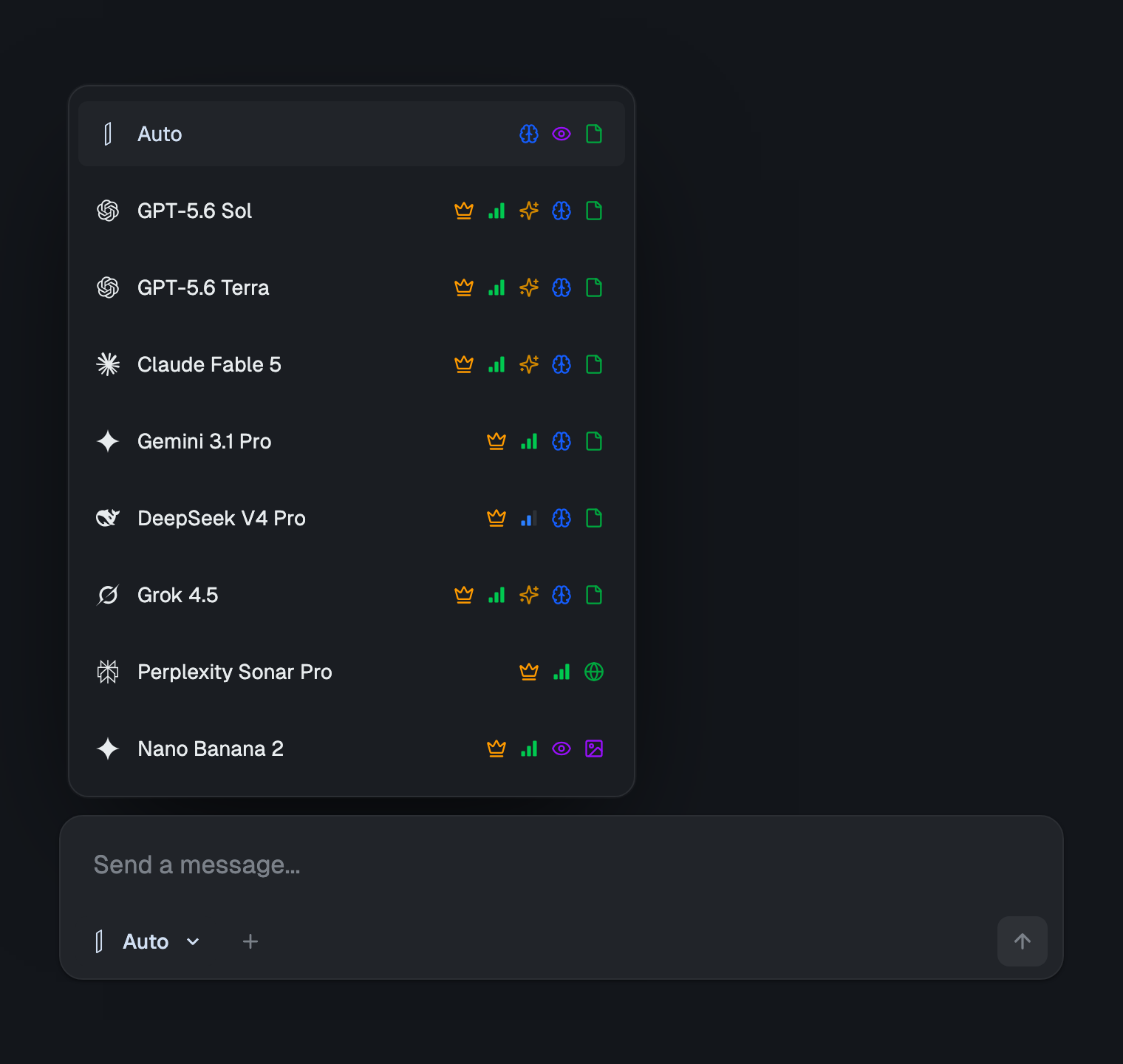
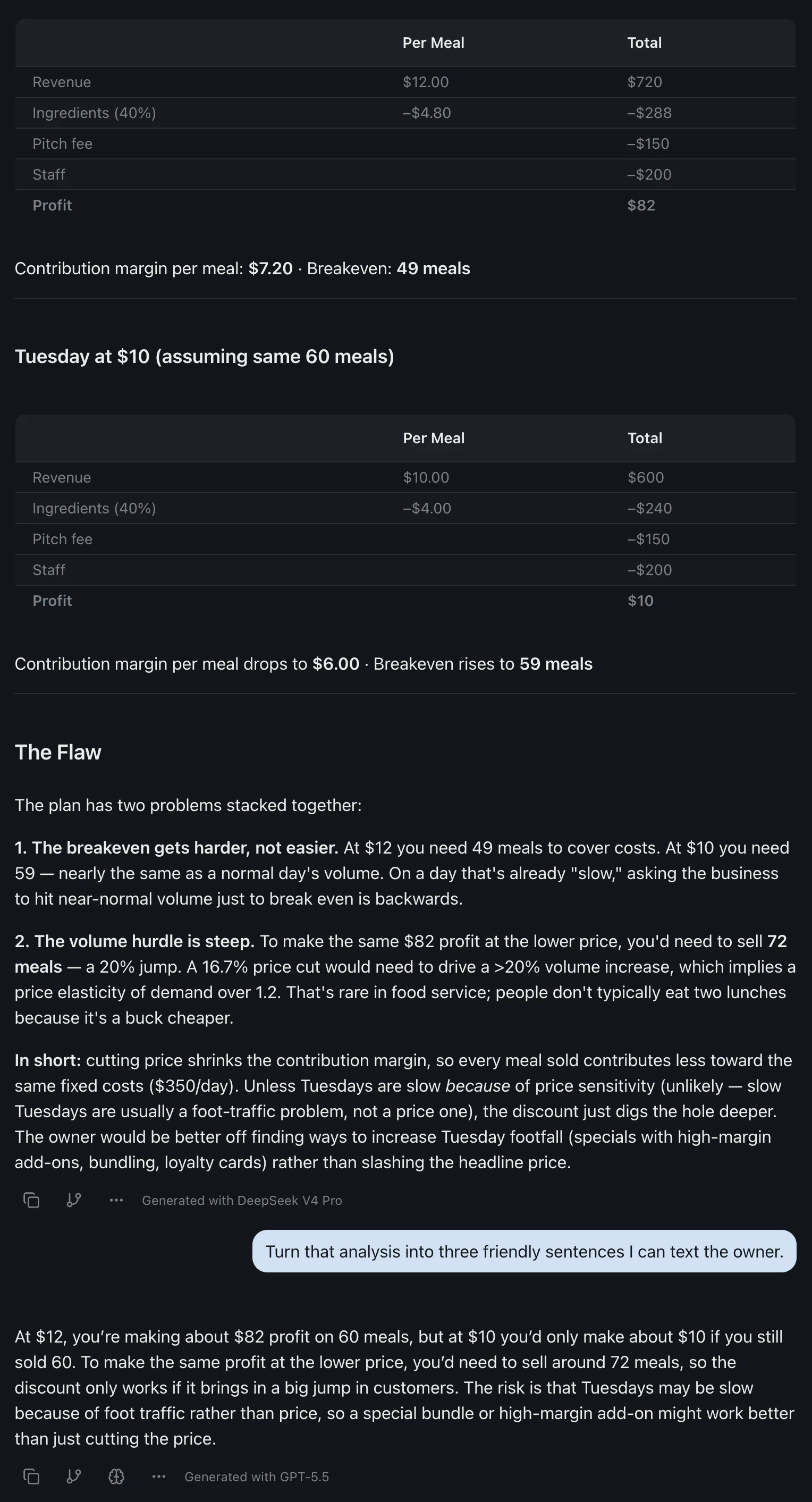
The move that makes it click is the mid-conversation switch. Hand DeepSeek the ugly part — "find the flaw in this pricing plan", "check this statistics reasoning" — and when the analysis is done, switch the same thread to ChatGPT and have it turn the findings into the email, the summary, the deck outline. Context carries over; nothing gets re-explained. The free brain does the thinking, the polished product does the presenting, and neither of them costs you $20.
Here's that exact hand-off in a real thread — DeepSeek runs the breakeven math on a pricing plan and flags the flaw, then ChatGPT picks up the same conversation and turns it into a friendly note, with each model's name shown under its reply:
A note on limits, since "what's the catch" is fair: there's no points ledger to manage here. The bill is a flat monthly price unless you switch on usage-based billing, which is off by default, and fair use runs quietly in the background on a short rolling window with a weekly pool behind it, so an unusually heavy burst on the priciest models means a brief pause before the window clears — and an unusually heavy week means waiting on the pool instead (plan specifics live on the pricing page).
The cheapest second opinion in AI
One more habit worth stealing. Any single model — including both of these — is confidently wrong just often enough to bite. The counter is structural, not hopeful: put the question to a second model and watch for disagreement. Where the answers align, move on; where they split, you've found the exact spot to verify. DeepSeek's economics make it the perfect standing skeptic — a frontier-grade reasoner reviewing your other model's work for free. In one workspace that's a click, not a copy-paste ritual.
If the several-models-one-thread idea is new to you, this walkthrough shows the whole workflow in practice.
The Bottom Line
DeepSeek vs ChatGPT in 2026 comes down to one sentence: DeepSeek gives away the thinking; ChatGPT sells the everything. The free app delivers reasoning that embarrasses some paid tiers, wrapped in almost no product; the $20 one delivers the most complete AI experience on the market, with depth that's merely excellent. Forced to keep just one, most people should keep ChatGPT — the breadth carries a normal week. But nobody is forcing you, and the smarter setup costs less than either path: both models in one thread, each doing what it's best at, with their disagreements flagging what deserves a second look. (Curious how the rest of the field — Claude, Gemini, Grok, Perplexity — scores on these same jobs? That capstone is here.)
$20 buys a great product. $0 buys a great brain. $6 puts them in the same conversation.
Want DeepSeek's reasoning and ChatGPT's polish in one thread — plus Claude, Gemini, Grok and Perplexity a click away? Try izzedo chat free — no credit card required.
Topics
- deepseek vs chatgpt
- DeepSeek
- ChatGPT
- AI model comparison
Start on the free plan. Pay when you want the premium models.
Free
$0
Claude Haiku, Gemini Flash, Grok and more, with agent mode and 50+ connectors
Hobby
$6/mo
Every chat and image model
Pro
$12/mo
Higher limits, 400k context and more video models
Max
from $50/mo
5x or 10x Pro's usage, and every video model
Frequently asked questions
Is DeepSeek as good as ChatGPT?
At structured reasoning — math, logic, careful analysis — DeepSeek genuinely competes with ChatGPT's best, and it charges nothing for it. As a complete product it isn't close: ChatGPT has voice, image tools, memory, custom assistants and years of polish. So the accurate answer is: as good at thinking, not as good at everything wrapped around the thinking.
How much does DeepSeek cost compared to ChatGPT?
DeepSeek's consumer app is free — reasoning mode included. ChatGPT has a capped free tier, then ChatGPT Go at about $6/month and ChatGPT Plus at about $20/month for the stronger models and features. That gap is DeepSeek's whole pitch. If you want both anyway, a multi-model workspace like izzedo chat includes DeepSeek and ChatGPT together from $6/month, with a free plan that needs no card.
Why is DeepSeek so cheap?
Architecture and strategy. DeepSeek uses a mixture-of-experts design that activates only a small slice of the full model for each query, which slashes computing costs — and the lab publishes most of its models openly and prices aggressively to win adoption. Cheap here doesn't mean weak: the low cost of serving the model is precisely what lets it give away reasoning that other labs put behind paid tiers.
Is DeepSeek safe to use for work?
The distinction that matters is app versus model. The official DeepSeek app stores prompts, chat history and device data on servers in China and uses them for training unless you switch that off, which is why a number of governments have barred it from work devices. The model itself is open-weight and can be served by providers that never touch DeepSeek's infrastructure. In izzedo chat, DeepSeek runs on Fireworks AI, which doesn't store prompts for open models, so DeepSeek never receives them. What the host can't remove is the model's built-in refusals on topics sensitive in China.
Can I use DeepSeek and ChatGPT together?
Yes, and it's the setup this comparison points to. In a multi-model workspace both live in one thread: let DeepSeek grind through the analysis, then switch to ChatGPT in the same conversation to shape the result — context carries over automatically. You can also fire one question at both and compare. izzedo chat does this from $6/month, starting free with no credit card.