How Much Does Grok Cost? Every Plan, Priced (2026)
SuperGrok and X Premium closed to new sign-ups on 12 October, replaced by one plan family called The X Subscription. Here's every tier from $0 to $200, the first annual prices, what the $30 Premium bundle includes, the API rates, and what to do if you're still on SuperGrok.
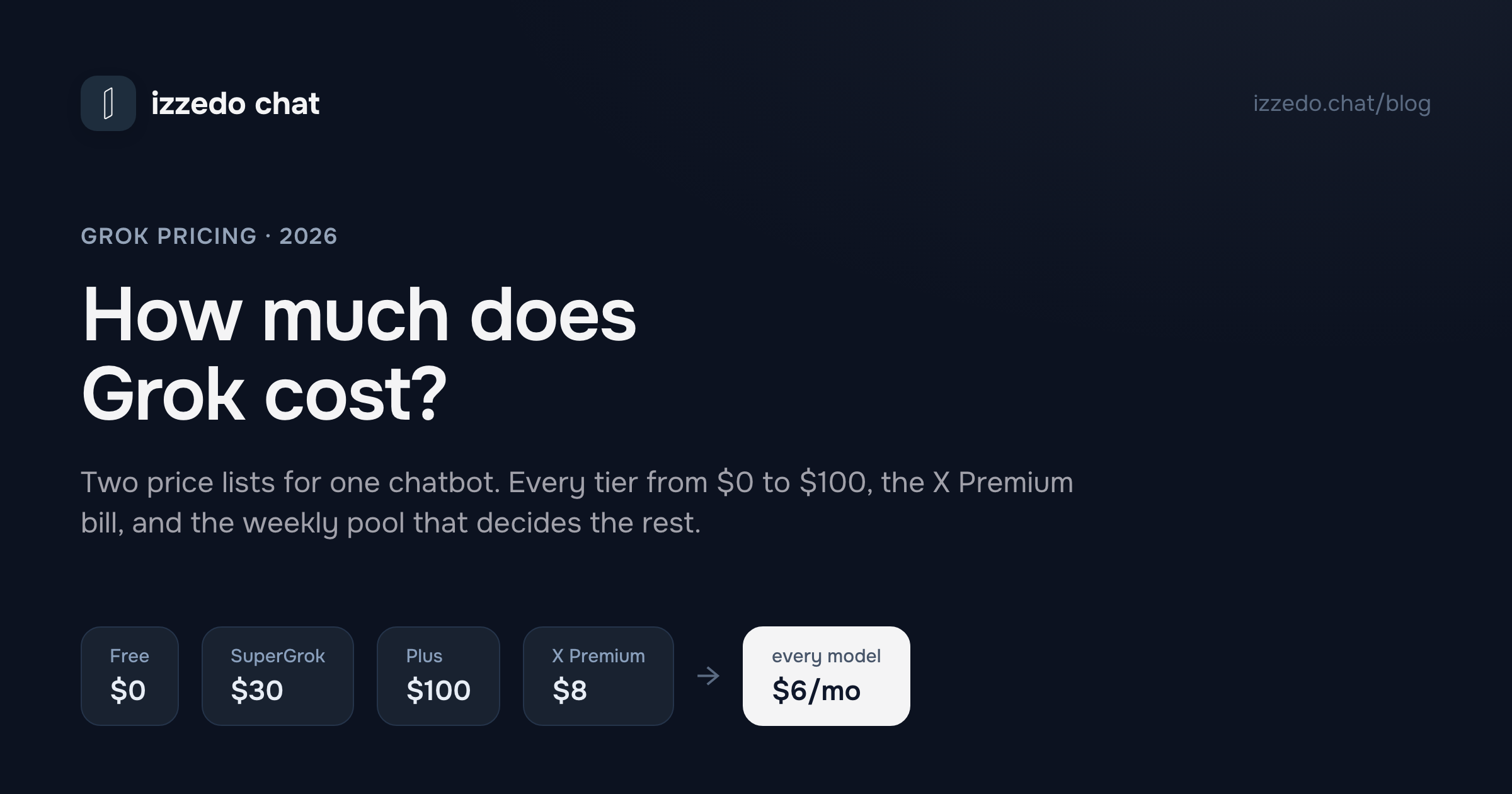
Until 12 October 2026, "how much does Grok cost" had two correct answers. xAI sold SuperGrok at $30 a month and SuperGrok Plus at $100. X sold X Premium at $3, $8 and $40, and its tiers raised Grok's limits inside X. Two products, two bills, both giving you Grok.
Plenty of people ended up paying both without noticing.
For new customers that's over. xAI folded SuperGrok, X Premium and the coding agent Cursor into The X Subscription, xAI's new plan family since 12 October 2026, and says the previous plans "are no longer available for new sign-ups." There's one ladder now, $0, $8, $30, $100 and $200 a month, and for the first time there are annual prices. Existing SuperGrok and X Premium subscribers keep what they have unless they switch, so the old prices still decide a lot of bills.
Below is every current price, what each tier buys, how the weekly usage pool decides your real monthly cost, what to do if you're already on SuperGrok, and the API rates for anyone building on it. I first wrote this on 29 August 2026 and rewrote the plan sections on 13 October from xAI's pricing page, its launch post and its help centre. This is the second time since June that xAI has rebuilt how Grok is sold or metered, so treat it as a dated snapshot.
Update, 13 October 2026: the tables, prices and FAQs on this page now describe The X Subscription. If you already pay for SuperGrok or X Premium, your options are further down. If you're weighing whether Grok is worth paying for at all, the Grok alternatives guide prices something else for each job.
How Much Does Grok Cost? The Short Answer
| Plan | Price (US) | What it is |
|---|---|---|
| Free | $0 | Daily access to Grok's chat, voice, image and Build tools in limited amounts, plus standard X |
| Plus | $8/mo or $80/yr | A base usage pool shared with Cursor, the Grok API, and a checkmark and fewer ads on X. No video |
| Premium | $30/mo or $300/yr | 4x Plus's usage, video, Grok Bot, the latest Grok models and full X Premium+ benefits |
| Super | $100/mo or $1,000/yr | 15x Plus's usage and priority model access at peak times |
| Ultra | $200/mo or $2,000/yr | 50x Plus's usage and the earliest access to new products and models |
| Teams | $30, $100 or $200 per seat/mo | Premium, Super or Ultra seats with SSO, central billing and usage analytics |
| Enterprise | Custom quote | Custom rate limits, SSO and SCIM, data residency, invoice billing, volume pricing |
| API | Per token | Pay as you go for developers, roughly $2 in and $6 out per million tokens |
Three things have changed that matter before we get into the tiers.
Annual prices exist now. The old pricing page listed monthly figures only, with no yearly toggle anywhere. Every paid plan now has a yearly price, and each one is ten months of the monthly figure: $80 instead of $96 for Plus, $300 instead of $360 for Premium. That's two months free if you're sure you'll stay.
There's a rung below $30 at last. The old ladder went straight from $0 to $30. Plus at $8 is now the cheapest way to pay for Grok, though it leaves out video and Grok Bot, which matters more than the price suggests.
And the $30 plan is a bundle. Premium includes Cursor Pro and X Premium+ benefits as well as Grok. If you use all three, that's a good deal. If you use one, you're paying $30 for it. More on that below.
Does Grok Cost Money? What You Get for $0
No, not necessarily. Grok still has a permanent free plan. xAI's launch FAQ says it includes "daily access to Grok Chat, Imagine, Voice, and Build," along with a starter allowance for Cursor's coding agents and standard X. The plan table marks chat and image generation as Limited and puts no number on either. Video generation isn't on it.
The one thing the new table doesn't settle is live X search, the feature that sets Grok apart. It reads a firehose that Google's index gets to hours later, and I've written before about why that changes what Grok is good for. The new table has no row for search at all. The one xAI showed on 10 October listed web and X search on the free plan as Limited, and that's the last thing xAI has published about it.
If you're choosing between free plans, Grok vs Claude goes through what each one gives away, though I wrote it before xAI's new plans.
Grok Premium: What $30 a Month Buys Now
Grok Premium costs $30/month, or $300 a year. It sits where SuperGrok used to, and it's the plan xAI's pricing FAQ recommends "for new AI users."
What you get over Plus, from xAI's plan card:
- Four times Plus's usage, from a pool shared between Grok and Cursor
- "Latest Grok models," which the card doesn't name
- Faster chat responses
- Image and video generation
- Grok Bot, which xAI's launch post describes as "AI teammates that get work done"
- Cursor's cloud agents, code hosting and AI code reviews
- Full X Premium+ benefits on the X account you connect, including ad-free scrolling on most of X
xAI's launch post sums it up as "the benefits of SuperGrok, Cursor Pro, and X Premium+, previously $90/month combined." If you'd pay for all three anyway, that's a real saving. Most people asking what Grok costs want one of them. If you don't write software and don't spend much time on X, you're paying $30 for the Grok part, while ChatGPT Plus and Claude Pro cost $20 and Google AI Pro $19.99. Within Grok itself, the extra $10 buys video, Grok Bot and the latest models. That's worth it if you use them and overhead if you don't.
If you're holding off on Premium until Grok 5 arrives, there's no date to wait for. xAI has confirmed only that it's in training, and every release date given for Grok 5 so far has passed. Premium's card promises the latest models without saying which. The newest, Grok 4.7, launched on 21 September at the same API price as the model before it.
Grok Plus at $8: The New Cheapest Rung
Plus costs $8/month, or $80 a year, and it's new. It gets you Grok Chat, Voice, Imagine and Build from the shared usage pool, plus the Grok API and Cursor. On X it adds the Premium checkmark, fewer timeline ads, creator tools and advanced analytics.
What it leaves out matters more than what it includes. xAI's plan table has no video generation on Plus, and its help centre says Plus doesn't include Grok Bot. "Latest Grok models" sits on the Premium card as an addition, and xAI doesn't say which Grok model Plus runs, so check what you're talking to before you assume Plus answers the way Premium does.
xAI's own advice is that Plus suits "social creators with limited AI usage," and I'd agree. It's the same $8 that X Premium used to cost. X Premium raised Grok's limits inside X. Plus covers Grok's own apps as well.
Super at $100 and Ultra at $200
Super is $100/month or $1,000 a year. It has 15 times Plus's usage and priority model access when demand peaks. Ultra is $200/month or $2,000 a year, with 50 times Plus's usage and the earliest access to new products and models.
The multiples make one thing easy to work out. Usage per dollar climbs as you go up. Plus gives you one unit for $8, Premium four for $30, Super 15 for $100 and Ultra 50 for $200, so per dollar Ultra buys twice what Plus does. That's my arithmetic on xAI's multiples, not a figure xAI quotes.
What the multiples don't tell you is how big Plus is. xAI publishes the ratios and not the base, so you can compare the tiers with each other but not with a number of messages or videos. SuperGrok was no different, and it published no numbers either.
The old ladder had a stranger gap. Its comparison table listed SuperGrok Lite and SuperGrok Heavy with feature rows and no price. The new table prices every self-serve plan, and only Enterprise asks you to talk to sales.
X Premium Is Now Part of the Same Plan
This is where most of the confusion used to live. X sold Premium on its own, at $3, $8 and $40 a month, and its tiers raised Grok's limits inside X on a bill separate from xAI's. Since 12 October, X's help centre says X Premium "is now part of The X Subscription," and every paid plan includes X Premium benefits on the X account you connect.
For a new subscriber the X side works out like this, per xAI's help centre:
| The X Subscription plan | What you get on X |
|---|---|
| Free | Standard X |
| Plus, $8 | A checkmark, creator tools and fewer ads |
| Premium, Super, Ultra, $30 and up | Full X Premium+ benefits, including ad-free scrolling on most of X |
So the old trap can't catch a new customer. Paying X $40 for Premium+ and xAI another $30 for SuperGrok meant $70 a month for overlapping Grok access. With one plan covering both, a new subscriber can't end up there. You do need a personal X account for the X part. xAI says accounts managed by an organisation can't be connected.
If you already pay X for Basic, Premium or Premium+, your plan and price stay the same until you switch, and X's help centre says its old details still apply to you. In the US those are $3, $8 and $40 a month, or $32, $84 and $395 a year. If you're on Premium+ and want to keep its benefits after switching, xAI says to pick Premium or higher. And if you're paying for Premium+ and SuperGrok at the same time, look at that before your next renewal, because X lists SuperGrok access among Premium+'s benefits.
The Weekly Usage Pool: What Actually Decides Your Grok Bill
In June 2026 xAI replaced Grok's per-product limits with one shared weekly pool. The X Subscription keeps the pool and widens it. Within Grok it covers Chat, Imagine, Voice, Grok Bot and the API, and Cursor draws from the same allowance. The launch post says the pool covers Grok models "whether you use them in the Grok apps, the Grok tab on X, or Cursor."
Different things drain it at very different rates. xAI's pricing FAQ says only that "usage costs vary by product." Its Grok FAQ, still written for SuperGrok, is plainer. A chat message uses little compute, while "generating a high-quality video or running a long coding task uses far more." The pool refreshes weekly, and your account's usage view shows what's left and when it resets.
I like the honesty of this design and I think most people will underestimate it. A pooled allowance means the video you generated on Tuesday is the reason chat feels tight on Friday, and now a long session in Cursor can do the same. There's no separate budget for any of them. If video is the reason you chose Grok over the $20 alternatives, it's also the thing most likely to leave you rationing chat by the weekend. It's worth checking the rate you're paying for it: Grok Imagine is one of the cheapest video models per second, and the full per-second rate card shows what $30 a month is buying against a $10 Kling or Wan plan.
When the pool runs dry, you can wait for the weekly refresh, upgrade, or keep going on what xAI calls Additional Usage, paid from a prepaid balance you top up. xAI's help centre is clear about the controls. Auto Top-up stays off unless you turn it on, and an optional monthly cap stops paid extra usage once you reach it, even if credit is left in the balance.
So the real answer to what Grok costs isn't a tier. It's a tier plus whatever top-ups your habits require, and the heavier your video use, the more of those there will be. Set the monthly cap in your billing settings before the first heavy week, not after it.
Already on SuperGrok? Keep It or Switch
If you already pay for SuperGrok, SuperGrok Plus, SuperGrok Heavy or X Premium, nothing happens unless you act. xAI's launch FAQ says "Your existing plan, price, and features continue exactly as they are."
Keeping it. SuperGrok stays at $30 a month and SuperGrok Plus at $100, and your limits work as before. xAI's Grok FAQ still describes SuperGrok's weekly pool. When you use it up, paid features pause until the reset, but you keep the free plan's Chat and Voice limits, which sit outside the pool. Extra Usage Credits get you past it sooner, and the same FAQ says they're "priced at standard rates, which means the cost per action is higher than the effective rate you get from the included weekly usage." If you're on an annual plan, xAI says you keep every day you paid for.
Keeping it isn't forever, though. xAI says it will "eventually" move remaining customers to the new plans, with no timeline yet and advance notice before anything changes.
Switching. The option appears in your account billing settings as xAI rolls it out, along with what xAI calls limited-time offers for switching. Your old SuperGrok, X Premium and Cursor subscriptions are cancelled at checkout. The refund for unused time goes back to your original payment method, separately from the new charge, so the new plan bills at full price and starts straight away. If you paid through Apple or Google Play there's an extra step. Apple decides on refunds for App Store purchases, a Cursor plan bought through the App Store has to be cancelled in your iPhone settings, and Google Play subscriptions need checking in Google Play afterwards.
The catch. Switching is one-way. xAI's help centre says "A completed switch is permanent and cannot be undone by Support."
Which way to go depends on what you were paying for.
- SuperGrok and X Premium+. Switch to Premium. One $30 plan covers what cost you $70 across two bills.
- SuperGrok, and you write code. Premium adds Cursor Pro's benefits for the same $30, though Grok and Cursor then share one weekly pool.
- SuperGrok alone, for chat. This one's closer. xAI says each new tier gives "more usage-per-dollar than the plan it replaces," but it publishes neither pool's size, so you can't check. The new plans' docs also don't mention the free-plan fallback described above.
- SuperGrok, and you mainly want to pay less. Plus at $8 is an option now, as long as you can live without video and Grok Bot. The switch can't be reversed, so be sure first.
Grok API Cost: Paying Per Token
The API isn't a subscription. You pay for tokens, roughly words in and words out, and there are no minimums.
| What you're paying for | Input | Cached input | Output |
|---|---|---|---|
| Flagship model, under 200K context | $2.00 / M | $0.50 / M | $6.00 / M |
| Flagship model, over 200K context | $4.00 / M | $1.00 / M | $12.00 / M |
| Lighter fast model, under 200K | $1.25 / M | $0.20 / M | $2.50 / M |
| Build model, under 200K | $1.00 / M | $0.20 / M | $2.00 / M |
Beyond text: images run $0.02 to $0.05 each, video is priced by the second at $0.02 to $0.08, speech to text is $0.10 per hour over REST and $0.20 streaming, and text to speech is $15 per million characters.
Two things to notice. Prices double once a request crosses 200,000 tokens of context, so a habit of dumping enormous documents into every call quietly doubles your unit economics. And cached input is a quarter of the normal rate on the flagship, which makes repeated system prompts far cheaper than they look if you structure calls to hit the cache.
For most people reading this, the API is the wrong product. It exists for building Grok into something else, not for chatting. If you're costing out an automated workload rather than a subscription, what AI agents actually cost to run is the closer comparison.
Grok for Teams and Enterprise
The $30 Business plan is no longer on xAI's pricing page. Teams now buy Premium, Super or Ultra seats at the individual prices, $30, $100 or $200 per seat a month, and each seat gets the same usage as the matching individual plan. xAI's docs say one team can mix tiers, three Premium seats and one Super for example. Each seat has its own weekly pool, and the team shares one prepaid balance for extra usage. Plus isn't sold to teams.
The Teams card lists SAML/OIDC SSO, centralised billing and administration, usage analytics, team-wide privacy settings and custom chat data retention, and the launch post adds SOC 2 compliance. The old Business card never said whether $30 was per seat or per workspace. The docs now say per seat.
Enterprise is still quote-only. It covers custom rate limits, dedicated infrastructure, SSO and SCIM, data residency and volume pricing, plus invoice billing and one usage pool shared by the whole organisation instead of one per seat. Existing Enterprise customers aren't moved over automatically.
Grok's Price Next to ChatGPT, Claude and Gemini
Set the consumer tiers side by side and the shape of the market is clear.
| Assistant | Main paid tier | Heavy tier |
|---|---|---|
| ChatGPT | $20/mo | $200/mo |
| Claude | $20/mo (about $17 annual) | from $100/mo |
| Gemini | $20/mo | higher tiers above |
| Perplexity | $20/mo | $200/mo |
| Grok | $30/mo ($25 annual) | $100 or $200/mo |
Grok's main plan still costs the most, $10 above everyone else's, while Super and Ultra line up with the $100 and $200 heavy tiers sold elsewhere. Below the main tier, Plus at $8 now sits in the cheap bracket with ChatGPT Go at $6 and Google AI Plus at $4.99. And Grok is still the most expensive line in the stack most people actually end up with. Add it up: ChatGPT $20, Claude $20, Gemini $20, Perplexity $20, Grok Premium $30, with DeepSeek free. That's $110 a month for six logins that can't see each other's work, and Grok is more than a quarter of it.
If you want the same accounting for the other vendors, ChatGPT's full price ladder and what Claude costs across every tier run the same exercise.
The $6 Version: Grok Plus Every Other Model
The assumption underneath that $110 is that each model needs its own subscription. It doesn't.
izzedo chat runs Grok alongside ChatGPT, Claude, Gemini, Perplexity, DeepSeek and around twenty more models behind one login for $6/month, with a free plan that needs no card. That's a fifth of Grok Premium's price for Grok plus everything Grok is usually compared against.
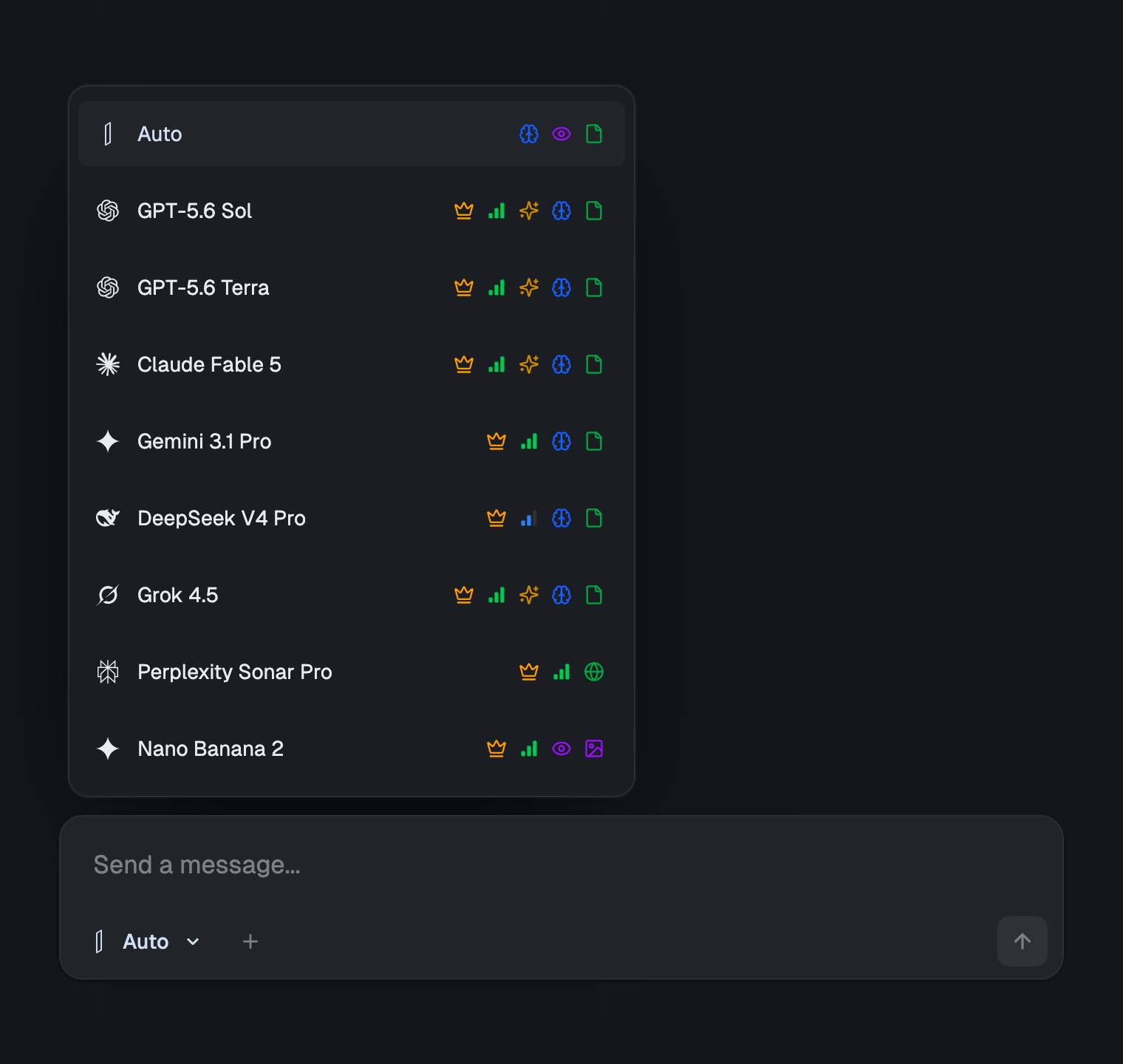
Being straight about our own meter, since the whole point of this page is honest numbers: izzedo limits usage too. Everyone serious does, because the expensive models cost real money every time they run. Usage is measured on a short rolling window that clears in hours, alongside a weekly pool, and the current figures live on the pricing page rather than in a blog post that would go stale. Lighter models stretch a lot further than the premium ones, which is worth knowing before you point a frontier model at a task that doesn't need one.
What changes isn't that limits disappear. It's what you do when you meet one.
On a single subscription, hitting a ceiling means waiting for a reset or topping up a prepaid balance on top of your plan. Here there's one allowance, and you choose which model spends it. Point a lighter model at the work that doesn't need a frontier one and the same allowance goes several times further — and because the switch happens inside the thread, the model you move to keeps everything above it in the conversation. Spend the allowance down anyway and you wait for the window, the same as anywhere. Or switch on the optional usage-based setting, off by default, which bills what you used past the pool on your invoice under a cap you set, instead of asking you to prepay.
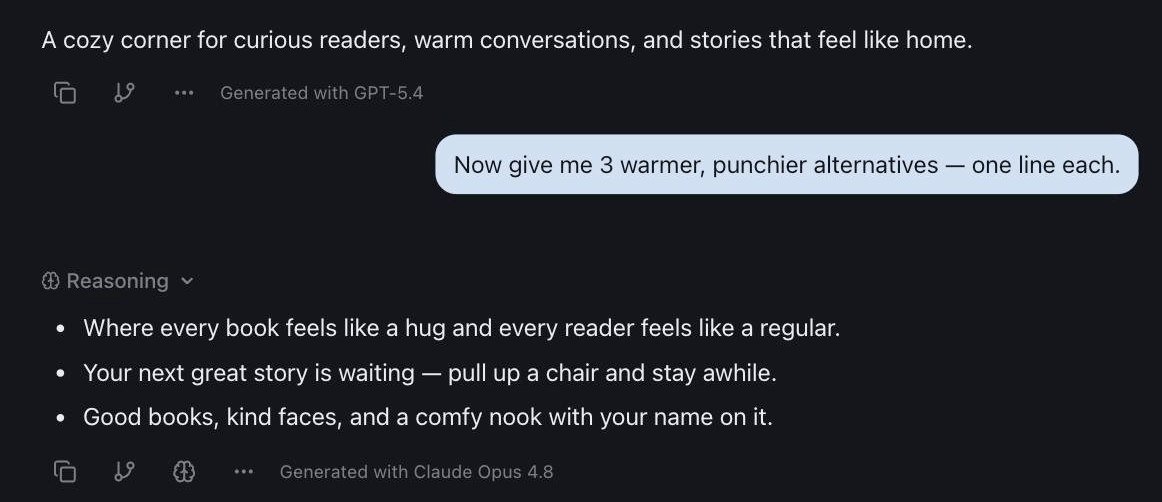
That switch is also the reason to keep more than one model within reach for its own sake, not just for billing. Asking two models the same question and comparing takes a click here, and disagreement is the useful signal because it flags the one claim worth checking before it goes anywhere public. If the whole approach is new, here's how running several models in one place works in practice.
So What Should You Actually Pay for Grok?
- $0 if you use Grok a few times a week for chat, voice or the odd image. The free plan is daily access, not a trial.
- $8 if you want more Grok than the free plan gives and you're on X anyway. Plus brings the checkmark and fewer ads, but no video and no Grok Bot.
- $30 if Grok is your daily driver and you want video, or you'll use the Cursor and X Premium+ parts of the bundle. Set a monthly cap on top-ups if you generate video regularly.
- $100 or $200 if the weekly pool keeps running out before the week does. Ultra buys the most usage per dollar of any tier.
- Nothing new if you're on SuperGrok and happy with it. Your price holds until you switch, and the switch is permanent.
- Per token if you're building rather than chatting, and watch the 200K context line where prices double.
- $6 if what you actually wanted was the right model for each job rather than this particular vendor.
That last one is the honest reframe. Almost nobody's real question is how much Grok costs. It's how much it costs to always have the right model available, and answering that vendor by vendor is how people end up at $110 a month with six tabs open and no thread that remembers anything.
Grok is genuinely the best of them at one thing, which is telling you what happened twenty minutes ago. It is not the best at everything, and $30 a month is a lot to pay to find that out one task at a time. Compare it against ChatGPT and Gemini on live news and the split is obvious within a few questions.
Want Grok plus every other major model in one conversation, on one $6 plan? Try izzedo chat free with no card required.
Topics
- how much does grok cost
- Grok pricing
- SuperGrok price
- The X Subscription
Start on the free plan. Pay when you want the premium models.
Free
$0
Claude Haiku, Gemini Flash, Grok and more, with agent mode and 50+ connectors
Hobby
$6/mo
Every chat and image model
Pro
$12/mo
Higher limits, 400k context and more video models
Max
from $50/mo
5x or 10x Pro's usage, and every video model
Frequently asked questions
How much does Grok cost per month?
New customers buy Grok through The X Subscription, xAI's plan family since 12 October 2026. Free is $0, Plus is $8 a month, Premium $30, Super $100 and Ultra $200. Paid yearly, the four paid plans cost $80, $300, $1,000 and $2,000. Team seats cost $30, $100 or $200 each, Enterprise is quote-only, and the API bills per token. These are US list prices before tax, read on xAI's pricing page on 13 October 2026.
Is Grok free?
Yes, and it isn't a trial. xAI's launch FAQ says the free plan includes daily access to Grok Chat, Imagine, Voice and Build. Its plan table calls the allowance Limited and gives no number. Video generation is missing from both Free and the $8 Plus plan, so the cheapest Grok that makes video is Premium at $30 a month.
How much is SuperGrok?
SuperGrok was $30 a month, and it closed to new sign-ups on 12 October 2026. The plan that replaces it is Grok Premium, still $30 a month or $300 a year, which xAI describes as the benefits of SuperGrok, Cursor Pro and X Premium+ together. If you already pay for SuperGrok, your plan and price carry on unless you switch, and xAI's help centre says a completed switch is permanent.
Does X Premium include Grok?
X Premium is now part of The X Subscription, so a new customer gets Grok and the X benefits on one plan. Plus at $8 gives you the checkmark, creator tools and fewer ads on X, and Premium at $30 or above gives you full X Premium+ benefits. Existing X Premium subscribers keep their plan and price until they switch. If you're on the old $40 Premium+, X's help centre lists SuperGrok access among its benefits, so check before paying for a separate Grok plan on top.
How much does the Grok API cost?
It bills per token, not monthly. The flagship model runs about $2 per million input tokens and $6 per million output under a 200,000 token context, and doubles to roughly $4 and $12 above it. Cached input is much cheaper, around $0.50 per million. The lighter models run about $1.25 in and $2.50 out. Image generation is priced per image at roughly $0.02 to $0.05, and video by the second.
What's the cheapest way to use Grok alongside other models?
One workspace instead of one subscription per vendor. izzedo chat runs Grok together with ChatGPT, Claude, Gemini, Perplexity and DeepSeek behind a single login for $6/month, which is a fifth of what Grok Premium costs on its own, and there's a free plan that asks for no card. Usage is one allowance shared across every model, and running a lighter model where a frontier one isn't needed stretches it several times further.