Grok vs ChatGPT vs Gemini in 2026: Three Models, Three Different Internets
Ask all three what happened this morning and you get three different answers. That's not one model being smarter — it's three models reading three different internets. Here's which source wins which question.
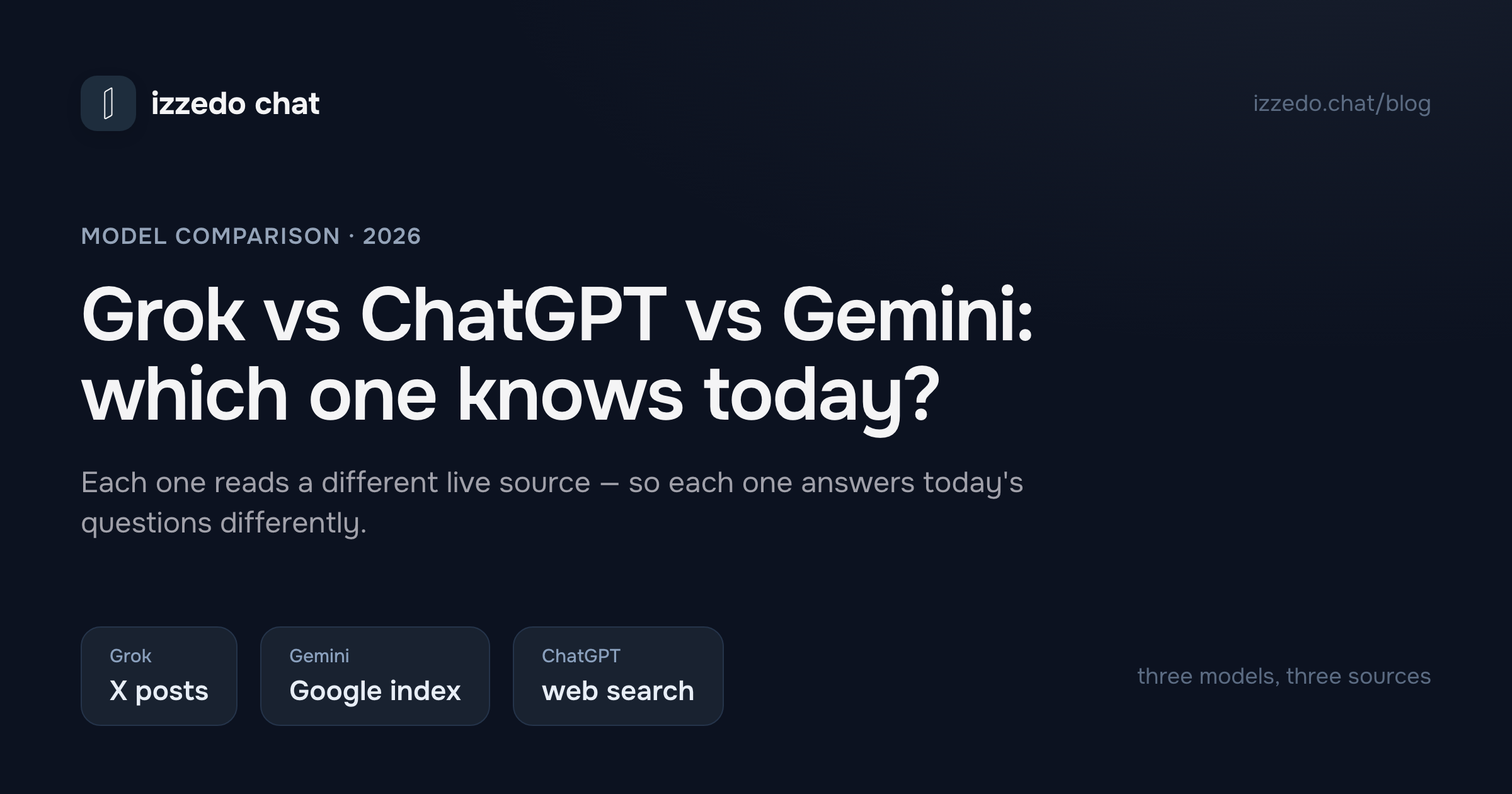
Here's an experiment that takes two minutes and tells you more than any benchmark chart. Open Grok, ChatGPT and Gemini side by side and ask all three the same question about something that happened this morning.
You will get three different answers.
Not three phrasings of one answer — three genuinely different accounts, sometimes disagreeing about whether the thing happened at all. The instinct is to decide that one of them is broken, or that the one matching your assumption is the smart one. Both readings are wrong, and the real explanation is the most useful thing in this comparison: these three models are not reading the same internet.
That's the thread worth pulling, because it's also the reason this particular matchup exists. Notice who isn't in it. Nobody searches grok vs chatgpt vs claude nearly as often, even though Claude outwrites all three. The three names people group together are the three wired into a live source — and each one is wired into a different live source. Grok reads X. Gemini reads Google. ChatGPT reads its own search layer. When today is the subject, you're not choosing a brain. You're choosing a feed.
The Short Answer: Grok vs ChatGPT vs Gemini
The fastest way to hold this comparison in your head is by source, not by score.
| What you're asking | Best pick | Why it wins | Where it burns you |
|---|---|---|---|
| Something that broke minutes ago | Grok | Sees X posts as they're written, before anyone has published an article | Relays rumour with the same confidence as fact |
| What people think about it | Grok | Sentiment and reaction are its native material | X is not the world; the vibe skews to who posts |
| A story a few hours old | Gemini | Google grounding surfaces who's actually reported it, with links | Needs the web to have caught up and been crawled |
| Research you must verify | Gemini | Every claim arrives with something you can click | Link presence isn't link quality — still your job to read |
| Turning findings into work | ChatGPT | Steadiest at drafting, restructuring and following instructions | Least likely to be first to a fresh fact |
| Everyday questions | ChatGPT | Widest range, fewest follow-up prompts needed | Confidently smooth even when it's guessing |
| Long documents you supply | Gemini | Holds enormous inputs in a single pass | Prose comes out functional; wants a polish pass |
| Writing that has to sound human | ChatGPT | Best of these three for tone you can steer | Claude beats all three — it's just not in this matchup |
Read the "best pick" column and you'll notice nobody sweeps it, which is the same conclusion every honest model comparison reaches. What's specific to this trio is why nobody sweeps it. In a Claude-vs-ChatGPT-vs-Gemini matchup the differences come down to temperament and training. Here, the differences come down to plumbing — and plumbing is a much more predictable thing to plan around than vibes.
Why These Three Get Compared (and Claude Doesn't)
Claude is the strongest writer of any model most people can name, and it's absent from this search entirely. That's not an oversight by the internet; it's a signal about what this question is really asking.
Grok, ChatGPT and Gemini are the three consumer AI products that lead with knowing things now. Each was built on top of an existing information business, and each inherited that business's view of the world:
- Grok sits on X. Its distinguishing feature is direct access to the live post stream — the running commentary of a very large, very fast, very opinionated public square.
- Gemini sits on Google. It answers time-sensitive questions grounded in live Search, which means it inherits the world's most complete index of published pages.
- ChatGPT sits on OpenAI's own stack, reaching current information through its search and browsing layer rather than through a search company's index or a social firehose.
Three different upstream sources. That's the whole comparison in one line, and everything below is the consequence.
Three Models, Three Different Internets
It's worth being precise about what each one can actually see, because this is where the disagreements come from.
Grok sees the conversation. X is a stream of people reacting in real time. That's an extraordinary source for is something happening and a genuinely bad source for is it true. There is no editorial layer between a post and Grok reading it. When a story breaks, Grok is often the only one of the three that knows — and it knows in the same undifferentiated way the timeline knows, with the correction and the rumour sitting side by side. Its conversational bluntness, which people either love or find grating, is downstream of the same thing: it's trained near a corpus that talks like that.
Gemini sees the record. Google's index is the published web — articles, pages, documents that someone wrote and something crawled. That's a filter, and mostly a useful one: by the time a claim is in the index, an outlet has usually attached its name to it. The cost is latency. A thing that happened twenty minutes ago and hasn't been written up anywhere yet is, from Gemini's position, close to invisible. The upside is that when Gemini does answer, it hands you links, and a link you can open is worth more than a confident paragraph you can't check.
ChatGPT sees a curated middle. It reaches the live web through its own search layer, which in practice lands between the other two — not as fast as the timeline, not as exhaustive as the index, but consistent, and attached to the model that's best at doing something with the result. This is the underrated part of ChatGPT's position in this trio: it's rarely first to a fact, and it's the one you actually want holding the pen once the facts are in.
None of these is a defect. They're three different trade-offs between speed, verifiability and coverage, and there is no arrangement of those three that gets you all of them at once.
Grok vs ChatGPT vs Gemini, Task by Task
Breaking news and live events
Grok first, Gemini second, ChatGPT third — and the order flips within a few hours. In the first stretch of a developing story, Grok is genuinely alone: it can tell you that something is unfolding because it can read people saying so. Ask the other two and you'll often get a polite admission that they have nothing. Wait two hours and the ranking inverts completely — once the story is written up, Gemini gives you the reported version with sources, and Grok is still showing you the argument about it. The mistake is treating that first-hour advantage as a general one.
Sentiment, reaction and "what are people saying"
Grok, and nothing else is close. If the question is what the response to something looks like — a product launch, an announcement, a controversy — Grok is reading the actual responses while the others are reading summaries of responses. Just hold onto the obvious caveat: X's population is not the population. What Grok reports is what X thinks, delivered with more confidence than that distinction deserves.
Research with sources you can check
Gemini, comfortably. This is the inverse of the news case. When you need to be able to defend a claim later, the model whose answers come with openable links wins by default, and the Google-grounded one produces those most reliably. ChatGPT does this well too. Grok is the weakest of the three here — not because it's careless, but because a post is not a source, and a lot of what it's reading is posts. If citations are the entire job rather than a nice-to-have, that's really Perplexity's home turf.
Writing, drafting and editing
ChatGPT, clearly, among these three. It takes tone direction, produces usable structure on the first pass and handles volume — five subject lines, three openings, a shorter version for a different audience. Gemini's writing is organized and correct and reads a little assembled. Grok's has personality, which is occasionally exactly what a piece needs and more often the wrong register for anything you're sending to a client. Worth saying plainly: none of the three is the best writer available — Claude is, and it's the reason the other three-way comparison exists.
Everyday questions and range
ChatGPT. The unglamorous middle of daily use — explain this, plan that, reformat these notes, what's a better word for this — is where breadth beats specialization. ChatGPT understands what you meant with the fewest retries. Gemini is a strong second and pulls ahead the moment the everyday question turns out to need current information. Grok is fine here and more entertaining than either, which is not the same as more useful.
Long documents and heavy inputs
Gemini, by capacity. Hand it a stack of reports, a long contract, several transcripts at once, and it holds all of it and cross-references across it in one pass. This is a straightforward hardware-of-the-model advantage rather than a sourcing one, and it's the one task in this comparison that has nothing to do with live data. ChatGPT is capable; Grok is the least suited of the three to a genuinely large pile of input.
The Disagreement Test: Run It Yourself
This is the part I'd actually keep. Rather than trusting anyone's ranking — mine included — there's a two-minute check that turns the three-way difference into something you can see, and it works on whatever you happen to care about today.
Ask all three the same present-tense question, then ask each one where it got the answer:
What happened with [your topic] in the last 24 hours? For each claim, tell me specifically where it came from — a post, an article, a page you can link — and flag anything you're inferring rather than reading.
The three answers won't just differ in content. They'll differ in shape, and the shape is the tell:
- Grok will come back fastest and most specific about what people are saying, and its sourcing will skew heavily toward posts — often from accounts you've never heard of. High signal about the temperature, low guarantee about the facts.
- Gemini will come back with named outlets and links, and will be visibly thinner on anything too recent to have been written up. If it has little to say, that itself is information: the story hasn't been reported yet.
- ChatGPT will produce the most readable synthesis and be the most likely to smooth over the seams — including the seam between what it verified and what it reasonably assumed. That second prompt asking it to flag inferences earns its keep here.
Now the useful bit. Where two of them agree and one doesn't, you've learned something concrete: either the odd one out is reading a source the others can't see, or it's reading noise. Both cases are worth knowing, and you can usually tell which by asking the dissenter to show its work. A disagreement between models with different sources isn't a malfunction — it's a coverage map, and it points at exactly the claim worth checking before you repeat it to anyone.
This is also the honest reason to keep more than one of them within reach, which is where the cost question comes in.
What Running All Three Costs
The trap in this comparison is that the "right" answer changes by the hour, and paying for the right answer three times is expensive. ChatGPT's paid plan is about $20/month, and its caps sit on uploads, images and research rather than on chat. Google's AI plan is about $20/month. Grok's own subscription, SuperGrok, is $30/month from xAI, with X Premium billing separately for higher Grok limits inside X (the full Grok price list). "Higher" is doing a lot of work there: Grok's limits are one weekly pool shown as a percentage, with no published size on any tier. Cover the trio properly and you're at roughly $70/month, three logins, three histories that can't see each other.
And three is rarely where it stops, because the moment writing quality or citations matter you're looking at the models this matchup left out:
- ChatGPT — $20/mo
- Claude — $20/mo
- Gemini — $20/mo
- Perplexity — $20/mo
- Grok — $30/mo
- DeepSeek — free (consumer app; API is usage-priced)
That's $110/month at retail for the full set, nearly all of it sitting idle at any given moment. For a workflow whose entire premise is routing a question to whichever source can answer it, that bill shape is precisely wrong: you need access to every source, and you use one at a time.
Is Grok Better Than ChatGPT or Gemini?
Asked as a ranking, it doesn't resolve — but this trio has a cleaner answer than most, because the question is really about time.
In the first hour of a story, Grok is better, and it isn't particularly close. Nothing else in this comparison can read a public conversation as it happens. After that hour, Gemini is better, because the story now exists in the index with sources attached, and verifiability beats speed once both are available. For everything that isn't time-sensitive at all, ChatGPT is better, because most work isn't news — it's drafting, explaining, planning and rewriting, and that's the widest, steadiest of the three.
So the honest ranking is a clock, not a podium. Which is a genuinely awkward thing to act on if you've committed to one subscription, and a trivial thing to act on if you haven't.
Which One Should You Use? Pick by the Job
If you really are picking one, pick by what your week is actually made of:
- Anyone tracking a fast-moving space — markets, sports, a live launch, an unfolding story: Grok, with the standing discipline of confirming anything you'd repeat publicly somewhere else.
- Analysts, researchers and anyone who has to show their work: Gemini. Links are not a luxury when someone will ask you where a number came from. (It's also the pick when the input is enormous — see Gemini vs ChatGPT for that head-to-head.)
- Writers, marketers and generalists: ChatGPT, for range and steadiness, with the caveat that it will be the last of the three to know something just happened. The Grok vs ChatGPT two-way digs into exactly that trade.
- Anyone whose real job is turning current information into a written deliverable: you genuinely need two of these, and you'll feel it every week.
Every one of those bullets ends in a caveat pointing at a different model. That's not fence-sitting — it's what a three-source market looks like when nobody's selling you a winner.
Every other comparison on this blog sits on one page if you want the rest of the field.
How to Run All Three Without Three Subscriptions
Here's the setup that makes the clock-not-podium answer practical. A multi-model workspace like izzedo chat puts Grok, ChatGPT and Gemini — plus Claude, Perplexity, DeepSeek and more than twenty models in all — behind one login for $6/month, with a free plan that needs no card. The billing stays deliberately dull: one flat monthly price, no credit packs or points to ration. Fair use exists, as it does anywhere real models are involved, but it runs quietly in the background on a short rolling window that clears in hours, with a weekly pool underneath, rather than an allowance you nurse message by message.
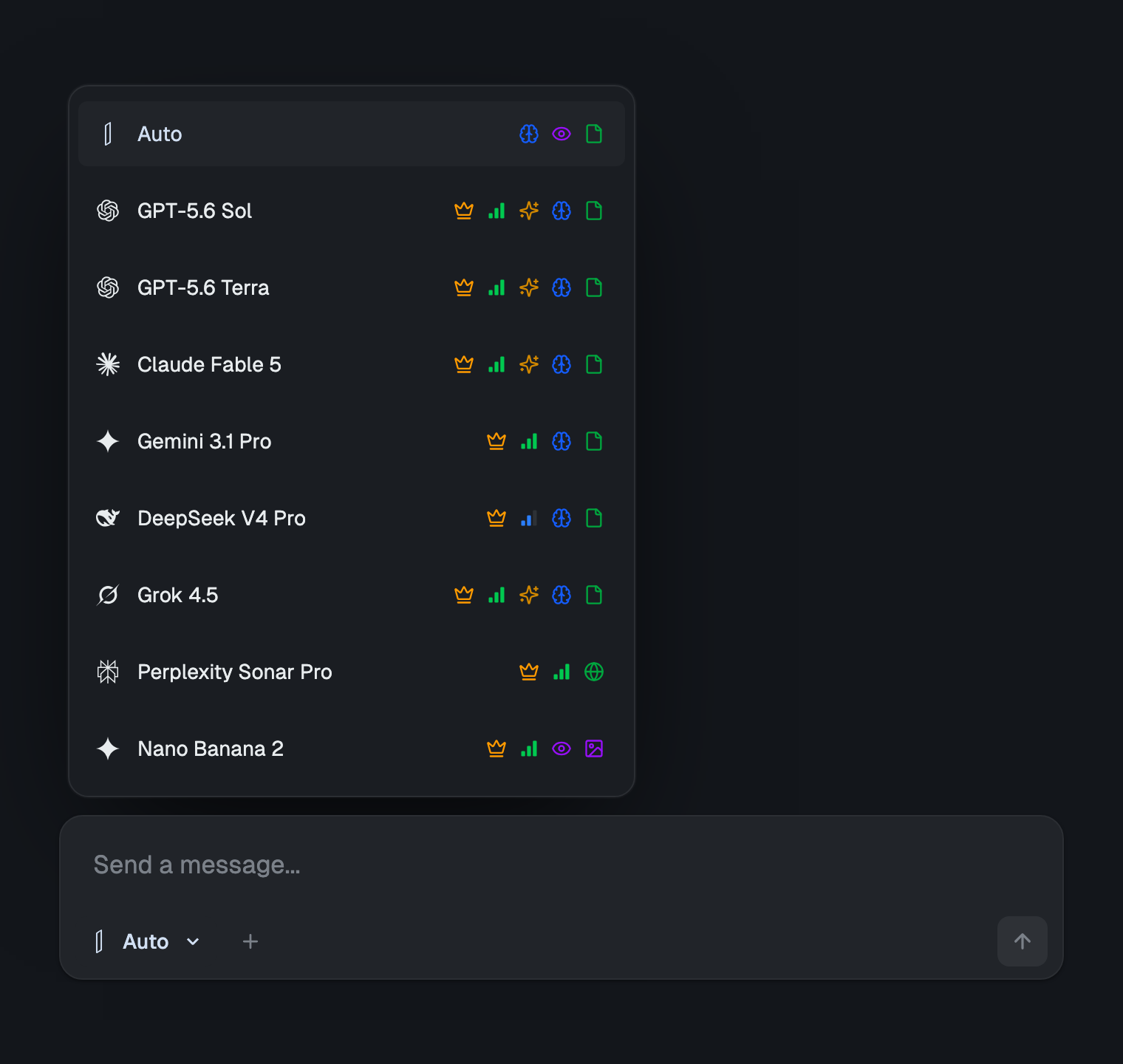
What makes this more than a bundle is that all of them share one thread. Switching models mid-conversation keeps the context, so the sequence this whole comparison points at becomes a single chat instead of three tabs and a clipboard: ask Grok what's moving and what people are saying, switch to Gemini in the same thread to find who has actually reported it and collect the links, then switch to ChatGPT to turn the whole thing into the brief, the summary or the post you needed. Each model arrives already knowing everything said before it. Nothing gets re-pasted, nothing gets re-explained.
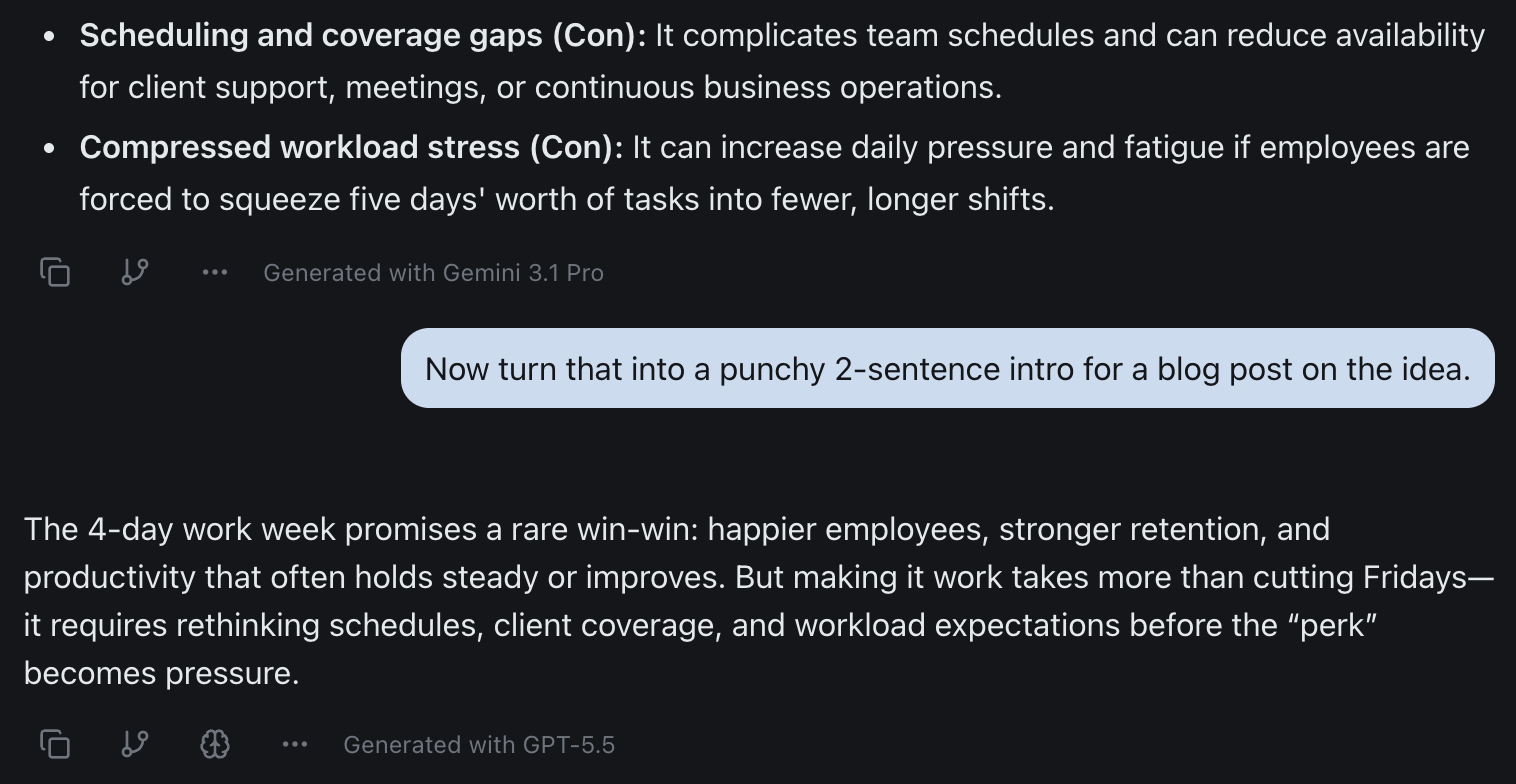
That's also what turns the disagreement test from a nice idea into a ten-second habit. Same question, second model, one click — and when the answers diverge you know which claim to check first. There's a one-minute version of that routine here.
The Bottom Line
Grok vs ChatGPT vs Gemini isn't settled by which model is smartest, because on this particular question they're barely competing on intelligence at all. Grok reads the conversation — fastest to a developing story, loosest with the truth of it. Gemini reads the record — slower, sourced, checkable. ChatGPT reads a curated middle — rarely first, consistently the best at turning what's found into something finished.
Pick one and you're not choosing a winner; you're choosing which two views of today to give up. The better move is to stop treating their disagreement as a problem to resolve and start reading it as what it is: three different windows onto the same event, and the gap between them marking exactly where to look closer. (Want the full field? Claude and Perplexity join these three in the five-model capstone — and the fourth big consumer assistant sits outside all of it, because Meta AI is only reachable where Meta can see you.)
Want Grok, ChatGPT and Gemini in one thread — with Claude, Perplexity and DeepSeek on the same $6 plan? Try izzedo chat free — no card needed.
Frequently asked questions
Which is better: Grok, ChatGPT, or Gemini?
For anything happening right now, they're not really competing on intelligence — they're competing on sources. Grok reads X, so it sees reaction and chatter first. Gemini is grounded in Google Search, so it sees the indexed, published web. ChatGPT reaches the web through its own search layer and is the steadiest at turning what it finds into usable work. On settled questions the three are close enough that the tie-breaker is your workflow, not a leaderboard.
Is Grok better than ChatGPT for real-time information?
For the first hour of a story, usually yes — Grok's access to live X posts means it sees an event while it's still being argued about rather than after it's been written up. But that speed comes from an unfiltered source: early X posts include rumour, jokes and deliberate noise, and Grok will relay them with the same confidence as a confirmed fact. ChatGPT is slower to the story and more careful with it. The practical answer is to use Grok to find out that something is happening and something else to find out what actually happened.
Does Gemini have real-time data?
Yes, through Google Search grounding — Gemini answers time-sensitive questions from live search results and gives you links to open. The catch is that it inherits Google's indexing pipeline, so it knows about things once they've been published and crawled somewhere. That makes it excellent for a story that is a few hours old and already covered, and slower than Grok on one that broke twenty minutes ago.
Which AI is best for current events and news?
Use them in sequence rather than picking one. Grok tells you a thing is happening and what people are saying about it. Gemini tells you which outlets have actually reported it, with links. ChatGPT turns the result into the brief, email or summary you needed in the first place. If you only get one shot, Gemini is the safest single pick for news because its answers come with sources you can verify yourself.
What's the cheapest way to use Grok, ChatGPT and Gemini together?
Paying each provider separately runs roughly $70/month — about $20 for ChatGPT Plus, about $20 for Google's AI plan and around $30 for full Grok access through X's premium tiers — across three logins. A multi-model workspace is far cheaper: izzedo chat includes Grok, ChatGPT and Gemini alongside Claude, Perplexity and DeepSeek for $6/month, with a free plan that doesn't ask for a card.
Ready to try multi-model AI workflows?
Access GPT, Claude, Gemini, Perplexity, and more — all in one place.
Start for Free →