Perplexity vs ChatGPT vs Claude in 2026: Best for Research & Daily Use
Perplexity, ChatGPT or Claude for research? After running real research tasks through all three, the answer isn't a winner — it's an assembly line. Here's who does which step, and how to run it in one thread.
Put perplexity vs chatgpt vs claude into a search box and you're really asking three tools to compete at a job only one of them was built for. Perplexity is an answer engine that hunts the live web and staples sources to everything it says. Claude is a deep reader and the best writer of the three. ChatGPT is the generalist that does a bit of everything, all day, without complaint.
I've spent months running real research through all three — market scans, fact-heavy articles, "is this claim actually true" checks, plus the ordinary daily miscellany in between. The finding is blunt: this isn't a race with a winner. It's an assembly line with three stations. One tool finds, one thinks, one fills every gap in between — and the order you type the names in (claude vs perplexity vs chatgpt gets searched almost as often) changes nothing about who stands where.
Here's who does which step, where each one breaks, and the workflow that uses all three without paying for three subscriptions.
The Verdict Up Front
One table, the whole comparison. Left column is the job, middle is the tool I actually reach for, right is why.
| Job | Winner | Why |
|---|---|---|
| Finding live, verifiable facts | Perplexity | Searches the live web, cites every claim — you can click and check |
| Fact-checking a specific claim | Perplexity | Numbered sources beat confident prose with nothing behind it |
| Reading sources closely & synthesizing | Claude | The most careful reader; catches what the abstract hides |
| Writing up the findings | Claude | Prose that ships with the least rewriting; ChatGPT close behind |
| Everyday questions & quick tasks | ChatGPT | Widest range, fastest to useful on almost anything |
| Brainstorming & open-ended thinking | ChatGPT | Thinks alongside you when there's nothing to retrieve |
| One tool for the whole job | ChatGPT | The only one that's adequate at every station |
Notice the shape: Perplexity owns the finding, Claude owns the understanding and writing, ChatGPT owns the everything else. That split runs through every test below.
Three Tools, Three Different Species
The reason this matchup confuses people is that only two of the contenders are the same kind of thing.
Perplexity isn't really a chat model — it's an answer engine wrapped around them. Ask it anything and it searches the live web, synthesizes what it finds, and attaches numbered citations you can open. Being current and checkable is its entire identity; on its paid tier it will even route your question through other frontier models, which tells you where the value sits: in the search-and-cite layer, not the model underneath. The cost of that identity is stiffness — ask it to draft, riff, or think out loud and you get a research brief where a piece of writing should be.
Claude (Anthropic) is the one you hand things to. Feed it the ten sources Perplexity found and it reads them the way a good analyst does — noticing the qualifier in paragraph nine, the study that doesn't quite say what the headline claims, the two sources that quietly contradict each other. Then it writes the synthesis in prose you can mostly ship as-is. What it's least built for is the fetching: it can search the web from its apps now, but retrieval is an add-on to its character, not the spine of it.
ChatGPT (OpenAI) is the utility infielder. It searches decently, reasons well, writes fast, and handles the long tail of daily asks better than either rival. It rarely produces the single best answer in this trio's specialist categories — Perplexity out-sources it, Claude out-writes it — but it's never the wrong tool, and there's real value in that. If you forced me to keep exactly one of the three, it's ChatGPT, precisely because it's nobody's specialist.
Head-to-Head: The Research Gauntlet
Same questions, same source material, three tabs. Here's how the actual work divided up.
Live facts and citations
Perplexity, decisively. Anything where the answer lives on the current web — a market size, a pricing change, what happened with X this quarter, whether a statistic is real — Perplexity returns it sourced, numbered, and clickable. That last part is the whole game: an AI answer you can verify is a different product from an AI answer you have to trust. ChatGPT is a genuine second here; its browsing is mature and it will link what it finds when it decides to look. Claude comes third not because it can't search, but because it's the least inclined to — its instinct is to reason from what it has, which is exactly the wrong instinct for a freshness question.
The caveat that keeps you honest: Perplexity's answer is only as good as the pages it found, and it will occasionally lean on a thin one. But a visible weak source is a solvable problem. A confident unsourced claim is not.
Deep synthesis — making sense of what you gathered
Claude, and this is the station most comparisons miss. Retrieval is half of research; the other half is reading. Hand all three the same pile of sources and ask what it actually adds up to, and Claude's read is consistently the deepest — it keeps the caveats attached, flags where the evidence is thin, and disagrees with the pile when the pile deserves it. ChatGPT produces a faster, tidier summary that occasionally sands off the nuance that mattered. Perplexity is weakest exactly here: it summarizes fluently, but it's tuned to compress and cite, not to argue with the material.
This is also where the "which is smartest" question gets its real answer: it depends whether the intelligence you need is finding intelligence or judging intelligence. They're different muscles, and no tool in this trio has both as its strongest.
Writing it up
Claude first, ChatGPT for volume. When the research becomes a deliverable — a memo, an article, a report someone will actually read — Claude's draft needs the least de-robotizing and takes editing direction most gracefully. ChatGPT is the right tool when the writing is high-volume or utilitarian: five subject lines, a summary for a different audience, the same finding at three lengths. Perplexity's writing stays what it always was — a competent research brief — and there's no shame in that, because writing was never its job. (For the full research-to-final-draft pipeline across models, I mapped it in Best AI for Writing Essays.)
Everyday use — the other 80% of your week
ChatGPT, comfortably. Research is why you compare these three; the daily grind is where you actually live. Explain this error, tighten this paragraph, plan the offsite, turn these notes into an agenda — ChatGPT fields that spread with the least friction and holds a long conversational thread most naturally. Claude handles the same range with more depth and slightly less speed, and it's the better everyday pick if your days are mostly words. Perplexity is the wrong shape for this entirely: it's built around the query — ask, receive, refine — which makes it superb at look-ups and oddly formal company for open-ended back-and-forth.
So the Real Answer Is a Workflow, Not a Winner
Look back at the gauntlet and the assembly line assembles itself: Perplexity gathers, Claude reads and writes, ChatGPT handles everything around it. Pick any single one and you're not choosing a champion — you're choosing which station to staff and which two to leave empty. (If Gemini is on your shortlist instead of Perplexity, I ran the equivalent three-way in Claude vs ChatGPT vs Gemini; the deeper Perplexity-only matchup is in Perplexity vs ChatGPT, and if ChatGPT is out of the running entirely, the two-way is Perplexity vs Claude.)
The catch is what staffing all three costs retail: Perplexity Pro, ChatGPT Plus and Claude Pro each run about $20/month — roughly $60/month for three accounts, three tabs, and three conversations with total amnesia between them. The pile of sources Perplexity just found can't be handed to Claude without copy-paste; ChatGPT never sees either. You end up as the courier between your own tools.
The Better Setup: All Three Stations, One Thread
A multi-model workspace collapses the whole line into one conversation. izzedo chat puts Perplexity Sonar, ChatGPT and Claude — plus Gemini, Grok, DeepSeek and twenty-some models in all — behind one login for $6/month, with a free plan that asks for no card. It's also the practical way to reach models whose own apps are region-locked, like the Chinese ChatGPT alternatives DeepSeek and Qwen. The bill stays flat unless you opt into usage-based billing, which is off by default — no credits to ration, nothing to prepay; fair-use limits exist like everywhere in AI, but they work in the background on a short rolling window that resets in hours, with a weekly pool behind it, and the plan details live on the pricing page.
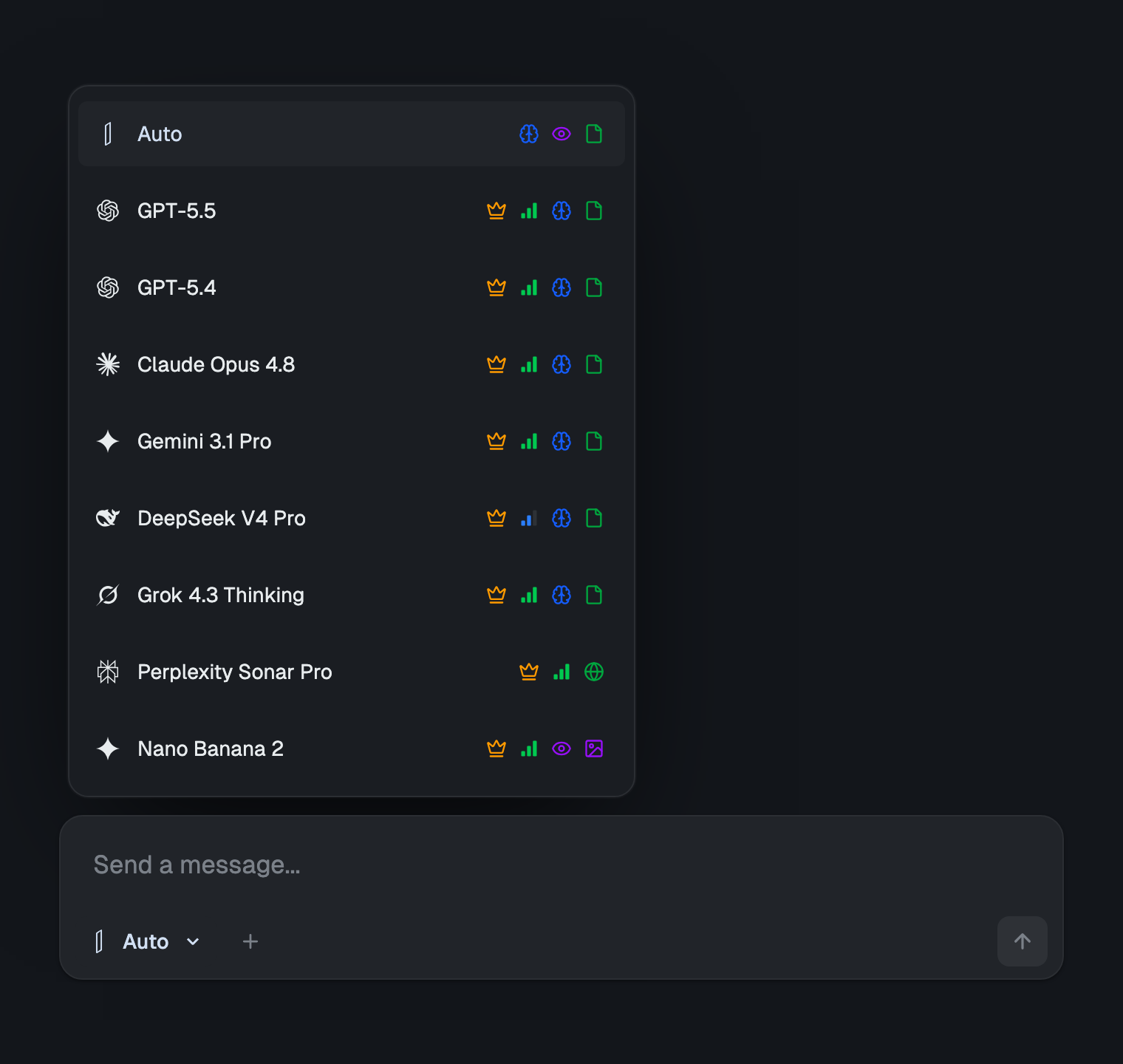
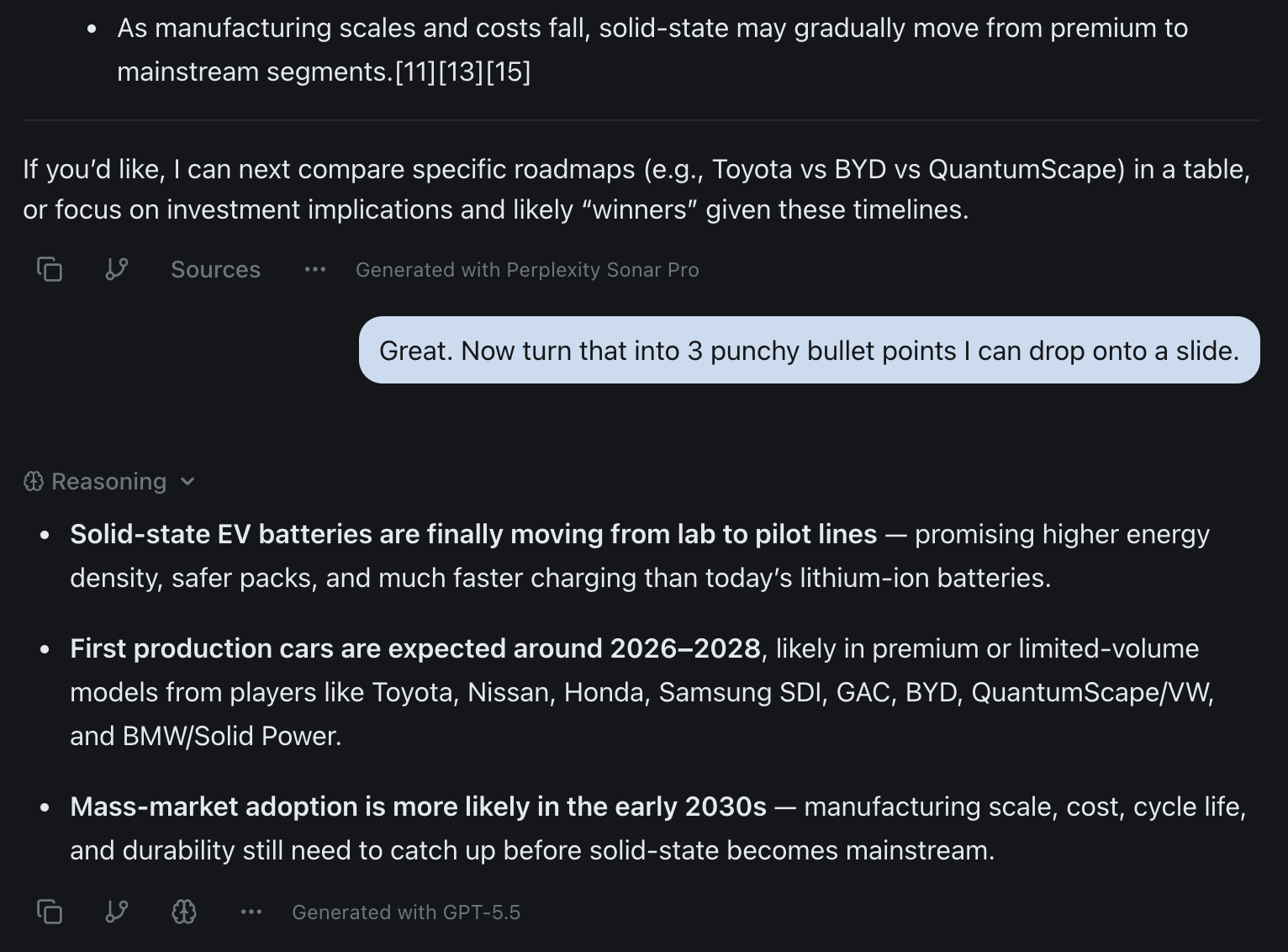
What makes it a research tool rather than a bundle is mid-thread model switching: every model joins the same conversation and inherits everything above it. The assembly line becomes literal —
- Ask Perplexity Sonar for the web-grounded answer, sources attached.
- Switch to Claude in the same thread — it reads the sourced answer it was just handed and does the synthesis and the write-up.
- Flip to ChatGPT for the follow-through: variants, a version for a different audience, the quick side-questions that pop up on the way.
No copy-paste, no re-explaining, no courier duty. Each specialist walks up to the bench with the previous station's work already in front of it.
The disagreement dividend
One more thing three-models-in-one-place buys you: an error detector. Every tool here is occasionally, confidently wrong — Perplexity via a weak source, ChatGPT and Claude via a stale memory. Ask the question that matters twice, on two models, and compare. Agreement is mild reassurance; disagreement is a flare over the exact claim that needs checking before it goes in something with your name on it. Across three subscriptions that habit costs too much friction to survive. In one thread it's a click — here are four longer workflows built on it. It's the same logic that makes running multiple models at once the quiet upgrade for everything else you do with AI.
The Bottom Line
Perplexity vs ChatGPT vs Claude isn't a podium — it's a job description split three ways. Perplexity finds and proves. Claude reads, judges, and writes. ChatGPT covers the rest of the day. If one subscription is genuinely all you want, take ChatGPT for the range and accept the gaps. But the honest conclusion from months of running all three is that the gaps are the story: real research keeps needing the other two stations within arm's reach.
So skip the either/or. Put all three in one thread, let each do the step it was built for, and make them check each other's work on anything that counts — one login, one bill, no couriering. (And for the full standings — these three plus Gemini and Grok, one verdict table — the mega comparison lives here.)
Want Perplexity's sourced answers, Claude's synthesis and ChatGPT's range in the same conversation — on one $6 plan? Try izzedo chat free — no card needed.
Frequently asked questions
Which is best for research: Perplexity, ChatGPT, or Claude?
It depends on which half of research you mean. For finding facts — current, verifiable, with sources you can click — Perplexity wins clearly, because it searches the live web and cites every claim. For making sense of what you found — reading the sources closely, spotting the weak argument, synthesizing a position — Claude is the strongest of the three. ChatGPT sits between them: a capable searcher and a capable synthesizer, and the best pick when one tool has to do the whole job adequately.
Does Perplexity replace ChatGPT or Claude?
No — it does a different job. Perplexity is an answer engine: a live-search-and-cite layer built around language models, ideal for retrieving verifiable facts. ChatGPT and Claude are generalist models built to reason, write, and converse. Perplexity's own paid tier even routes questions to other frontier models, which tells you the search-and-citation layer is the product, not a replacement for the models themselves. Most research workflows want Perplexity plus a generalist, not instead of one.
Which is best for everyday use?
ChatGPT, for most people. It has the widest range across the small tasks that fill a day — explain this, draft that, plan this trip, fix this formula — and the most mature ecosystem around them. Claude is the pick when everyday use skews toward writing and careful thinking. Perplexity is the least suited to being an all-day assistant: it's built around the query, not the conversation, which is exactly right for research and stiffer for everything else.
Can Claude and ChatGPT cite sources like Perplexity?
Both can search the web and link to what they find, but citation isn't their spine the way it is Perplexity's. Perplexity attaches numbered sources to every claim by default; with ChatGPT and Claude, sourcing arrives when the tool decides to look things up — and when they answer from memory instead, you get confident prose with nothing to click. For anything you'll have to defend or cite, start where the receipts are guaranteed.
What's the cheapest way to use Perplexity, ChatGPT and Claude together?
Paying retail, Perplexity Pro, ChatGPT Plus and Claude Pro run about $20/month each — roughly $60/month across three accounts that can't share a conversation. A multi-model workspace is far cheaper: izzedo chat includes Perplexity Sonar, ChatGPT and Claude — plus Gemini, Grok and DeepSeek — in one workspace for $6/month, with a free plan that requires no card.
Ready to try multi-model AI workflows?
Access GPT, Claude, Gemini, Perplexity, and more — all in one place.
Start for Free →