Perplexity vs ChatGPT in 2026: I Tested Both for Research
Perplexity or ChatGPT? I tested both across research, writing, and everyday work. Neither wins outright — each owns different tasks. Here's the breakdown.
"Perplexity vs ChatGPT" almost always gets posed as an either/or — pick the winner, ditch the loser. After leaning on both for everyday work, I think that framing quietly misreads the situation. These aren't two takes on the same tool. They're two different species of tool that happen to share a chat box.
Perplexity is an answer engine: it searches the live web and hands you a response with the sources stapled to it. ChatGPT is a generalist: it creates, reasons, and converses across an enormous range of tasks. So I gave each the jobs people actually open an AI for — digging up sourced facts, drafting, reasoning, and the everyday miscellany — and graded them one task at a time. What follows is where each pulled ahead, where it stumbled, and the workflow I'd point you to once the dust settles.
The Short Answer: Perplexity vs ChatGPT at a Glance
Short on time? This table is the whole comparison in miniature — the tool I'd grab for each job, and the reason.
| Task | Better pick | Why it wins here |
|---|---|---|
| Sourced research & live facts | Perplexity | Searches the live web and cites every claim, so you can verify and click through |
| Quick fact-checking | Perplexity | Answers arrive with numbered sources instead of an unverifiable statement |
| Writing & editing | ChatGPT | More polished prose, easier to steer on tone, better at long-form drafts |
| Open-ended reasoning & planning | ChatGPT | Thinks alongside you when there's no single fact to fetch |
| Everyday range & long chats | ChatGPT | Wider all-purpose ability and steadier across a long back-and-forth |
| Code help | ChatGPT (slight edge) | A little stronger on everyday code questions; both can help |
No single name sweeps that column — and that split is exactly why the back half of this guide is about pairing them up rather than picking a winner.
The Two Tools, in Brief
A short, fair sketch of each — and no version numbers, since the digits churn every few weeks while the character stays put.
Perplexity is an answer engine built around the live web. Ask it something and it searches, synthesizes, and — the part that matters — puts numbered citations right under each claim so you can click through and check. It's fast, it's current, and it's allergic to hand-waving: every fact points somewhere. Its instinct is to answer with receipts. The trade-off is that it's shaped for retrieval, not creation — its prose reads like a tidy research summary, and it's stiffer than a generalist when you want it to draft, brainstorm, or just think out loud with you.
ChatGPT is the generalist that made AI a daily habit. Give it a half-formed prompt and it still returns clean, well-organized prose; it reasons through open-ended problems and stays dependable across a huge spread of work — outlining, drafting, explaining, planning. It's what most people picture when they hear "AI." Its blind spots are the exact inverse of Perplexity's strengths: freshness (it leans on training data unless you nudge it to look) and proof — it answers with total confidence but rarely a clickable trail to back it up.
Wait — Does Perplexity Even Compete with ChatGPT?
This is the nuance most comparisons skip, and it changes how you should read the whole matchup. Perplexity isn't really a rival model to ChatGPT — it's a search-and-cite layer wrapped around large language models. Its default is its own Sonar model, and on the paid tier you can point a question at other leading models entirely.
So "Perplexity vs ChatGPT" is partly "a sourced search wrapper vs the raw generalist." That sounds like a knock on Perplexity; it isn't. The web search and inline citations are the product, and they're exactly what a plain chat model doesn't lead with. But it does explain the pattern you'll feel in every test below: Perplexity is unbeatable when the job is "find the verifiable answer," and oddly limited when the job is "make something." Which is the clearest sign yet that these two belong together, not in a cage match.
How I Ran This
No leaderboards here — just real tasks. I handed both tools the same set of jobs a normal person opens an AI for: pulling up a current, citable fact, chewing through a reasoning problem, drafting and tightening a piece of writing, and fielding the usual everyday questions. Identical prompt, identical context, answers lined up next to each other.
My yardstick was four things: was the answer current and checkable, did the reasoning hold, was the writing usable without a heavy edit, and did the tool actually suit the shape of the task. Call these field notes rather than lab results — your mileage will vary by topic — but the pattern held firmly enough to make the call below.
Perplexity vs ChatGPT, Task by Task
Sourced research and live facts
This is Perplexity's clear win, and it's the reason to keep it around. Ask it a question and it searches the live web, synthesizes an answer, and drops numbered citations under each claim so you can verify exactly where it came from. For anything where being current and provable matters — a statistic, a price, a recent development, a "what's the latest on X" — Perplexity hands you something you can actually trust, because you can see the receipts.
ChatGPT can browse too, but its instinct is to answer; the sourcing is an add-on rather than the whole point. When I need facts I'll actually have to cite or defend, Perplexity goes first.
The catch: a cited answer is only as good as its sources, and Perplexity will occasionally lean on a thin page. But the citations make that easy to catch — which is the opposite problem from a model that states something confidently with nothing to check. (More on turning that into a habit below.)
Writing and editing
This is ChatGPT's domain, and it isn't close. Perplexity can produce prose, but its output is shaped for retrieval — concise, citation-studded, structured like a research brief instead of a piece of writing. ChatGPT turns a messy pile of notes into a clean draft, takes direction on tone ("warmer," "tighter," "lose the jargon"), and iterates without losing the thread.
If the deliverable is words someone will read — an essay, an email, an article — I start in ChatGPT. (For the full research-draft-edit workflow across several models, I broke it down in Best AI for Writing Essays.)
Reasoning and open-ended thinking
ChatGPT takes this, with a caveat worth understanding. Perplexity is excellent at "go find the answer" — but a lot of real thinking has no answer to fetch. It's untangling a decision, weighing trade-offs, planning a project, or working through a hypothetical. That open-ended reasoning is where ChatGPT's range shows: it thinks alongside you rather than retrieving for you.
Perplexity is optimized to search and summarize; ChatGPT is optimized to reason. For "help me think this through," it's ChatGPT.
Everyday range and follow-ups
ChatGPT, comfortably. It holds context across a long back-and-forth, handles the random everyday asks (explain this, summarize that, brainstorm names, plan the week), and stays conversational over many turns. Perplexity is built around the query — ask, get a sourced answer, refine — which is perfect for research but stiffer as an all-day assistant.
The deciding factor for most people isn't a single feature. It's that one project keeps needing Perplexity's sources and ChatGPT's range, often inside the same task — gather the facts, then write the thing.
Where Perplexity Wins / Where ChatGPT Wins
Strip away the task-by-task detail and it comes down to a clean split:
- Perplexity wins when the answer lives on the web and has to be verifiable — current events, statistics, prices, "find me a source for this," competitive scans, anything you'll cite or defend.
- ChatGPT wins when you're making or thinking — drafting and editing, brainstorming, open-ended reasoning, planning, and the long tail of everyday questions that don't have a single citable answer.
In other words: Perplexity is the researcher, ChatGPT is the writer-and-thinker. That's not a tie nobody can break — it's two specialists, and the trick is having both on hand. (Swap ChatGPT for Anthropic's model and the split lands in a different place again — that one is Perplexity vs Claude.)
What They Cost — and What Running Both Adds Up To
This is where picking "just one" starts to look like a false economy. Perplexity Pro and ChatGPT Plus each run about $20/month. They meter different things, though. Perplexity meters its advanced searches, while ChatGPT lists chat as unlimited and caps uploads, images and research. Want Perplexity for sourced research and ChatGPT for writing and reasoning — which, if you've read this far, you probably do? That's roughly $40/month, two logins, and two bills, for two of the tools you'll lean on.
And almost nobody stops at two. Once the gaps show, you start eyeing Claude for editing, Gemini for long documents, Grok for live takes. Pay for each on its own and the tab climbs fast:
- ChatGPT — $20/mo
- Claude — $20/mo
- Gemini — $20/mo
- Perplexity — $20/mo
- Grok — $30/mo
- DeepSeek — free (consumer app; API is usage-priced)
That's $110/month for the whole lineup — most of it sitting unused on any given day. The way out — and the reason this matchup needn't end with one winner — is to put the entire set in a single workspace for a fraction of that. That's next.
Is Perplexity Better Than ChatGPT?
So, is Perplexity better than ChatGPT? After living in both, my honest take is that the question itself is wrong. Perplexity is better at finding and citing. ChatGPT is better at creating and reasoning. Crowning "the winner" means handing back whichever strength you passed on — and since most real work needs both, that's a poor bargain.
The people who get the most out of AI worked this out long ago: they don't swear allegiance to one tool. They send each task to whatever's best at it — Perplexity to gather sourced facts, ChatGPT to shape them into something — and they cross-check the answers that count. The catch has always been the logistics: two tabs, two logins, two separate invoices.
So Which Should You Pick? Match It to Your Work
If a single choice is truly unavoidable, let your most common task decide:
- Students and researchers: Perplexity for sourced material you can actually cite — then ChatGPT to turn those sources into the essay, summary, or notes. (More on the cost trade-off in Is ChatGPT Plus Worth It?. Perplexity also sells Education Pro to verified students at a discount, one of the student offers worth checking before paying full price.)
- Writers and marketers: ChatGPT to draft and polish copy you can steer on tone — with Perplexity nearby to pull current facts, stats, and references you can link.
- Analysts and fact-checkers: Perplexity for verifiable, linked answers — with ChatGPT for the interpretation and write-up once the facts are in.
- Everyday questions and planning: ChatGPT's range makes it the safer default — but you'll want Perplexity the second you need a real source instead of a confident guess.
See the pattern? Every line ends in "…but you'll want the other for X." That's not fence-sitting — it's what you get from two tools built for different jobs. And it's the tell that the right move isn't choosing between them at all.
If neither fits, the comparison page lines up every other matchup I've tested, verdict and price side by side.
The Better Answer: Run Both, in One Place
This is the part that quietly dissolves the dilemma. Instead of paying ~$20 for Perplexity, ~$20 for ChatGPT, and re-explaining your task every time you switch tabs, you can get ChatGPT, Perplexity, Claude, Gemini, Grok, DeepSeek and more in one workspace for $6/month — with a free plan that needs no credit card to start. The bill itself stays flat unless you opt into usage-based billing, which is off by default — no credits to count, nothing to prepay. Usage isn't infinite (no AI service can afford that), but fair use is handled behind the scenes on a rolling window measured in hours, with a weekly pool behind it, rather than a balance you drain and repurchase — the exact plan sizes live on that same pricing page.
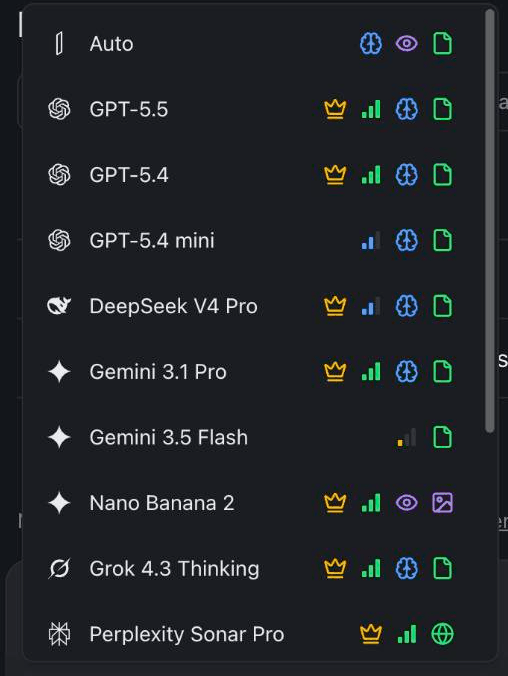
Because every model lives in the same thread, you can switch between them mid-conversation without losing context. That maps perfectly onto the workflow this whole comparison points to: ask Perplexity Sonar for a web-grounded, sourced answer, then switch to ChatGPT in the same thread to write it up — and it already sees the sources you just gathered. Nothing to re-paste, no extra tab, no second login.
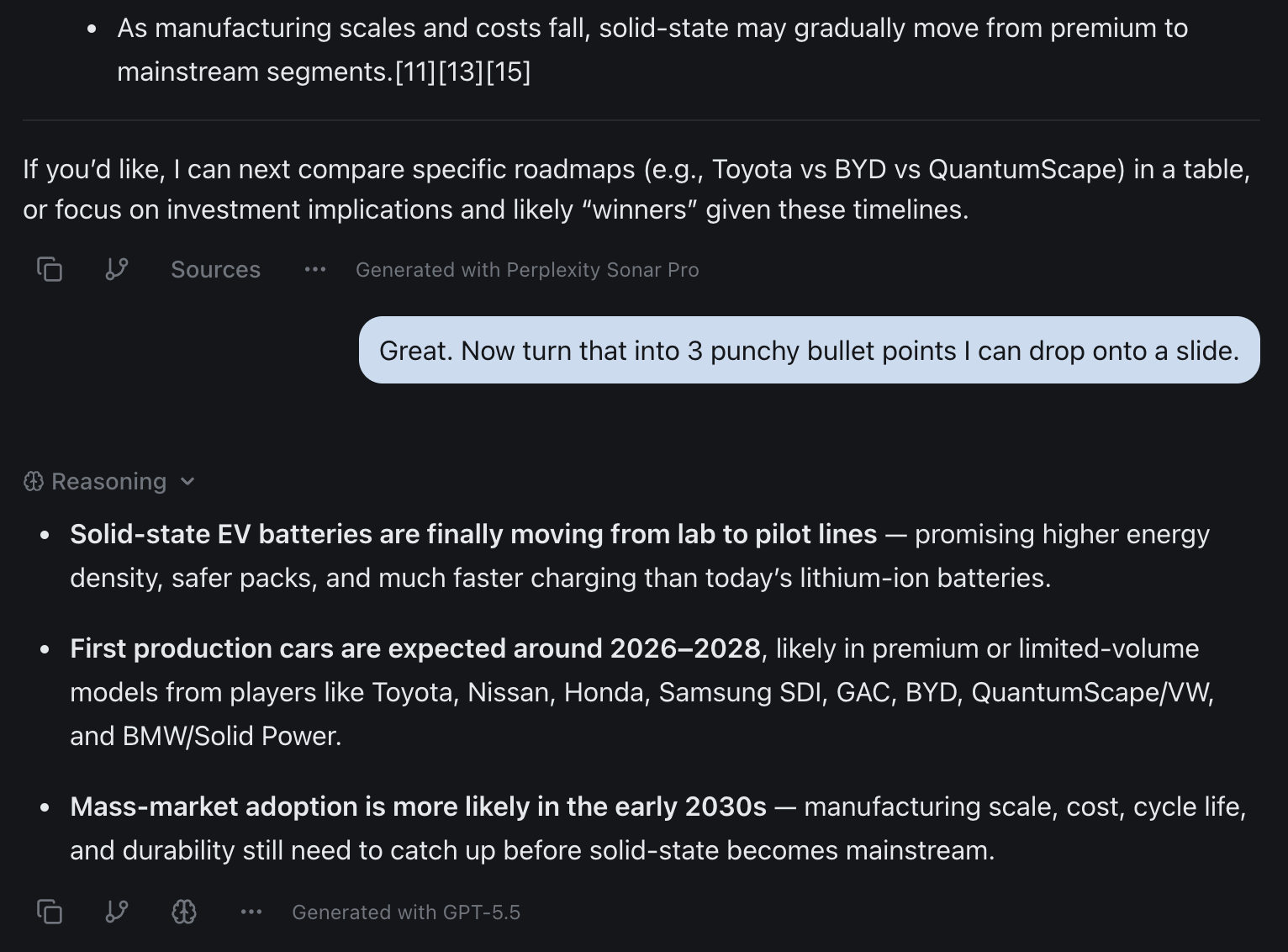
The bigger win: a built-in second opinion
The best part of keeping both side by side isn't the convenience — it's the accuracy. Any single tool is confidently wrong often enough that one answer shouldn't be taken at face value. Perplexity can cite a flimsy source; ChatGPT can deliver a stale "fact" without blinking. The remedy is easy: put the same question to a second model and watch whether the two line up. When they agree, breathe easy. When they clash, you've surfaced the very thing worth verifying before it costs you.
Across two separate subscriptions, that's a hassle. In one workspace it's a click — pose the question to both at once, or send a follow-up to a second model in the same thread. I've got a one-minute version of that second-opinion move.
That's the setup I actually use, and it's why the "Perplexity vs ChatGPT" question stopped mattering to me: I have both, plus the rest, and I point each task at whatever's best. (If you're comparing the other big rivalry too, I ran the same test on Grok vs ChatGPT — and if Claude is on your shortlist as well, the three-way Perplexity vs ChatGPT vs Claude settles who does which part of research.)
The Verdict
Perplexity vs ChatGPT in 2026 isn't really a contest — it's two specialists doing different jobs. Perplexity wins sourced research and anything that has to be current and verifiable; ChatGPT wins writing, reasoning, and dependable all-around range. Pin me down to one tool forever and I'd take ChatGPT for the sheer breadth — but I'd miss Perplexity's citations every time I had to prove a point.
The good news: nothing actually forces the choice. Keep both in one place, gather with one and create with the other, let their disagreements catch the slips — and the question answers itself. Match the tool to the job, keep your context in a single thread, and stop paying two bills for two tools you want anyway. (Wondering where Claude, Gemini and Grok land on the same scorecard? I ranked all five in one table here.)
Want Perplexity and ChatGPT in the same thread — with Claude, Gemini, Grok and the rest a click away? Try izzedo chat free — no card needed.
Frequently asked questions
Is Perplexity better than ChatGPT?
Neither is better overall — they're built for different jobs. Perplexity wins on research: it searches the live web and puts numbered sources under every claim, so you can verify the answer and follow the links. ChatGPT wins on creating and conversing — drafting, brainstorming, reasoning through a messy problem, and handling a huge range of everyday tasks. The strongest setup uses Perplexity to find and cite, and ChatGPT to think and write.
Does Perplexity use ChatGPT under the hood?
Partly. Perplexity is an answer engine — a live-search-and-cite layer wrapped around large language models. Its default is its own Sonar model, and on the paid tier you can route a question to other leading models too. So Perplexity and ChatGPT aren't pure rivals: Perplexity often runs on a similar class of model, then adds the web search and inline citations that plain ChatGPT doesn't lead with.
When should I use Perplexity instead of ChatGPT?
Reach for Perplexity whenever the answer needs to be current and verifiable — looking up facts, prices, news, statistics, or anything where you want to click the source. Use ChatGPT when you're creating or thinking out loud: drafting, rewriting, brainstorming, planning, or working through a problem that has no single fact to cite.
Is Perplexity Pro worth it?
If your work is research-heavy — constant fact-finding, citing sources, scanning current information — Perplexity Pro earns its roughly $20/month. But most people also want a strong generalist for writing and reasoning, which means a second ~$20 ChatGPT subscription. A multi-model workspace like izzedo chat gives you Perplexity's web research plus ChatGPT, Claude, Gemini and Grok for $6/month, with a free plan to test it first.
Can I use Perplexity and ChatGPT at the same time?
Yes. In a multi-model workspace you can run both in one thread — get a sourced answer from Perplexity, then switch to ChatGPT to write it up, with all the context carried over. You can also ask both the same question side by side and let any disagreement flag what's worth double-checking. izzedo chat does this natively, starting free with no card.
Ready to try multi-model AI workflows?
Access GPT, Claude, Gemini, Perplexity, and more — all in one place.
Start for Free →