The Best AI for Math in 2026: I Gave Every Frontier Model the Same Problems
Every AI will solve a math problem with total confidence — including the ones it gets wrong. I ran the same algebra, calculus, word problems and proofs through the frontier models to find out which deserve your trust, and built the two-model habit that catches the rest.
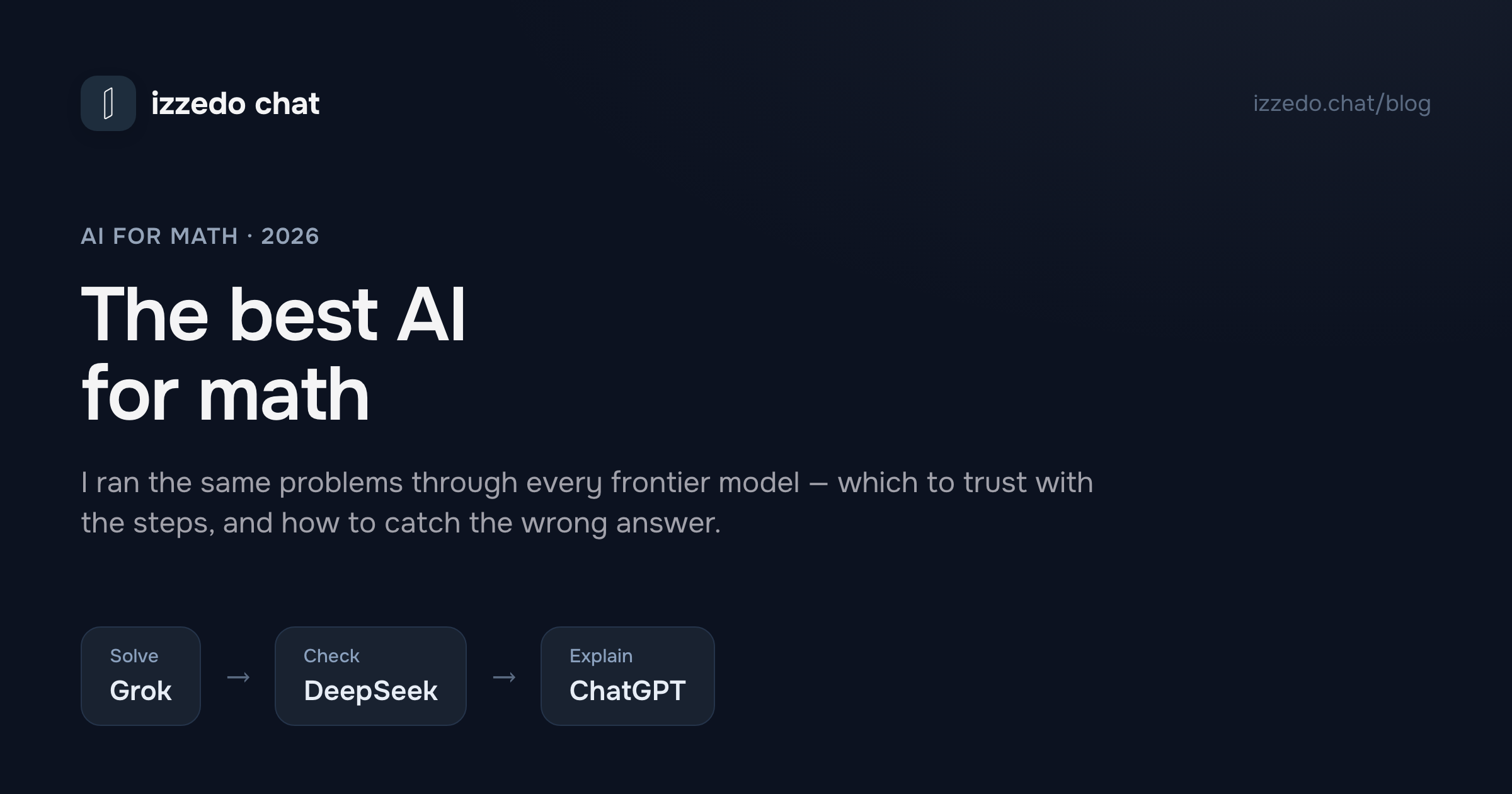
Ask any AI a hard math question and you'll get back something that looks impeccable: a confident tone, numbered steps, a tidy final answer. Whether it's correct is a separate matter — every model on the market will happily lay out six flawless steps and drop a sign in the seventh, without a flicker of doubt. So "what's the best AI for math?" is really two questions. Which model gets the most problems right, with steps you can actually learn from? And how do you catch the ones it still gets wrong?
To answer both, I ran the same problem set — algebra, calculus, word problems and a short proof — through the frontier models and graded not just the answers but the work. Here's who won each event, what the free options really cover, and the two-model habit that turns "probably right" into "checked."
The Short Answer: The Best AI for Math at a Glance
| Math job | Best pick | Why it wins |
|---|---|---|
| Algebra & routine problem sets | Grok | Cleanest worked steps, strongest at "explain why this works" |
| Calculus, step by step | Grok / DeepSeek | Both grind through limits and integrals with auditable reasoning |
| Word problems & applied math | ChatGPT | Best at untangling a messy setup into the right equations |
| Proofs & rigorous logic | DeepSeek | Deliberate, visible reasoning chains that hold up under scrutiny |
| Problem sets that live in a PDF | Gemini | Reads the whole document, then reasons over it |
| Best free option | DeepSeek | The entire app is free — reasoning mode included |
| Checking any answer | A second model | Two models rarely make the same mistake |
Notice the last row. It matters more than any other, and the end of this post is about it.
How I Tested
Same set, every model: an equation-manipulation exercise, a related-rates calculus problem, a multi-step business word problem (margins and breakeven), a proof by induction, and one deliberately unsolvable question to see who would admit it. Each response was graded on four things — the final answer, the quality of the steps, how well the model explained why the method works, and what it did when it was wrong.
Two ground rules. No benchmark tables: competition-math scores tell you little about whether a model's steps are followable at 11pm before a deadline. And no version numbers: models get replaced monthly, but each one's mathematical character — how it reasons, where it slips — has stayed remarkably consistent, so that's what I'm reporting.
The Best AI for Math, Model by Model
Grok: the best steps — and the best "but why?"
Grok has quietly built a reputation as a math-first model, and the testing backed it up. Its worked solutions were the most consistently correct across algebra and calculus, laid out the way a good teaching assistant would write them. Where it really separates itself is the follow-up: ask "why does this method work?" or "where would this approach break?" and Grok gives the kind of conceptual answer that actually makes the next problem easier. The catch is access — its full strength sits behind the priciest subscription of the major models, about $30/month bought directly.
DeepSeek: frontier-grade rigor for exactly $0
DeepSeek treats every problem like it's being graded. Its reasoning mode visibly deliberates — trying an approach, checking it, backtracking — and that thoroughness made it the strongest performer on the proof and the most reliable on the trap question, where it was quickest to flag that the premise was impossible rather than "solve" it anyway. The prose around the math is dry, and the app around the model is bare. But the reasoning itself competes with models that cost real money, and the price is zero — which is why it's the budget pick for anyone with a problem-set-heavy semester. (Full breakdown of that trade-off in DeepSeek vs ChatGPT.)
ChatGPT: the word-problem and explanation champion
Pure symbol-pushing isn't where ChatGPT stands out — it's what happens before the algebra. Real-world math rarely arrives as an equation; it arrives as a paragraph about discount tiers, loan terms or conversion rates, and ChatGPT was the best at translating that mess into the right mathematical setup. It's also the clearest teacher of the group, pitching explanations at whatever level you ask for. Its failure mode is the sneaky one, though: small arithmetic slips delivered with complete confidence, which is precisely why the verification habit below exists.
Gemini: when the problem arrives as a 40-page PDF
Gemini's edge in math isn't the solving — it's the intake. Hand it an entire problem set, a lecture-notes PDF or a spreadsheet export and it reasons across the whole document: summarizing which topics the set covers, working through selected problems, cross-referencing the notation your course actually uses. For a single hard integral it's mid-pack; for "here are this week's fifty pages, get me through them," it's the right call.
Where they all fail: long arithmetic. Every model in this test, without exception, becomes less reliable as the raw number-crunching grows — a 12-digit multiplication or a 30-row sum belongs in a calculator or spreadsheet, full stop. The models' real value is upstream of the arithmetic: choosing the method, structuring the solution, explaining the concept.
The Best AI for Calculus: Derivatives, Integrals and Related Rates
Calculus is where the confident-and-wrong problem gets expensive, because the errors hide in the middle of a solution that looks right at both ends. So it's worth splitting out from the rest of the subject.
The related-rates problem in my set was the most revealing single question I asked. It has a translation step (words into a relationship between variables), a differentiation step, and a substitution step that must happen after differentiating, not before. That last one is the classic trap, and it's the one that separates a model reasoning about the problem from a model pattern-matching to problems that look like it.
| Calculus task | Reach for | What actually goes wrong |
|---|---|---|
| Routine differentiation | Any of them | Almost nothing. This is the safest thing you can ask an AI to do |
| Integrals, symbolic | Grok or DeepSeek | A dropped constant, or a substitution that quietly changes the limits |
| Related rates and optimisation | Grok | Substituting fixed values before differentiating |
| Limits and convergence | DeepSeek | Asserting a limit exists rather than showing it does |
| Series and sequences | DeepSeek | The right test named, the conditions for it unchecked |
| A whole problem set in a PDF | Gemini | Reads everything, reasons less deeply on any one item |
Two habits make calculus answers far more trustworthy, and neither costs you anything.
Ask for the method before the answer. "What approach would you use here, and why that one?" gets you a paragraph you can check in ten seconds against what your course actually taught. If the method is right, the arithmetic is the easy part to verify. If it's wrong, you've saved yourself from auditing six correct-looking lines of algebra that were never going to arrive anywhere.
Verify the result backwards. Differentiate the antiderivative. Plug the critical point into the original relationship. Calculus has a built-in check that most other math doesn't, and it takes a fraction of the time re-deriving the whole solution would. When a model does slip, this is almost always where it shows up.
The general point holds here too: the best AI model for math isn't one name, it's whichever model suits the specific job, plus a second one looking over its shoulder. On calculus that second opinion matters more than anywhere else in the subject, because a sign error in step four propagates silently all the way to an answer you'd have no reason to doubt.
Free vs Paid: What $0 Buys You in Math AI
The free landscape for math is unusually good. DeepSeek gives away its full reasoning ability — one reason the Chinese ChatGPT alternatives changed what free math help looks like. ChatGPT and Gemini both handle everyday math on their capped free tiers, though ChatGPT's free plan allows three file uploads a day, which runs out fast if you photograph problem sets. What the caps actually cost you is consistency — free tiers throttle exactly when a five-hour problem-set session needs them most, and Grok's best math sits behind its paid plan entirely, on a plan whose allowance xAI has never put a number on.
Paying list price for the lineup solves that and creates a new problem: ChatGPT, Claude, Gemini and Perplexity at $20 each and Grok Premium at $30, with DeepSeek free — about $110/month if you subscribe to all five paid tiers, for tools that mostly sit idle between assignments. For one subject, nobody should do that. The sensible endpoint is a multi-model workspace: izzedo chat puts Grok, DeepSeek, ChatGPT, Gemini and the rest behind one flat bill from $6/month, with a free plan that needs no credit card. (Students weighing this exact budget call should read Is ChatGPT Plus Worth It for Students? — and the broader student toolkit lives in Best AI for College Students.)
The Workflow That Catches Wrong Answers
Here's the uncomfortable statistic from my testing: every model missed at least one problem — and every miss was delivered in the same confident voice as the correct answers. For math, that changes the goal. You're not hunting for the one infallible model, because it doesn't exist. You're building a setup where a wrong answer gets caught.
The fix is structural and takes about a minute: solve with one model, verify with another. Different models are trained differently and rarely make the identical mistake, so when two independent solutions agree, confidence is high — and when they disagree, you've found the exact step worth re-deriving by hand. It's the same logic as asking three models and picking the best answer, applied to the one subject where being wrong is unambiguous.
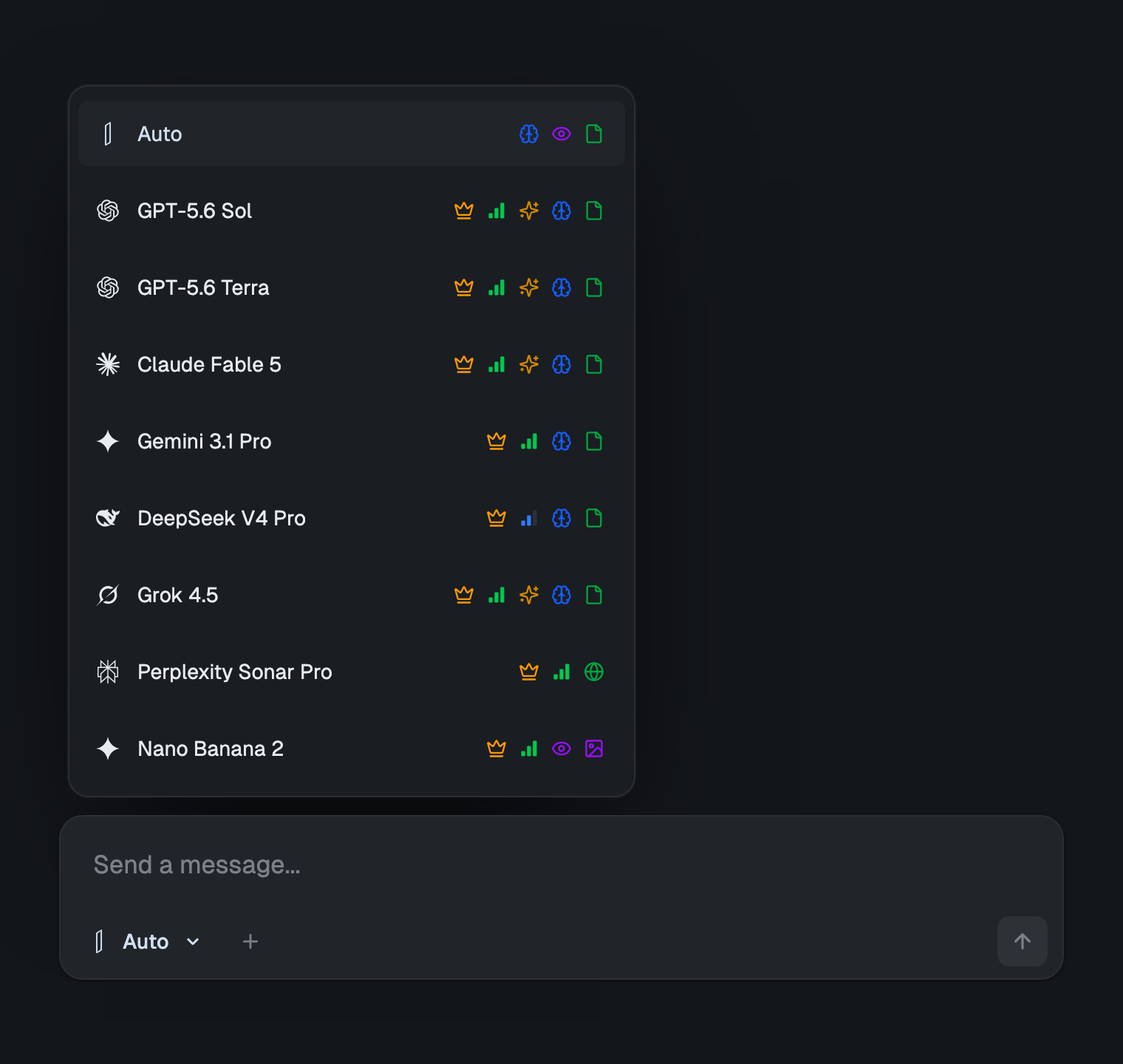
In one workspace, the habit is nearly frictionless. Have DeepSeek grind through the problem, then switch the same thread to Grok — context carries over — and ask it to check the reasoning cold. Or fire the question at several models side-by-side with Multiple Model Opinions and compare the answers directly. Here's what the hand-off looks like in a real thread — one model works a pricing plan's breakeven math step by step and flags the flaw in the plan, then a second model picks up the same conversation and restates the verdict in plain language:
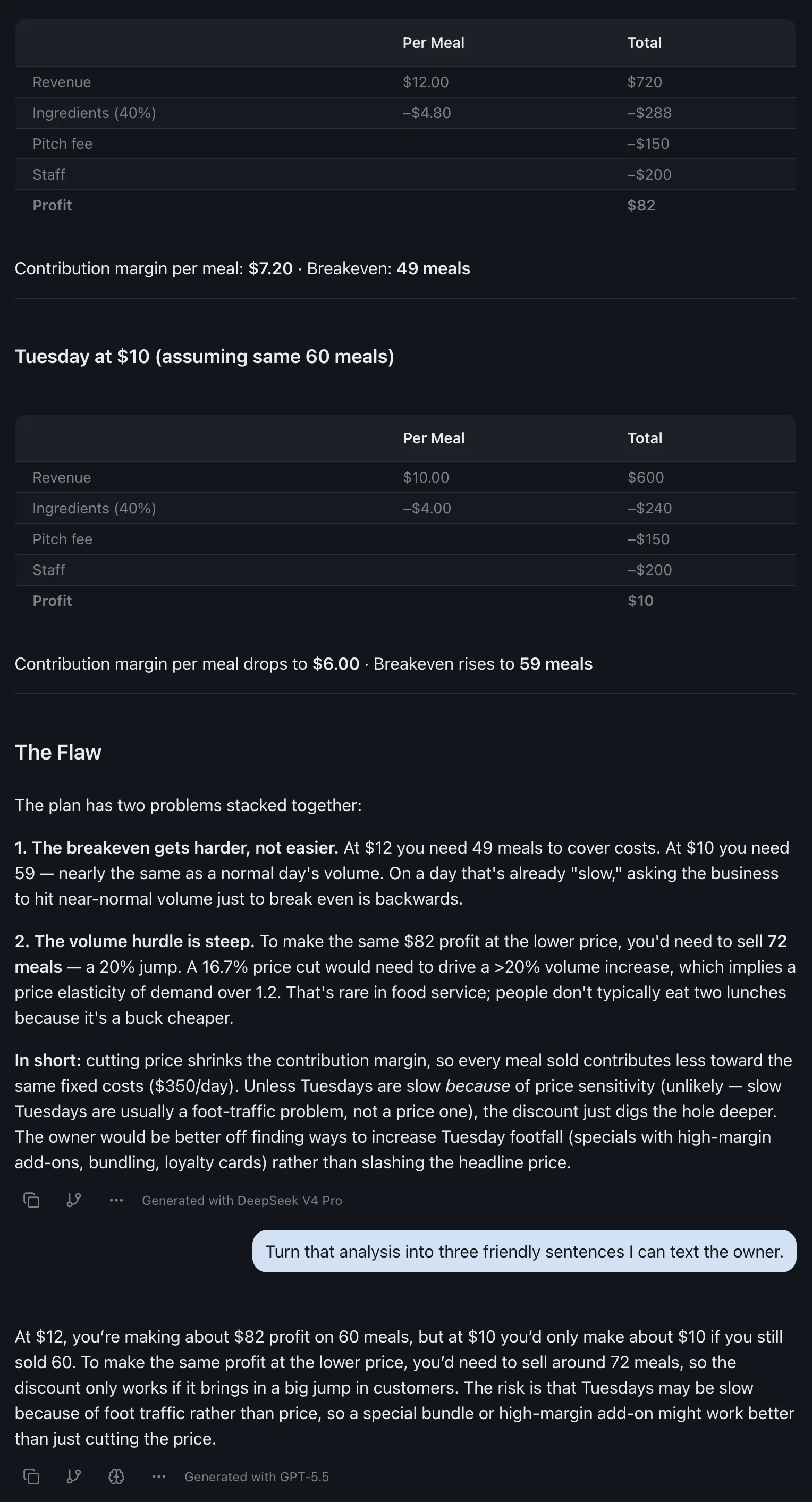
That's the whole method: the specialist does the math, the communicator translates it, and any disagreement between models tells you where to look before it costs you. (New to running several models in one thread? The full walkthrough is here.)
The Bottom Line
The best AI for math in 2026 is a short bench, not a single name: Grok when you want the strongest steps and the "why," DeepSeek when you want frontier rigor for free or a proof done properly, ChatGPT when the problem starts as a messy paragraph, Gemini when it starts as a long document. Any one of them will still, occasionally, be confidently wrong — which is why the real upgrade isn't picking the perfect solver, it's never trusting a single model unchecked. One model solving and one model checking beats any model working alone.
Want the whole math bench — Grok, DeepSeek, ChatGPT and Gemini — in one thread, with a second opinion one click away? Try izzedo chat free — no credit card required.
Topics
- best ai for math
- AI math solver
- step-by-step math
- Grok
Start on the free plan. Pay when you want the premium models.
Free
$0
Claude Haiku, Gemini Flash, Grok and more, with agent mode and 50+ connectors
Hobby
$6/mo
Every chat and image model
Pro
$12/mo
Higher limits, 400k context and more video models
Max
from $50/mo
5x or 10x Pro's usage, and every video model
Frequently asked questions
What is the best AI for math?
There isn't a single winner — the jobs split. Grok is the strongest all-round solver and the best at explaining why a method works, DeepSeek matches that step-by-step rigor for free and shines on proofs, and ChatGPT is the pick for messy word problems that first need translating into equations. The most reliable setup is two of them: one to solve, one to verify.
Is ChatGPT good at math?
Genuinely good, especially at applied math — word problems, percentages, finance-style questions — and at teaching, because its explanations are the easiest to follow. Its weakness is quiet arithmetic slips delivered in a confident tone, so treat its answer as a first pass and check anything that matters against a second model.
Which AI is best for calculus?
Grok and DeepSeek, for different reasons. Grok lays out the cleanest worked steps on derivatives, integrals and related-rates problems, and explains why a method applies. DeepSeek is more deliberate on limits, convergence and anything needing a proof. The trap in calculus is substituting fixed values before differentiating, so ask the model to state its method first, then verify the result backwards by differentiating its antiderivative or plugging the answer back in.
What is the best free AI for math?
DeepSeek, and it isn't close: its consumer app is free with the step-by-step reasoning mode included, which is exactly the capability math needs. ChatGPT and Gemini have capped free tiers that also handle math well. A multi-model workspace like izzedo chat bundles several of these behind one free plan with no credit card, which makes the solve-then-verify workflow free too.
Can AI solve calculus problems?
Yes — modern reasoning models handle derivatives, integrals, limits and related-rates problems with full worked steps, at the level of a typical university course. Two caveats: they should show steps you can audit, and heavy symbolic computation is still safer in a dedicated calculator or CAS. Use the AI for the reasoning and the explanation, and verify results that count.
How do I check whether an AI's math answer is right?
Ask a second model the same question and compare. Two models rarely make the identical mistake, so agreement is a good (not perfect) signal and disagreement tells you exactly which steps to re-derive. In izzedo chat this is built in — switch models mid-thread with context preserved, or use Multiple Model Opinions to put the same question to several models side-by-side.