Google Gemini vs ChatGPT in 2026: I Tested Both Head-to-Head
Gemini or ChatGPT? I tested both across long documents, search, writing and reasoning. Neither wins outright — each owns different tasks. Here's the breakdown.
Search "Gemini vs ChatGPT", or "Google Gemini vs ChatGPT" if you are the precise type, and you're clearly hoping for a verdict — one name to commit to, the other to forget. After running both through the work I do every day, I don't think that verdict exists. These two aren't competing to be the same thing. They're optimized for opposite ends of the same workday: one for scale, the other for craft.
Gemini is Google's model, and it shows — it swallows enormous documents whole, stays plugged into Google's live index, and treats images and text as one fluid thing. ChatGPT is the incumbent that turned "ask an AI" into muscle memory, with the most polished writing and the steadiest all-round feel. So I handed each the jobs people actually open an AI for — chewing through a long document, looking something up, drafting, reasoning, working with images — and scored them task by task instead of forcing a single champion. Here's where each pulled ahead, where it slipped, and the setup I'd genuinely recommend at the end.
The Short Answer: Gemini vs ChatGPT at a Glance
Pressed for time? This table is the entire comparison compressed — the model I'd grab for each job, and the reason.
| Task | Better pick | Why it wins here |
|---|---|---|
| Long documents & huge context | Gemini | Holds an enormous amount of text at once, so it reasons over whole reports and books in one pass |
| Current info & web search | Gemini | Grounded in Google Search, so answers stay fresh and come with links you can open |
| Writing & editing | ChatGPT | More polished default prose, easier to steer on tone and structure |
| Reasoning & problem-solving | Tie (lean Gemini on hard, structured problems) | Both reason well; Gemini edges dense multi-step problems, ChatGPT the messy real-world ones |
| Images & multimodal | Gemini (slight edge) | Treats text and images as one medium; strong at reading and generating visuals |
| Everyday range & follow-ups | ChatGPT | The dependable generalist across the widest spread of small daily tasks |
No single name owns that column — and that split is exactly why the second half of this guide is about running both rather than anointing a winner.
Meet the Two Contenders
A quick, fair character sketch of each — no version numbers, because the digits roll over every few weeks while the temperament stays put.
Gemini, from Google, is the model built for scale and connection. Its defining traits are an enormous context window — you can feed it a long report, a stack of PDFs, or an entire book and it keeps the whole thing in view — plus a deep tie to Google's world: it grounds answers in live Search, so it leans current and linkable rather than frozen at a training cutoff. It's also natively multimodal, meaning it reads images, charts and documents as comfortably as plain text, and generates images too. Its weaker spot is voice: its default prose is competent but a touch flatter than ChatGPT's, and it can feel more like a powerful engine than a smooth conversationalist.
ChatGPT, from OpenAI, is the all-rounder that set the bar. Hand it a half-formed prompt and it still hands back clean, well-shaped prose; it reasons through open-ended problems and stays reliable across an enormous range of tasks — outlining, drafting, explaining, planning. It's the model most people mean when they say "AI," and that ubiquity is earned: it's the safe default that rarely disappoints. Its blind spots are the mirror image of Gemini's strengths — freshness (it leans on training data unless nudged to look) and sheer context size, where it's strong but not built around the huge-document use case the way Gemini is.
The Real Divide: Scale vs Craft
Before the task-by-task notes, it's worth naming the pattern you'll feel underneath every one of them, because it explains the whole matchup. Gemini is engineered for scale — more context, Google's live index behind it, media of every kind in one place. ChatGPT is honed for craft — the sentence that lands, the explanation that clicks, the reliable answer to whatever you throw at it.
That's why "which is better" keeps refusing to resolve. When the job is handle a lot — a 200-page document, a question that needs today's facts, a mix of text and images — Gemini's scale wins. When the job is make something good — an essay, a tricky explanation, a careful piece of reasoning with no single fact to fetch — ChatGPT's craft wins. Most real work is a braid of both, which is the first hint that picking one means deliberately giving up the other half.
Gemini vs ChatGPT, Task by Task
Long documents and big context
This is Gemini's headline win, and it's the reason power users keep it close. Its context window is large enough to hold a long report, a research paper, a contract, or a whole book in working memory at once — then answer questions, summarize, and cross-reference across the entire thing without losing the early pages. Paste in something dense and ask it to pull the through-line, and it actually does.
ChatGPT handles documents capably too, but as the material gets longer its edge fades; it's strong here, not built here. When the task is "digest this enormous pile of text and reason over all of it," Gemini is the one I reach for first.
The catch: a model holding a whole document in context can still misread it. The bigger the input, the more worth spot-checking the key claims it pulls out — more on building that habit below.
Search and current information
Gemini's other clear strength is freshness, and it comes from the obvious place: Google. Because it grounds answers in live Search, questions about right now — a recent development, a current figure, the latest on a topic — come back current, often with links you can open and verify. It feels less like asking a model what it remembers and more like asking one that just looked it up.
ChatGPT can browse the web too, but its instinct is to answer from what it knows and reach for search second. For anything where being up-to-date matters, Gemini's Google grounding gives it the head start. (If sourced, citation-heavy research is your core job, that's actually Perplexity's specialty — I compared it to ChatGPT separately.)
One rival beats even Google's index on the very freshest stories, because it reads a social feed rather than a crawl: the three-way Grok vs ChatGPT vs Gemini breaks down which live source wins at which point in a story's life.
Writing and editing
ChatGPT's home turf, and it isn't especially close. Its default prose is more polished, it takes direction on tone with less fuss ("warmer," "tighter," "lose the jargon"), and it shapes a heap of rough notes into a clean draft that needs less rewriting. Gemini writes perfectly serviceable copy — clear, organized, correct — but it reads a little more functional, a little less finished, and usually wants another editing pass to sing.
When the output is prose someone will actually read — an essay, a newsletter, a pitch — ChatGPT is where I open the document. (For the full multi-model research-draft-edit workflow, I broke it down in Best AI for Writing Essays.)
Reasoning and problem-solving
The closest column on the board. Both are genuinely strong reasoners, so this comes down to which kind of hard. Gemini is excellent on dense, structured, multi-step problems — the sort where you need to hold a lot of moving parts in your head and grind through them methodically, which plays straight into its big-context strength. ChatGPT is the steadier hand on messy, ambiguous, real-world reasoning — untangling a decision, weighing trade-offs, thinking through a half-defined problem.
I give Gemini a slight edge on the heavy, structured stuff and ChatGPT the nod on open-ended judgment, but honestly the gap is small enough that the other factors usually decide which one you should open.
Images and everyday extras
Gemini takes a slight edge here, mostly because multimodal is in its bones: it reads an image, a chart, or a screenshot and folds it into the conversation as naturally as text, and it generates images too. ChatGPT is also genuinely multimodal — it sees images, it makes them — so this is a lead, not a blowout; for pure image generation the better pick often comes down to the look you're after rather than one being broadly superior.
On the everyday miscellany, though — explain this, summarize that, brainstorm names, plan the week, hold a thread across a long back-and-forth — ChatGPT's range and consistency make it the comfortable default. The deciding factor for most people isn't any single feature. It's that one project keeps needing Gemini's scale and ChatGPT's polish, often inside the same hour.
Where Gemini Wins / Where ChatGPT Wins
Strip out the task detail and it lands on a clean split:
- Gemini wins when the job is big or current — long documents and huge context, live Google-grounded search, multimodal work that mixes text and images, and dense structured reasoning.
- ChatGPT wins when the job is craft or breadth — polished writing and editing, open-ended judgment, and the long tail of everyday tasks where a dependable, conversational generalist matters most.
Put plainly: Gemini is the heavy-lifting engine, ChatGPT is the all-purpose craftsman. That's not a stalemate nobody can break — it's two specialists, and the move is to keep both within reach.
Pricing: What Google AI Pro and ChatGPT Plus Actually Include
Here's the twist that makes the choice awkward: the headline plans cost the same. I re-read both vendors' plan pages on 22 September 2026, and the $20 rung is still a dead heat.
| Plan | Price | What the vendor says you get |
|---|---|---|
| Gemini, free | $0 | The everyday model, with lower usage than any paid plan |
| Google AI Plus | $4.99/mo | Roughly double the free usage; the plan Google's student offer gives students outside the U.S. |
| Google AI Pro | $19.99/mo ($199.99/yr) | More access to Gemini's Pro model, usage "4x higher" than Free, a 1 million token context window Google describes as "up to 1,500 pages of file uploads", video generation, 5 TB of storage |
| Google AI Ultra | $99.99/mo or $199.99/mo | 5x or 20x AI Pro's usage limits |
| ChatGPT, free | $0 | Text chat "unlimited" with an asterisk, tighter caps on uploads, images and tools |
| ChatGPT Plus | $20/mo | The flagship model, no ads, the full feature set |
| ChatGPT Pro | $100, $200 or $500/mo | About 5x or 20x Plus usage on the first two, 25x plus Ultrafast on the $500 tier; the Go vs Plus vs Pro breakdown has the full ladder |
Two things in that table are new since I first wrote this comparison.
The first is the name. Google AI Pro is what Gemini Advanced became, and the older name still turns up in half the comparisons you will read. Same plan, same price, different label.
The second is the shape of the top rung. Google now sells Ultra as $99.99 for 5x AI Pro's usage or $199.99 for 20x. That is the identical $100 and $200, 5x and 20x ladder OpenAI sells above Plus and Anthropic sells above Claude Pro, and I went through what that arithmetic means for the middle rung in Claude Pro vs Max. Three vendors, one price list, at least up to $200. OpenAI stepped past it on 29 September with a $500 tier that neither rival matches. Whichever of these two you pick, the upgrade path above it is the same shape, and it charges the same rate per unit of usage as the $20 plan you started on.
One more change sits inside the app rather than on the price list. Since 17 May, Gemini's model picker no longer offers Fast, Thinking and Pro. It lists Flash-Lite, Flash and Pro, Google marks all three as available without a plan, and thinking became a separate level you set on top of the model. So the $19.99 buys more of the Pro model and a bigger context window, not access to Pro itself. I went through what replaced Gemini's Thinking option, and when Pro is still worth selecting in a separate post.
So unlike some matchups where price breaks the tie, here it doesn't. Pick one and you're leaving the other's strengths on the table for no saving at all. Want Gemini for big-context and current work and ChatGPT for writing and range, which, if you've read this far, you probably do? That's roughly $40/month, two logins, and two bills.
And two is rarely where it ends. Once the gaps show, you start adding Claude for editing, Perplexity for sourced research, Grok for live, fast-moving takes. Pay for each separately and the tab climbs fast:
- ChatGPT Plus — $20/mo
- Claude Pro — $20/mo
- Google AI Pro — $19.99/mo
- Perplexity Pro — $20/mo
- SuperGrok — $30/mo
- DeepSeek — free (consumer app; API is usage-priced)
That's about $110/month for the full lineup, most of it idle on any given day. The way out, and the reason this comparison needn't end with a single pick, is to put the whole set in one workspace for a fraction of that. That's next.
Is Gemini Better Than ChatGPT?
So, is Gemini better than ChatGPT? After living in both, my honest take is that the question is built wrong. Gemini is better at scale — long context, current info, multimodal. ChatGPT is better at craft — writing, range, and dependable polish. Declaring "the winner" just means handing back whichever strength you chose against, and since most real work needs both, that's a bad trade.
The people who get the most out of AI sorted this out long ago: they don't pledge loyalty to one model. They route each task to whatever's best at it — Gemini for the big-document, current, multimodal work, ChatGPT for the writing and the everyday thinking — and they cross-check the answers that matter. The friction has always been logistical: two tabs, two logins, two separate invoices.
Which Is Better, ChatGPT or Gemini, for Your Work?
If a single choice is genuinely unavoidable, let your most common task decide:
- Students and researchers: Gemini to digest long readings, PDFs and dense sources — then ChatGPT to turn what you've gathered into the essay, summary, or notes. (More on that cost trade-off in Is ChatGPT Plus Worth It?, and check what each vendor actually offers students before you pay either one.)
- Writers and marketers: ChatGPT to draft and polish copy you can steer on tone — with Gemini nearby for the moments you need current facts or a long source document folded in.
- Analysts and heavy readers: Gemini for big-context work and live, linkable information — with ChatGPT for the interpretation and write-up once the material's in hand.
- Everyday questions and planning: ChatGPT's range makes it the safer default — but you'll want Gemini the second a task turns huge or time-sensitive.
Notice the shape? Every line ends in "…but you'll want the other for X." That's not fence-sitting — it's the honest result of two models built for different ends of the work. And it's the clearest sign that the right move isn't choosing between them at all.
For the rest of the field, every head-to-head I've run is on one page, with the verdict and the price question for each.
You Don't Have to Choose: Run Both in One Workspace
Here's the part that quietly dissolves the dilemma. Instead of paying ~$20 for Gemini, ~$20 for ChatGPT, and re-explaining your task every time you switch tabs, you can get ChatGPT, Gemini, Claude, Grok, Perplexity, DeepSeek and more in one workspace for $6/month — with a free plan that needs no credit card to start. One honest footnote: fair-use limits exist here like everywhere else in AI, the difference is that there is no point system to manage. A heavy burst on the most expensive models means a short wait while the rolling window clears, and a heavy week can reach the weekly pool sitting behind it. If you would rather keep going than wait, usage-based billing is an optional setting, off by default, postpaid under a cap you set.
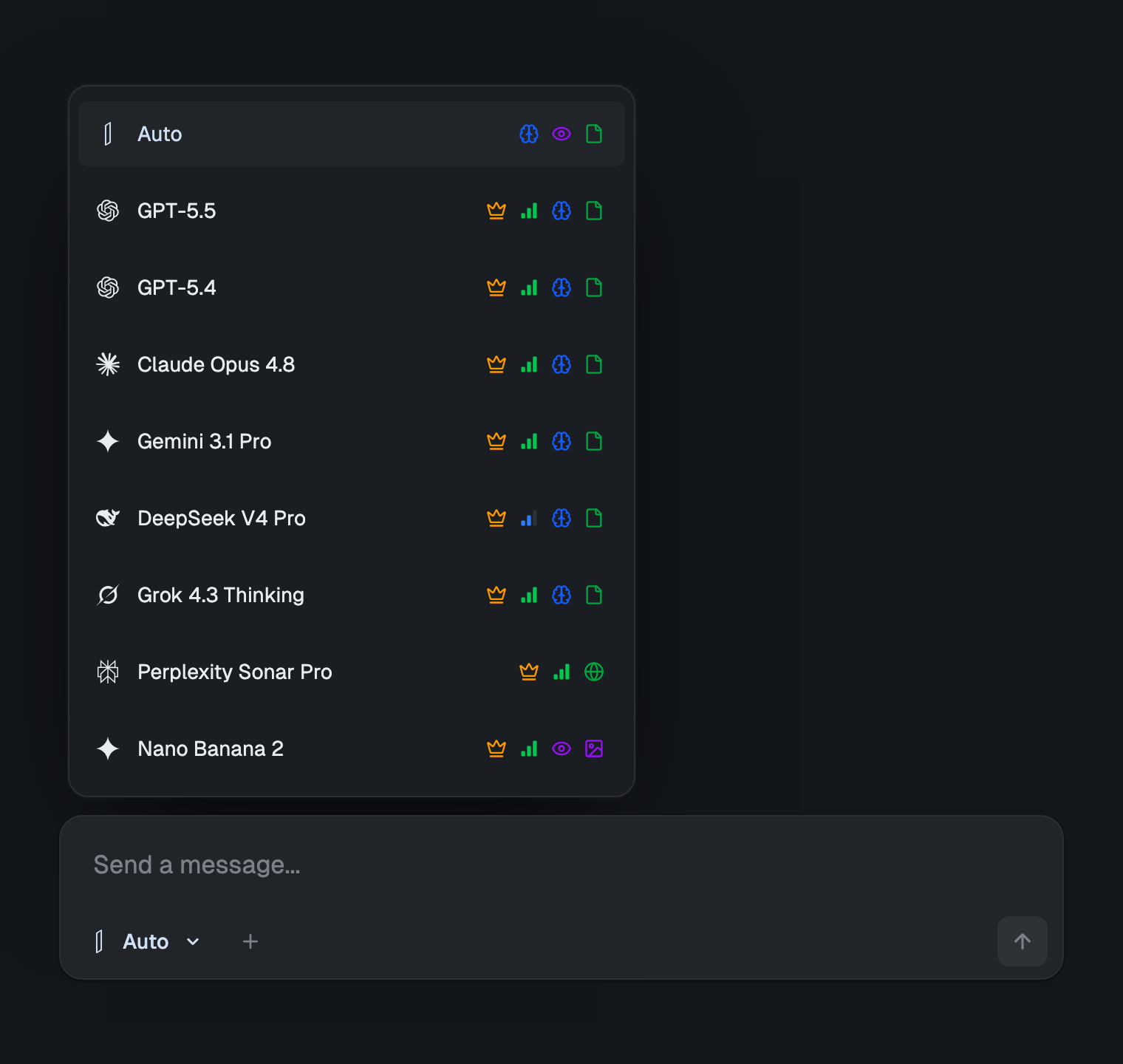
Every model shares one thread, so you can hand off between them mid-conversation and the context comes along for the ride. That maps cleanly onto the workflow this whole comparison points to: drop a long document or a current-info question into Gemini, then switch to ChatGPT in the same thread to draft the write-up — and it already sees everything Gemini surfaced. No copy-pasting between tabs, no second login.
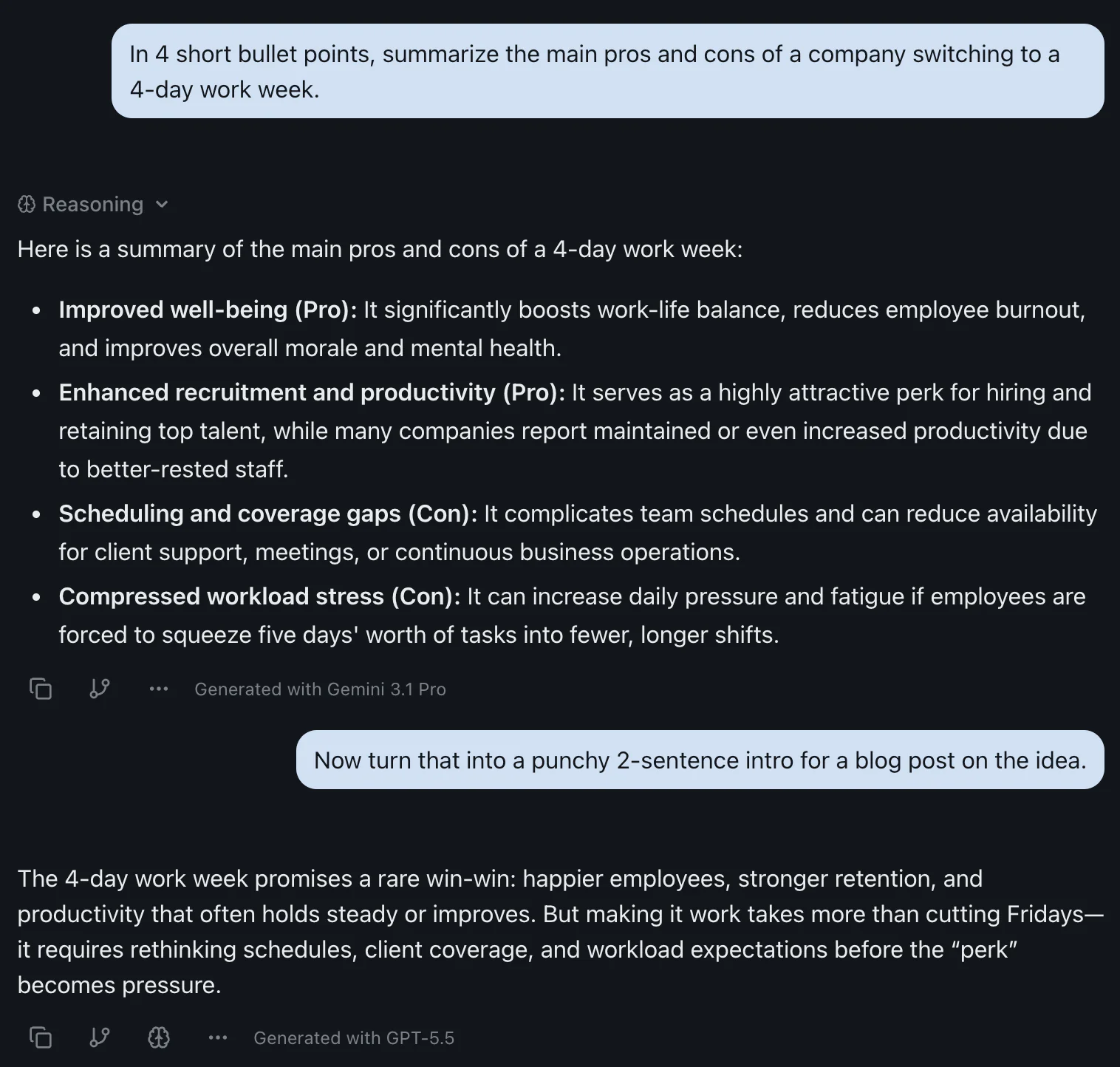
The real upgrade: a built-in second opinion
The best part of keeping both side by side isn't the convenience — it's the accuracy. Any single model is confidently wrong often enough that one answer shouldn't be taken at face value, especially on numbers, dates, and freshly fetched "facts." The fix is simple: ask the same question of a second model and watch whether they line up. When Gemini and ChatGPT agree, you can relax. When they clash, you've just surfaced the exact thing worth verifying before it costs you.
Spread across two separate subscriptions, that's friction you'll skip. In one workspace it's a click — fire the same question at both at once, or hand a follow-up to a second model right inside the thread. I've written up a one-minute version of that second-opinion move.
That's the setup I actually use, and it's why the "Gemini vs ChatGPT" question stopped nagging at me: I have both, plus the rest, and I point each task at whatever's best. (Curious how the same test runs against the other big rivals? I did it for Grok vs ChatGPT and Perplexity vs ChatGPT too — and for Claude, Gemini and ChatGPT judged side by side, there's the full three-way in Claude vs ChatGPT vs Gemini. Gemini's most revealing one-on-one, though, isn't against ChatGPT at all — it's Gemini against Claude, the best reader versus the best writer.)
The Bottom Line
Gemini vs ChatGPT in 2026 isn't a knockout — it's a split decision that turns on the task. Gemini wins scale: long documents, current Google-grounded search, and multimodal work. ChatGPT wins craft: writing, everyday range, and dependable polish. If someone forced me to keep one tool forever, I'd take ChatGPT for the sheer breadth — but I'd feel the loss of Gemini's context and freshness every time a job got big.
The reassuring part is that nothing actually forces the choice. Put both in one place, switch between them as the task changes, and let their disagreements catch the slips — and the question quietly answers itself. Match the model to the job, keep your context in one thread, and stop paying two bills for two tools you want anyway. (For the full field — this pair plus Claude, Grok and Perplexity — see how all five stack up in the capstone comparison.)
Want Gemini and ChatGPT in the same thread — with Claude, Grok, Perplexity and the rest a click away? Get started with izzedo chat free — no credit card to begin.
Frequently asked questions
Is Gemini better than ChatGPT?
Neither is better overall — they're tuned for different jobs. Gemini wins on scale: it digests huge documents in one pass, stays current through its Google Search grounding, and handles images and other media natively. ChatGPT wins on craft: more polished writing, smoother everyday range, and a dependable feel across almost any task. The best setup uses Gemini for big-context and current-info work, and ChatGPT for drafting and day-to-day thinking.
Is Gemini free?
Yes. Gemini has a capable free tier with a Google account. The paid plans, read on Google's subscription page on 22 September 2026, are Google AI Plus at $4.99/month, Google AI Pro at $19.99/month (four times the free usage and the 1 million token context window) and Google AI Ultra at $99.99 or $199.99/month for 5x or 20x AI Pro's usage. ChatGPT works the same way, with a free tier and ChatGPT Plus at $20/month. If you want both without paying twice, a multi-model workspace like izzedo chat runs Gemini, ChatGPT and other top models for $6/month, with a free plan to test first.
Is Google AI Pro worth it?
If your work leans on long documents, Google's ecosystem, or constantly current information, Google AI Pro (the plan that used to be called Gemini Advanced) earns its $19.99/month. But most people also want ChatGPT's writing and range, which means a second ~$20 subscription. A multi-model workspace gives you Gemini plus ChatGPT, Claude, Grok and Perplexity for $6/month — cheaper than a single one of them on its own.
Which is better, ChatGPT or Gemini?
For writing, everyday questions and open-ended judgment, ChatGPT. For long documents, current information and anything that mixes text with images, Gemini. Neither wins the other's column, which is why the useful answer is to run both and let the task decide. On price the two are level: Google AI Pro and ChatGPT Plus each cost about $20 a month, and both vendors sell the same $100 and $200 upgrade rungs above that, with OpenAI adding a $500 one on 29 September.
Which is better for students, Gemini or ChatGPT?
It depends on the task. Gemini is excellent for working through long readings, PDFs and dense source material, and for pulling current, linkable information. ChatGPT is the smoother pick for drafting essays, explaining concepts and everyday study help. Most students get the most from having both — gather and digest with Gemini, draft and refine with ChatGPT.
Can I use Gemini and ChatGPT at the same time?
Yes. In a multi-model workspace you can run both in a single thread — drop a long document into Gemini, then switch to ChatGPT to write it up, with all the context carried over. You can also put the same question to both and let any disagreement flag what's worth double-checking. izzedo chat does this natively, starting free with no card.
Ready to try multi-model AI workflows?
Access GPT, Claude, Gemini, Perplexity, and more — all in one place.
Start for Free →