ChatGPT Go vs Plus vs Pro (2026): Which Plan Is Worth It — or Should You Skip All Three?
ChatGPT now has five paid price points, from $6 to $500 a month. Here's who each tier is actually for, when the free version is enough — and what the same $6 buys outside OpenAI's ladder.
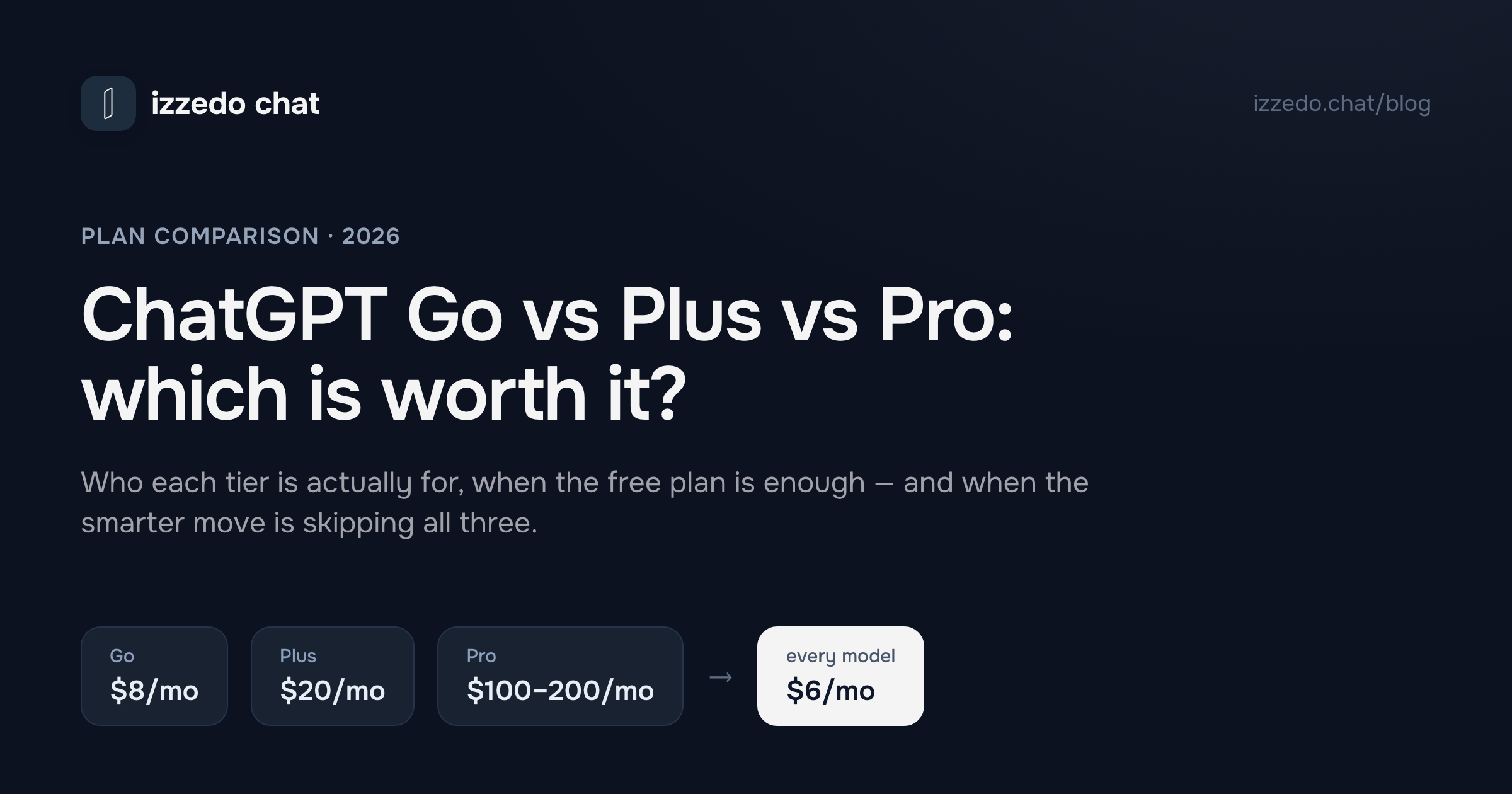
Paying for ChatGPT used to be a simple yes-or-no: twenty dollars, or free. In 2026 it's a ladder. There's Free, Go at $6/month, Plus at $20/month, and Pro at $100, $200 or $500/month depending on how hard you push it — plus Business plans beyond that. Each rung is priced to make the next one look reasonable, which is great for OpenAI and genuinely confusing for you.
This post is the honest map: what each tier actually includes, who each one is really for, and where the money stops making sense. And at the end, the option OpenAI's pricing page won't show you — every major AI model, not just one, for the same price as its cheapest paid rung.
The Quick Answer: Which ChatGPT Plan for Whom
| Plan | Price (US) | What you get | Who it's for |
|---|---|---|---|
| Free | $0 | Basic access, tight limits, ads | Occasional questions |
| Go | $6/mo | More messages, uploads, images and memory than free — lighter model, may include ads | Casual daily chatting on a budget |
| Plus | $20/mo | Flagship model, no ads, the full feature set | Most people who pay OpenAI |
| Pro | $100/mo | Plus with ~5× the usage + the extended reasoning tier | Heavy users who keep hitting Plus caps |
| Pro | $200/mo | ~20× Plus usage for existing subscribers; new ones get a smaller allowance | A small set of professional power users |
| Pro | $500/mo | 25× Plus usage, plus Ultrafast in Work and Codex | People paying for speed on long agent runs |
| The fourth option | $6/mo | ChatGPT and Claude, Gemini, Grok, Perplexity, DeepSeek in one workspace | Anyone who'd rather have every model than more of one |
If you want the one-sentence version: casual → Free or Go, real work inside one vendor → Plus, industrial-scale use → Pro, and if you want breadth instead of depth → skip the ladder entirely (that's the last section).
Prices are US monthly figures at the time of writing. OpenAI bills in USD, with local-currency billing in a limited set of countries, and it revises all of this often enough that the official pricing page is worth a glance before you commit.
ChatGPT Go: What $6 Actually Buys
Go is the newest and cheapest rung, first launched in India and now sold in every country ChatGPT supports. It exists to convert free users who bump into limits but flinch at $20.
For the money you get more of the things the free tier rations: more messages with tools, more file uploads, more image generation, longer memory, and roughly double the free tier's context window. For light use it feels like the limits disappeared. What you don't get matters more:
- The flagship model stays upstream. Go runs the fast, lighter model family; OpenAI's own Go documentation says the top reasoning model isn't included. Good for everyday questions, noticeably shallower on hard reasoning, long documents, and careful writing.
- The ads stay. OpenAI's pricing page attaches a "this plan may include ads" note to Go, and doesn't attach it to Plus. Paying $6 doesn't buy them off. OpenAI isn't alone here either: Meta now reads AI chats for ad targeting too, which makes "just use the free one" a thinner argument than it was.
- Deep research doesn't improve. This is the one that surprises people. Go sits at exactly the same "limited" level as the free tier for deep research; the step up to "expanded" happens at Plus. You're paying for volume, not for the research tool getting better.
Verdict: Go is a fair deal for one specific person — the casual user who chats daily, hits free limits, and doesn't want AI for work. If that's you, it's the cheapest way to stay inside ChatGPT. If your use case involves the word "deadline", keep reading.
ChatGPT Plus: The Default Paid Tier
Plus is what most people mean by "paying for ChatGPT," and it's the first tier that feels like the whole product: the flagship model with generous everyday limits, no ads, faster responses, image generation, file and data analysis, voice, projects, and expanded deep research.
At $20/month, Plus is honestly priced for what it is. If you work inside one AI vendor every day — drafting, summarizing, analyzing, planning — it earns its keep quickly, and it's where OpenAI wants its serious individual users to sit. (The worth-it question is big enough that I've given it a full post of its own.)
The catch isn't the price. It's the shape of the purchase: $20 buys you depth in exactly one ecosystem. No model is best at everything — the strongest writer, the strongest researcher, and the strongest reasoner are rarely the same model, which is exactly what head-to-head tests like Claude vs ChatGPT and Gemini vs ChatGPT keep showing. Plus makes you better equipped inside OpenAI's walls and does nothing about what's outside them. (The cross-vendor version of this $20 decision — ChatGPT Plus vs Claude Pro — is its own comparison.)
ChatGPT Pro: $100, $200 or $500 — Who Actually Needs It
Pro used to be a single $200 tier. In spring 2026, OpenAI slotted a $100 version underneath it, mostly to catch people who kept hitting Plus's ceilings (especially on heavy agent workloads) but couldn't justify $200. On 29 September it added a third rung above both, Pro 500 at $500 a month.
This ladder is not unique to OpenAI, and the coincidence is worth knowing about before you assume $100 is a considered price. Anthropic sells the identical shape: a $20 plan, a $100 tier at 5× its usage, a $200 tier at 20×. Same two multipliers, same three numbers, at least up to $200, since Anthropic has nothing to match the new $500 rung. I pulled that comparison apart in Claude Pro vs Max, and the finding travels across both vendors.
The two rungs share the important part — access to OpenAI's most capable configuration, including the extended reasoning tier that thinks longer on genuinely hard problems. What you're choosing between is headroom: roughly 5× Plus usage at $100, roughly 20× at $200, and 25× at $500, with the higher tiers keeping the highest research allowances and the biggest working context.
Here's the honest qualifier: Pro doesn't make everyday answers better. Plus already gives you the flagship model — Pro raises ceilings. So the test is simple: do Plus's limits actually interrupt your work, regularly, in ways that cost you money or hours? If yes, start at $100 and see whether the interruptions stop. If you're merely curious whether $200 AI feels smarter — it won't, and you'll have spent a used-laptop's worth finding out.
Update, 29 September 2026. The $200 tier is open to new subscribers again. OpenAI had paused sign-ups on 10 September, and new subscriptions now come with a smaller usage allowance than Pro 200 had before. Existing subscribers keep the old allowance through 29 October. The same day OpenAI added Pro 500 at $500 a month, with the highest usage of the three Pro tiers and the only personal access to Ultrafast, a faster version of its newest model inside ChatGPT Work and Codex. OpenAI's launch post puts Pro 500 at 25 times Plus's allowance, and Ultrafast at up to 8× faster generation in Codex. It hasn't published the new Pro 200 figure. I went through what the $500 actually buys separately. For a team, a Premium seat inside ChatGPT Business is still the other route past Plus, and it changes who controls your chat history.
ChatGPT Go vs Plus: The Differences That Matter in 2026
This is the comparison most people are actually running, so here it is in one table, built from what OpenAI's pricing page lists today:
| Go — $6/mo | Plus — $20/mo | |
|---|---|---|
| Model | The lighter, faster family; top reasoning model not included | The flagship, including its advanced reasoning |
| Ads | "May include ads" | No such note |
| Response times | Limited by bandwidth and availability | Fast |
| Context window | 54K instant, 256K reasoning | 54K instant, 256K reasoning — identical |
| Deep research | Limited, same as free | Expanded |
| Memory | Included | Expanded |
| Office file extensions | Limited | Full |
| Apps connecting to internal tools | No | Yes |
| Best for | Casual daily chatting on a budget | Work that depends on the output |
Look at the context window row, because it's the one nobody expects: Go and Plus give you exactly the same room. The $14 doesn't buy a longer conversation or a bigger document. It buys a better model answering, deeper research, faster replies, and no ads.
One row in that table matters more to a business than the model row does, and it rarely gets mentioned. OpenAI's pricing page now lists Apps connecting to internal tools as No on Free and Go, and Yes on Plus and Pro. The plugin directory itself is open on every plan, so Go can use published integrations like Gmail or Slack; what it cannot do is wire ChatGPT into a system nobody has published a plugin for. I've mapped which plan gets what across all six major assistants in the connectors guide.
There is one thing $6 unlocks over the free plan that nothing else on this page does, and it is easy to miss because it sits under a feature name rather than a plan name. OpenAI's pricing comparison lists Scheduled tasks as No on Free and Yes from Go up. Free accounts can run agentic work in the desktop app and watch it happen; they cannot leave it running on a timer. If the reason you are considering Go is to have something check a source every morning, that is the row that justifies it, and it is the same boundary every vendor now draws around agent mode.
So the split is clean. If AI is entertainment and quick questions, Go is enough. The moment AI touches your income, your grades, or your output, the $14 upgrade pays for itself — if you've already decided to live inside one vendor. Whether you should is a different question (see below).
Worth flagging for anyone running the comparison in the other direction, as ChatGPT Plus vs Go: the upgrade is not a bigger bucket of the same thing. It's a different model doing the answering, plus features that get materially better rather than merely more plentiful.
ChatGPT Plus vs Pro: The Real Difference
This is the comparison people search most, so let me be precise: Plus and Pro mostly run the same models. Pro's premium buys you three things — much higher usage ceilings, the extended slow-thinking tier for the hardest problems, and (on the higher rungs) the maximum research and context allowances OpenAI offers.
That means the Plus-vs-Pro decision isn't about intelligence, it's about volume. A Plus user who occasionally waits out a cap loses a few minutes; a professional who hits caps mid-delivery loses billable time. The second person should be on Pro — realistically the $100 rung first. Everyone else asking "is Pro worth it?" already has their answer: if you have to ask, you don't have the usage pattern that justifies it.
ChatGPT Go vs Pro: The Two Ends of the Ladder
A surprising number of people compare the bottom rung straight against the top, so here's the honest answer: Go and Pro aren't neighboring options — they're different products for different lives. Go at $6 is the lighter model with ads and free-tier-level deep research: a better free tier, essentially. Pro at $100–$200 is the flagship at maximum everything — the highest usage ceilings, the extended slow-thinking tier, the biggest research and context allowances OpenAI sells. Nobody upgrades from Go to Pro. The price gap runs from 17× to 33× depending on which Pro rung you mean, and it exists because the rungs answer different questions: Go asks "is casual AI worth $6?", Pro asks "does waiting on a cap ever cost me billable work?"
If you're genuinely torn between them, that's usually a sign neither is right — you want flagship-quality output (which rules out Go) at a sane price (which rules out Pro). Inside OpenAI's ladder that lands on Plus at $20. Outside the ladder, it's exactly the gap a multi-model workspace fills for the price of Go.
ChatGPT Usage Limits by Plan: What Each Tier Actually Caps
Most of this ladder is sold on limits, and yet the word "limits" does a lot of hiding. Here's what OpenAI's pricing page documents, tier by tier, at the time of writing.
| Free | Go ($6) | Plus ($20) | Pro (from $100) | |
|---|---|---|---|---|
| Everyday text chat | Unlimited* | Unlimited* | Unlimited* | Unlimited* |
| Instant context window | 27K | 54K | 54K | 128K |
| Instant input maximum | ~12 pages of text | ~40 pages | ~40 pages | ~250 pages |
| Reasoning context window | Varies | 256K | 256K | 400K |
| Reasoning input maximum | Varies | ~320 pages | ~320 pages | ~680 pages |
| Response times | Limited by bandwidth | Limited by bandwidth | Fast | Fast |
| Deep research | Limited | Limited | Expanded | Expanded |
| Uploads, data analysis, vision | Limited | Included | Included | Included |
| Memory | Limited | Included | Expanded | Expanded |
*OpenAI's footnote: usage must be reasonable and comply with its policies.
Three things fall out of that table, and they're the reason "how many messages do I get?" is the wrong question.
The chat counter is not where the ladder charges you. OpenAI lists everyday text chat as unlimited on every tier, free included, subject to abuse guardrails. What separates $6 from $20 isn't how many times you can press enter. It's which model answers, how fast it answers, whether ads sit next to the answer, and how deep the research tool goes. So when people run ChatGPT Plus vs Go on message counts, they compare the one axis where the two tiers don't differ at all.
Go buys you room; Plus buys you quality. The context window doubles from Free to Go and then stops. Go and Plus are identical at 54K instant and 256K reasoning, and the next jump waits for Pro. If your problem is that documents don't fit, Go solves it for $6 and Plus adds nothing. If your problem is that the answers aren't good enough, only Plus helps.
OpenAI has stopped publishing the numbers that used to matter. Its Plus help article now says only that subscriptions "may include usage limits such as message caps, especially during high demand," and that these "may vary based on system conditions." There's no per-three-hours figure to plan around any more. That's worth knowing before you pick a tier on the strength of a message count you read somewhere — including an older version of this page. What replaced the message cap is a set of quieter ceilings on uploads, images and research, and I've documented what ChatGPT actually limits now alongside the error messages people mistake for limits. Anthropic gets criticised for putting Claude Pro on a similar clock, though it does at least show you a countdown.
One caveat, the same one that applies to the prices above: OpenAI revises these numbers often and quietly. Check the official pricing page before you make a purchase decision on any single figure here.
When Free Is Enough
Don't let the ladder pressure you off the ground floor. The free tier — tight limits, lighter model, ads and all — still handles occasional questions, quick explanations, and short drafts perfectly well. Usage for most people is bursty: nothing for days, then a flurry. Caps mostly bite during the flurries, and an afternoon's patience is cheaper than a subscription. (I've written a whole piece on this pattern for the tightest budget of all: Is ChatGPT Plus worth it for students?)
There's also a quiet trick the pricing ladder hopes you won't notice: ChatGPT's free tier is not the only free tier. Claude, Gemini, Perplexity and others all have one, and together they cover far more ground than any single vendor's $6 plan.
The Fourth Option: Every Model for the Price of Go
Now the premise-check. OpenAI's ladder answers the question "how much of ChatGPT do you need?" — but the better question in 2026 is "how many models do you need?", because different models win different tasks, and the way to catch AI's mistakes is a second model's opinion, not more of the same model.
That's what izzedo chat is: one workspace with ChatGPT, Claude, Gemini, Grok, Perplexity, DeepSeek, Qwen, Llama and more — plus image models — behind one login, for $6/month. That's the same $6 OpenAI charges for Go, which makes the comparison unusually clean: for identical money, you can have one company's lighter model, or all of them. No ads either way, and you can switch models mid-conversation without losing your thread.
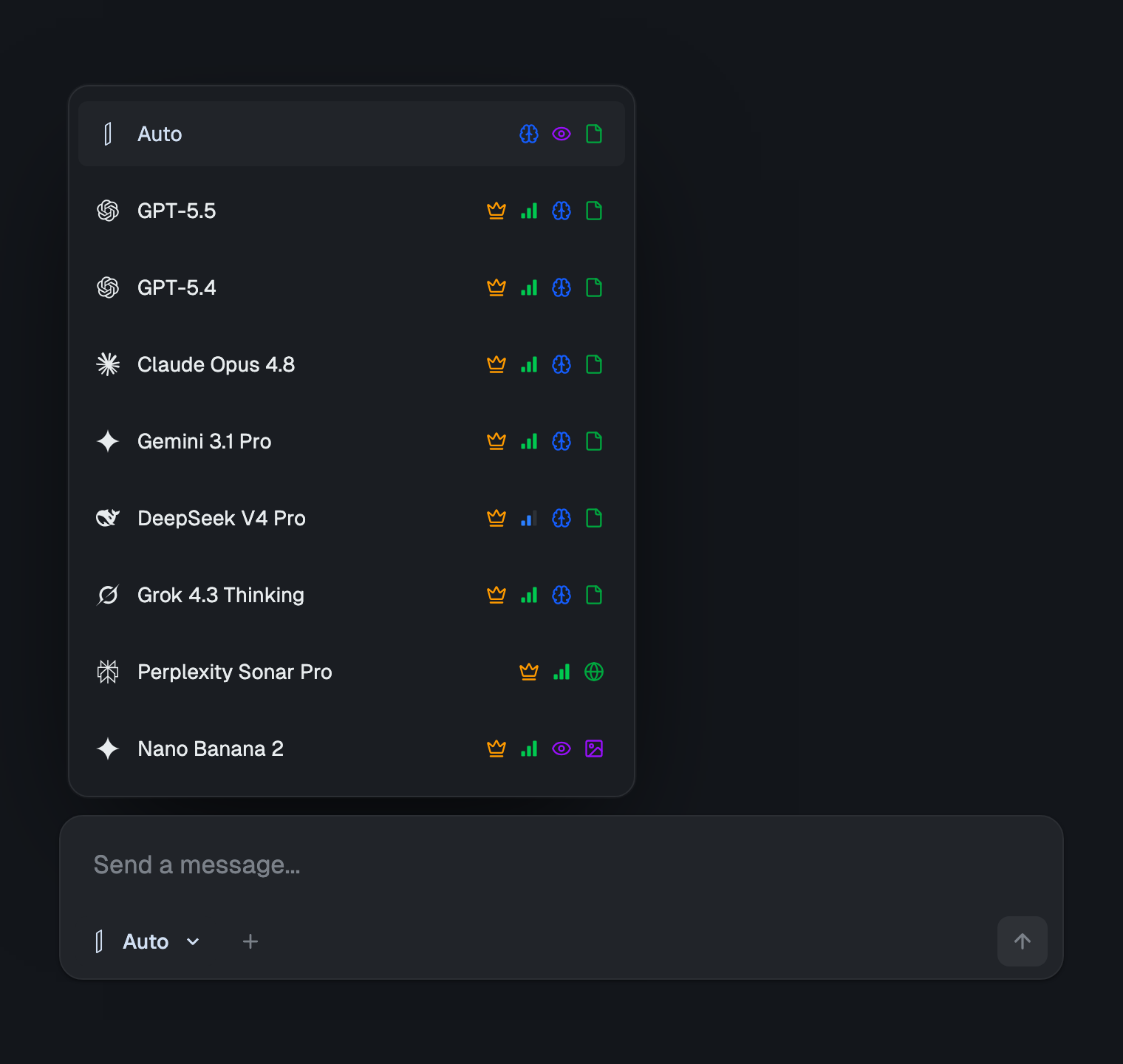
Do the ladder math from the other direction. Buying the majors separately — ChatGPT $20, Claude $20, Gemini $20, Perplexity $20, Grok $30, with DeepSeek free — runs about $110/month. One izzedo plan is $6 for all of them, and there's a free plan with no credit card to test it — the free models, with a usage allowance whose current numbers live on the pricing page.
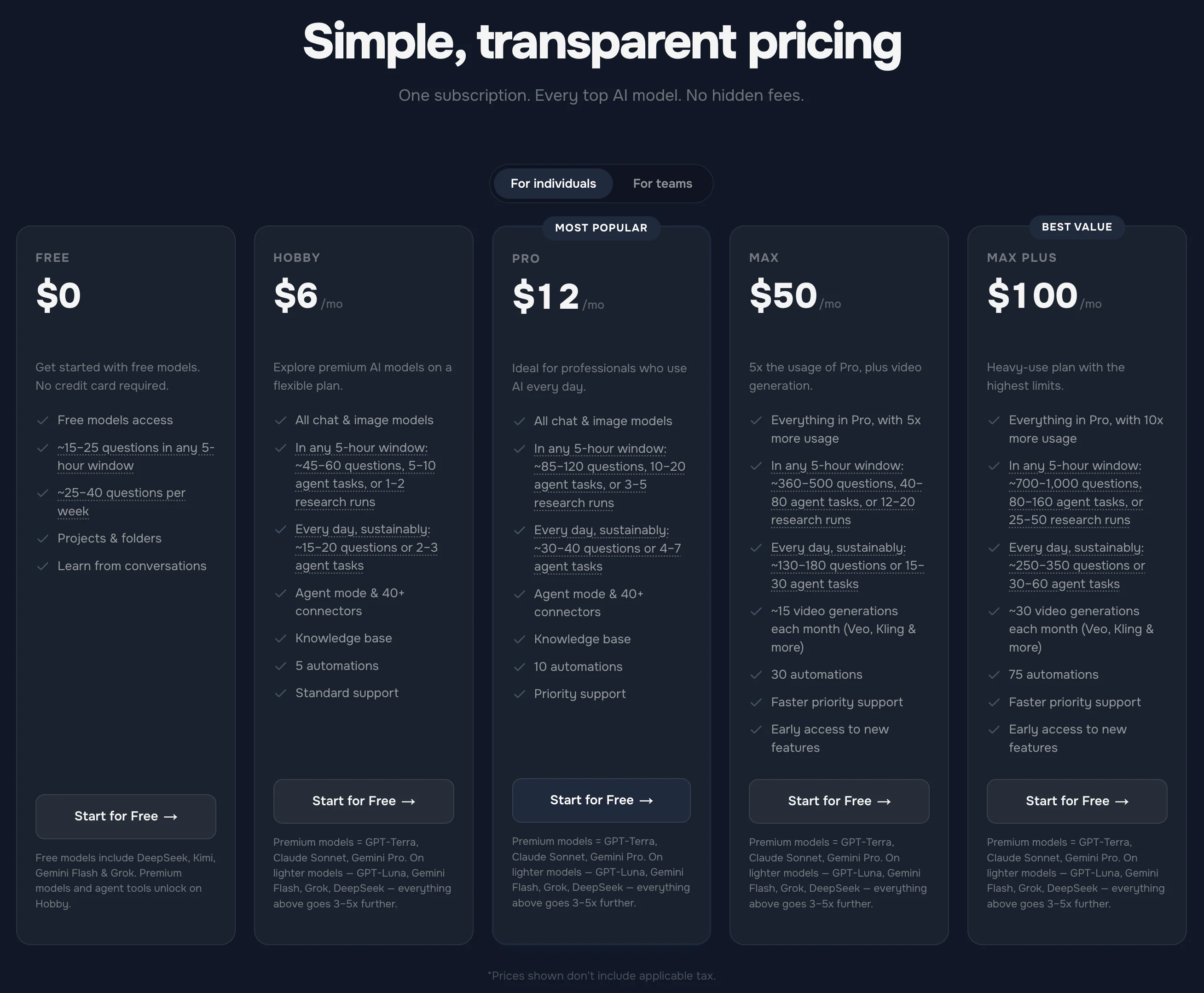
On billing, one honest note, since you're reading a pricing post: every AI service limits usage somewhere, because top models genuinely cost more to run. izzedo's version is a flat monthly bill with fair use handled in the background — no points to budget, nothing to prepay, and an optional usage-based setting that is off by default. Fair use runs on a short rolling window with a weekly pool behind it, so pushing the most expensive models nonstop means waiting for the window, and doing it all week means waiting on the week. Your bill still never moves, and the current allowances are published on the pricing page. (That points-ledger model is the usual complaint about multi-model bundlers — the best Poe alternatives walks through it.)
And it's a workspace, not just a switcher: projects with their own system prompts, a knowledge base for your documents, scheduled automations, 50+ integrations (Notion, Google Drive, Gmail and more), and side-by-side answers from several models when you want a comparison rather than a leap of faith. If that workflow is new to you, here's how running multiple models in one place actually works. It's GDPR compliant, doesn't train on your inputs, and retains nothing you don't choose to keep.
The Bottom Line
The ladder, honestly ranked:
- Free — right for occasional use; let the caps annoy you before you pay anything.
- Go ($6) — right for exactly one person: the casual daily chatter who can live with ads and the lighter model.
- Plus ($20) — the correct choice if you've deliberately decided one vendor is enough. Fair price, real product.
- Pro ($100, $200 or $500) — for people whose workday measurably stalls at Plus's ceilings. Start at $100. If you have to ask, skip it.
- The fourth option ($6) — if what you actually want is the best answer per task, breadth beats depth: one model is a single point of failure, and every model together costs exactly what OpenAI's cheapest paid rung does.
The tiers aren't a trap — they're just answers to a narrower question than the one most of us are really asking.
And if this rung is already sitting next to a Claude or Perplexity charge on your statement, the ladder isn't your problem — the pile is. Here's how to audit and cut a stack of AI subscriptions without losing access to anything.
Rather have ChatGPT, Claude, Gemini, Grok and Perplexity in one thread than pick a rung? Try izzedo chat free — no credit card required.
Frequently asked questions
What is the difference between ChatGPT Plus and Pro?
Model access is broadly the same — the difference is headroom. Plus ($20/month) gives you the flagship model with generous everyday limits and no ads. Pro raises those ceilings dramatically and unlocks the extended, slow-thinking tier for the hardest problems, at three price points: $100/month, $200/month and, since 29 September 2026, $500/month. OpenAI's usage tables describe the first two as roughly 5× and 20× Plus, though new $200 subscribers now get a smaller allowance than before, and its launch post puts the $500 tier at 25× Plus. If you never hit Plus's limits, Pro buys you nothing.
Is ChatGPT Go worth it?
At $6/month, Go is worth it for casual daily chatting. You get more messages with tools, more uploads, more image generation and longer memory than the free tier. But it runs the lighter model rather than the flagship, deep research stays limited, and OpenAI's pricing page notes the plan may include ads. If you use AI for actual work, Plus or a multi-model workspace is the better spend.
ChatGPT Plus vs Go: is the extra $14 worth it?
It depends on whether AI touches your work. Go at $6 runs OpenAI's lighter model, keeps deep research at the same limited level as the free tier, and may show ads. Plus at $20 adds the advanced reasoning model, expanded deep research, faster responses and no ads. What it does not add is room: OpenAI's pricing page lists the same context window for both tiers. So the upgrade buys a better answer, not a longer one. Casual chatting doesn't feel that gap; anything with a deadline attached does.
Is ChatGPT Pro worth $200 a month?
Only if AI is hours of your workday and Plus's caps genuinely interrupt you — Pro's value is headroom, not smarter answers on everyday questions. Since spring 2026 there's also a $100 Pro tier with the same model access at lower limits, so try that rung (or stay on Plus) before committing to $200. The $500 tier added on 29 September 2026 mainly buys speed on long agent runs, which almost nobody needs.
Does ChatGPT Go show ads?
OpenAI's pricing page states that the Go plan may include ads, and Plus is the first tier without that note attached. Ads are labeled as sponsored and OpenAI says they don't influence answers, but you should assume they're part of the Go experience.
Can I switch between ChatGPT plans?
Yes. The consumer plans bill monthly and you can upgrade, downgrade, or cancel from your account settings at any time — the change applies from the next billing cycle. Note that OpenAI doesn't refund a switch down: your current plan runs to the end of the cycle before the cheaper rate starts. A sensible path is to start low and only move up when you actually hit a limit that costs you time.
What's the cheapest way to get ChatGPT and other AI models together?
A multi-model workspace. izzedo chat includes ChatGPT, Claude, Gemini, Grok, Perplexity, DeepSeek and more in one app for $6/month — the same price as ChatGPT Go — with a free plan that needs no credit card. For identical money, you get every major vendor instead of one vendor's lighter model.
Ready to try multi-model AI workflows?
Access GPT, Claude, Gemini, Perplexity, and more — all in one place.
Start for Free →