Grok Limits in 2026: One Weekly Pool, a Percentage Bar, and No Published Numbers
Grok shows you a percentage. It never tells you what the percentage is of. Here is every limit xAI and X actually publish, the one that downgrades your video without saying so, and what to do when the bar hits 100%.
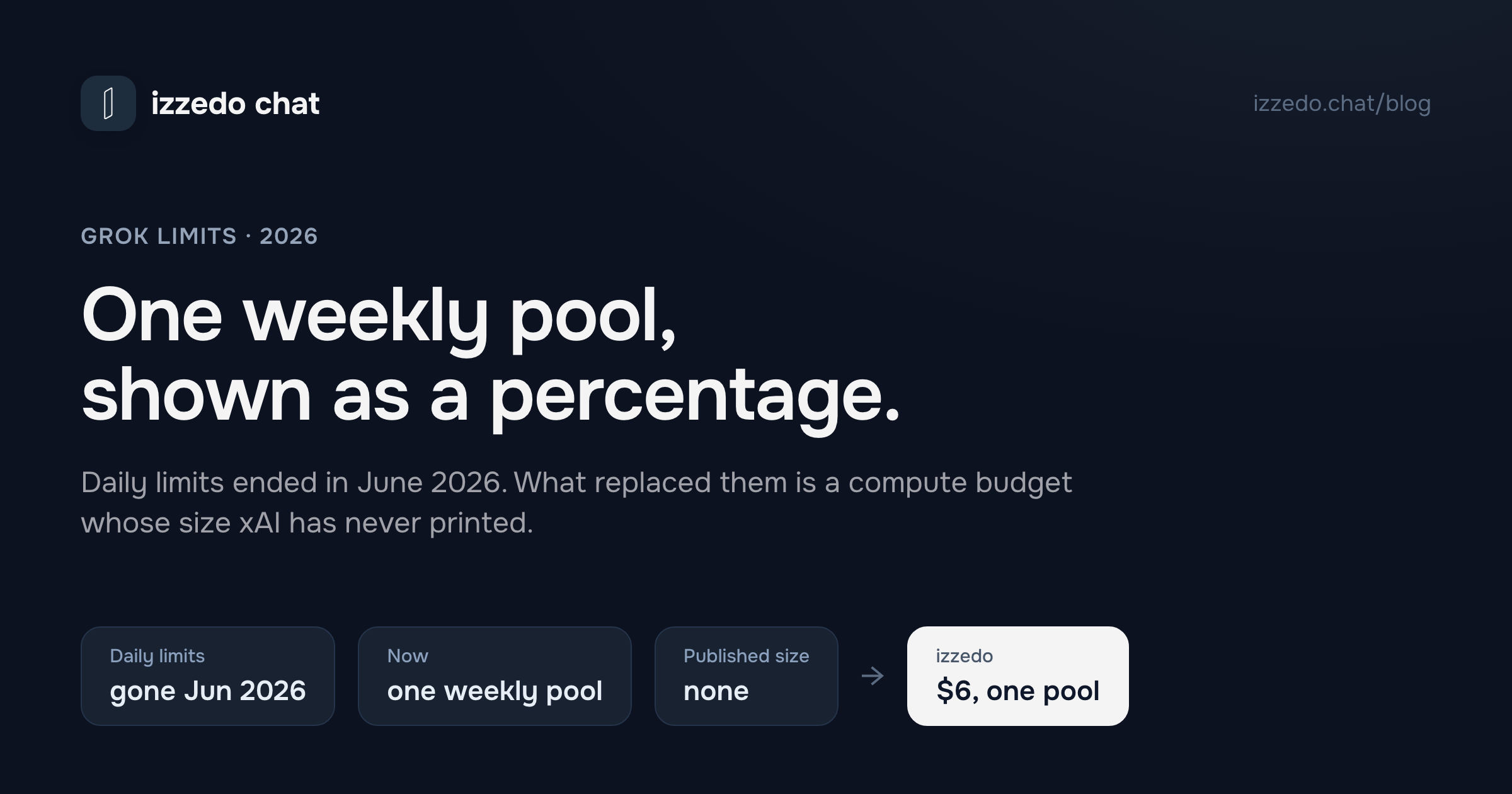
Grok tells you how much you have left as a percentage. There is a bar in Settings under Usage, it fills up as you work, and beneath it sits a breakdown of which product spent what.
Ask what the percentage is a percentage of and nobody answers. Not the pricing page, not the help centre, not X. I went looking on 7 September 2026 across all three, and on the consumer plans not one published figure tells you how much Grok you get. The comparison table on x.ai/pricing runs seven plans down twenty-six rows, and every cell in it is a tick, a dash, or a word. The Free column's description of how much search you get is the word "Limited". The Free plan itself is sold "within generous limits".
I want to be fair about why. Since June 2026 Grok has metered compute rather than actions, and a compute budget genuinely does not convert into a message count, because a chat reply and a ten-second video are not the same purchase. Anthropic and OpenAI arrived at versions of the same answer. But Grok took it furthest, and the result is a subscription whose size you learn by spending it.
So this is not a table of Grok message limits, because that table does not exist. It is everything xAI and X do publish, in one place: what replaced the daily limits, when the pool resets, what happens when it empties, the one Imagine limit that quietly degrades your work instead of stopping it, and the only corner of Grok where the numbers are printed in full.
Grok Limits in 2026: The Short Answer
| Plan | Price | What actually limits you | Published number |
|---|---|---|---|
| Free | $0 | Free-tier limits on Chat and Voice, on their own reset clock | None. Search is marked "Limited" |
| SuperGrok Lite | Not priced on the page | Weekly usage pool | None |
| SuperGrok | $30/mo | Weekly usage pool | None |
| SuperGrok Plus | $100/mo | "Significantly higher usage" across the same pool | None |
| SuperGrok Heavy | Not priced on the page | Weekly usage pool | None |
| Business | $30/mo | Weekly usage pool, plus admin controls | None |
| Grok on X, Premium | $8/mo or $84/yr | "Increased usage limits on Grok" inside X | None |
| Grok on X, Premium+ | $40/mo or $395/yr | Includes SuperGrok outright | None |
| API | Per token | Requests per second and tokens per minute | Yes, a full table |
Three things in that table need saying out loud.
Two of the seven plans have no price. SuperGrok Lite and SuperGrok Heavy each get a column in the comparison table and a button, and neither has a figure attached anywhere on the page. Heavy is real enough to generate billing complaints: xAI's own FAQ has an entry for people who receive an invoice they do not recognise, and the answer is that large unexpected charges are "often a SuperGrok Heavy yearly subscription, not API usage."
The paid tiers differ by adjective. SuperGrok promises "higher rate limits", Plus promises "significantly higher usage" and "priority access at peak times". If you are trying to work out whether $30 or $100 covers your week, the page gives you comparatives with nothing to compare against.
The API column is the odd one out. Developers get exact per-model numbers, five spend tiers and a documented error code. Consumers get a bar. Same company, same models, opposite disclosure.
The Grok Daily Limit Is Gone
If you are searching for a Grok daily limit, you are searching for a system that was retired. xAI's FAQ dates the change to June 2026 and explains the reasoning plainly: before, "each Grok product had its own daily limits", which "often meant running out of usage in one product (for example, Imagine) while still having usage left in another (for example, Chat)."
What replaced it is one weekly usage pool, spent however you like across Chat, Imagine, Voice, Build and the API. No per-product caps, no daily reset, no separate video budget.
For most people this is better, and I would rather have it than the old arrangement. The catch is in how it is measured. From the FAQ: "Different products cost different amounts depending on how much compute that product requires. A chat message uses little compute; generating a high-quality video or running a long coding task uses far more."
Read that as a budgeting rule and it stops being a footnote. One pool means the expensive thing you did on Monday is why the cheap thing feels tight on Friday. Video is the obvious offender, and video is also the reason many people pick Grok in the first place, so the feature that sold you the plan is the feature most likely to end your week early. There is no ring-fenced allowance to protect ordinary chat from it.
The pool is shown to you as a percentage used, broken down by product, with the five categories named as API, Build, Chat, Imagine and Voice. That breakdown is the most useful thing in Settings, because it turns a vague sense that Grok has got stingy into a specific line item you can stop doing.
When Does the Grok Limit Reset?
Weekly, on a schedule attached to your account rather than a calendar day shared by everyone. xAI's wording is that the pool "resets every week on a schedule shown in the Usage tab in Settings", and that the tab shows "your weekly reset date and time".
There is no published day. No Monday, no Sunday midnight, no billing-date rule. If you want yours, Settings under Usage is the only place it exists, on web and mobile alike.
Free-tier limits work differently and reset on their own, shorter schedule. xAI says so directly while explaining what happens when a paid pool empties: free-tier limits on Chat and Voice are "separate from your weekly usage limit and reset on their own schedule". So a paid account that has run dry is not one clock but two, the weekly one you are waiting on and the faster free-tier one still ticking underneath.
What Happens When You Hit Your Grok Limit
Paid features pause. That is the whole mechanism, and xAI is careful to add that "hitting the weekly usage limit is not a hard stop", which is accurate for a reason most write-ups miss.
You do not lose Grok. You fall back to the free tier on Chat and Voice, because those limits sit outside the pool. A SuperGrok subscriber who empties the week still has a working assistant, on the free plan's terms, until the reset. That is a genuinely decent piece of design and nobody advertises it.
From there xAI lists three ways forward, and they are worth pricing out before you meet the wall rather than during.
Buy Extra Usage Credits. From $5, purchased in the Usage tab on the web, added immediately, spent only after your included weekly usage is gone, and they expire a year after purchase. The line that matters is the warning xAI prints itself: credits "are priced at standard rates, which means the cost per action is higher than the effective rate you get from the included weekly usage in your plan." Top-ups cost more per action than the plan you already pay for. That is ordinary pricing, and it is also how a $30 month becomes a $50 month without a decision being made anywhere.
Turn on Auto Top Up. You set an amount and a monthly cap, and credits are added when the balance runs low. Convenient, and the point at which your usage limit stops being a limit and becomes a spending rate.
Upgrade. xAI's own advice on choosing between the two is the honest version: "Upgrading to a higher plan provides significantly more weekly usage at a lower cost per action compared to repeatedly buying Extra Usage Credits." If you top up most weeks, you are paying the expensive rate on purpose.
One practical note for anyone who subscribed through a phone. Extra Usage Credits can currently only be bought on the web. In-app purchases on mobile are listed as a future thing, so an iOS subscriber who runs out on a Saturday needs a browser.
Now the part nobody prints. There is no published wording for the message you see when the pool empties, no documented error code, and no status-page entry for it. Grok tells you in the app, and the app is the only place it is written down.
Grok Imagine Limits: The Cap That Doesn't Announce Itself
Image and video generation have no published count. Imagine draws from the same weekly pool as everything else, at the heavy end of it, and that is the entire official answer to how many images or videos you get.
There is one hard cap xAI documents, though, and it is buried in a troubleshooting question rather than anywhere near the pricing page. Someone asks why their 720p video came out at 480p. The answer: "720p videos automatically fall back to 480p once you hit the 720p cap for your tier."
Sit with that. There is a per-tier cap on high-resolution video, xAI never says what it is, and crossing it does not produce an error, a warning, or a prompt to upgrade. It produces a worse video. You would reasonably conclude the model had a bad day. This is the single most useful thing in this article and it is a support answer about a rendering complaint.
Above that sits resolution as a paywall. The pricing page lists 1080p video creation only under SuperGrok Plus at $100, so the $30 tier's ceiling is 720p, subject to the fallback above.
Two more Imagine limits people search for and hit:
The watermark is not removable. Every generated image and video carries a Grok watermark, there is no setting to turn it off, and xAI notes that removing or obscuring it is prohibited under its acceptable use policy and that labelling AI content is legally required in some places. If you need unwatermarked output, this is a limit that no amount of money on this pricing page lifts.
Free accounts get images but not video. More on that next.
If Imagine's ceiling is what pushed you to look this up, the per-second rate card in our roundup of Sora alternatives is the useful comparison, because paying per second of video is a different shape of bill from spending a weekly pool and often a cheaper one for occasional work.
Grok Free Limits, and What "Limited" Means
The free plan is more capable than its price suggests and less specified than any other tier, which is saying something.
What the comparison table grants a free account: the flagship model, image generation, the web, iOS and Android apps, Grok Build, connectors, real-time web and X search marked "Limited", voice mode, and community support.
What it withholds: video generation, Grok Bot, and a capability row labelled "Expert" that the page lists without defining anywhere.
So "is Grok Imagine free" has a split answer. Images, yes, on a free account, with the watermark. Video, no, at any usage level, because the row is a dash rather than a smaller number.
As for how much free usage you get, xAI's marketing calls it "generous limits" and its FAQ calls it "free tier limits on Chat and Voice" with a reset schedule of their own. Neither is a number. The free tier is also the floor every paid subscriber lands on when the weekly pool runs out, which makes its size the most consequential unpublished figure in the entire product.
Grok on X Is a Different Limit System
Grok inside X and Grok at grok.com are sold by two companies with one owner, and they meter you separately.
X Premium at $8 a month, or $84 a year, lists "increased usage limits on Grok" among its benefits. Increased from what, to what, is not stated. Premium+ at $40 a month, or $395 a year, goes further and includes SuperGrok itself: X describes it as "higher limits on the latest Grok models so you can keep going", along with Grok Bot, Imagine for images and video, and voice mode. Basic at $3 lists no Grok benefit at all.
Two consequences worth knowing.
First, if you are on Premium+ you already have SuperGrok. Buying a $30 SuperGrok subscription on top is paying twice for the same product, and the reason people do it is that the two are sold on different websites with different account systems. If you subscribed to both, link your X account to your xAI account in Settings under Account, then check what you are actually paying for before the next renewal. Our full breakdown of what Grok costs has the complete ladder, including the tiers with no price.
Second, X's own help centre article about Grok does not contain the word "limit" once. It covers training data, personalisation, opting out and deleting conversation history in detail, and how much Grok you get not at all. When you are limited inside X, the page that is supposed to explain Grok on X will not tell you why.
Grok Rate Limits: The Only Numbers xAI Publishes
Two different things go by this name, and searching for one gets you the other.
On consumer plans, "higher rate limits" is a phrase on the SuperGrok card. It is comparative marketing, not a figure, and what it refers to is the weekly pool above.
On the API, rate limits are exact. Every team gets per-model caps on two dimensions, requests per second and tokens per minute, and those caps scale across five tiers set by cumulative spend since 1 January 2026: Tier 0 at $0, then $50, $250, $1,000 and $5,000, with Enterprise on request. Tiers unlock automatically, and xAI states they never downgrade once earned.
The published numbers are generous at the bottom. A brand new Tier 0 team gets 150 requests per second and 50 million tokens per minute on the flagship models, dropping to 37 requests per second on the lighter and coding models, and to single digits on the multi-agent and image endpoints. Video generation sits at 10 requests per second on Tier 0. Exceed either dimension and you get an HTTP 429, which xAI's docs pair with a worked exponential-backoff example rather than a sales pitch.
One detail catches people out: your per-second budget is derived from your per-minute one, deliberately, so you cannot spend a minute's worth of requests in a single second. Bursts fail before your quota does. And cached prompt tokens still count toward the tokens-per-minute limit even though they are billed at a reduced rate.
Rate limit tiers cover text and embedding models. Increases for Voice and Imagine are a sales conversation, not an automatic unlock.
If this is the section you came for, you are building rather than chatting, and the relevant cost model is what running an AI agent actually costs rather than any subscription tier on this page.
Grok File Upload Limits: The Hard Numbers
Here is the one place xAI publishes real figures for consumers, and they are worth knowing because file-heavy work is a fast way to spend a pool.
| Limit | Figure |
|---|---|
| Size per file | Up to 150 MB for documents, images, code and audio |
| Files per message, web | Up to about 100 |
| Files per message, Android | Up to 20 |
| Files per message, iOS | "Multiple", unspecified |
| Large PDFs | Over 100 pages, Grok focuses on text and key visuals |
Supported formats are broad: PDF, DOCX, TXT, CSV, XLSX, PPTX, HTML, XML, JSON, Markdown, LaTeX, ODT and RTF for documents, JPEG, PNG, WebP, HEIC and BMP for images, MP3, WAV, M4A, OGG, FLAC and AAC for audio, and MP4 and MOV for video. GIF and SVG are flagged as inconsistent across platforms, which is a polite way of saying try it and see.
Two caveats xAI adds itself. Very long files "may be summarized or handled in sections", so a 150 MB upload does not mean 150 MB of attention. And embedded images inside non-PDF documents may not be read visually at all, which quietly breaks the common case of a slide deck exported to Word.
To clear space, grok.com/files deletes uploaded content and generated assets.
The Honest Workaround: Move the Work Before the Bar Fills
Every vendor's advice for running out is some version of pay more, and Grok's is unusually explicit about it, with a $5 button and an automatic top-up switch. There is a cheaper move, and it is the same one every AI company quietly recommends: put the task on a lighter model.
Inside Grok that advice has nowhere to land. The pool covers everything, so choosing a cheaper Grok product only changes your burn rate, and once the bar reads 100% there is no model in the picker that is still open. You are back to free-tier chat until the reset, or you are buying credits at standard rates.
It works properly when the lighter model belongs to somebody else.
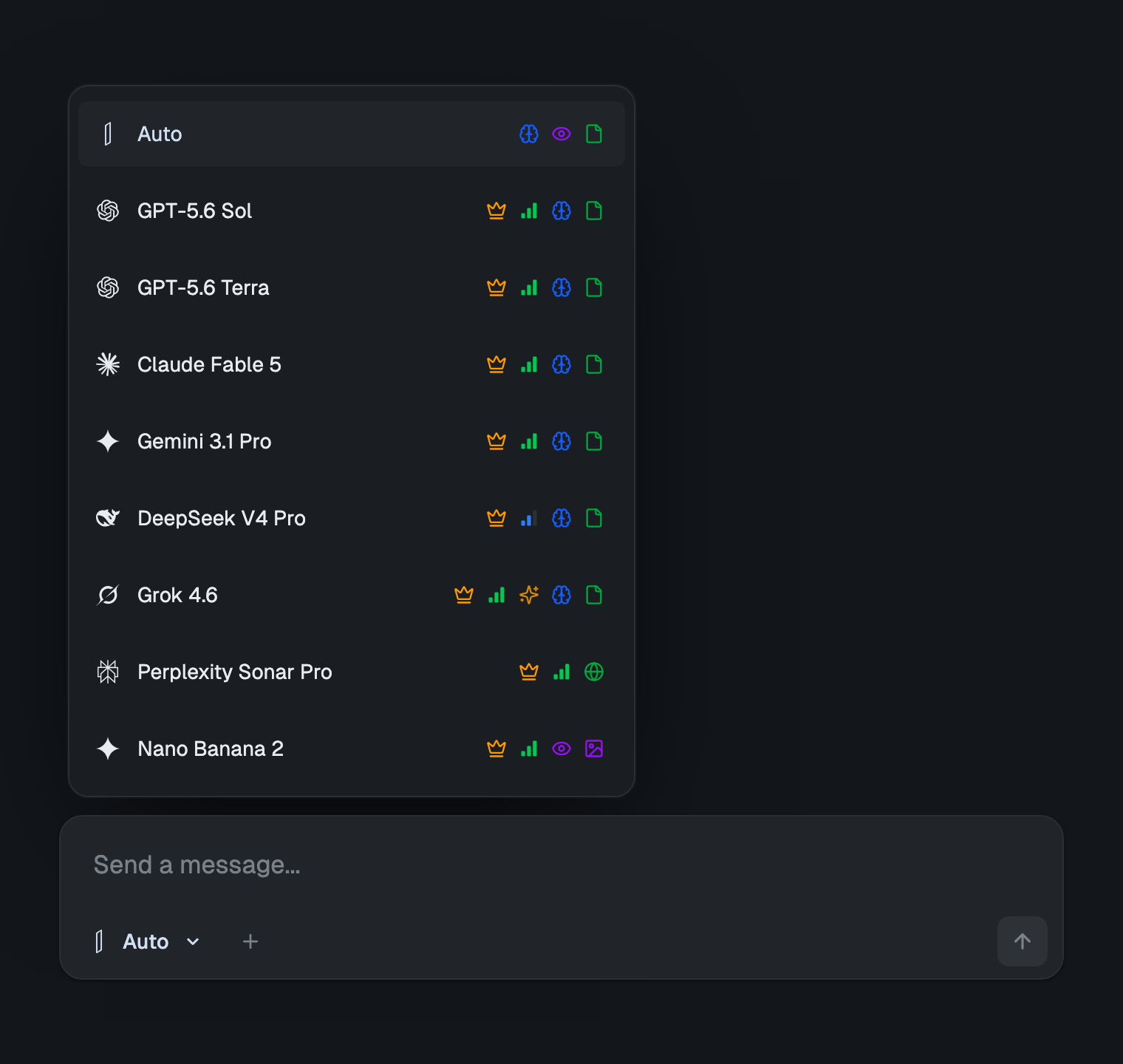
izzedo chat runs Grok next to ChatGPT, Claude, Gemini, Perplexity Sonar, DeepSeek and around twenty more models behind one login for $6/month, with a free plan that needs no card. Assembled one subscription at a time, that lineup is about $110 a month across six accounts.
The shape of the allowance is what changes. One pool, metered by what each model costs to run, with no vendor holding its own clock. Move a summarising job off a frontier model and onto a light one and the same allowance covers several times more work, because the cheap model draws less from it. Nothing sits outside the plan waiting to bill you separately.
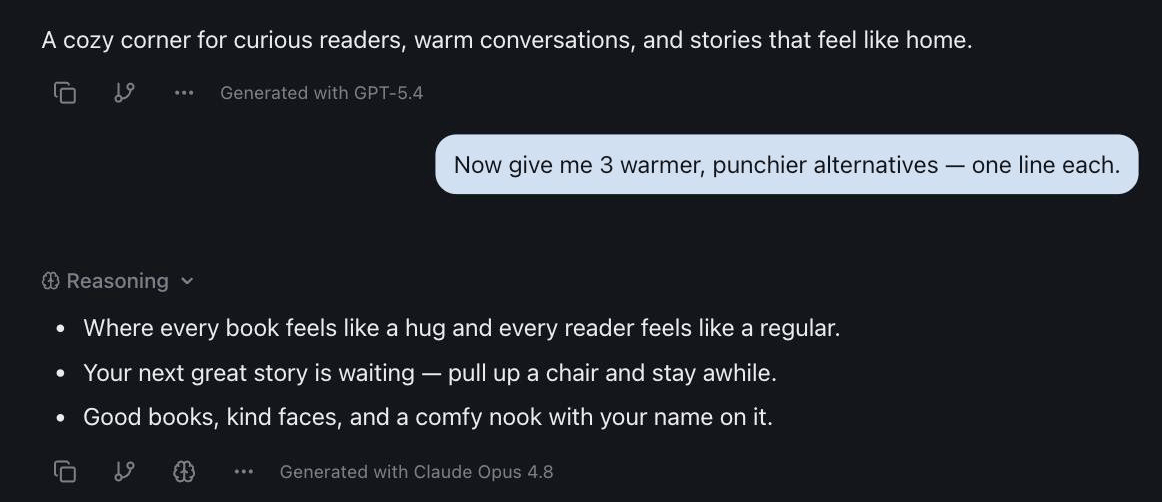
Switching happens inside the thread, and the model you switch to reads everything above it. Ask Grok what X is saying about a story, hand the thread to another model to write it up, send it to a third to check the claims, and none of it involves copying text between tabs.
Since the whole point of this page is that vendors should publish their limits, here are ours. izzedo meters usage too, because every frontier answer costs real money and nobody serves them for free. Fair use runs on a short rolling window with a weekly pool behind it, and the current allowances live on the pricing page instead of in a post that would go stale by December. There is an optional usage-based setting in Settings as well, off by default, and it works unlike a credit balance: nothing to prepay, nothing to expire, and anything past the pool appears on your invoice for what you used, under a cap you set. Leave it off and the bill does not move. Spend the pool and you wait for the window, the same as anywhere.
The difference is not that the ceiling disappears. It is that switching models is a real answer rather than a consolation, and that you are never told a percentage without being told what it is a percentage of.
There is a second reason to keep several models in reach, unrelated to limits. Grok is the best of the major assistants at telling you what happened twenty minutes ago, and it is not the best at everything else. Asking two models the same question and reading the disagreement is a one-minute habit that catches the confident wrong answer before it reaches anything public, which is most of the case for not routing everything through a single vendor. If you want to see the split for yourself, Grok against ChatGPT and Gemini makes it obvious within a few questions.
The Bottom Line
Grok's limits in 2026 are one weekly pool, measured in compute, shown as a percentage, and quantified nowhere. Daily limits ended in June 2026. The reset is weekly on a schedule specific to your account, visible only in Settings under Usage. Empty the pool and paid features pause while you drop to the free tier, which is a softer landing than most vendors give you and which xAI barely mentions.
The parts that catch people are the ones written down in the wrong places. Video quietly drops from 720p to 480p when you cross a cap that has no published size. Top-up credits cost more per action than the plan you already bought. X Premium+ already includes SuperGrok, so a fair number of people are paying two companies for one subscription. And two of the seven plans on the pricing page have no price at all.
If you want an exact number from xAI, there is one place to find it, and it is the API documentation. Everywhere else, the honest answer to how much Grok you get is: spend it and find out.
Tired of finding out where the limit is by hitting it? Try izzedo chat free with no card required, and move the task to another model instead of waiting out the week.
Frequently asked questions
What is Grok's daily limit?
There isn't one any more. xAI's own FAQ says that from June 2026 the separate daily limits for Chat, Imagine, Voice and Build were replaced by a single weekly usage pool shared across every Grok product. If you find a page quoting Grok daily message counts, it is describing the old system. The only daily-ish limits left are the free tier's, which xAI does not quantify anywhere.
When does the Grok limit reset?
Weekly, on a schedule tied to your account rather than a fixed day for everyone. xAI does not publish the day or the hour because it is not the same for every subscriber. Your exact reset date and time is in Settings under Usage, next to the percentage bar and the per-product breakdown. Free-tier limits on Chat and Voice sit outside that pool and reset on their own, shorter schedule.
What happens when you hit the Grok limit?
Paid features pause until your weekly reset, and you drop to Grok's free-tier limits on Chat and Voice, which are not part of the pool. xAI calls this 'not a hard stop', which is fair. You can also buy Extra Usage Credits from $5 on the web to resume immediately, turn on Auto Top Up so credits are added automatically, or upgrade to a plan with a bigger weekly allowance. Credits are billed at standard rates, so each action costs more than the same action inside your plan.
What is the Grok Imagine limit?
There is no published number of images or videos. Imagine draws from the same weekly usage pool as everything else, and video draws far more than chat. The specific cap worth knowing is on resolution: xAI's FAQ says 720p videos automatically fall back to 480p once you hit the 720p cap for your tier. You get a lower-quality video rather than an error, so most people never notice they crossed a limit. 1080p generation is listed only on SuperGrok Plus.
Is Grok Imagine free?
Image generation is, video is not. The comparison table on x.ai/pricing marks image generation as available on the Free plan and video generation as unavailable, so a free account can make images but has to upgrade to make video. Every generated image and video carries a Grok watermark, on every tier, with no setting to remove it.
What are Grok's rate limits?
Two different things share that name. On the API, xAI publishes exact per-model limits on requests per second and tokens per minute, scaling across five tiers set by your cumulative spend, with a 429 error when you exceed either. On consumer plans, 'higher rate limits' is marketing copy on the SuperGrok card, not a published figure. Chat, Imagine, Voice and Build all draw from one unquantified weekly pool instead.
Ready to try multi-model AI workflows?
Access GPT, Claude, Gemini, Perplexity, and more — all in one place.
Start for Free →