Claude vs ChatGPT in 2026: I Tested Both Head-to-Head
Claude or ChatGPT? I tested both across writing, reasoning, long documents and research. Neither wins outright — one goes deep, the other goes wide. Here's the breakdown.
Search "Claude vs ChatGPT" and the real question underneath is usually "which one do I cancel." After putting both through a normal week of actual work, I don't think that's the question to ask — because these two aren't the same kind of tool. One goes deep; the other goes wide.
Claude, from Anthropic, is the careful one: it writes the most human-sounding prose, holds nuance the longest, and would rather think for a beat than blurt an answer. ChatGPT is the versatile default that does a little of everything well and drags the biggest ecosystem along with it — voice, image generation, browsing, a tool for nearly anything. So I handed each the jobs people genuinely open an AI for — writing, reasoning, long documents, research, the everyday grab-bag — and scored them one task at a time instead of forcing one to lose. Here's where each pulls ahead, where it falls back, and the setup I'd actually recommend by the end.
The Short Answer: Claude vs ChatGPT at a Glance
Short on time? This table is the whole comparison boiled down — the model I'd reach for at each job, and the reason.
| Task | Better pick | Why it wins here |
|---|---|---|
| Writing & editing | Claude | The most natural, least "templated" prose; best at long-form and a careful editing pass |
| Careful reasoning & nuance | Claude (slight edge) | Thinks before it answers and holds caveats and nuance through multi-step problems |
| Long, dense documents | Claude | Large context plus genuinely close reading — works through long source material without losing the thread |
| Live info & research tools | ChatGPT | More mature web browsing and a broader built-in toolset for pulling and checking current facts |
| Images, voice & everyday range | ChatGPT | Image generation, voice, and the widest spread of day-to-day tasks in one familiar app |
| Coding | Tie — many developers lean Claude | Both are strong here; it really comes down to your stack and habits |
Look down the "better pick" column and there's no runaway winner — depth tilts one way, breadth the other. That split is the entire point of this comparison, and the reason the back half of this guide is about running both rather than crowning one.
Meet the Two Contenders
A quick, fair character sketch of each — and no version numbers, since the digits get replaced every few weeks while the temperament stays the same.
Claude, from Anthropic, is the model built for depth and care. Its signature is writing that doesn't sound like a machine wrote it — warm, well-paced, and easy to steer toward a specific voice — paired with reasoning that takes its time and shows nuance instead of rushing to a tidy answer. It's comfortable with long, dense material: feed it a big document and it reads closely rather than skimming. The trade-off is range. Claude is more of a focused craftsman than a do-everything hub, it carries a thinner ecosystem of extras, and its caution can mean an extra nudge before it'll engage with an edgy or borderline request. One wrinkle worth knowing before you judge it: "Claude" is four models at four prices, and picking the wrong one is the most common reason people conclude it's weaker than it is (which tier to use).
ChatGPT, from OpenAI, is the generalist everyone else gets measured against. Hand it a half-baked prompt and it still returns something clean and usable; it covers an enormous spread of tasks — drafting, explaining, planning, summarizing — and it ships with the deepest bench of extras, from voice to image generation to browsing. It's the model most people picture when they hear "AI," and that default status is earned: it rarely leaves you stuck. Its softer spots are the flip side of Claude's strengths — prose that can read a touch more generic until you push it, and writing that's competent rather than crafted.
How I Tested
No benchmarks here — I just used them for the work. I gave both models the same prompts across the tasks a normal person reaches for AI to do: drafting and editing a piece of writing, reasoning through a knotty problem, digesting a long document, and chasing down current information. Identical prompt, identical context, then the two outputs lined up next to each other.
I weighed each on four things: how usable the writing was before any cleanup, how well the reasoning held together, how faithfully it handled a long source without drifting, and how much of the everyday range it could cover. These are hands-on impressions rather than lab scores — your mileage will shift with the topic — but the pattern below repeated often enough to make the recommendation an easy one.
Claude vs ChatGPT, Task by Task
Writing and editing
This is Claude's headline win, and it isn't especially close. Its default prose lands more naturally — fewer stock phrases, a smoother rhythm, less of that faintly robotic cadence — and it takes editing direction gracefully ("warmer here," "cut the throat-clearing," "match this voice"). Hand it rough notes and you get back a draft that needs less rewriting before a person would actually read it. It's also the steadier editor of the two: ask it to tighten or restructure existing text and it preserves your meaning instead of flattening it.
ChatGPT writes perfectly well and is quicker to a serviceable first pass, but its output more often reads finished by an AI than written by a person, and polished prose usually wants another round with it. When the deliverable is words someone will read closely, Claude is where I open the document. (For the full research-draft-edit version of that workflow, I broke it down in Best AI for Writing Essays — and if you want the whole field split by what you're writing, from long-form to ad copy to fiction, that's the best AI for writing.)
Reasoning and nuance
The closest column on the board, and it comes down to which kind of thinking. Claude tends to slow down on a hard problem — it weighs the trade-offs, names the caveats, and resists collapsing a messy question into a false-clean answer. On anything where nuance matters more than speed, that restraint is a real asset. ChatGPT is also a strong reasoner and is rarely tripped up by a structured problem; it just gets to its answer faster and with more confidence, which is great until the question actually needed the hedge.
I give Claude a slight edge on careful, judgment-heavy reasoning and ChatGPT the nod when you want a quick, decisive read — but the gap is small enough that the other factors usually decide which one you should open.
Long documents and dense reading
Another lean toward Claude. Its large context window lets it hold a long report, a contract, or a stack of notes in working memory, and — more importantly — it reads them closely, pulling the through-line and cross-referencing across the whole thing rather than skimming the first few pages. Drop in something dense and ask for the real argument buried inside, and it tends to find it.
ChatGPT handles documents capably too, and its broader toolset can help when a task spills into search or data. But for "sit with this long, complicated text and reason over all of it," Claude is the one I trust to actually read it. (If huge context is your single biggest need, that's also where Gemini shines — I compared it to ChatGPT separately.)
The catch: careful reading isn't the same as correct reading. Even the model that reads closest can misinterpret a clause or invent a citation, so the longer and higher-stakes the document, the more worth spot-checking the key claims it pulls out — more on building that habit below.
Research and current information
Here the lean flips to ChatGPT. Its web browsing is more mature and its built-in tools make it the smoother choice for pulling and sanity-checking current facts, working across sources, and handling a task that wanders from "write this" into "go find that." Claude can work with information you give it brilliantly, but ChatGPT is the more natural fit when the job starts with go look it up.
That said, if sourced, citation-heavy research is the core of your work, neither generalist is really the specialist — that's Perplexity's home turf, which I tested against ChatGPT on its own, and against Claude directly in Perplexity vs Claude. Between these two specifically, ChatGPT's tooling gives it the research edge.
Everyday range and ecosystem
ChatGPT's comfort zone. Explain this, summarize that, brainstorm names, plan the week, talk through it out loud, generate a quick image, hold a long back-and-forth without losing the plot — its sheer breadth and the depth of its ecosystem make it the dependable default for the long tail of small daily tasks. Claude can do most of this too, but it's built as a focused thinker more than an everything-hub, so it carries fewer of the extras.
That difference is exactly why most people don't actually want to choose. One project keeps needing Claude's careful writing and ChatGPT's range and tooling, often inside the same hour — which is the first real hint that picking one means deliberately giving up the other half.
Where Claude Wins / Where ChatGPT Wins
Strip away the task detail and it settles into a clean split:
- Claude wins when the job is depth — natural, polished writing and editing, careful judgment-heavy reasoning, and close reading of long, dense documents where nuance matters more than speed.
- ChatGPT wins when the job is breadth — live information and research tooling, voice and image generation, and the long tail of everyday tasks where a fast, versatile generalist matters most.
Put plainly: Claude is the careful specialist, ChatGPT is the versatile generalist. That's not a tie nobody can break — it's two different tools, and the smart move is to keep both within reach.
Pricing: What Each Costs (and the Cost of Buying Both)
Here's the awkward bit: the headline plans cost exactly the same. Claude Pro and ChatGPT Plus each land at about $20/month. So unlike matchups where price snaps the tie, it doesn't here — commit to one and you forfeit the other's strengths for no saving at all. The meters differ even though the price doesn't. Claude Pro runs in five-hour sessions with a weekly cap on top, while ChatGPT lists everyday chat as unlimited and puts its caps on uploads, images and research instead. (The subscription version of this matchup — Claude Pro vs ChatGPT Plus, plan against plan, meter against meter — gets its own breakdown.) Want Claude for the writing and careful thinking and ChatGPT for the range and tooling — which, if you've read this far, you almost certainly do? That's roughly $40/month, two logins, and two separate bills. (And $20 is only the middle rung on Anthropic's side — the full Claude pricing breakdown walks the whole ladder from free tier to the $200 Max plan.)
And two is rarely the finish line. Once the gaps show, you start adding Gemini for huge documents, Perplexity for sourced research, Grok for live, fast-moving takes. Pay for each on its own and the tab climbs quickly:
- ChatGPT — $20/mo
- Claude — $20/mo
- Gemini — $20/mo
- Perplexity — $20/mo
- Grok — $30/mo
- DeepSeek — free (consumer app; API is usage-priced)
That's $110/month for the full lineup, most of it sitting idle on any given day. The way out — and the reason this comparison doesn't have to end with a single pick — is to put the whole set in one workspace for a fraction of that. That's next.
Is Claude Better Than ChatGPT?
So, is Claude better than ChatGPT? After living in both, my honest take is that the question is aimed wrong. Claude is better at depth — writing, careful reasoning, long-document work. ChatGPT is better at breadth — everyday range, current-info tooling, and the ecosystem around it. Naming "the winner" just hands back whichever strength you decided against, and since most real work needs both, that's a poor trade — a take you'll see echoed in just about every Reddit thread on the subject.
The people who get the most out of AI sorted this out long ago: they don't swear allegiance to one model. They send each task to whatever's best at it — Claude for the writing and the careful thinking, ChatGPT for the range and the live, tool-heavy work — and they cross-check the answers that matter. The catch has always been logistical: two tabs, two logins, two invoices.
So Which Should You Pick? Match It to Your Work
If you really must commit to just one, let the task you do most often make the call:
- Writers and marketers: Claude, for the most natural drafts and the cleanest editing pass — with ChatGPT nearby for the moments you need a current fact, a quick image, or a fast versatile take.
- Students and researchers: Claude to write the essay and work through long readings and dense sources — then ChatGPT for everyday study help and anything that needs to go look something up. (More on that cost trade-off in Is ChatGPT Plus Worth It?, and check what each vendor actually offers students before you pay either one.)
- Analysts and careful thinkers: Claude for judgment-heavy reasoning and close reading — with ChatGPT for the live data, the tooling, and the quick turns around the edges.
- Everyday questions and planning: ChatGPT's range and ecosystem make it the safer default — but you'll want Claude the second the task turns into real writing or careful thinking.
Spot the recurring ending? Every line lands on "…but you'll reach for the other when X." That's not me dodging the call — it's what falls out of two tools built for opposite ends of the work. And it's the surest tell that the right answer isn't either one on its own.
If you're weighing more than these two, every comparison I've run sits on one page with its verdict and what the plans cost.
You Don't Have to Choose: Run Both in One Workspace
Here's the move that makes the whole dilemma evaporate. Instead of paying ~$20 for Claude, ~$20 for ChatGPT, and re-explaining your task every time you switch tabs, you can get Claude, ChatGPT, Gemini, Grok, Perplexity, DeepSeek and more in one workspace for $6/month — with a free plan that needs no credit card to start. Full disclosure on the fine print: izzedo applies fair use too — every AI service does — but it operates quietly on a short rolling window that clears within a few hours, with a weekly pool behind it for a sustained heavy stretch — all under one flat bill with no credits or points to track.
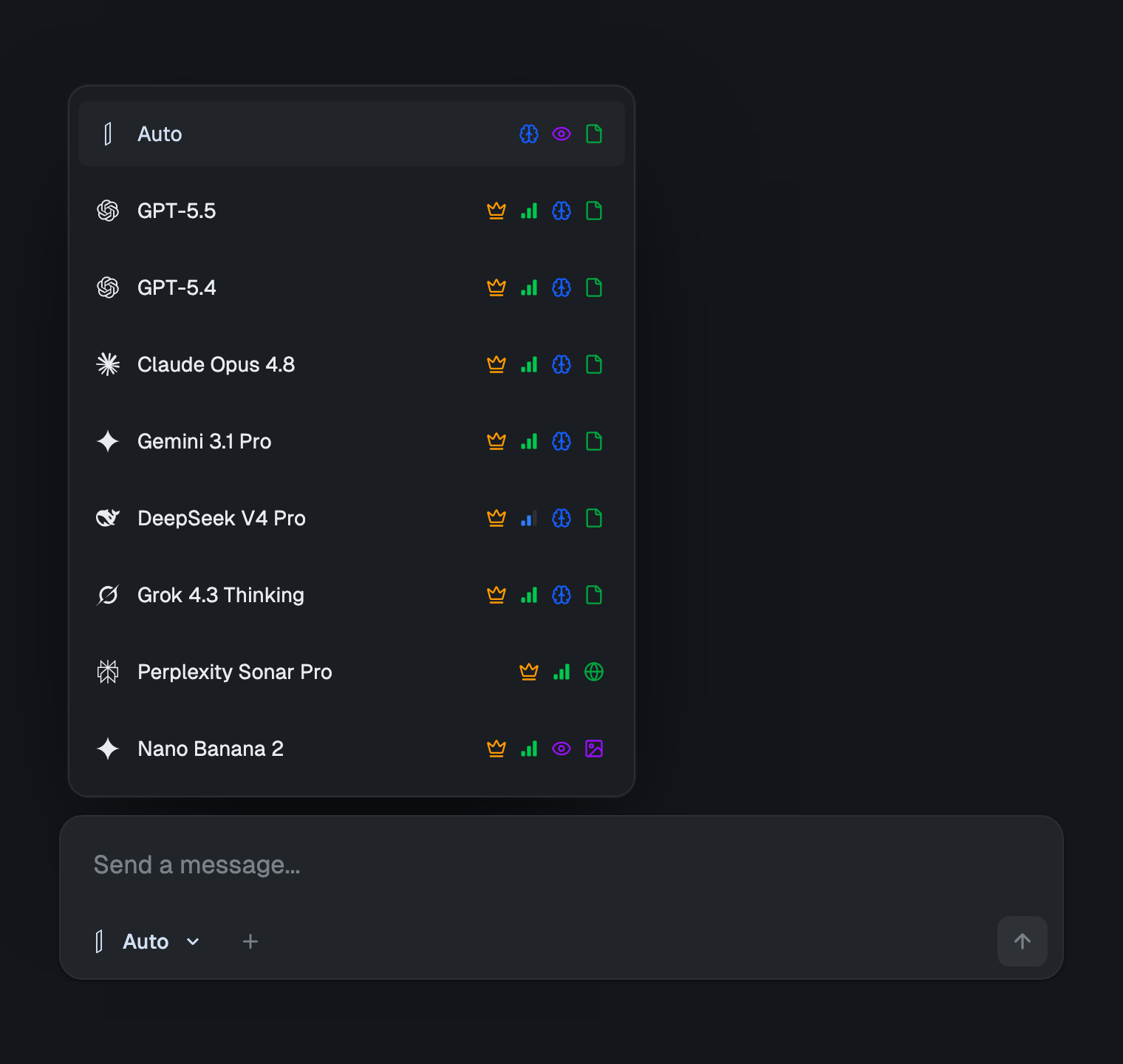
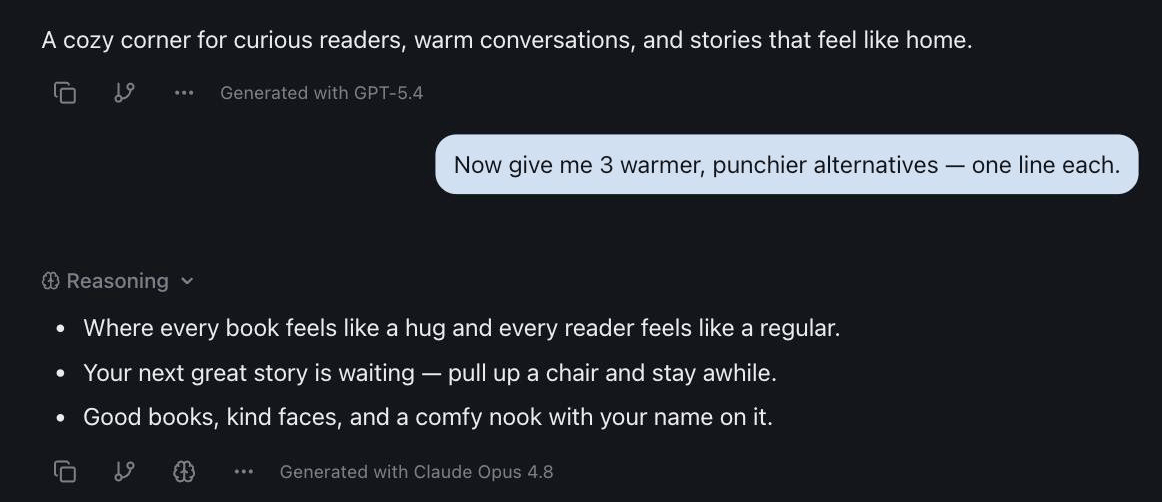
Because every model lives in the same thread, you can pass work from one to the next mid-conversation and nothing about the context gets left behind. That lines up exactly with the workflow this whole comparison points to: draft something in Claude, then switch to ChatGPT in the same thread to pull a current fact or run a quick tool — and it already sees everything Claude wrote. No shuttling text between tabs, no second account to log into.
The bigger payoff: a built-in second opinion
The best thing about keeping both side by side isn't the convenience — it's the accuracy. Any one model is confidently wrong often enough that a single answer shouldn't be taken on faith, especially on numbers, dates, and freshly fetched "facts." The fix is low-effort: pose the same question to a second model and watch whether the answers converge. When Claude and ChatGPT agree, you can move on. When they split, you've just spotlighted the exact claim worth verifying before it costs you.
Stretched across two separate subscriptions, that's friction you'll quietly skip. In one workspace it's a click — fire the same question at both at once, or pass a follow-up to a second model right inside the thread. I wrote up a one-minute version of that second-opinion move.
That's the setup I actually use, and it's why the "Claude vs ChatGPT" question stopped nagging at me: I have both, plus the rest, and I aim each task at whatever's best for it. (Curious how the same test runs against the other big names? I did it for Gemini vs ChatGPT, Perplexity vs ChatGPT and Grok vs ChatGPT too — and if you want Gemini in the ring at the same time, the three-way Claude vs ChatGPT vs Gemini settles which of the big three to use for what. And with ChatGPT taken out of the room entirely, Claude vs Gemini is the matchup with no safe default.)
The Bottom Line
Claude vs ChatGPT in 2026 isn't a knockout — it's a split decision that turns on the task. Claude wins depth: the most natural writing, careful reasoning, and close reading of long documents. ChatGPT wins breadth: everyday range, current-info tooling, and the ecosystem around it. If someone forced me to keep one tool forever, I'd probably take ChatGPT for the sheer range — but I'd feel the loss of Claude's writing and care every time the work got serious.
The good news: nothing actually forces that choice. Keep both on hand, switch as the work shifts, and let the moments they disagree flag the mistakes — and the question more or less answers itself. Point each task at the model that's best for it, hold one shared context, and quit paying two bills for two tools you wanted both of anyway. (This matchup is also one chapter of a bigger contest — every big model, tested in one place, is here — and if you're specifically shopping for a way out of ChatGPT, Claude is only one of the alternatives worth weighing.)
Want Claude and ChatGPT in one thread — with Gemini, Grok, Perplexity and the rest a click away? Try izzedo chat free — no card needed to start.
Frequently asked questions
Is Claude better than ChatGPT?
Neither is better overall — they're built for different kinds of work. Claude wins on depth: the most natural writing, careful step-by-step reasoning, and close reading of long, dense documents. ChatGPT wins on breadth: the widest everyday range, the bigger ecosystem of voice, image generation and tools, and a dependable feel across almost any task. The best setup uses Claude for writing and careful thinking, and ChatGPT for everyday range and current-info work.
Is Claude AI better than ChatGPT for writing?
For most writing, yes. Claude tends to produce the most natural, least 'templated' prose and takes editing direction on tone and structure with the least fuss, which is why so many writers keep it for drafting and editing. ChatGPT is the faster, more versatile generalist and still writes well — but if the deliverable is polished prose someone will read closely, Claude usually needs fewer rewrites. The ideal is having both and choosing per draft.
Is Claude free?
Yes. Claude has a capable free tier you can use with an account, plus a paid plan (Claude Pro) at roughly $20/month that raises the limits and unlocks the strongest model. ChatGPT works the same way — a free tier plus ChatGPT Plus at about $20/month. If you want both without paying twice, a multi-model workspace like izzedo chat bundles Claude, ChatGPT and other top models for $6/month, with a free plan to try first.
Which is better for students, Claude or ChatGPT?
It depends on the task. Claude is excellent for essays, careful editing, and working through long readings and dense source material. ChatGPT is the smoother pick for everyday study help, quick explanations, and tasks that lean on its broader toolset. Most students get the most from having both — think and write with Claude, and lean on ChatGPT's range for the day-to-day.
Can I use Claude and ChatGPT at the same time?
Yes. In a multi-model workspace you can run both in a single thread — draft with Claude, then switch to ChatGPT for a follow-up or a current-info check, with all the context carried over. You can also put the same question to both and let any disagreement flag what's worth double-checking. izzedo chat does this natively, starting free with no card.
Ready to try multi-model AI workflows?
Access GPT, Claude, Gemini, Perplexity, and more — all in one place.
Start for Free →