Grok vs ChatGPT in 2026: I Tested Both Head-to-Head
Grok or ChatGPT? I tested both head-to-head across research, reasoning, and writing. Neither wins outright — each takes different tasks. Here's the breakdown.
"Grok vs ChatGPT" usually gets answered like a boxing match — one model has to win, the other has to lose. After actually using both for the kind of work people do every day, I think that framing is wrong. They're built around different instincts, and the honest answer is that each one wins a different set of tasks.
ChatGPT is the polished generalist that turned "ask an AI" into a habit. Grok is the brash, web-connected challenger built to be current and direct. So I ran them head-to-head on the things you'd realistically use them for — live information, reasoning, writing, and general questions — and kept score by task instead of crowning one winner. Here's what held up, where each pulls ahead, and the setup I'd actually recommend at the end.
The Short Answer: Grok vs ChatGPT at a Glance
If you only read one section, read this. Here's which model I'd reach for at each task, and why.
| Task | Better pick | Why it wins here |
|---|---|---|
| Real-time info & current events | Grok | Pulls from the live web and X, so answers are fresher and more current |
| Math & step-by-step reasoning | Grok (slight edge) | Built around language, math, and reasoning; stays methodical |
| Writing & editing | ChatGPT | More polished default prose and easier to steer on tone |
| Everyday questions & brainstorming | ChatGPT | The dependable all-rounder with the widest range |
| Blunt, no-hedge takes | Grok | Direct by design, with less of the over-cautious filler |
| Image generation | Tie | Both generate images well — pick by the look you want |
Notice that no single column runs the table. That's the whole point of this comparison, and the reason the back half of this guide is about using both, not declaring a champion.
Meet the Two Contenders
A quick, honest character sketch of each — no version numbers, because those change every few weeks and the personality doesn't.
ChatGPT is the all-rounder that set the standard. It handles a messy prompt gracefully, writes clean and structured prose, and is reliably good across an enormous range of tasks — outlining, drafting, explaining, summarizing, planning. It's the model most people mean when they say "AI," and for good reason: it's the safe default that rarely lets you down. Its weak spots are freshness (it leans on what it was trained on unless it goes looking) and a default voice that can read a little generic until you push it.
Grok, from xAI, is the current, plugged-in challenger. Its signature traits are real-time access — it can pull from the live web and from X — and a blunt, low-hedging tone that says the thing instead of wrapping it in caveats. It's strong at language, math, and reasoning, and it shines when now matters: trending topics, breaking developments, anything where a fresh answer beats a polished one. The trade-off is that its directness sometimes needs an edit before it's ready for a professional context.
How I Tested
I didn't run benchmarks — I ran the work. I gave both models the same prompts across the tasks a normal person actually uses AI for: looking up something current, working through a reasoning problem, drafting and editing a piece of writing, and answering everyday questions. Same prompt, same context, then I compared the outputs side by side.
I judged each on four things: how current and accurate the answer was, how strong the reasoning held up, how usable the writing was without heavy cleanup, and how much the tone fit the job. These are my hands-on impressions, not lab scores — your results will shift by topic — but the pattern below was consistent enough to make a clear recommendation.
Grok vs ChatGPT, Task by Task
Real-time facts and current events
This is Grok's clearest win. Because it can reach the live web and X, it answers questions about right now — what's trending, a developing story, a just-released update — with current information instead of a polite "my knowledge has a cutoff." Ask it what people are saying about a topic today and it pulls a genuinely fresh read.
ChatGPT can browse too, but real-time, pulse-of-the-internet questions are the thing Grok was built around, and it shows. For anything time-sensitive, Grok is the one I reach for first.
The catch: "fresh" isn't the same as "true." A live answer still needs a sanity check — pulling from the open web and X means Grok can surface a take that's current but wrong. More on that below.
Reasoning and math
Closer than you'd expect. Grok is built around language, math, and reasoning, and on multi-step problems it stays methodical and shows its work in a way that's easy to follow. ChatGPT is also a strong reasoner and rarely fumbles a structured problem.
I give Grok a slight edge on raw step-by-step math and logic puzzles, while ChatGPT is the steadier hand when the "reasoning" is really about untangling a messy, real-world question with a lot of context. For most people the difference here is small — both are good enough that the other factors decide it. (The math-only shootout — with DeepSeek and Gemini also in the field — is in Best AI for Math.)
Writing and editing
ChatGPT's home turf. Its default prose is more polished, it's easier to steer on tone ("make this warmer," "tighten it," "lose the jargon"), and it turns a pile of notes into a clean draft with less fuss. For outlining, drafting, and editing, it's the smoother writer of the two.
Grok can absolutely write, and its bluntness is a feature when you want a punchy, no-fluff paragraph. But its directness usually needs a pass before it fits a polished or professional context. If the deliverable is words, I start in ChatGPT. (For the full multi-model writing workflow — research, draft, edit — I broke it down in Best AI for Writing Essays.)
Tone: blunt vs measured
This one's about preference, not capability. Grok is direct and low-hedging — ask for an opinion and you get one, with fewer "it depends" disclaimers. Some people love that; it cuts to the answer. ChatGPT is more measured and careful, which is reassuring for sensitive topics and safer for anything you'll publish, but it can feel like it's hedging when you just want a straight call.
If you're tired of over-cautious answers, Grok is refreshing. If you want a diplomatic, professional default, ChatGPT fits better. Knowing which you want for a given task is half the battle.
Images and everyday extras
Both can generate images and handle the everyday extras — answering questions, summarizing, explaining a concept, even handling a bit of code when you need it. Image generation is genuinely a tie; the right pick depends on the visual style you're after, not on one being broadly "better."
The deciding factor for most people isn't a feature checklist — it's that you end up wanting Grok's freshness and ChatGPT's polish on the same project, often within the same hour.
Pricing: What Each Costs (and the Cost of Buying Both)
Here's where the "which one" question gets expensive. ChatGPT's paid plan runs about $20/month, with its caps on uploads, images and research rather than on everyday chat. Grok's own subscription, SuperGrok, is $30/month direct from xAI, and X sells higher Grok limits inside X Premium as a separate bill (both price lists, laid out). What neither price list tells you is how much Grok either one buys, because xAI publishes no usage figures for any consumer plan. Want both — Grok for current info, ChatGPT for everything else? That's about $50/month, two logins, and two bills, for two of the models you might use.
And most people don't stop at two. Once you've felt the gaps, you start eyeing Claude for editing, Perplexity for sourced research, Gemini for long documents. Subscribe to each separately and the math gets silly fast:
- ChatGPT — $20/mo
- Claude — $20/mo
- Gemini — $20/mo
- Perplexity — $20/mo
- Grok — $30/mo
- DeepSeek — free (consumer app; API is usage-priced)
That's $110/month for the full set, most of it idle most of the time. The alternative — and the reason this comparison doesn't have to end in a single pick — is to get all of them in one workspace for far less. More on that next.
Is Grok Better Than ChatGPT?
So, is Grok better than ChatGPT? After all the testing, my honest answer is that it's the wrong question. Grok is better at being current and direct. ChatGPT is better at writing and being a versatile all-rounder. Picking "the winner" means deliberately giving up whichever strength you didn't choose.
The people who get the most out of AI figured this out a while ago: they don't pledge loyalty to one model. They route each task to whatever's best at it — Grok for the live, fast-moving stuff, ChatGPT for the polished, general work — and they cross-check the important answers across both. The trouble has always been that doing it meant juggling tabs, logins, and two separate bills.
Which One Should You Use? Pick by the Job
If you genuinely have to choose just one, decide by what you spend the most time doing:
- Students and researchers: ChatGPT is the better daily driver for outlining, drafting, and working through dense material — but you'll keep wanting Grok the moment a topic is fresh or fast-moving. (More on that trade-off in Is ChatGPT Plus Worth It?. xAI publishes no student discount, while OpenAI and Google both run student offers, compared here.)
- Writers and marketers: ChatGPT, for polished copy you can steer on tone — with Grok kept nearby for current references and a punchier, less-filtered angle.
- Anyone who lives on current events: Grok, for the live web and X access — with ChatGPT as the calmer hand for anything you'll write up or send. There's a third model with a claim on that job, reading a different live source again: Grok vs ChatGPT vs Gemini settles which of the three actually knows what happened today.
- Everyday questions and planning: ChatGPT's range makes it the safer default, while Grok's bluntness wins when you just want a straight answer with no hedging.
See the pattern? Every recommendation ends in "…but you'll want the other for X." That's not indecision — it's the honest result of two models built around different strengths. Which is exactly why the best setup isn't picking one of them.
Grok and ChatGPT are one pairing out of many, and the full comparison page has the verdict for each of the others.
You Don't Have to Choose: Run Both in One Workspace
Here's the part that changes the decision. Instead of paying ~$20 for ChatGPT, ~$30 for Grok, and re-explaining your task every time you switch tabs, you can get ChatGPT, Grok, Claude, Gemini, Perplexity, DeepSeek and more in one workspace for $6/month — with a free plan that needs no credit card to start. The billing is deliberately boring: one flat monthly price, no points or credit packs to manage. Fair use still exists — it does everywhere serious models are involved — but it runs in the background on a short rolling window that clears in hours, with a weekly pool behind it — not an allowance you ration message by message.
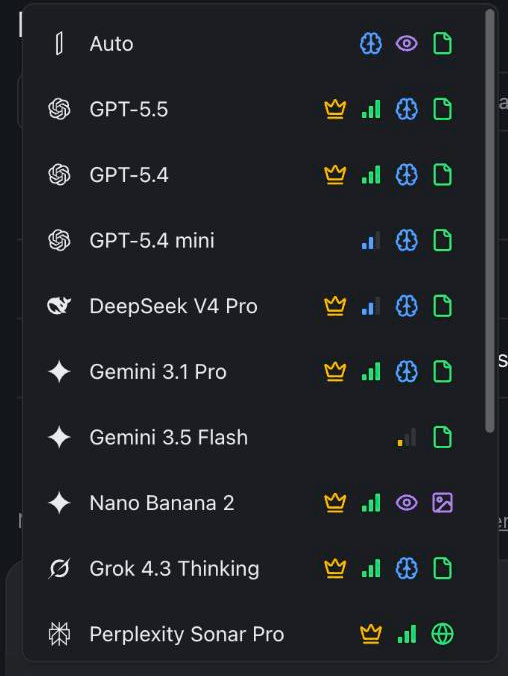
Because every model lives in the same thread, you can switch between them mid-conversation without losing context — draft with one model, then switch to another for a second take, and it already sees everything that came before. No re-pasting, no new tab, no second login. In practice that means starting a draft in ChatGPT and flipping to Grok the moment you need a current fact or a blunter read, all in one chat.
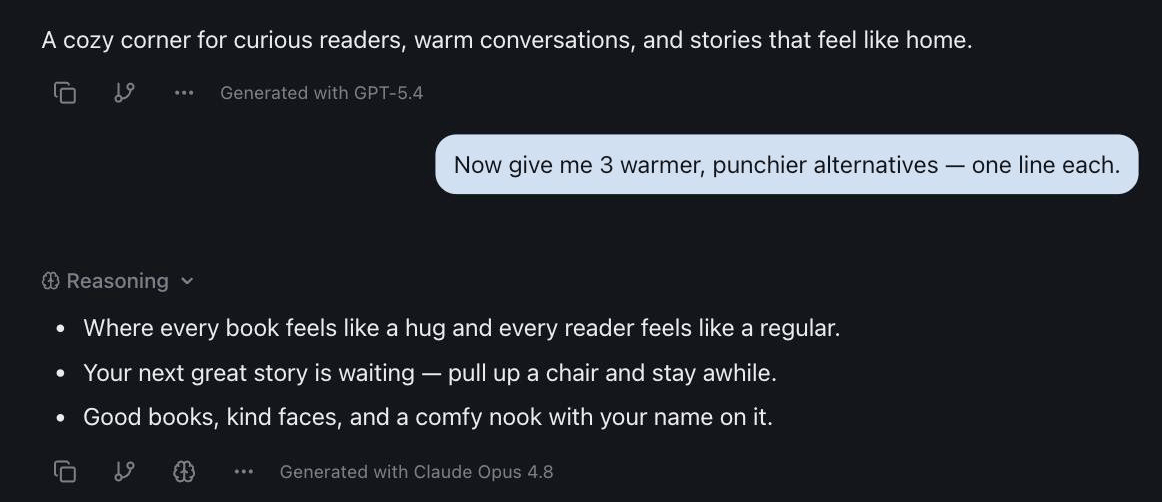
The real upgrade: a built-in second opinion
The most useful thing about having both in one place isn't convenience — it's accuracy. Any single model is confidently wrong often enough that you can't take one answer at face value, especially for dates, numbers, and fresh "facts" (exactly the area where Grok's live data is powerful and risky). The fix is simple: ask the same question of a second model and see whether they agree. When Grok and ChatGPT line up, you can relax. When they disagree, you've just found something worth checking before it bites you.
Doing that across two subscriptions is a chore. Doing it in one workspace is a click — ask both the same thing side by side, or fire off a follow-up to a second model in the same thread. Here's a one-minute version of that second-opinion move.
That's the setup I actually use, and it's why the "Grok vs ChatGPT" question stopped mattering to me: I have both, plus the rest, and I point each task at whatever's best. (If you're weighing the cost specifically, Is ChatGPT Plus Worth It? runs the same math from the single-subscription side.)
The Bottom Line
Grok vs ChatGPT in 2026 isn't a knockout — it's a draw that depends on the task. Grok wins real-time information, blunt takes, and a slight edge in math; ChatGPT wins writing, range, and dependable all-around polish. If someone forced me to pick one tool forever, I'd take ChatGPT for the breadth — but I'd resent losing Grok's freshness every time news broke.
The good news is that nobody's forcing the choice. Put both in one place, switch between them as the task changes, and let their disagreements catch the mistakes — and the question quietly answers itself. Use the right model for each job, keep your context in one thread, and stop paying two bills for two of the models you want. (And when you're ready to see how this pair ranks against Claude, Gemini and Perplexity on the same jobs, the five-model verdict table is here.)
Want to run Grok and ChatGPT side by side in one thread — plus Claude, Gemini, Perplexity and more? Start using izzedo chat for free — no credit card required.
Frequently asked questions
Is Grok better than ChatGPT?
Neither is better overall — they're better at different things. Grok wins on real-time information and current events because it can pull from the live web and X, and it gives blunt, low-hedging answers. ChatGPT wins on polished writing, range, and being a dependable all-rounder. The smartest setup uses Grok for live facts and direct takes, and ChatGPT for drafting and everyday work.
When should I use Grok instead of ChatGPT?
Reach for Grok when freshness matters — breaking news, what's trending, a fast-moving topic, or anything where a current answer beats a polished one. It's also good for blunt, no-hedge takes and for math and reasoning. For careful writing, editing, and broad general-purpose tasks, ChatGPT is usually the smoother choice.
Do I need X Premium to use Grok?
Grok is tied to X's paid tiers for full access, which is why a standalone Grok subscription runs more than ChatGPT Plus. You can also reach Grok — alongside ChatGPT, Claude, Gemini, Perplexity and more — inside a multi-model workspace like izzedo chat for one bill, with a free plan to try it without a card.
Is Grok free?
Grok has a limited free tier, but full access is gated behind X's premium plans. If you want to use Grok regularly without committing to X's pricing, a multi-model workspace gives you Grok plus the other major models for less than a single subscription.
Can I use Grok and ChatGPT at the same time?
Yes. In a multi-model workspace you can run both in one thread — ask ChatGPT to draft, switch to Grok for a current-events check, and keep all the context as you go. You can also ask both the same question side by side and let the disagreement flag anything worth double-checking. izzedo chat does this natively, starting free.
Ready to try multi-model AI workflows?
Access GPT, Claude, Gemini, Perplexity, and more — all in one place.
Start for Free →