ChatGPT Plus vs Claude Pro (2026): Which $20 Plan Wins — or Should You Skip Both?
ChatGPT Plus and Claude Pro cost exactly the same $20 — and buy you very different things. Here's what each plan actually includes, how their limits compare, and why the sharpest move in 2026 might be paying for neither.
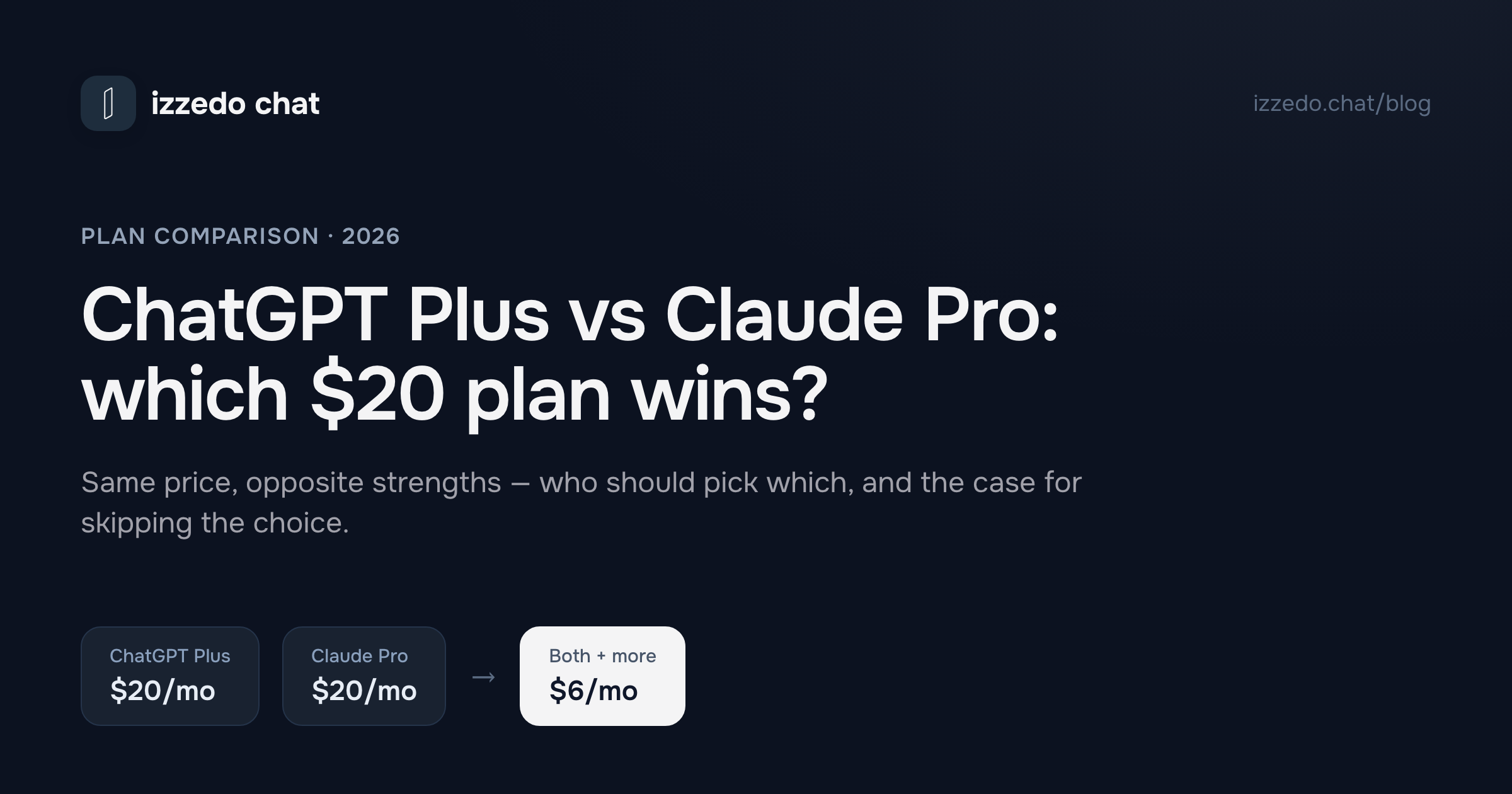
ChatGPT Plus and Claude Pro have arrived at the same number from opposite directions: $20 a month. Identical price tags, which sounds convenient until you realize it removes the easiest tiebreaker there is. You can't pick the cheaper one, so you're forced to pick the right one — and the two plans are genuinely different products wearing the same price.
One is OpenAI's everything-app: the broadest toolset in consumer AI, sold as depth in a single ecosystem. The other is Anthropic's specialist: the model people pay for specifically because of how it writes and thinks. This post lays out exactly what each $20 buys in 2026, where each plan's meter actually sits, and then asks the question both pricing pages politely avoid: whether either $20 is the right spend at all.
The Quick Verdict: Two $20 Plans, Side by Side
| ChatGPT Plus ($20/mo) | Claude Pro ($20/mo) | |
|---|---|---|
| What it unlocks | OpenAI's flagship model, ad-free, with the full feature set | Anthropic's strongest models at several times the free tier's usage |
| Standout strength | Breadth — voice, images, mature web tools, everyday range | Depth — writing, careful reasoning, long-document work |
| How it's metered | Text chat listed as unlimited; undisclosed caps on tools, with $100–$500 Pro tiers above for headroom | 5-hour sessions plus a weekly ceiling; optional extra usage credits |
| Notable extras | Image generation, voice, projects, research and agent features | Projects, research, integrations, a terminal coding tool |
| Weak spot | Prose and careful reasoning are good, not best-in-class | Thinner ecosystem; the session meter annoys heavy users |
| Best for | Living inside one versatile vendor | Writers, analysts, and long-document people |
The one-sentence version: ChatGPT Plus is the better $20 for range, Claude Pro is the better $20 for craft — and if what you really want is both, there's a way to stop at $6 instead of $40 (that's the last section).
If you read that table and wanted both columns, you don't have to pay $40 to get them. izzedo chat runs Claude and ChatGPT in the same thread for $6 a month, with Gemini, Grok and DeepSeek in the same model picker. Draft with Claude, switch to ChatGPT for the next message, and it reads everything Claude wrote. The free plan needs no card, so you can try it on the exact task you're weighing these two plans for.
ChatGPT Plus: What Your $20 Buys
Plus is the default answer to "should I pay for AI?" — and on its own terms, a solid one. The $20 moves you from the free tier's lighter experience to OpenAI's flagship model with room to actually work: no ads (which now sit on the Free and Go tiers), image generation, voice, file and data analysis, projects, and the research and agent features at standard allowances.
What you're really buying is coverage. ChatGPT Plus is the plan for people whose AI use sprawls — explain this, draft that, make an image, talk it through, go look something up — because no other single subscription covers that much surface this smoothly. OpenAI's whole ladder now runs from $6 to $500 (I mapped every rung in ChatGPT Go vs Plus vs Pro), and Plus remains the rung with the sanest value-per-dollar on it. Whether that rung deserves your $20 at all gets its own full breakdown — here I'll assume you're paying someone and deciding whom.
Its limitation is the one this whole comparison exists for: everything you get is OpenAI. The $20 doesn't buy you the model that writes the most natural prose or reads a 200-page document most carefully — because in 2026, on those specific jobs, that model usually isn't ChatGPT.
Claude Pro: What Your $20 Buys
Claude Pro is a more pointed purchase. The $20, or $17/month if you commit to a year, unlocks Anthropic's Opus reasoning tier, which the free plan withholds, at several times the free usage, plus projects, web-connected research, integrations with tools like Google Workspace, and a terminal-based coding assistant that developers rate highly. It does not unlock everything: the tier above Opus is selectable on Pro but sits outside the plan's allowance, so it bills at API rates per message (the four tiers, compared).
People don't subscribe to Claude Pro for coverage; they subscribe for quality on specific work. Claude's prose reads less machine-made than anything else on the market, it edits without flattening your voice, it holds nuance through judgment-heavy reasoning, and it genuinely reads long documents instead of skimming them. If your output is words or analysis someone will scrutinize, that's what the $20 is for.
The commitment terms differ too, and in Anthropic's case they are stricter than the price tag implies. Its refund page states that all payments are non-refundable except where its consumer terms or local law say otherwise, and the exception is a 14-day prorated window for the European Economic Area and the UK. So the $17 annual rate is a year-long bet almost everywhere else, which is the main reason I recommend paying monthly first in is Claude Pro worth it.
The trade-offs are real, though. The ecosystem around the model is thinner than OpenAI's — less of the voice-and-image everything-app experience. And Claude Pro's meter is famously present: usage runs in sessions that reset roughly every five hours, with a weekly ceiling across all models on top. Anthropic has loosened these limits over time (and sells extra usage credits when you hit them), but heavy users still learn the reset clock by heart.
Same $20, Different Task Winners
I've run the full head-to-head between these two models elsewhere — Claude vs ChatGPT, tested task by task — so here's just the scoreboard as it applies to the plans:
- Writing and editing → Claude Pro. The most natural drafts, the most respectful editing pass. This is the single biggest reason to point your $20 at Anthropic.
- Long, dense documents → Claude Pro. Contracts, reports, research stacks — Claude reads closely across the whole thing rather than summarizing the first act.
- Everyday range and extras → ChatGPT Plus. Voice, images, quick explanations, planning, the long tail of small tasks — Plus covers more ground per dollar than anything else with one vendor's name on it.
- Live information and web tools → ChatGPT Plus. Its browsing and research tooling is the more mature of the two when the task starts with "go find out."
- Careful, judgment-heavy reasoning → slight edge Claude. Both are strong; Claude hedges where hedging is honest.
- Coding → genuinely contested. Both ship capable coding tools and developers argue about this endlessly; call it a tie that your stack will break for you.
Notice the shape: it's not that one plan wins and the other loses. It's that your $20 wins or loses depending on which half of this list looks like your week. The rest of the matchups, model against model and plan against plan, are on one comparison page.
Claude Pro vs ChatGPT Plus Usage Limits: Whose Meter Bites First
Here's the part neither pricing page leads with. At $20, both plans are metered slices of one vendor, and the two meters are shaped differently enough that the same workload can hit a wall on one plan and sail through on the other.
| ChatGPT Plus | Claude Pro | |
|---|---|---|
| The main window | Rolling three-hour cap on its main model | Session that resets every five hours |
| The ceiling above it | Separate allowances for images, research and agent runs | A weekly cap across all models, plus its own weekly cap on the most expensive one |
| File uploads | Up to 80 files per three hours, 512MB each | Up to 20 files per chat, 500MB each |
| What happens at the ceiling | You're switched down to a mini model until it resets | Claude stops until the session rolls over |
| Can you watch it? | Settings shows which allowance is spent and the reset time, mostly once you're near it | Progress bars in Settings, under Usage, for session and week both |
| When you run out | Wait it out, or climb to Pro at $100, $200 or $500 | Wait it out, buy usage credits, or climb to Max from $100 |
Take the numbers as the shape of the thing, not the specification, because both vendors revise them without much ceremony, and because neither plan has one single limit. Neither vendor publishes a message count any more. OpenAI's pricing page now lists everyday text chat as unlimited on every tier, footnoted only with a requirement that usage be reasonable, and its Plus help article says merely that subscriptions "may include usage limits such as message caps, especially during high demand" which "may vary based on system conditions". The real ChatGPT caps have moved onto uploads, images, deep research and voice, and I've mapped every one of them, plus the error messages that only look like limits, in a separate guide. Claude's side, the five-hour session, the fixed weekly reset and what the usage credits really cost once you run out, gets the same treatment here. Anthropic publishes no message count either, and that's not evasion. Claude's allowance genuinely depends on how long your messages run, how heavy your attachments are, how far the conversation has already grown, and which model you picked, so two people on the same $20 plan can hit the wall hours apart.
The more useful difference is what each one does when you arrive at the ceiling. Claude stops. The session is spent, and you wait for the rollover or buy credits. ChatGPT doesn't stop, it demotes: past the cap your chats switch to a mini version of the model until the window resets. That sounds gentler and is arguably worse, because a hard stop is impossible to miss while a quieter model answering your questions is very easy to miss. If a ChatGPT answer ever felt inexplicably shallow late in a working afternoon, this is the likeliest explanation.
Visibility follows the same pattern. Claude puts progress bars in Settings under Usage, showing how much of the five-hour session and of the week you've spent, with the weekly reset pinned to a fixed hour assigned to your account, which is why heavy users know their clock by heart. ChatGPT does surface the state, listing which allowance is exhausted and when it resets, but it does so mostly once you're already up against it, and the richer usage dashboards live on the Business and Enterprise seats rather than on Plus. One plan lets you pace yourself. The other lets you find out.
And both vendors sell the cure for their own limits. OpenAI's Pro tiers sit at $100 and $200, plus a $500 tier added on 29 September, and Anthropic's Max tiers sit at the same first two price points for 5x or 20x Pro's usage. The $20 plans are, structurally, the middle rungs of two separate ladders that each want you climbing. (Anthropic's full ladder, free tier through Pro, Max, Team and the API, is priced out rung by rung here, and the same $20 weighed against Perplexity Pro, which meters questions rather than working time, is Perplexity vs Claude.) If you want the tell that the five-hour window is winning as an industry habit rather than an Anthropic quirk: in August 2026 OpenAI put a five-hour usage limit on ChatGPT Business standard seats, then started selling a premium seat at $125 that removes it. Whether a Business seat beats Plus at all is a separate question, and it turns less on limits than on who gets to export and delete the chats.
None of this is a scandal — frontier models are genuinely expensive to run, and every serious AI service limits usage somewhere. But it reframes the decision. You're not choosing which $20 buys "unlimited AI"; you're choosing which vendor's meter you'd rather live inside. And once it's put that way, a third question becomes hard to ignore: why rent one meter when the same money — actually, a third of it — can rent the whole market?
Can't You Just Get Both? The $40 Problem
Nothing stops you from holding both subscriptions, and many people whose work spans writing and everything-else do exactly that. But look at what you've signed up for: $40 a month, two logins, and — the part that grates daily — two apps that share nothing. The brief you gave Claude doesn't exist when you open ChatGPT; every handoff between them is you, copy-pasting context like a courier.
And the two-subscription setup has a way of growing. The same logic that justified adding Claude to ChatGPT eventually adds Gemini for huge-context work, Perplexity for cited research, Grok for the live take. Priced separately — ChatGPT $20, Claude $20, Gemini $20, Perplexity $20, Grok $30, with DeepSeek free — the full lineup runs about $110/month, mostly idle at any given moment. I've made the longer case that committing to a single model is the real mistake; the problem is that fixing it by stacking $20 subscriptions punishes you for being right.
The Third Option: Both Models (and More) for $6
This is where I stop pretending the two-plan standoff is the whole menu. izzedo chat is one workspace with ChatGPT, Claude, Gemini, Grok, Perplexity, DeepSeek, Qwen, Llama and more — text and image models — behind a single login for $6/month. That's both of this article's contenders, plus the rest of the market, for less than a third of either one alone.
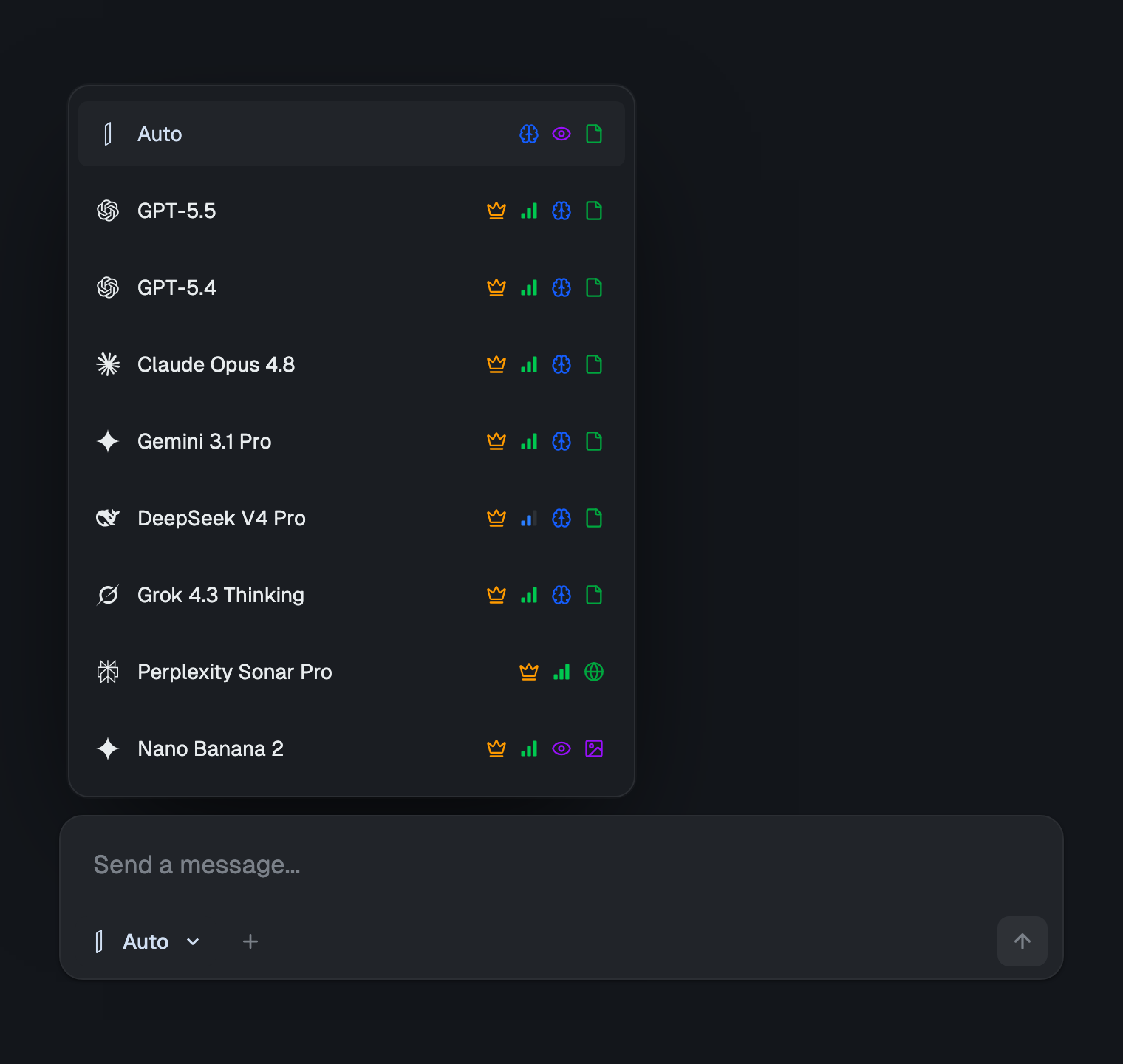
The mechanics matter more than the price. Models share a thread: you can draft with Claude, then switch to ChatGPT mid-conversation for a current-info check or a quick image, and it picks up everything Claude already wrote — the exact workflow that costs $40 and a lot of copy-paste across two separate apps. When an answer matters, you can put the same question to several models side by side and treat any disagreement as the flag that something needs checking. There's also the workspace layer neither $20 plan really has as its focus: projects with their own system prompts, a knowledge base for your documents, scheduled automations, and 50+ integrations like Notion, Google Drive and Gmail. It's GDPR compliant and doesn't train on your inputs.
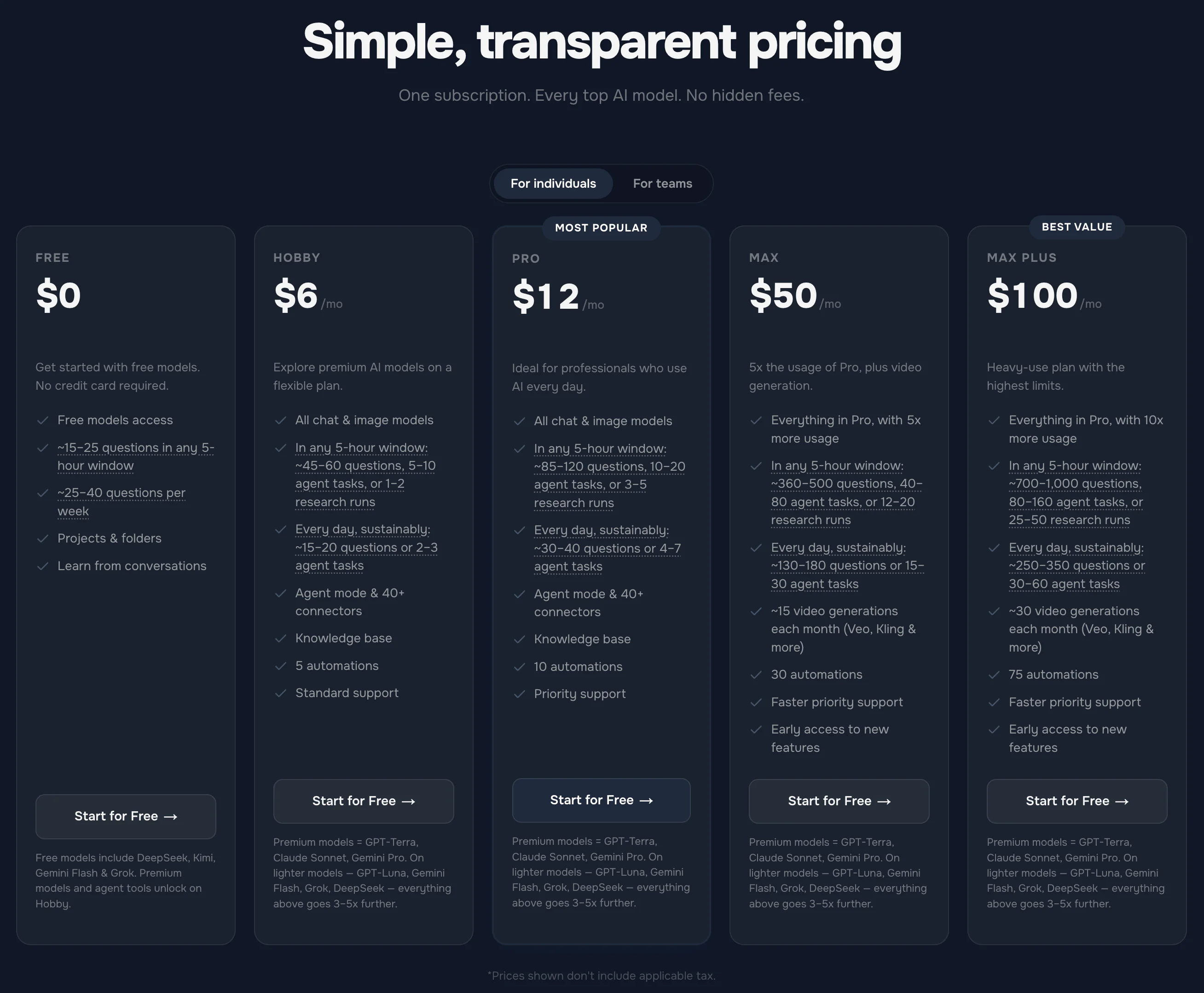
On limits — because after the section above, you should be asking: izzedo meters usage too. Everyone does. The difference is the shape: a flat monthly bill with no points or credits to manage, and fair use enforced quietly in the background on a short rolling window that frees up within hours, with a weekly pool behind it. Hammer the most expensive models nonstop and you wait for the window; keep that up all week and you wait for the week. The bill doesn't move unless you opt into usage-based billing, which is off by default and charges after the fact for what you used rather than selling you credits in advance. Exact plan numbers live on the pricing page, and there's a free plan with no credit card to test whether the multi-model workflow fits before any money changes hands. (New to that workflow? Here's how running several models in one place works in practice.)
The Bottom Line
The honest scorecard for the $20 standoff:
- Pick ChatGPT Plus if you've decided one vendor is enough and your AI use is wide — everyday tasks, voice, images, live information. It's the best generalist subscription in AI.
- Pick Claude Pro if your work is writing, editing, or long-document analysis and you'll feel the quality gap daily. Budget your heavy days around the session meter.
- Pick neither if reading the task list gave you the obvious thought — "I want the left half AND the right half" — because that instinct is correct, and $40 across two disconnected apps is the worst available way to act on it. One workspace with both models in the same thread costs $6. (Students weighing the same $20 have an even stronger case for skipping it.)
Two excellent products, one price, opposite strengths. The only losing move is paying full freight for one and then spending the year wishing you had the other.
Want Claude's writing and ChatGPT's range in the same thread — with Gemini, Grok and Perplexity a click away? Try izzedo chat free — no credit card required.
Frequently asked questions
Is Claude Pro better than ChatGPT Plus?
Neither plan is better across the board — they buy depth in different vendors. Claude Pro is the stronger $20 for writing, editing, careful reasoning, and working through long documents. ChatGPT Plus is the stronger $20 for everyday range: voice, image generation, mature web tools, and the widest spread of day-to-day tasks. Decide by the work you do most — or use a multi-model workspace and stop deciding.
Can I subscribe to both ChatGPT Plus and Claude Pro?
Yes — they're independent subscriptions and plenty of people carry both. The cost is $40/month, two logins, and two apps that never share context, so you end up re-explaining the same task in each. A multi-model workspace like izzedo chat solves the same problem for $6/month by putting ChatGPT, Claude and other top models in one thread.
Is Claude Pro worth $20 a month?
If your daily work is writing, editing, or reasoning over long documents and the free tier's limits keep interrupting you, Claude Pro is a fair $20 — it unlocks Anthropic's strongest models at several times the free usage. Just know the meter doesn't disappear: Pro still works in roughly five-hour sessions with a weekly ceiling on top. Casual users should stay free; task-switchers may get more from a multi-model plan.
Does Claude Pro have usage limits?
Yes. Claude Pro meters usage in sessions that reset roughly every five hours, with an additional weekly limit across all models. How far the allowance stretches depends on message length, attachments, conversation length, and which model you use. Anthropic adjusts the exact ceilings over time, and Pro users can optionally buy extra usage credits when they hit them.
Claude Pro vs ChatGPT Plus: which has better usage limits?
They meter differently, and only one of them still publishes numbers. OpenAI now lists everyday text chat as unlimited on every ChatGPT tier and says only that Plus 'may include usage limits such as message caps, especially during high demand' that 'may vary based on system conditions' — so there is no message count to plan around, and the real caps sit on uploads, images, deep research and voice instead. Claude Pro works in sessions that reset every five hours, with a weekly ceiling on top and a separate one on its most expensive model. Claude shows progress bars in Settings under Usage; ChatGPT mostly tells you once you are already at a limit. One plan lets you pace yourself, the other lets you find out.
What's the cheapest way to get ChatGPT and Claude together?
A multi-model workspace. izzedo chat includes ChatGPT, Claude, Gemini, Grok, Perplexity, DeepSeek and more for $6/month — less than a third of one $20 plan — with mid-conversation model switching so both models work in the same thread. There's a free plan with no credit card to try it first.
Ready to try multi-model AI workflows?
Access GPT, Claude, Gemini, Perplexity, and more — all in one place.
Start for Free →