Claude vs Grok vs Gemini for School: The Upload Decides It
Every three-way comparison of these models answers a benchmark question. School asks a different one. Your coursework arrives as a 50-minute recording, a 300-page reader and a slide deck, and only one of these three will take the recording at all. Here is what each one accepts, who built a study product, and whose rules mention your homework.
Every three-way comparison of these models runs the same test. Same prompts, same benchmark scores, same conclusion that Claude reasons, Gemini searches and Grok is fast. It is a fine answer to a question about three models. School asks a different question, and almost nobody answers it.
Here is the version of the question that actually has a consequence. Your coursework does not arrive as a prompt. It arrives as a fifty-minute recording of a lecture you half-followed, a three-hundred-page course reader with the diagrams that matter, a slide deck in whatever format the department standardised on in 2014, and a problem set you photographed on your phone at the library. Before any of these models can be good or bad at your work, it has to accept your work.
On that test the three are much further apart than any benchmark suggests. One of them takes the recording. One of them stops reading your diagrams at page 100. One of them has never published a single upload limit.
The Short Answer, by What You Are Holding
| What you have | Use | Why |
|---|---|---|
| A recorded lecture | Gemini | The only one of the three that accepts audio at all |
| A 300-page course reader | Claude | 1,000-page PDFs at 500MB, 20 files to a chat |
| A lecture slide deck | Gemini, or Grok inside PowerPoint | PowerPoint is not on Claude's supported list |
| A photographed problem set | Any of the three | All three read images |
| Practice questions before a final | Gemini | Study notebooks, quizzes and a progress tracker, built in |
| A tutor that will not just answer | Claude or Gemini | Both shipped one. xAI did not |
| A draft you want torn apart | Claude | Pushes back rather than agreeing, and it holds a long thread |
| What people are saying this week | Grok | Live search of X, which neither of the others has |
| Anything you are handing in | None of them, unread | One of these three bans that in its own rules |
Everything below is the working, read off vendor pages on 17 September 2026. Where a number is missing, it is missing because the company does not publish it.
What the Comparisons Answer Instead
The comparisons that exist answer a question about three models. They line up the flagships, score them on reasoning and writing and speed, and conclude that Claude writes well, Gemini reaches into Google's tools and Grok knows what happened this morning. All of that is true, and none of it tells you whether the thing will open your lecture recording.
That is not laziness, it is a sourcing problem. General knowledge about these three models is everywhere, and their upload limits are buried in help articles that nobody links to and that neither vendor advertises. So the questions with file sizes and policy clauses in them go unanswered, and those are the ones that decide a term.
This post skips the benchmark and goes at the three things you can check for yourself: what each one accepts, what each company has built for school, and what each company's own rules say about handing in its output.
How I Checked
I read Anthropic's file upload help article and its higher education page, Google's Gemini file upload and learning tools help articles and its student page, xAI's Grok product page, solutions page, legal FAQ and its full product news feed, plus all three companies' usage policies, on 17 September 2026. Where a page publishes a figure I quote the figure. Where it does not, I say so, because on this topic the absence is the finding.
For capability I checked each model's page on Artificial Analysis, which is independent of all three vendors. It appears once, in a table near the end, and deliberately does not drive the recommendation.
Coursework Is a File Problem Before It Is a Model Problem
Here is the table that decides most of this. It took three help articles to put together, and I have not seen the three columns set side by side anywhere.
| Claude | Gemini | Grok | |
|---|---|---|---|
| Files per go | 20 per chat | 10 per prompt | Not published |
| Max file size | 500MB | 100MB, 2GB for video | Not published |
| PDF page cap | 1,000 pages | Not published | Not published |
| Reads charts inside a PDF | Only to page 100 | Not specified | Not published |
| Audio | Not on the list | 10 min free, 3 hours on Pro | Not published |
| Video | Not on the list | 5 min free, 1 hour on Pro | Not published |
| Slide decks | Not on the list | Supported | Not published |
| Document formats named | 10 | "most file types" | "your documents" |
Claude's list, from a help article dated 23 July 2026, is PDF, DOCX, CSV, TXT, HTML, ODT, RTF, EPUB, JSON and XLSX, with the spreadsheet format needing code execution switched on first. Images can be JPEG, PNG, GIF or WebP. That is the complete set.
Google's help page commits to numbers for everything and says Gemini Apps "support most file types". xAI's legal FAQ, which is the closest thing Grok has to a specification, says this: "You can also upload your documents and ask Grok to analyze them." That is the entire published policy on files. No count, no size, no page cap, no format list. It is the same silence I ran into writing about Grok's limits, and it is a pattern with that company rather than an oversight.
Three details in that table are worth pulling out, because each one closes a decision on its own.
Only One of Them Will Listen to Your Lecture
Google publishes a total audio length for uploads: 10 minutes on the free tier, extended to 3 hours on Google AI Pro or Ultra. Video runs 5 minutes free and up to an hour on the paid plans.
Read the audio row against a timetable and it does something useful. A lecture is fifty minutes. A seminar is ninety. Neither fits in ten minutes, so free Gemini cannot take a real recording, and the paid tier can take two lectures back to back with room left over. That is not a subtle difference in quality between plans. It is the difference between the feature existing and not existing, and it is the single clearest case I have found where paying for one of these actually changes what you can do rather than how much of it you get.
The other two do not compete here at all. Claude's supported file list has no audio format on it and no video format either. xAI has published nothing. So if your degree involves recorded lectures, recorded interviews, language practice or anything else that arrives as sound, the comparison ends before it starts.
Worth knowing: Anthropic does solve this, just not in the product you would buy. Its July 2025 education announcement describes students connecting Panopto to Claude to pull lecture transcripts into a conversation, alongside a Wiley connector for peer-reviewed content and support for Canvas LTI so Claude runs inside a Canvas course. Those are institutional integrations, which is a theme I will come back to.
Claude Stops Looking at Your Diagrams on Page 101
This is the most specific thing in Anthropic's upload article and I have never seen it quoted anywhere:
"Claude analyzes both text and visual elements (like images, charts, and graphics) in PDFs of 100 pages or fewer. For PDFs from 101 to 1000 pages, Claude processes text only and doesn't analyze visual elements."
So the 1,000-page ceiling is real, and it is a text ceiling. Feed Claude a 340-page course reader and it will read every word and none of the figures. For a literature or history course that costs you nothing. For economics, biology, engineering or anything where the argument lives in a chart, you have quietly lost the half of the document you most needed help with, and nothing in the interface tells you.
The workaround is dull and it works: split the reader and upload the chapter you are on. Under 100 pages, Claude reads the figures.
The same article has one more line worth internalising, because it catches people out with slide decks and lab reports: "For non-PDF documents, Claude extracts text only. If they contain embedded images, Claude won't be able to read or interpret them." A DOCX full of screenshots is, to Claude, a DOCX full of captions.
And PowerPoint is simply not on the list. Not PPTX, not PPT. Lecture slides are the second most common object in a degree after the PDF, and the answer for Claude is to export them to PDF first. Gemini takes decks directly. Grok, through the Microsoft add-in xAI shipped in June 2026, works inside PowerPoint rather than reading an upload of it.
Two of These Companies Built a School Product. The Third Built a Procurement Product.
This is the part that reframed the post for me, and it took ten minutes of reading three menus.
Google has built a student surface that is hard to overstate. Its student page advertises a student hub as "a dedicated in-app space where your courses and content connect", study notebooks you create per course, personalised quizzes generated from your own notes, a performance tracker to "find your growth areas", and interactive visualisations for concepts that will not sit still in your head. Exam prep turns your notes and slides into a study guide, a practice test, or an audio overview you can listen to. Its homework help is described as uploading an image of what you are working on and getting it broken down step by step.
Anthropic has built a university surface. Learning mode, Canvas, Panopto, Wiley, campus-wide agreements, a campus ambassadors programme, API credits for student projects, and free AI Fluency courses. Its higher education page opens on research and teaching, and the buttons on it say "Contact our Education team", which tells you who the customer is.
xAI has built neither. Its Solutions page lists five things: Business, Government, Customer Support, Legal and Security. Education is not one of them.
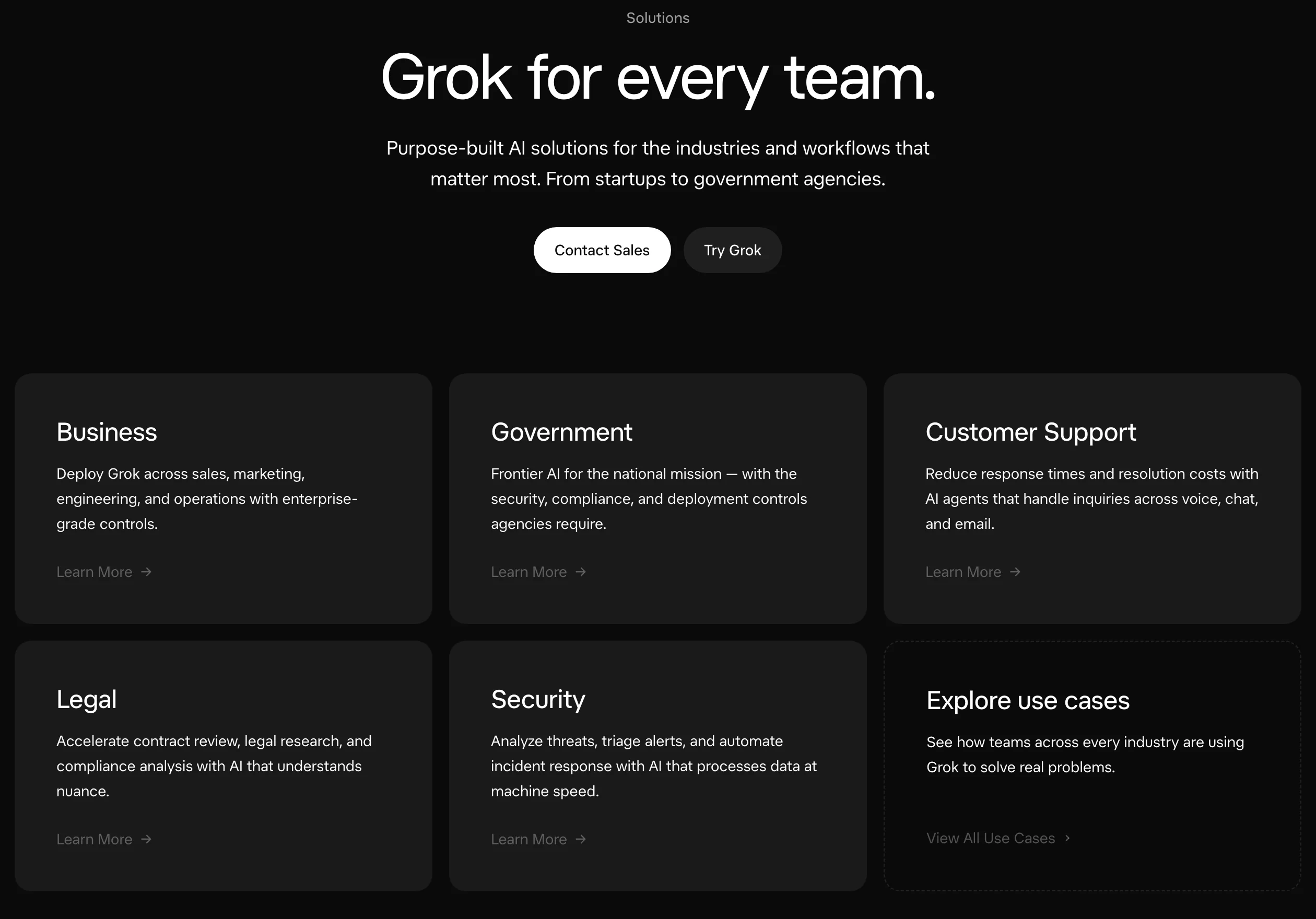
That is the page, read on 17 September 2026.
I did not want to rest that on one page, so I read xAI's product news feed back to May 2026. It is roughly fifty launches in four months, and they are relentless: Grok Bot for Enterprise, memory in Grok Build, agents for procurement, Grok for Word, Grok for Excel, Grok for PowerPoint, Grok for Outlook, a Google Workspace add-on, voice agents, video models, a plugin marketplace, biosecurity work, and a long run of coding releases. It is an impressive four months. There is not one item for students on it.
That is not a criticism of the product, which is fast and good and clearly aimed at people at work. It is an answer to the question in the title. If you are choosing for school, two of these three companies have spent engineering time on your exact problem and one has spent it on somebody else's.
Both Study Modes Refuse to Give You the Answer
Here is the coincidence that convinced me the two of them are onto something.
Anthropic describes learning mode on its education page as working "like a good tutor: it asks questions that help you find the answers yourself". The original launch spelled out the mechanics: guiding rather than answering, asking "How would you approach this problem?" instead of solving it, Socratic questioning like "What evidence supports your conclusion?", and templates for research papers and study guides.
Google's student page describes homework help as uploading what you are stuck on so Gemini can "break it down with clear, step-by-step guidance to help you learn how to get to the answer". Guided Learning is a mode you switch on from the More tools menu next to the file picker, and its study layer will hand you practice questions with hints and feedback rather than solutions.
Two competitors, working separately, both concluded that the valuable student feature is the one that withholds the answer. That is a strange thing for a product team to build. Every instinct in consumer software says reduce friction and give people what they asked for, and both of these companies deliberately did the opposite in the one place where the customer is a student.
Grok's product page makes the opposite promise, and makes it well: "Answers with reasoning you can follow step by step." Showing the work is genuinely useful on a problem set, and Grok is good at it. But showing the work and withholding the answer are different products, and only one of them survives contact with the version of you that is starting at 11pm.
Which means the honest framing of this whole comparison is not about capability. Two of these will help you learn the material if you find the setting. One will help you finish the assignment. You know which of those your term actually needs, and you also know which one you will reach for at 11pm.
Google's Study Tools Are Switched Off on Your University Account
This one is worth checking before you plan a semester around it. Google's own help article carries two restrictions on the learning tools:
"For now, these features are only available in English and in the United States."
"For now, these features are not available to users under the age of 18 or users signed in with a work or school account."
Read that second line twice. The study features are unavailable on the account your university issued you. To get Gemini's practice questions and its OpenStax textbook grounding, you have to be signed in to a personal Google account, not the one with your institution's domain on it.
It is not the only Google student perk with that shape. The free student plan has the same restriction in its terms, which I went through along with every other vendor's offer in every AI student discount in 2026. Two separate Google surfaces, both aimed at students, both excluding the account most students actually use for coursework. Set up a personal account first and save yourself the afternoon.
The Claude That Is Good for School Is the One Your University Buys
There is a gap between the Claude Anthropic markets to education and the Claude you get for $20, and it is bigger than a feature or two.
Anthropic's education announcement states that in Claude for Education, student "conversations are private by default and are excluded from AI training by default as well". On the consumer plans, the same company's pricing table prints model training as opt-out for Free, Pro and both Max tiers alike, which I went through in detail in is Claude Pro worth it. The default flips depending on who signed the contract, and it is not you.
Learning mode has the same shape. It is the headline feature on Anthropic's higher education page, but search the consumer help centre for "learning" and you get Claude Code power-user tips and instructions for setting up Claude for Teachers across a school district. There is no article explaining to an individual subscriber where the setting is. Anthropic announced learning mode as part of Claude for Education, living inside Projects, and the consumer documentation has never caught up with the marketing.
So before you pay anything for Claude, spend one email on your IT or library help desk asking whether your institution already has an agreement. Anthropic names Northeastern, LSE, Champlain College, the University of San Francisco School of Law and Northumbria among its campus-wide partners, and the list has been growing for over a year. Campus access is free to you, and it is a materially better product than the one on the pricing page.
One more, for anyone on a research degree: Anthropic's education page currently carries a banner offering the Claude Team plan to scientists at academic and nonprofit research institutions "at no cost to start". If that is you, it is worth two minutes.
Only One of These Three Mentions Your Homework in Its Own Rules
Everyone writes the paragraph about checking your university's academic integrity policy. Nobody checks the vendor's, which is strange, because one of these three names the exact thing you are wondering about.
Anthropic's Usage Policy, in the section on fraudulent and deceptive practices, lists this as a prohibited use:
"Plagiarize or submit AI-assisted work without proper permission or attribution"
That is not a syllabus. That is the terms of the product. Submitting work Claude helped with, without permission or attribution, is a violation of Anthropic's own rules, which sits oddly beside the fact that half the internet sells Claude as an essay machine.
Google gets to the same place from a different direction. Its generative AI prohibited use policy bans "misrepresenting the provenance of generated content by claiming it was created solely by a human, in order to deceive". Less specific, same target, and it certainly covers a paper with your name on it.
xAI's Acceptable Use Policy has no academic clause at all. I searched the full text for plagiarism, academic, school, exam and attribution. The nearest thing in it is a line about "misleading others or not being transparent regarding your use of AI", filed under illegal and harmful activity next to phishing and fake accounts. It is a policy about deceiving strangers, not a policy about coursework.
None of this changes what your department will do if you are caught. It does mean that on the one question students most want an authoritative answer to, the three companies range from explicit to silent, and the explicit one is the company whose product is most often recommended for essays.
Which Model for Which Coursework
Pulling the above into the actual jobs.
Long papers, literature reviews, dissertations: Claude. The upload ceiling is the reason. Twenty files to a chat at 500MB each is an entire term of sources rather than one article, and Anthropic's paid plans run up to a million tokens of context, so the model still has chapter two when you are arguing about chapter nine. It also disagrees with you, which is the single most useful property in a thing you are asking to review an argument. Keep each PDF under 100 pages if the figures matter.
Recorded lectures, seminars, anything that arrives as sound or video: Gemini, on a paid plan. Nothing else on this list competes, and the free tier's ten-minute cap is not a real option.
Readings you have to get through this week: either Gemini or Claude, and the tiebreaker is the format. PDF goes to Claude. A deck, a video, a folder of mixed formats or anything from Drive goes to Gemini, which takes ten files of any supported kind in one prompt.
Exam prep: Gemini, comfortably. Study notebooks per course, quizzes generated from your own notes, a tracker for weak areas, and an audio overview of your material. The other two will make you practice questions if you ask. Only Google has built the room to keep them in.
Problem sets: any of the three, checked by a second one. All three read a photo. All three show steps. All three will also walk you confidently through a sign error in line four and then build the rest of the answer on it, which is the failure mode that costs marks. Run anything that counts past a second model, because the two models disagreeing marks the exact line that needed a human.
Presentations and anything living in Office: Grok. The add-ins for Word, PowerPoint and Excel, and the Google Workspace add-on for Docs, Sheets and Slides, mean Grok is already inside the file rather than waiting for an upload. For a group project on shared Office documents, that removes the whole copy-paste loop.
A current-events topic, a policy that changed last week, a debate that is live right now: Grok. Live X search is a real monopoly among these three, and neither of the others has anything like it at any price. I went through how it compares against Anthropic's lineup in detail in Grok vs Claude.
And the benchmark, since it belongs somewhere. On Artificial Analysis's intelligence index, read on 17 September 2026, Claude Opus scores 51, Grok scores 44, Google's Flash model scores 41 and Claude Sonnet scores 38, out of a 199-model field whose median is 25. Every one of these is a strong model. That spread is smaller than the difference between a tool that takes your lecture recording and one that does not, which is exactly why it goes at the bottom of this post rather than the top.
Where ChatGPT Went
Fair question, since it is the assistant most students already have open. It is left out because this comparison is about the three that get asked about together, and adding a fourth column would have meant less room for the details that decide it. ChatGPT's student case is its own argument and I have made it separately, in is ChatGPT Plus worth it for students. If you want all of them scored against each other in one table, that is the five-way.
The short version, so the omission is not misleading: OpenAI does run a student offer, and it is a time-limited one rather than a discount. It belongs in the same conversation as Google's free year, and both are in the discounts post above.
The Version Where You Don't Pick One
Read the table at the top again and notice its actual shape. Every row has a different winner, and none of the winners is winning on intelligence. Gemini wins the lecture because it accepts audio. Claude wins the reader because of a page count. Grok wins the group project because of a Microsoft add-in. These are plumbing decisions, and no single subscription can win all of them, because the constraints are built into three different products by three different companies with three different customers in mind.
Which is a strange thing to have to choose between, and izzedo chat exists because you do not have to. Claude, Gemini and Grok sit in the same model picker, in one conversation, behind one login and one bill starting at $6 a month, which is less than any one of them charges alone.
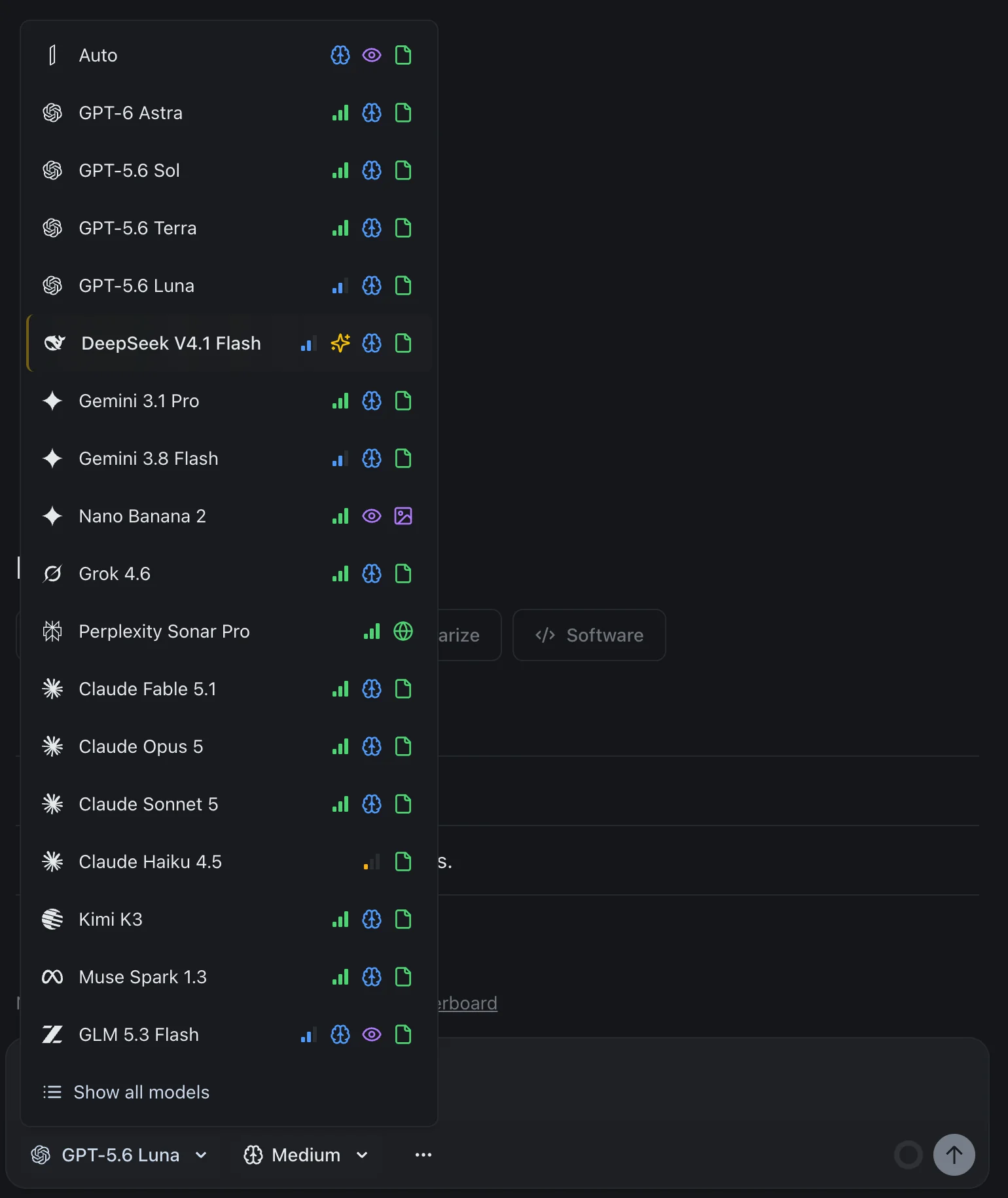
For a term that turns into something specific. A project per course keeps that module's conversations, files and instructions together, so every new chat inherits the citation style and the professor's emphasis instead of being told again. Switching models mid-thread means the second opinion happens inside the work rather than in another tab: have one model summarise the reading, then ask a different one whether the summary is fair, with both of them looking at the same conversation. Neither vendor can do that half, because neither of them sells the other one's model.
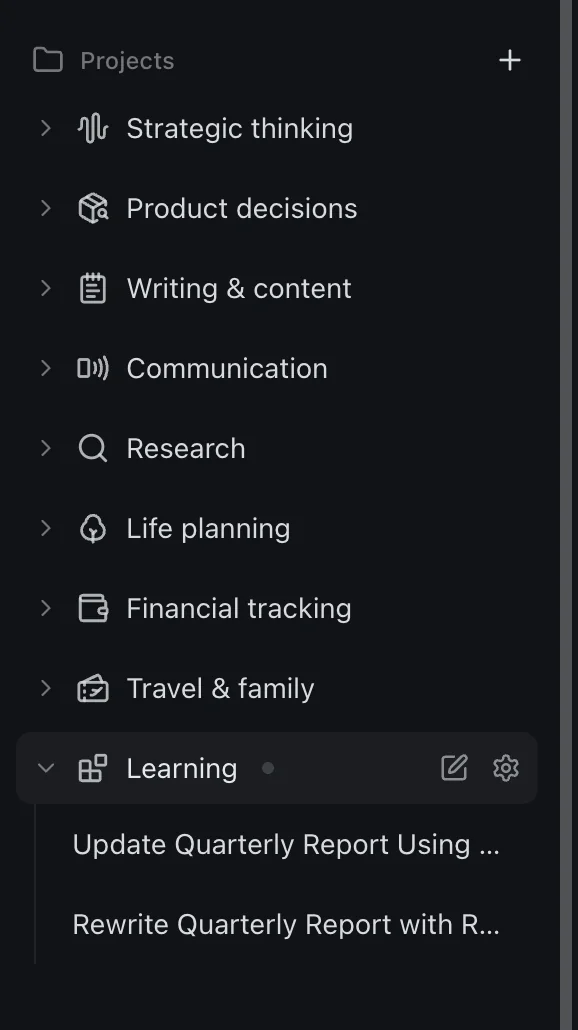
The free plan needs no card and includes the free model lineup, projects and folders, and memory that learns how you work. Paid plans from $6 add the premium tiers, which is where Claude Opus, Gemini and Grok live, plus a knowledge base you can load with a syllabus and a term of readings once and query all semester. Current allowances are on the pricing page, because that is the only honest place for numbers that move. And a strict no-training policy with zero provider retention applies on every plan, including the free one, which as this post has established is something none of these three companies offers an individual at any price.
The habit underneath all of it is in not running one model on everything, and it matters more at university than anywhere else, because a confident wrong answer in a seminar is embarrassing and a confident wrong answer in a submitted paper is a grade.
The Bottom Line
Claude vs Grok vs Gemini for school is not a question about which model is smartest. All three are strong, the spread between them on an independent index is seven points, and none of that is what will decide your term.
What decides it is what each one will accept and what each company built. Gemini takes your lecture recording, and it is alone in that, though the free tier's ten minutes will not hold one. Claude takes the biggest documents by a distance and then stops reading your charts at page 101, and it has no PowerPoint support at all. Grok publishes no limits, has shipped nothing for students in four months of near-weekly launches, and is nonetheless the one already sitting inside the Office file your group is editing.
Two of the three built a study mode designed to refuse you the answer, which is the most quietly impressive thing in this whole comparison. One of the three bans handing in its own output without attribution, and it is the one most people recommend for essays.
And the Claude that is genuinely built for school, the one with lecture transcripts, peer-reviewed sources and privacy on by default, is not the $20 plan. It is the one your university might already be paying for. Ask before you subscribe. It is one email, and it is the highest-value thing in this post.
Frequently asked questions
Which is better for school, Claude, Grok or Gemini?
It depends on what your coursework arrives as, not on which model reasons best. Gemini is the only one of the three that takes an audio file, so a recorded lecture is a Gemini job. Claude takes the largest documents, up to 500MB and 1,000 pages per PDF, so a long course reader is a Claude job. Grok publishes no upload limits at all, but it sits inside Word, PowerPoint and Excel as an add-in, so it is the one that is already where your assignment is. Pick by the input and the answer stops being a matter of opinion.
Can Gemini summarize a recorded lecture?
Yes, and it is the only one of these three that can. Google's help page caps total audio length at 10 minutes on the free tier and extends it to 3 hours on Google AI Pro or Ultra. Since almost no lecture is under 10 minutes, the free tier will not take a real one and the paid tier will take several. Claude's supported file list has no audio format on it, and xAI has never published one for Grok.
Does Claude have a study mode?
Anthropic markets one. Its higher education page says Claude's learning mode "works like a good tutor: it asks questions that help you find the answers yourself", and the original announcement describes it as living inside Projects and asking "How would you approach this problem?" instead of answering. The catch is where it lives. Searching Anthropic's consumer help centre for learning turns up Claude Code tips and K-12 teacher setup, not an article telling an individual subscriber how to switch it on. If your university has a Claude for Education agreement, ask its IT desk before you pay $20 for it yourself.
Is it against the rules to use AI for homework?
Your university's policy is the one that decides your grade, and it varies by course. What almost nobody checks is that the vendor has a policy too, and one of these three names your homework directly. Anthropic's Usage Policy lists "Plagiarize or submit AI-assisted work without proper permission or attribution" as a prohibited use. Google's generative AI policy bans "misrepresenting the provenance of generated content by claiming it was created solely by a human, in order to deceive". xAI's Acceptable Use Policy has no academic clause at all.
Is Gemini free for students?
Google gives verified university students a student plan at no cost for one year, and it is the largest student offer any of these three companies makes, because Anthropic and xAI make none. The plan you get depends on the country of your institution, a payment method is required at sign-up, and the terms exclude several countries outright. I went through every vendor's offer and its renewal price separately, since what you pay in month thirteen is the part the marketing pages skip.
Which of the three is best for essays and long papers?
Claude, on the inputs alone. It accepts PDFs up to 1,000 pages at 500MB a file and up to 20 files in one chat, which is a semester of readings rather than a single article, and it runs up to a million tokens of context on paid plans. Two limits worth knowing before you rely on it: it only analyses images and charts inside PDFs of 100 pages or fewer, and PowerPoint is not on its supported document list at all, so a lecture deck has to be converted to PDF first.
Ready to try multi-model AI workflows?
Access GPT, Claude, Gemini, Perplexity, and more — all in one place.
Start for Free →