How Much Does ChatGPT Cost? Full 2026 Pricing Breakdown
ChatGPT ranges from $0 to $500 a month for one person, climbs per seat for teams, and turns into pay-per-token for the API. Here's every tier explained — and what a full AI stack really costs next to one flat $6 bill.
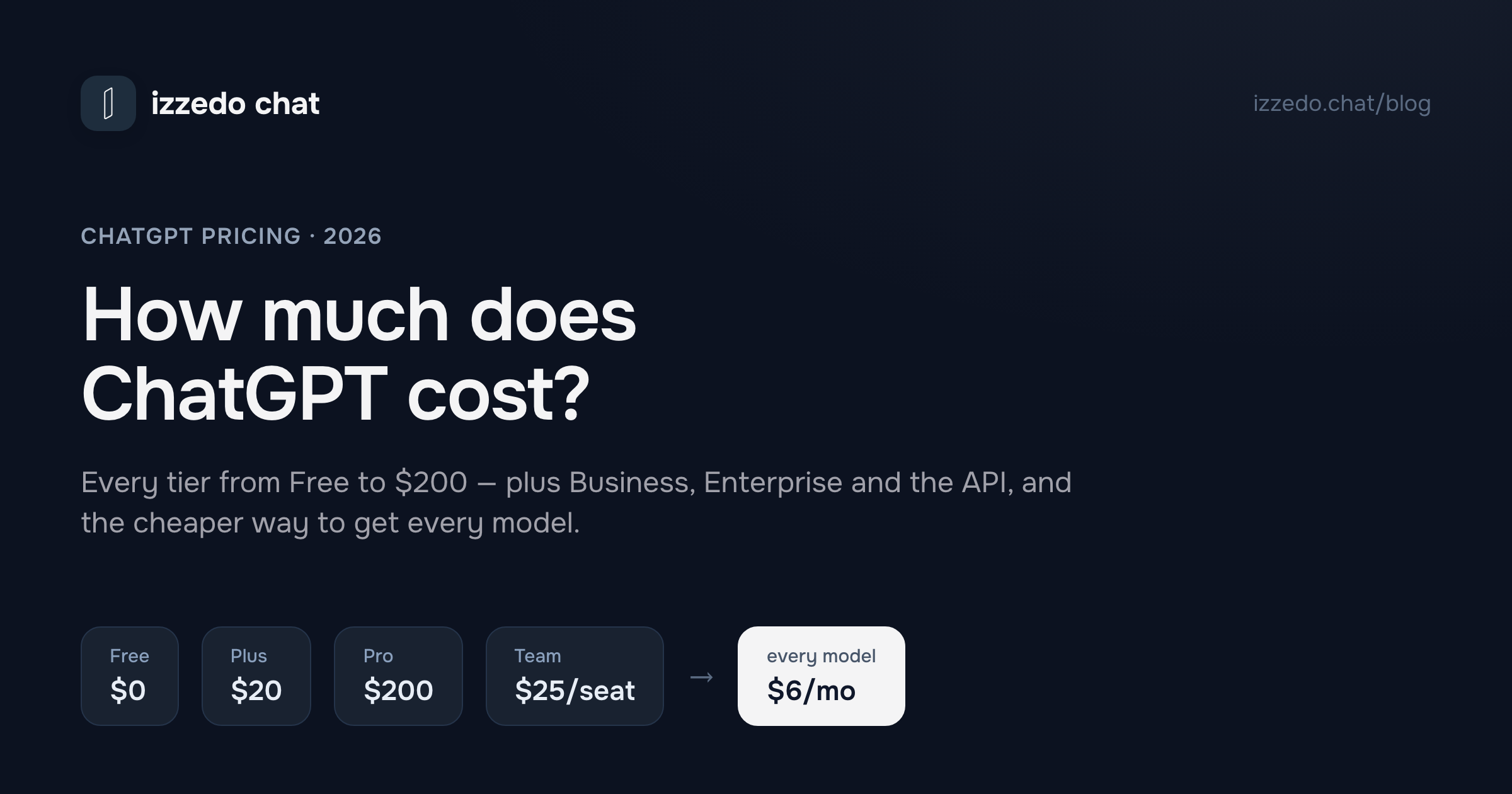
"How much does ChatGPT cost?" has a longer answer than it used to. In 2026 the price runs from $0 to $500 a month for one person, climbs per seat for teams, and becomes pay-as-you-go metering the moment you touch the API. So this is the full breakdown — every tier, what each one actually includes, the costs that never appear on the pricing page, and the question hiding underneath all of them: not what ChatGPT costs, but what a complete AI setup costs.
ChatGPT Pricing at a Glance
Here's every current tier in one place. Prices are US figures at the time of writing — OpenAI localizes some plans by country and changes numbers often, so treat this as a dated snapshot, not a contract.
| Plan | Price (US) | What it is |
|---|---|---|
| Free | $0 | Everyday access, lighter model, tighter limits, ads |
| Go | $6/mo | More messages, uploads, images and memory than free — lighter model, may include ads |
| Plus | $20/mo | Flagship model, no ads, the full feature set |
| Pro | $100/mo | ~5× Plus usage + the extended reasoning tier |
| Pro | $200/mo | ~20× Plus usage for existing subscribers; new ones get a smaller allowance |
| Pro | $500/mo | 25× Plus usage, plus Ultrafast in Work and Codex |
| Business | $25/user/mo standard, $125 premium | Team workspace with admin controls (both seats cheaper billed annually) |
| Enterprise | Custom quote | Volume seats, advanced security and support |
| API | Per token | Pay-as-you-go for developers building on the models |
The rest of this post walks each row, then adds the column no pricing page includes — what it costs to actually own the best model for every job, and the cheaper route to that (jump to it).
How Much Is ChatGPT Plus, Pro, and Per Month?
The three questions people search most, answered in one line each:
- How much is ChatGPT per month? Anywhere from $0 to $500, depending on tier — but for most individuals who pay, the real number is $20 (Plus).
- How much does ChatGPT Plus cost? $20/month in the US. It's the default paid plan and the first ad-free one.
- How much does ChatGPT Pro cost? $100, $200 or $500/month — same model access, wildly higher usage ceilings.
Everything below is the detail behind those numbers.
The Consumer Plans: Free, Go, Plus, Pro
For a single person, ChatGPT is a four-rung ladder, and each rung answers a narrower question than the last.
Free ($0) is a real product, not a trial. You get unlimited everyday text chat on a lighter default model, tight limits on tools like uploads and image creation, and ads, which started in the US in February and have spread to more countries since. For occasional questions, quick explanations, and short drafts, it holds up fine; the tool limits and the shallower model only bite on heavy days. What the free plan includes, and what it costs you instead of money, is in Is ChatGPT free?
Go ($6/mo) is the newest and cheapest paid tier, built to catch free users who keep hitting limits but balk at $20. It buys more messages with tools, more uploads, more image generation, longer memory, and double the free tier's context window — but it stays on the lighter model family, keeps deep research at the same limited level as free, and carries OpenAI's "may include ads" note. It's a fair deal for one specific person: the casual daily chatter on a budget.
Plus ($20/mo) is what most people mean by "paying for ChatGPT," and the first tier that feels like the whole product: the flagship model as your default, generous everyday limits, no ads, image generation, file and data analysis, voice, projects, and the research and agent features at standard allowances. Whether that's money well spent is its own long question — I've answered it in detail in Is ChatGPT Plus worth it?
Pro ($100, $200 or $500/mo) is where the numbers get serious. All three rungs share the important part — OpenAI's most capable configuration, including the extended, slow-thinking tier for genuinely hard problems. What you're buying up is headroom: about 5× Plus's usage at $100, about 20× at $200, and 25× at $500, which is also the only tier with Ultrafast. Pro won't make everyday answers smarter; it removes the ceilings a heavy user keeps hitting. If you're only curious whether $200 AI "feels" better, it won't.
Update, 29 September 2026. OpenAI reopened the $200 Pro tier to new subscribers, after pausing sign-ups on 10 September, and new subscriptions come with a smaller usage allowance than before. Existing subscribers keep the old one through 29 October. The same day it added Pro 500 at $500 a month, so the personal ladder now tops out at $500. OpenAI's launch post puts Pro 500 at 25 times Plus's allowance but gives no new figure for Pro 200, and I went through what the $500 actually buys separately.
One rung on this ladder is temporarily free if you're enrolled somewhere: eligible US students can claim four months of Plus before October 31, after which it bills at the usual $20. That's the only price break OpenAI offers a consumer, and it isn't a standing rate. Every AI student discount in 2026 covers it alongside what the other vendors give students, including the two that are permanently cheaper rather than temporarily free.
That's the quick version of the consumer ladder. For a rung-by-rung "which should I actually buy," I've written a full ChatGPT Go vs Plus vs Pro breakdown. Here, the more interesting rows are the ones consumer guides skip — teams and the API.
ChatGPT Business Pricing: What a Team Seat Costs
Once more than one person is involved, ChatGPT stops being a monthly subscription and becomes a per-seat line item, which changes the math entirely.
Business (OpenAI's team plan, formerly "Team") now sells two kinds of seat. The second one is new as of August 2026, so most ChatGPT business pricing articles you'll find still describe a single $25 seat:
| Seat type | Billed monthly | Billed annually | What the seat gets you |
|---|---|---|---|
| Standard | $25/user/mo | $20/user/mo | Plus-grade access in a shared workspace, admin console, business data kept out of training by default. Runs on a five-hour usage limit |
| Premium | $125/user/mo | $100/user/mo | Five times a standard seat's usage, and the five-hour limit removed |
A workspace needs a minimum of two paid seats, and you can mix the two types, then reassign them as people's workloads change.
Price is the smaller half of that decision. The bigger one is control: a Business member can't export or delete their own chats, and merging a personal Plus history into the workspace can't be undone. I've compared Plus and Business row by row, including what the owner of a small team does and doesn't get when someone leaves.
The premium seat is worth pausing on, because it's the individual ladder repeated one level up. OpenAI's answer to "my team keeps hitting limits" is the same as its answer to individuals: a rung costing five times as much, selling headroom rather than better answers. A team of five that upgrades everyone goes from $125/month to $625/month without a single new capability arriving.
ChatGPT Enterprise Cost Per User
Enterprise is quote-only. OpenAI publishes no number, so any specific ChatGPT enterprise cost per user you read is either someone's leaked contract or a guess wearing a suit. What's reliably true is the shape: it's negotiated per company, sits above the Business per-seat rate, and comes with a seat minimum, an annual commitment, and the security, compliance and support guarantees large organizations need.
The useful way to sanity-check a quote is to price it against the most expensive seat OpenAI does publish, the $100-per-user premium Business seat on annual billing. Above that number, you should be able to name exactly what the premium buys, whether that's SSO and SCIM, data residency, a support SLA, or compliance paperwork. If the answer is "the same models, but with a salesperson attached," the Business plan is sitting right there.
ChatGPT Small Business Pricing: What 3 to 5 People Actually Pay
There's no small-business tier, which is the honest answer to a question a lot of people search. Small teams buy the same Business seats as everyone else, so the arithmetic is short:
- Three people: $75/month on monthly billing, $60/month if you commit annually. About $720 a year.
- Five people: $125/month monthly, $100/month annually. About $1,200 a year.
- One person: not eligible. The two-seat minimum means a solo operator stays on Plus at $20, and buys a second seat only when there's a second human.
For a small operator, the number that matters isn't the $25. It's that $1,200 a year buys five people access to exactly one company's models, before anyone has touched Claude for a contract review or Perplexity for a cited answer.
The thing to notice: per-seat pricing multiplies a single-vendor decision across your whole team. Ten seats of Business is ten subscriptions to one company's models, and the bill arrives every month whether the team used the second-best model for the job or the right one.
The ChatGPT API: Paying by the Token
The API is the tier most "how much does ChatGPT cost" articles ignore, because it isn't a subscription at all. You don't pay monthly — you pay per token (loosely, per word) for everything you send in and get back, and you only pay when your code makes a call.
As a rough mid-2026 guide, the flagship model runs about $5 per million input tokens and $30 per million output, with faster, lighter models a fraction of that, plus discounts for batching and for reusing cached prompts. Those figures move faster than any subscription price, so check OpenAI's official API pricing before you build against them.
Two honest caveats. First, most people reading this will never spend a cent on the API — it exists for developers wiring ChatGPT into their own apps, not for chatting. Second, per-token billing is deceptively easy to underestimate: a quiet prototype costs pennies, but a popular product that calls the flagship model on every user action can turn into a four- or five-figure monthly bill nobody forecast. The API is the cheapest way to touch these models and the easiest way to overspend on them.
The Costs the Pricing Page Doesn't Show
Add up the sticker prices and you still haven't found the real cost of living inside one AI vendor. Three quieter ones:
- Per-seat multiplication. For teams, the price isn't $25 — it's $25 × everyone, every month, and annual plans ask you to commit up front.
- The upgrade tax. The ladder is designed so that hitting a limit nudges you to the next rung. "I pay and still hit caps" is the most common Plus complaint, and OpenAI's answer isn't more room — it's Pro at $100, $200 or $500. Worth knowing which ceilings you'd actually be buying past: here's what ChatGPT caps at each tier, and what the published numbers still are.
- The single-vendor cost. This is the big one, and it's invisible on any tier. Every dollar buys you more of one company's models — and no single model is best at everything. Pay $20 for the strongest generalist and you've still bought nothing for the tasks where a different vendor leads. One model is a single point of failure; paying more to deepen it doesn't fix that.
- The discontinuation risk. A subscription buys access, not a guarantee. OpenAI shut the Sora app in April 2026 and switched the Sora API off on 24 September. That is the same lesson in a different product. What a replacement actually costs is a smaller question than whether your next one can be swapped without changing plans.
Which leads to the number that actually matters.
The Real Cost of a Full AI Stack
If your goal is the best answer for each job — the strongest writer, the strongest researcher, the best fact-checker — you're not really pricing ChatGPT. You're pricing a stack, because those are different models from different companies. Bought the normal way, one subscription each, it looks like this:
| Model | Standalone plan | Price/mo |
|---|---|---|
| ChatGPT | Plus | $20 |
| Claude | Pro | $20 |
| Gemini | AI Pro | $19.99 |
| Perplexity | Pro | $20 |
| Grok | Premium | $30 |
| DeepSeek | free app | $0 |
| Total | six accounts, five bills | ~$110/mo |
Roughly $110 a month — around $1,320 a year paying month to month, or nearer $1,144 if you prepay each one annually — to have every major model on tap. Almost nobody actually pays this, and for a good reason: it means six logins, six renewal dates, and five apps sitting idle while you use the sixth. So most people don't build the stack. They pick one vendor — usually after agonizing over ChatGPT Plus vs Claude Pro — pay $20, and quietly accept that half their tasks are going to the wrong model. (DeepSeek is the odd one out here — it gives away frontier reasoning for almost nothing, which is a whole pricing story of its own. Qwen plays the same game, and both are covered in the guide to Chinese ChatGPT alternatives.) Claude's row hides a ladder of its own too — the full Claude pricing breakdown walks it from free tier to the $200 Max plan, and Grok's $30 row is now an X subscription with X Premium+ included, unpicked in how much Grok costs. If you're choosing just one of these, the best AI subscription compares what each main plan bundles, from Google's 5 TB of storage to Microsoft's Office apps.
If you're already carrying two or three of those charges, the useful next step is arithmetic on your own statement rather than on this table — the subscription audit walks through it, including the bundles that bill you twice for the same model. And if the bundle you're weighing is Poe, its compute-point meter is its own kind of unpredictable bill — the best Poe alternatives covers what people move to and why.
There's a third option that isn't "one vendor" or "$110 for six."
The Cheaper Way: Every Model for $6
The premise worth questioning is that each model needs its own subscription. It doesn't. izzedo chat puts ChatGPT, Claude, Gemini, Grok, Perplexity, DeepSeek, Qwen, Llama and more — plus image models — behind one login for $6/month. That's the same $6 OpenAI charges for Go, except it buys all of them, and you can switch models mid-conversation without losing the thread.
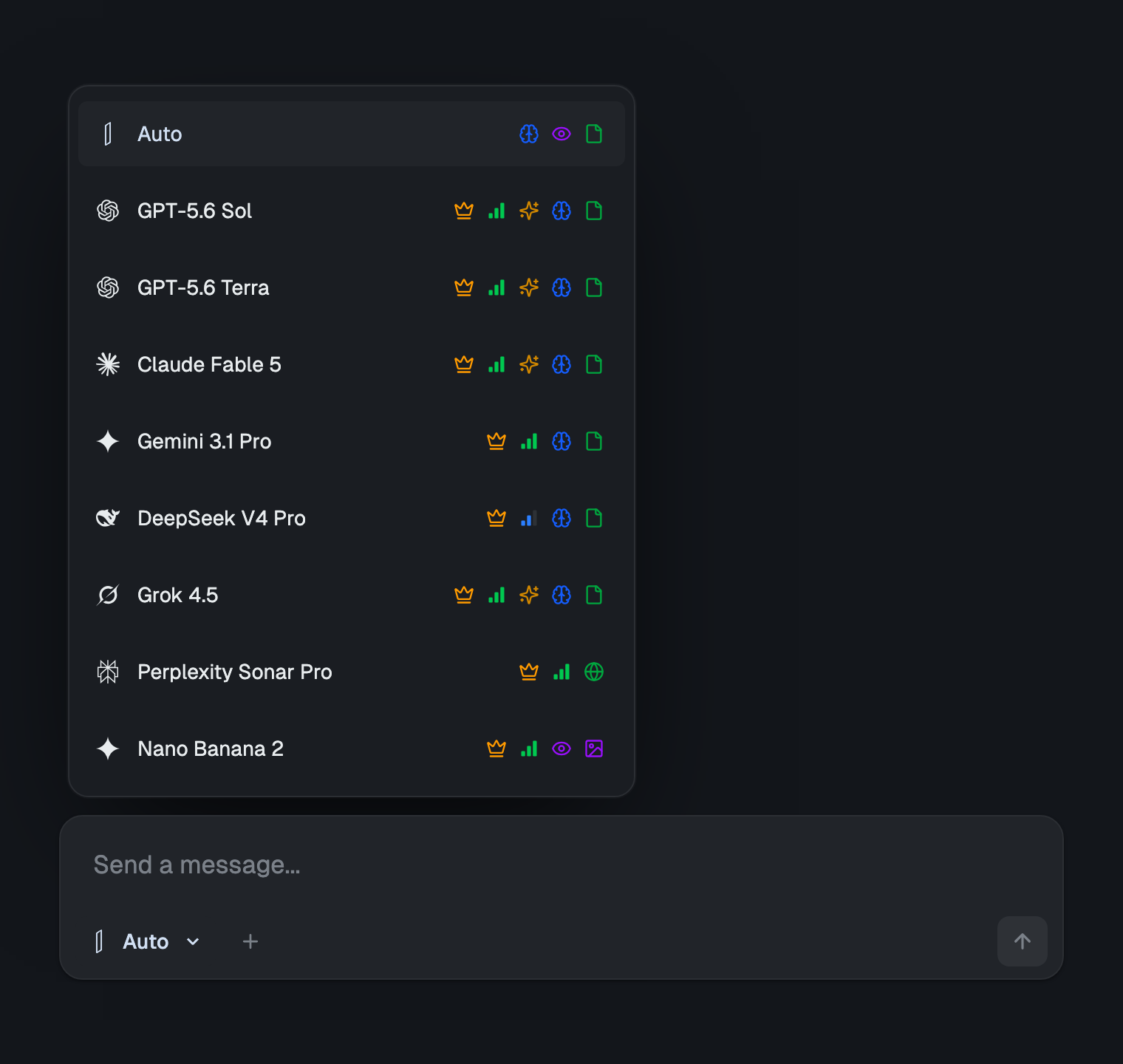
Set the $110 stack next to it and the gap is the whole point: every major model, one bill, for less than any single one of them charges alone — and less than OpenAI's cheapest paid rung. There's a free plan with no credit card to test it first — the free models included, with the exact usage allowance shown on the pricing page.
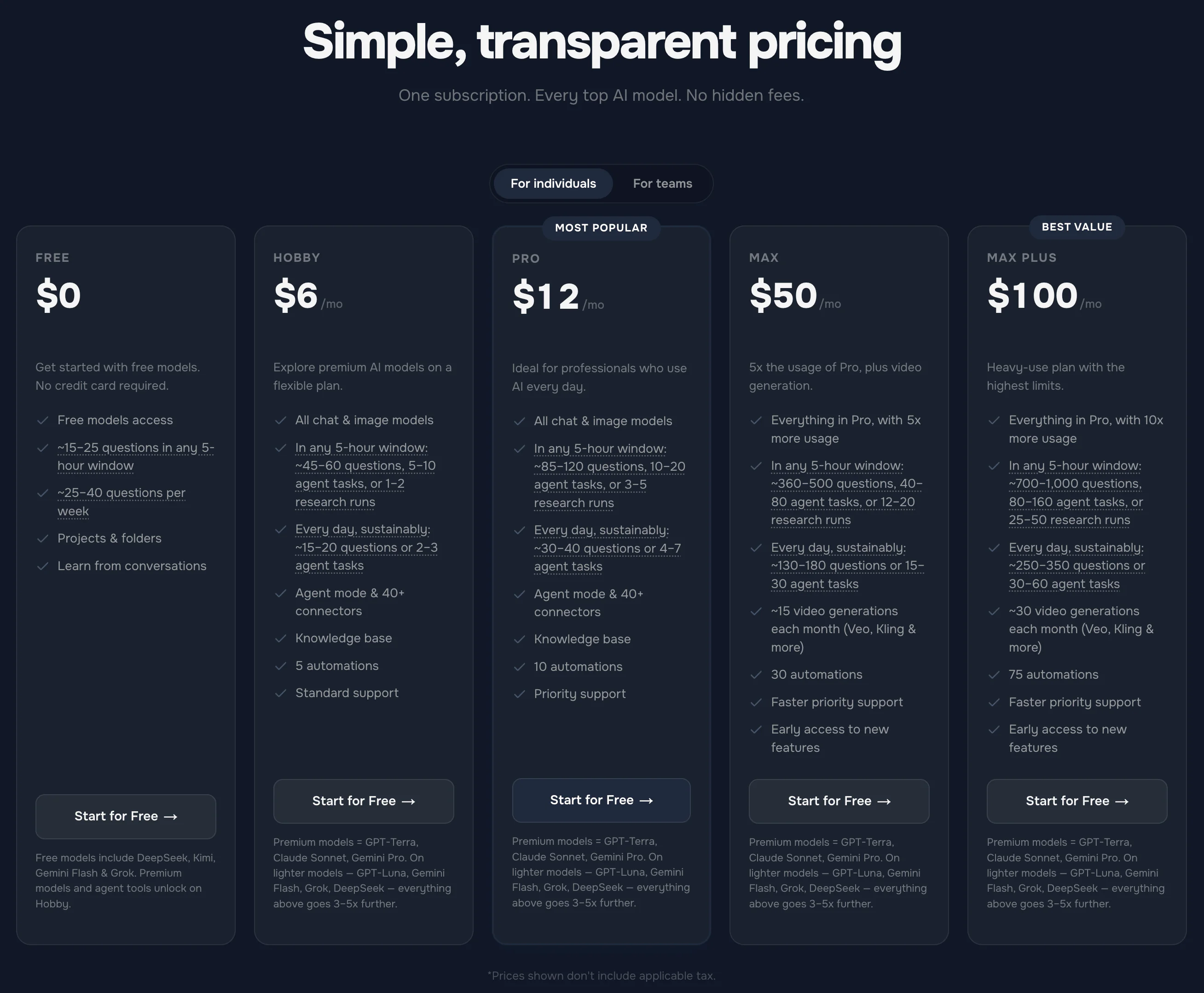
Since the entire point of this page is honest numbers, here's ours. Like every provider, izzedo caps usage somewhere — the priciest models cost real money each time they run. The difference is where the cap sits: there are no credits to count and nothing to prepay, just fair use measured quietly on a short rolling window that clears in hours, with a weekly pool behind it. Hammer the most expensive models back-to-back and you wait for the window; do it all week and you wait for the week. The invoice only grows if you switch on usage-based billing, which is off by default and stops at a cap you set.
And it's a workspace, not just a model switcher: projects with their own instructions, a knowledge base for your documents, scheduled automations, 50+ integrations (Notion, Google Drive, Gmail and more), and answers from several models at once when you'd rather compare than take one model's word for it. It's GDPR compliant, doesn't train on your inputs, and keeps nothing you don't choose to save. If the whole approach is new to you, here's how running multiple models in one place actually works. Teams get their own tiers too — worth a look next to $25-per-seat Business.
The Bottom Line
So, how much does ChatGPT cost in 2026?
- $0 if you're occasional — the free tier is better than most people assume.
- $6–$20 for individuals — Go for casual chatting, Plus for real daily work inside one vendor.
- $100–$500 for the heavy few whose work genuinely stalls at Plus's limits.
- ~$25 per seat for teams, multiplied across everyone, and quote-only above that.
- Per token for developers — cheap to start, easy to overspend.
Every one of those answers the same narrow question: how much of ChatGPT do you want? The broader question — how much does it cost to always have the right model for the job — has a better answer than $110 a month. It's $6, and there's a free plan to prove it before you pay anything.
Rather have ChatGPT, Claude, Gemini, Grok and Perplexity in one thread than price them one at a time? Try izzedo chat free — no credit card required.
Topics
- how much does chatgpt cost
- ChatGPT pricing
- ChatGPT Plus cost
- ChatGPT Pro
Start on the free plan. Pay when you want the premium models.
Free
$0
Claude Haiku, Gemini Flash, Grok and more, with agent mode and 50+ connectors
Hobby
$6/mo
Every chat and image model
Pro
$12/mo
Higher limits, 400k context and more video models
Max
from $50/mo
5x or 10x Pro's usage, and every video model
Frequently asked questions
How much does ChatGPT cost per month?
It depends on the tier. ChatGPT is $0 on the free plan, $6/month for Go, and $20/month for Plus — the tier most paying individuals choose. Above that, Pro runs $100, $200 or $500/month for heavy users, Business is $25 per user per month for a standard team seat ($125 for a premium one), Enterprise is custom-quoted, and the API is billed per token rather than as a subscription. US prices, mid-2026.
How much does ChatGPT Plus cost?
ChatGPT Plus costs $20/month in the US. That buys the flagship model as your default, higher limits than free, no ads, and the full feature set — image generation, file and data analysis, voice, projects, and the research and agent tools at standard allowances.
Is there a free version of ChatGPT?
Yes. ChatGPT has a permanent $0 tier with no credit card required. It runs a lighter default model, has tighter usage limits, and — in the US since early 2026 — shows ads. For occasional questions and short drafts it's genuinely enough; you feel the limits mainly on heavy days.
How much does ChatGPT Pro cost?
ChatGPT Pro has three price points: $100, $200 and, since 29 September 2026, $500 a month. OpenAI's usage tables describe the first two as roughly 5× and 20× the usage of Plus, though new $200 subscribers now get a smaller allowance than before, and OpenAI puts the $500 tier at 25 times Plus, with Ultrafast, a faster version of its newest model inside ChatGPT Work and Codex. All three include the extended reasoning tier for the hardest problems. Pro doesn't make everyday answers smarter — it raises the usage ceilings — so it only pays off if Plus's limits regularly interrupt your work.
How much does ChatGPT Business cost per user?
ChatGPT Business sells two seat types. A standard seat is $25 per user per month billed monthly, or $20 per user per month billed annually, and runs on a five-hour usage limit. A premium seat, added in August 2026, is $125 per user per month monthly or $100 annually, and gives five times the usage with no five-hour limit. A workspace needs at least two paid seats and you can mix the two types.
How much does ChatGPT Enterprise cost per user?
OpenAI doesn't publish an Enterprise price — it's quoted per company, with a seat minimum and an annual commitment. Any exact per-user figure you see quoted online is someone's contract or a guess. Benchmark a quote against the $100 per user per month premium Business seat, which is the most expensive seat OpenAI does list, and ask what the difference buys beyond the same models.
How much does the ChatGPT API cost?
The API isn't a subscription — you pay per token (roughly per word) for what you send and receive. As a rough guide in mid-2026, the flagship model runs about $5 per million input tokens and $30 per million output, with faster, lighter models a fraction of that. Most people never touch the API; it's for developers building ChatGPT into their own products.
What's the cheapest way to get ChatGPT plus other AI models?
One multi-model workspace instead of several subscriptions. izzedo chat puts ChatGPT, Claude, Gemini, Grok, Perplexity, DeepSeek and more behind a single login for $6/month — the same price as ChatGPT Go — with a free plan that needs no credit card. For identical money, you get every major vendor instead of one vendor's lighter model.