Best Poe (AI) Alternatives in 2026: Every Model, One Flat Plan
An honest look at the best Poe alternatives in 2026, who each one is actually for, and why the compute-points system is the thing that pushes most people out.
If you're reading this, you probably already tried Poe, Quora's app that lets you chat with lots of AI models and bots in one place, and something nudged you toward the exit. For most people that something is the points. Every message spends compute points out of an allowance, the best models spend them fastest, and Poe gives you a budget setting so you can cap what a single message is allowed to cost. That last part is the tell. When an app ships a budgeting screen, budgeting is part of using it.
Quick disambiguation first, because search engines mix these up: this guide is about Poe the AI chat app, not Path of Exile the game or Power over Ethernet the networking standard, both of which also go by "PoE." If you wanted one of those, this isn't your page.
For everyone still here: below is an honest look at the best Poe alternatives in 2026, what each one is genuinely good at, who it's for, and where each falls short. I'll be straight about when you should just stay on Poe, too. Then I'll show the option most ex-Poe users land on: every model in one place, on a flat plan, with no points to ration.
What Poe Is — and Why People Look for Alternatives
Poe's pitch is a good one: instead of juggling separate apps, you get ChatGPT, Claude, Gemini, and a long tail of community bots behind a single subscription. For a lot of people that was the first taste of a multi-model workflow, and it's genuinely useful.
The points meter reaches into the conversation
Poe's paid plans come with an allowance of compute points, granted daily or monthly depending on the plan, and every message spends some of them. Not equally, though. The strongest models cost far more per message than the light ones, so if you lean on the best models for real work, the allowance goes quickly. Unused points don't roll over. You can pre-buy more at roughly $30 per million.
None of that is hidden, and honestly, none of it is unfair. Compute costs money and Poe is upfront about the rates. What gets to people is where the accounting lands. There's a per-message budget in Settings, a separate budget you can set on any individual chat, and a warning when a message would go over it. So before the interesting question you wanted to ask, there's a small boring one: is this worth the points?
Then there's the setting most people never open. Poe's auto-manage context trims how much of your chat history gets sent to the bot with each new message, and the reason it exists is cost. Poe's own FAQ is refreshingly direct about the trade: leave it on and "you can chat for longer without using as many points," turn it off "when you need the bot to remember earlier parts of your conversation," and your per-message cost goes up.
That's the part worth sitting with. On Poe, how much of the conversation your model remembers is a billing decision.
The knowledge base belongs to the bot, not to you
Poe does still have a knowledge base, whatever you may have read. You attach files or raw text to a bot, up to 5GB or 30 million characters, and the bot pulls the relevant parts into its answers. It works fine.
Worth saying plainly, because a crop of posts announcing the death of Poe's Knowledge Base is circulating and most of them exist to sell you something else. Poe's creator documentation still lists it as a current step in bot creation. There's no announcement, no changelog entry, no help-center article. I went looking.
The real constraint is the shape of it. A knowledge base attaches to a bot, and each bot is built on one base model. Want the same documents in front of a different model? That's a different bot, and you upload again. Your material ends up copied across bots instead of sitting in one place your whole workspace can reach.
That's the itch behind most "poe ai alternatives" searches:
- Unpredictable cost. Points-per-message means you can't easily predict when you'll run out, and whatever's left doesn't carry over.
- Rationing the good models. The models you most want to use are the ones that drain points fastest.
- Memory priced as a feature. Keeping the full conversation in context costs more, so the cheap default is the forgetful one.
- Documents locked to one bot. Switch models and you're re-uploading.
- It's a chat app, not a workspace. No real projects, saved context across chats, automations, or connections to the tools you already work in.
- You only use one or two models. In which case you're paying for breadth you never touch.
None of that makes Poe bad — it makes it the wrong shape for certain people. The right alternative depends entirely on which of those itches is yours.
The Best Poe Alternatives in 2026
Here's the honest shortlist, sorted by who each one is actually for. Prices for other tools change constantly, so I've described each one's pricing model rather than a number that'll be stale next quarter.
| Alternative | Best for | How it charges |
|---|---|---|
| izzedo chat | Keeping Poe's "many models in one place" — without the points math — plus a real project workspace | Flat monthly (free plan, no card) |
| Going direct (ChatGPT, Claude, Gemini) | People who realized they only ever use one model | One flat fee per model |
| OpenRouter | Developers who want pay-as-you-go API access to many models via one key | Usage-based API credits |
| Monica | A browser-extension assistant that follows you around the web | Credit / query-based tiers |
| Open-source chat UIs | Technical users who want a free, do-it-yourself setup | Free (you host / bring keys) |
A few honest notes on each:
- Going direct is the simplest fix if your usage collapsed to one model. The catch is that wanting several models pulls you right back into multiple logins and multiple bills — the exact problem Poe was solving.
- OpenRouter is excellent, but it's a developer tool: one API key for many models, billed by usage. If you want a polished place to chat, write, and organize projects, it's the wrong layer.
- Monica keeps the assistant one click away in your browser, but its paid tiers are credit- and query-based — so you're back to metering usage, just with a different unit than Poe's points.
- Open-source options are free and flexible if you're comfortable hosting something or plugging in your own API keys; most people aren't.
- Staying on Poe is still the right call if you love its community bots and your usage fits comfortably inside the points allowance. No shame in that. Poe's bot ecosystem is genuinely deep and nothing else has quite replaced it.
If your reason for leaving is the points, and you still want many models, the next section is the one that matters.
izzedo vs Poe: Flat Pricing, No Compute Points
izzedo chat rebuilds the part of Poe people liked — every leading model in one app — around a different deal: a flat monthly bill with no points ledger.
Let me be honest about how that works, because it's probably why you're switching. Every AI service limits usage somewhere. The strongest models genuinely cost more to run, and anyone promising otherwise is hiding it. The difference is the shape of the limit. Poe hands you a pool of points and makes you do the accounting on every message. izzedo handles fair use quietly in the background — a short rolling window with a weekly pool behind it — rather than one balance you have to make last. Hammer the most expensive models nonstop and you'll hit the rolling ceiling and be back in hours; keep it up all week and you'll be waiting on the weekly one. What you can't do is burn an allowance to zero and face a top-up prompt. There's nothing to buy up front, and the bill only changes if you opt into usage-based billing, which is off by default. Current plan numbers are on the pricing page.
Under one login you get the models most people were bouncing between on Poe — ChatGPT, Claude, Gemini, Grok, Perplexity, DeepSeek, Qwen, and Llama, plus image models like Gemini Image, GPT Image, Seedream, and FLUX — and you can switch between them inside the same conversation without losing context. The full thread travels with you, and keeping it doesn't cost extra.
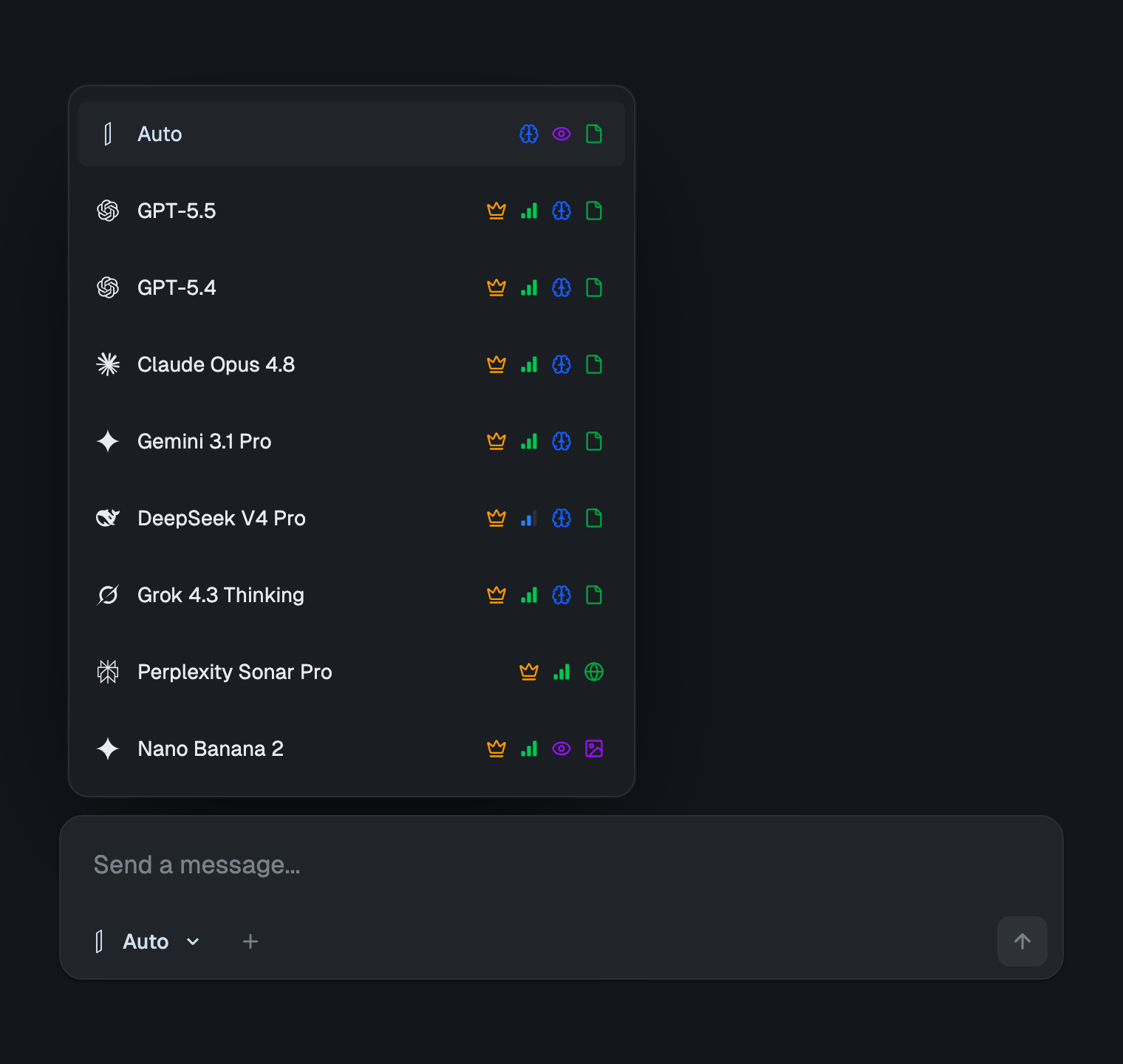
Where it stops being "just a bot picker" is the workspace around the chat:
- Projects and folders with project-level system prompts — the clean replacement for Poe's custom bots. Save the instructions and context once, and every chat in that project inherits them.
- A knowledge base that belongs to the workspace, not to one bot. Drop your documents in once and query across all of them from any model, instead of re-uploading the same files for each bot you build or re-pasting the same context into each new chat.
- Automations — run a saved prompt on a schedule (hourly, daily, weekly, or weekdays) with the model and integrations you choose.
- 50+ integrations — Notion, Google Drive, Gmail, Google Sheets, and more, so the AI can read from and write to the tools you already use.
- Second opinion built in — ask several models the same question side by side and compare, which is the whole point of having many models in one place. It's the same idea as reprompting across models to catch a weak answer.
Then there's the price itself. Running ChatGPT, Claude, Gemini, Perplexity and Grok as separate subscriptions is around $110/month, with DeepSeek free. izzedo has a free plan with no credit card, and every model unlocks at $6/month. Plan sizes are set for a realistic mix of models, not a hard per-message meter, so check the pricing page for the current numbers.
One more thing that matters if you feed it real work: izzedo is GDPR compliant, doesn't train on your inputs, and passes prompts through with zero data retention, and you can permanently delete your history whenever you want.
How to Switch From Poe
Moving over takes about ten minutes:
- Start on the free plan at izzedo chat — no credit card, so you can test it against your Poe habits before paying anything.
- Recreate your go-to bots as Projects. For each custom bot you relied on in Poe, make a Project and paste its instructions into the project-level system prompt. Now every chat in that project behaves the way your bot did — across any model, not just the one it was locked to.
- Move your documents into the knowledge base. Whatever you attached to individual Poe bots, plus anything you've been re-pasting into every chat, goes in once. Every model can reference it, not just the one bot you'd attached it to.
- Pick a model per job and switch freely. Draft with one, pressure-test with another, research with Perplexity — all in the same thread. If you're not sure which model fits which task, the multi-model workflow guide and the head-to-head comparisons are a good starting map.
- Automate the repeat work you were doing by hand in Poe — a weekly summary, a recurring brief — and let it run on a schedule.
That's it. Same "many models, one place" benefit that pulled you to Poe, minus the points.
The Bottom Line
The best Poe alternative isn't universal — it's whichever one removes your reason for leaving. Only use one model now? Go direct. Building on an API? OpenRouter. Want a browser sidekick? Monica. Happy inside the points budget? Stay on Poe. And if "go direct" is where you landed, the full field of ChatGPT alternatives compares each single-vendor option on price and weak spot before you commit to one. Buying for a team rather than yourself? The same comparison for the per-seat platforms is in the best Langdock alternatives, and its credit-pooled twin is the best Juma alternatives.
But if you came to Poe for many models in one place and left because the points turned every message into a small decision, the fix is a workspace that keeps the breadth and takes the accounting off your desk. A flat bill instead of a points ledger, a full conversation history that isn't a cost lever, and a document store that isn't tied to a single bot. That's exactly what izzedo chat is for — and it's the same philosophy behind not relying on a single AI model: the models are better together, and paying for them shouldn't require a spreadsheet.
Want every leading AI model in one place — no compute points, no six subscriptions? Try izzedo chat for free — no credit card required.
Frequently asked questions
What is the best alternative to Poe?
It depends on why you're leaving. If you loved Poe for having many AI models in one place but hated running out of compute points, a flat-priced multi-model workspace like izzedo chat is the closest match — every leading model in one app, one predictable monthly bill, no points to ration. If you've realized you only ever use one model, going direct to ChatGPT, Claude, or Gemini is simpler. If you're a developer, OpenRouter gives pay-as-you-go API access to many models.
Why do people look for a Poe alternative?
Mostly the compute points. Poe's plans come with an allowance of points that every message spends, and models cost wildly different amounts per message, so leaning on the strongest ones drains the allowance fast. Unused points don't roll over. Poe also ships a per-message budget setting and warns you when a message would exceed it, which tells you how much of the experience is budgeting. There's a second reason that's about shape rather than price: Poe is a chat app built around bots, so people who want projects, a shared knowledge base, automations, and connections to the tools they already use tend to outgrow it.
Is there a free alternative to Poe?
Yes. izzedo chat has a free plan with no credit card — the free models, with a usage allowance that's enough to genuinely try a multi-model workflow (current numbers are on the pricing page). Going direct to a single model's free tier (ChatGPT, Claude, or Gemini) is another free route if you only need one. Open-source chat interfaces are the free, do-it-yourself option for technical users.
Does izzedo use compute points like Poe?
No. There are no compute points and no balance to watch. izzedo plans are a flat monthly price, and usage is sized for a realistic mix of models rather than a hard per-message meter. Fair-use limits run in the background on a short rolling window with a weekly pool behind it, so sustained heavy use of only the most expensive models can pause you — hours on the rolling window, longer if you've spent the week — but there's nothing to prepay, and the bill only changes if you opt into usage-based billing, which is off by default. Current plan numbers are on the pricing page.
Does Poe still have a Knowledge Base?
Yes. As of August 2026, Poe's creator documentation still lists it as a step in bot creation: you attach files or raw text to a bot, up to 5GB or 30 million characters, and the bot retrieves the relevant parts when it answers. If you've read that Poe shut the Knowledge Base down, that claim traces back to a handful of affiliate posts rather than to Poe. There's no announcement, no changelog entry, and no help-center article behind it. The real limitation is structural: a Poe knowledge base is attached to one bot, so a different bot can't read it. izzedo's knowledge base belongs to your workspace instead, so every model you switch to reads the same documents.
Is Poe the AI app the same as Path of Exile or Power over Ethernet?
No — this guide is about Poe the AI chat app by Quora, which lets you message several AI models and bots in one place. It has nothing to do with the game Path of Exile (also abbreviated PoE) or the networking standard Power over Ethernet. If you searched for one of those, this isn't the page you want.
Can I use ChatGPT, Claude, and Gemini without Poe?
Yes. You can subscribe to each one directly, but that's three separate logins and three bills. The alternative is a single multi-model workspace that includes all of them — izzedo chat puts ChatGPT, Claude, Gemini, Grok, Perplexity, DeepSeek, and more behind one login and one flat plan, and lets you switch between them inside the same conversation.
Ready to try multi-model AI workflows?
Access GPT, Claude, Gemini, Perplexity, and more — all in one place.
Start for Free →