Sora Alternatives in 2026: What a Clip Actually Costs After the Shutdown
OpenAI shut the Sora app in April and the API goes dark on 24 September. I priced every replacement by the second, using each vendor's own published rates, because the plan pages sell credits and credits are designed to stop you doing this arithmetic.
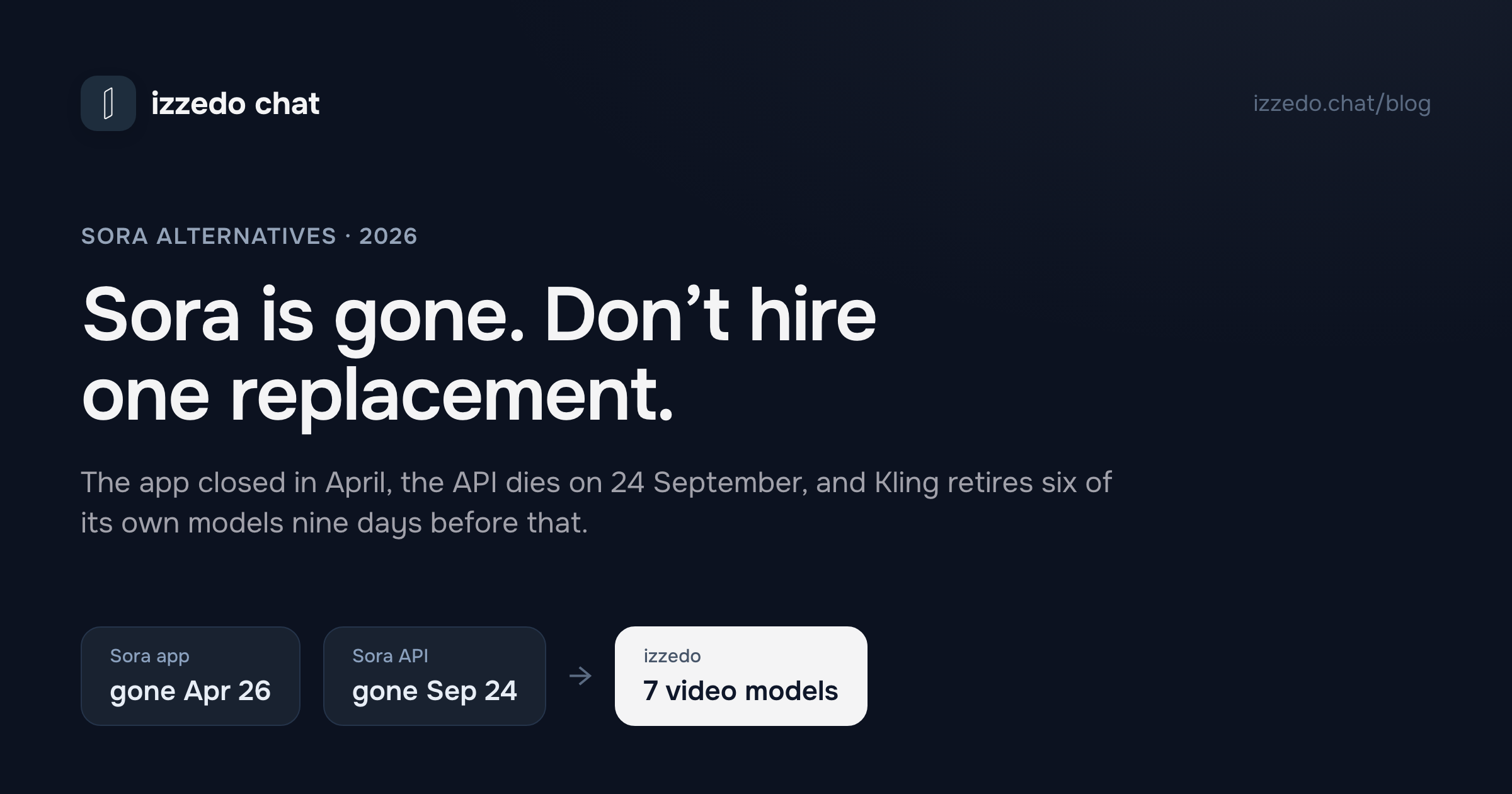
Two things happened to Sora, and most of the roundups you will find still only cover the first one.
The consumer app was discontinued on 26 April 2026. That is the event that produced the reddit threads and the wave of "10 best alternatives" posts. The second thing is still ahead: OpenAI's help centre says the Sora API will be discontinued on 24 September 2026, and the developer docs name the exact model IDs going with it. They are sora-2, sora-2-pro, and the three dated snapshots sora-2-2025-10-06, sora-2-2025-12-08 and sora-2-pro-2025-10-06. If anything you own generates video through those endpoints, it stops working three weeks from now.
I went through every replacement's own pricing page for this, on 2 September 2026, and I priced them the only way that lets you compare them: by the second. That turned out to be the interesting part. Almost every consumer video plan is sold in credits, and credits exist so that you cannot easily work out what one clip costs. When you do the arithmetic anyway, some of the headline prices invert.
Export first, read this second. OpenAI's instruction is to go to
sora.chatgpt.com/sunsetand click Export; you get an email when the archive is ready. The same article says that after the app was discontinued, and after any final export window passes, OpenAI will permanently delete the data associated with your use of Sora. No date is published for that deletion. Any purchased ChatGPT or Sora credits can still be spent on Codex.
What One Second of Video Actually Costs
This is the table nobody publishes, so here it is. These are provider rates for a single generation at the resolution most people actually use, with audio where the model generates it natively. Sora's own numbers are in the first two rows for as long as they mean anything.
| Model | Resolution | Price per second | Five seconds |
|---|---|---|---|
| Sora 2 (retiring 24 Sep) | 720p | $0.10 | $0.50 |
| Sora 2 Pro (retiring 24 Sep) | 1080p | $0.70 | $3.50 |
| Veo 3.1 | 720p/1080p, audio | $0.40 | $2.00 |
| Veo 3.1 Fast | 720p/1080p, audio | $0.15 | $0.75 |
| Seedance 2.0 | 720p, audio | $0.3034 | $1.52 |
| Kling 3.0 | 720p, native audio | $0.126 | $0.63 |
| Gemini Omni Flash | 720p | ~$0.125 | $0.63 |
| Wan 3.0 | 720p, audio | $0.10 | $0.50 |
| MiniMax H3 Max | 768p | $0.08 | $0.40 |
| Grok Imagine 1.5 | 480p | $0.08 | $0.40 |
Sora 2 at $0.10 per second was cheap, and Sora 2 Pro at $0.70 was the most expensive thing on this list by a distance. A ten-second Pro clip at 1080p cost $7.00. Nothing still on sale charges anywhere near that, which is worth remembering when a listicle tells you the alternatives are a downgrade. On price they are not.
Two caveats before anyone builds a spreadsheet on this. First, cheapest per second is not cheapest per usable clip; a model you re-roll four times to get one take has quadrupled its real rate, and prompt adherence is exactly where the gap between these models still shows. Second, rates move. MiniMax H3 Max is currently in a launch promotion at a quarter of the price listed above, which its host says ends on 7 September; the $0.08 figure is the rate after that. I have used post-promotion prices throughout so the table does not go stale in a week.
Disclosure, since it affects where some of these numbers come from: izzedo runs its video generation on fal, which is where several of the per-second rates above are published. Kling's rate comes from Kling's own developer pricing page, and Sora's from OpenAI's.
The Subscriptions, and What They Really Buy
Most people are not going to buy video by the second. They will buy a plan. Here is what each one gets you, and the third column is where the surprises live.
| Product | Entry price | What that actually buys |
|---|---|---|
| Google AI Pro | $19.99/mo | 1,000 Flow credits, so 10 Veo 3.1 Quality clips, 50 Fast, or 100 Lite |
| Google AI Plus | $4.99/mo | 200 Flow credits, so two Veo 3.1 Quality clips |
| Google Flow, no plan | $0 | 50 credits a day, Veo 3.1 only, no rollover |
| Kling Standard | $10/mo | 660 credits/mo; per-clip credit cost not published on the plan page |
| Hailuo (MiniMax) Standard | $14.99/mo | 1,000 credits ≈ 143 seconds of MiniMax H3 at 768p |
| Wan Pro | $10/mo | 300 credits, which Wan describes as up to 60 videos |
| SuperGrok | $30/mo | Image and video generation; 1080p needs the $100 tier |
| Runway Standard | $15/mo | 625 credits ≈ 52 seconds of its flagship model |
| izzedo Hobby | $6/mo | MiniMax H3 Max, plus every chat model in the same workspace |
Read the third column, not the second. Runway's $15 plan and Google's $19.99 plan look like near neighbours until you notice that one is 52 seconds of flagship video a month and the other is 80.
Google Is the Closest Replacement, and Its Credit Maths Is the Sharpest
Veo 3.1 is the model most people mean when they say they want Sora 2 quality back. It generates native synchronised audio, which was Sora's signature trick, and Google sells it three ways: inside the Gemini app, inside Google Flow, and through the API.
Flow is where the pricing is legible, because Google publishes an actual credit cost per generation in its help centre. Veo 3.1 Lite costs 10 credits. Fast costs 20. Quality costs 100, for everyone, with no subscriber discount. Gemini Omni Flash runs 15 to 30 credits depending on clip length, and 40 to edit an existing video.
Put that against the plans and Google AI Pro at $19.99 comes out well. A thousand credits a month is ten Quality generations, and since Quality only produces 8-second clips, that is 80 seconds of top-tier Veo. At the $0.40-per-second rate the same model costs through an API, 80 seconds is $32 of provider cost. Google is selling it under water, which is what you would expect from the company that trains the model.
The free tier is where it gets genuinely strange, and I have not seen this written down anywhere.
Anyone without a Google AI subscription gets 50 Flow credits a day. Those credits are restricted to Veo 3.1, meaning Lite, Fast and Quality. Unused credits do not roll over; the day's allowance refreshes when you make your first generation. So the bucket holds 50 credits, and Veo 3.1 Quality costs 100. A free user cannot generate a Veo 3.1 Quality clip at all, ever, no matter how long they wait. Five Lite clips a day, or two Fast, is the ceiling. That is a real free allowance and the best one in this category, but the top tier Google advertises on the same page is arithmetically out of reach.
There is also a contradiction between two Google pages that anyone spending $4.99 should check. The Flow pricing page lists Google AI Plus as "50 daily Google Flow credits + 200 monthly Google Flow credits." The Flow help centre says the daily free credits go to "all users who are not Google AI Plus, Pro, or Ultra subscribers," and adds that "if you upgrade to a paid subscription, any remaining free-of-charge Google Flow credits are immediately forfeited." Read literally, the help centre version means upgrading from free to Plus takes you from roughly 1,500 credits a month down to 200.
I would trust the help centre, because it is the more specific document and it explains the forfeiture rule in detail. But I would not spend $4.99 on Plus for video either way. Two Quality clips a month is not a plan, it is a demo, and if you want Veo the jump to Pro is the one that changes anything.
Kling 3.0: The Cheapest Cinematic Clip With Sound
Kling is the one I would point most people at if the goal is a good-looking five-second clip with audio and a budget. At $0.126 per second for 720p with native audio, a five-second clip costs 63 cents of provider spend, which is a fifth of what the same clip cost on Sora 2 Pro.
Kling's consumer plans start at $10/month for 660 credits, rising through $37, $92 and $180 tiers, with a first-month discount on each and 34% off if you pay yearly. What the membership page does not publish is how many credits a Kling 3.0 generation actually costs. It sells you credit bundles and a dollar-per-100-credits rate, $1.06 on Standard falling to $0.49 on Ultra, and leaves the conversion to the generation screen. Kling's developer pricing page does publish per-second dollar rates, which is where the number above comes from, and it is the honest yardstick if you are comparing across vendors.
While I was on that page I found the fact that reframes this entire article, so I will come back to it at the end: Kling is retiring six of its own video models on 15 September 2026.
MiniMax H3 Max: The Value Pick, and a Listing About to Break
MiniMax's H3 Max is the best price-to-quality point in the current generation, and it is the model we put on our own cheapest paid plan for that reason. At 768p it is around $0.08 per second after the launch promotion ends on 7 September.
MiniMax sells it consumer-side through Hailuo, where Standard is $14.99/month for 1,000 credits, which the plan page translates to roughly 143 seconds of 768p video, or 84 seconds at 2K. Pro is $54.99 for 4,500 credits, and the per-second rate drops as you climb, from $0.059 to $0.047 at 768p.
One thing to flag if you are evaluating Hailuo this week. Its plan comparison table still lists "Sora 2.0 (Audio)" as a video generation benefit on every paid tier, and every plan card still advertises "Access to Veo3.1, Sora2 models." I read that on 2 September. Whatever that access is worth, it has 22 days left on it. This is not a criticism of Hailuo specifically, since aggregators are always a step behind a vendor's deprecation notice. But if a plan's Sora line is part of why you are considering it, it should not be.
Wan 3.0: The Cheapest Way to Keep Making Video
Alibaba's Wan is the value answer to "free Sora alternative" that most listicles miss, partly because it is easy to get confused between the hosted product and the open weights.
The hosted product at create.wan.video has a free tier, then Pro at $10/month for 300 credits, which Wan describes as up to 60 videos, and Premium at $40/month for 1,200 credits and up to 240. Paid tiers unlock 1080p, watermark-free downloads and clips of 10 to 30 seconds, which is longer than most of this field allows. Both plans are half price if you pay yearly. One catch stated plainly in Wan's own small print: the subscription covers creation on create.wan.video only, and API use is a separate purchase.
Per second through a provider, Wan 3.0 is $0.05 at 480p, $0.10 at 720p and $0.20 at 1080p. It is also the only model in this comparison with open weights, which matters if the whole reason you are reading this is that a company switched off a model you were relying on.
Seedance 2.0: The Expensive One
ByteDance's Seedance 2.0 is the priciest current-generation model here at $0.3034 per second for 720p with audio, and $0.682 at 1080p, which is roughly what Sora 2 Pro charged at 720p. A five-second clip is $1.52.
It earns some of that. It takes multimodal references, up to nine images, three video clips and three audio files in a single generation, and it produces audio and video together in one pass rather than layering sound afterwards. If you are matching a character or a product across a series of shots, that is the feature you are paying for. If you are making a single establishing shot, you are paying a 2.4x premium over Kling for something the audience will not notice.
Runway is the easiest place to reach it consumer-side, at 160 credits per 4-second 1080p generation.
Grok Imagine 1.5: Only If You Already Pay xAI
Grok Imagine generates video with synchronised audio, dialogue and lip-sync, up to 15 seconds, and its per-second rate at 480p is the joint cheapest on the list at $0.08.
The problem is the packaging. xAI's pricing page puts image and video generation on SuperGrok at $30/month, and 1080p video behind SuperGrok Plus at $100/month. The free tier does not list video generation at all. If you are already paying for SuperGrok because you want Grok, the video is a nice inclusion. Nobody should pay $30 a month for it on its own when a $10 Kling plan or a $10 Wan plan exists. I have been through the rest of xAI's tiers in how much Grok costs.
Runway: The Honest Answer If You Need a Suite
I want to be fair about the category none of the above serves. If your work is a timeline, cutting shots together, lip-syncing dialogue, keeping a brand kit consistent, exporting ProRes, then you want a creative suite, and Runway is the best of them.
Standard is $15/month, or $12 billed annually, for 625 credits, which Runway itself translates as 52 seconds of its flagship Gen-4.5 model. Pro is $35 for 2,250 credits and adds custom voices for lip-sync. Max is $95 for 9,500 credits, studio formats, and rollover of unused credits for one month, which Google's Flow credits explicitly do not do. The free plan gives 125 one-time credits, which at 60 credits per 5-second generation is two clips and then a paywall.
The reason Runway belongs in a Sora alternatives article rather than a footnote is that it has already made the argument this piece is building towards. Runway does not just sell you Gen-4.5. Its plans list Veo 3.1, Kling 3.0, Seedance and Nano Banana Pro alongside its own models, because a suite that bet everything on one house model would be one leaderboard flip away from irrelevance.
The Free Options, Ranked Honestly
"Free Sora alternative" is the most common way people search for this, so here is the direct answer, best first.
- Google Flow, no subscription. 50 credits every day, on Veo 3.1. Five Lite clips or two Fast ones daily, renewing indefinitely. Nothing else comes close, with the Quality ceiling described above.
- Wan. A free tier with daily check-in credits and one concurrent generation, on a model whose weights are public.
- Kling Basic. Free tier exists, one video per generation, no daily subscriber credits.
- Hailuo free. One-time trial credits, Hailuo models only, no ongoing allowance.
- Runway free. 125 credits, once. Two clips.
If someone's roundup promises unlimited free AI video, check what model it runs and what it costs that site per second. Nobody is giving away 30-cent seconds.
What Nothing Replaces
Two honest concessions, because the listicles will not make them.
The first is that Sora 2's social layer has no equivalent. The cameo system, the feed, the shared remixing of other people's clips. That was a product, not a model, and none of the alternatives above is trying to rebuild it. If that was what you liked about Sora, you are not being offered a replacement, you are being offered a generator.
The second is that a chat workspace is not a video editor. We generate video; we do not cut it, colour it, or hold your brand assets. That is a real limitation and I would rather say it here than have you discover it on day two.
The Pattern Under the Shutdown
Here is the thing that should actually change how you choose.
While I was reading Kling's developer documentation for the pricing above, I found a retirement notice. On 15 September 2026, Kling is switching off Kling 1.0, 1.5, 1.6, 2.0 Master, 2.1 and 2.1 Master, plus its Virtual Try-On API and 119 video effect templates. Six models, one notice, nine days before Sora's API dies.
That is the real lesson of the Sora shutdown, and it is not "OpenAI abandoned a product." It is that AI video models have a shelf life measured in quarters, and every vendor in this market is retiring models on the same cadence. The people hurt by the Sora sunset were not hurt because they picked the wrong model. Sora 2 was genuinely good. They were hurt because their access to it ran through one company's subscription, so when that company changed its mind they had nowhere to stand.
Picking the "best Sora alternative" and pointing your workflow at it reproduces exactly that arrangement. You will be right for two quarters, and then either the leaderboard moves or the vendor sends an email.
The arrangement that survives is renting several models instead of committing to one. It costs less than you would think, because you are not paying six subscriptions to do it, and it means a retirement notice is an inconvenience rather than a migration. I have made this argument at more length about chat models in why one subscription is the expensive way to buy AI, and video is the version of it where the churn is fastest and the argument is easiest to see.
How We Handle It
izzedo chat puts seven video models in the same picker as the chat models, so switching model is a click inside the conversation you are already in rather than a new tab and a new card on file.
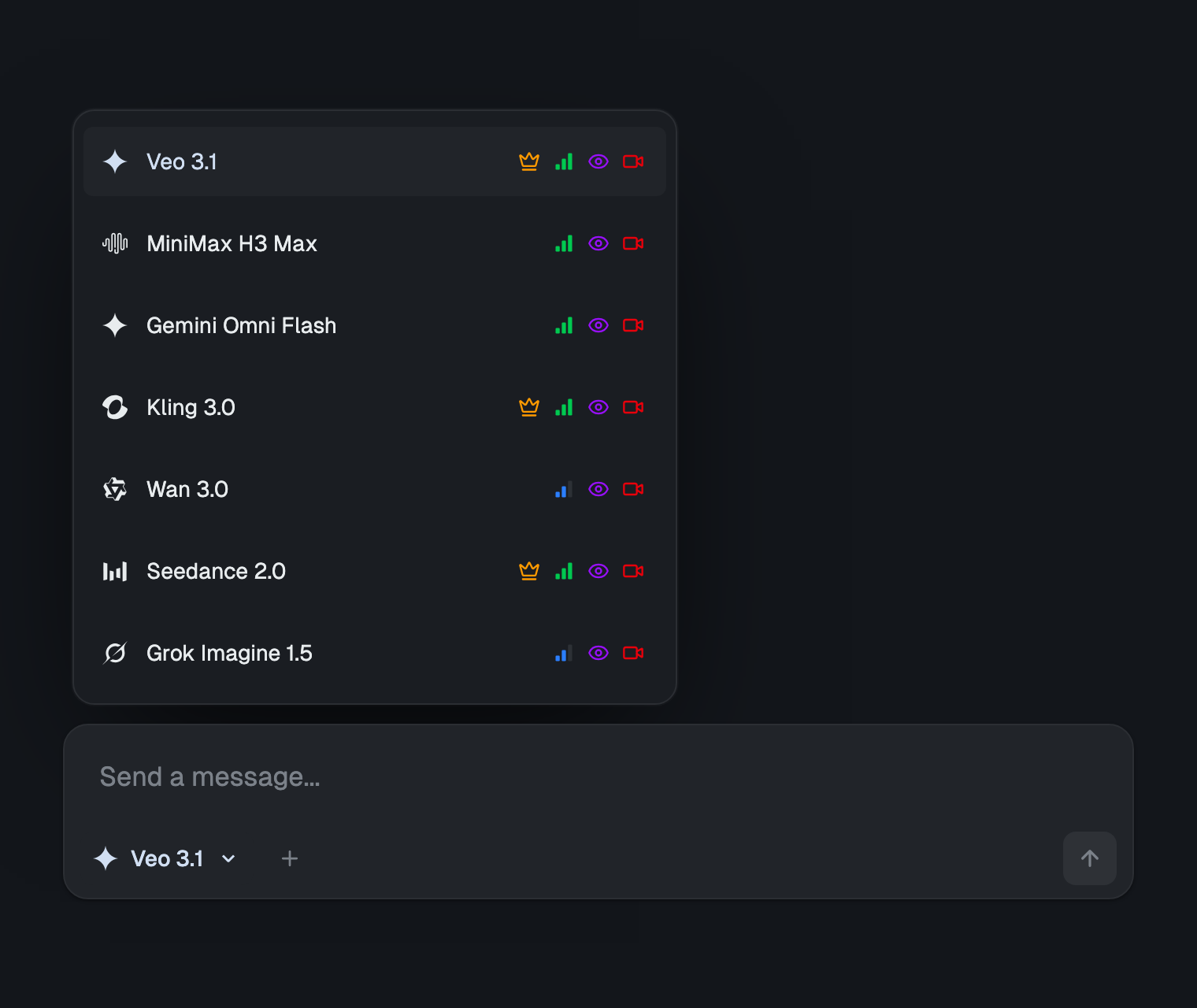
The lineup is Veo 3.1, MiniMax H3 Max, Gemini Omni Flash, Kling 3.0, Wan 3.0, Seedance 2.0 and Grok Imagine 1.5. That is every model in the rate card above except the two that are being switched off. Text-to-video and image-to-video, most with native audio, at resolutions up to 1080p.
They are spread across the plans by what they cost us to run, which is the only honest way to do it when one model is five times the price of another:
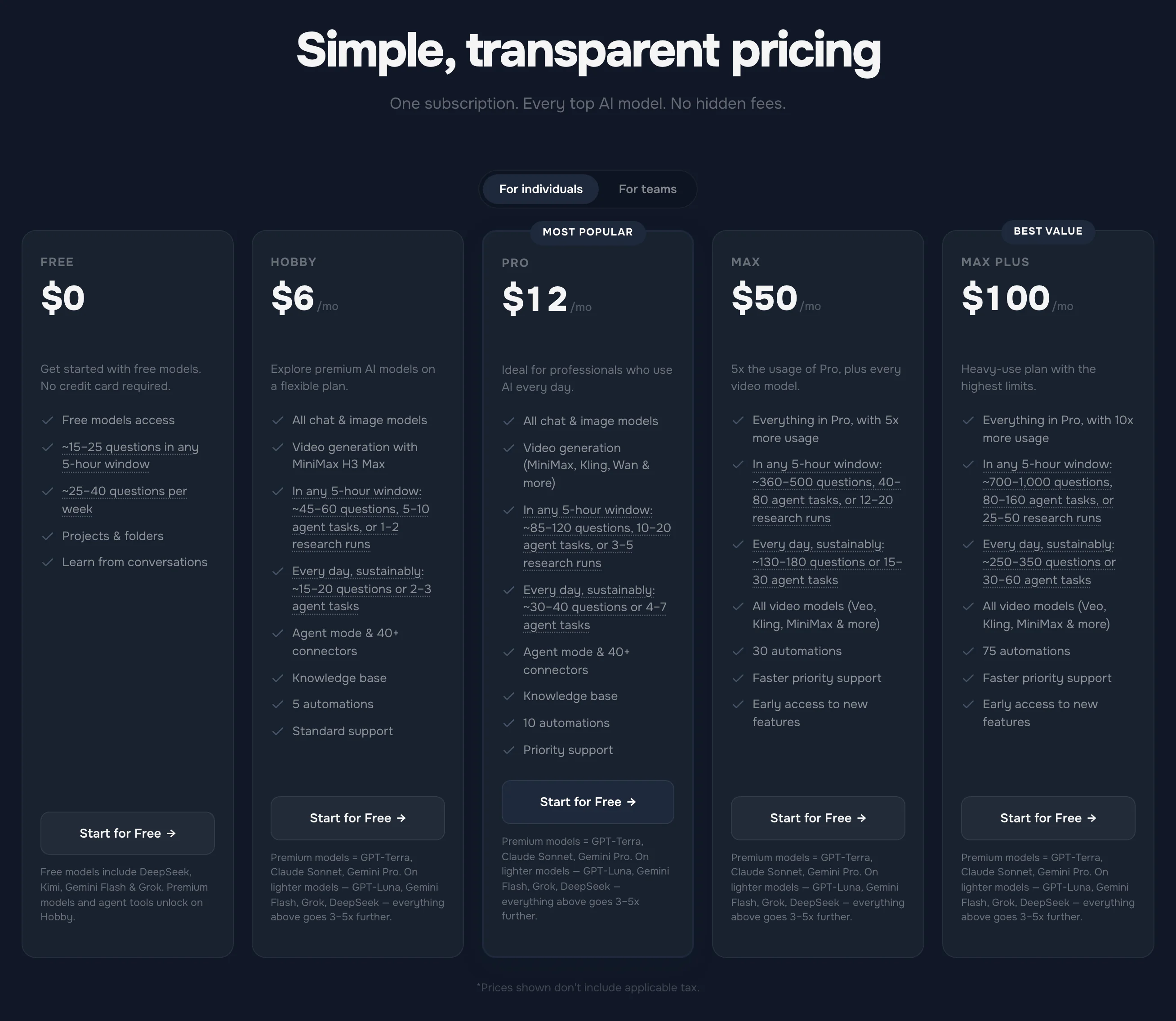
- Hobby, $6/month. MiniMax H3 Max, the value pick from the table above.
- Pro, $12/month. Adds Kling 3.0, Wan 3.0, Gemini Omni Flash and Grok Imagine 1.5.
- Max plans. Every video model, including Veo 3.1 and Seedance 2.0.
Generations draw on the same cost-metered usage pool as everything else in the plan, measured in what the model actually costs to run rather than in a count of clips. That is the honest consequence of the rate card at the top of this article: one Veo 3.1 generation costs us roughly six times what a MiniMax H3 Max one does, so it takes roughly six times the bite out of a month. The plans are here, including a free tier that needs no card, though video generation starts on Hobby.
The part that is easy to miss is that the video sits inside the same workspace as everything else. Draft the script with Claude, have Perplexity check the claim it makes, generate the clip with Kling, all in one thread with one context. It is the same reason people run several models at once for writing and research.
When the next model ships, or the next one is retired, that is a line in a changelog rather than a decision about a subscription. Sora made a good case for arranging things that way. So, nine days earlier, did Kling.
Frequently asked questions
What is the best Sora alternative in 2026?
For quality that is closest to what Sora 2 Pro produced, Veo 3.1 from Google. For cost, Kling 3.0 or Wan 3.0, both of which generate a five-second clip with sound for well under a dollar of provider cost. There is no single winner, because the top of the video leaderboard has changed roughly every quarter for two years. The practical answer is to pick a route that lets you switch models without switching subscriptions, since whichever model you name today is unlikely to be the best one in six months.
How much does Sora 2 cost?
Nothing, because you can no longer buy it. The consumer app closed on 26 April 2026 and the API shuts down on 24 September 2026. Until that date the published API rates are $0.10 per second for sora-2 at 720p, and $0.30, $0.50 and $0.70 per second for sora-2-pro at 720p, 1024p and 1080p. That put a ten-second Sora 2 Pro clip at 1080p at $7.00, which is roughly five times what the most expensive model still on sale charges for the same ten seconds.
Is there a free Sora alternative?
Google Flow is the only major one with a free allowance that renews. Anyone without a Google AI subscription gets 50 Flow credits a day, usable on Veo 3.1. That is five Lite generations a day, or two Fast ones. There is a catch worth knowing before you plan around it: Veo 3.1 Quality costs 100 credits for every user, the free bucket holds 50, and unused credits do not roll over, so the top Veo tier is mathematically out of reach on the free plan. Runway gives 125 one-time credits, which is two clips and then nothing. Wan, Kling and Hailuo all have free tiers built on trial or check-in credits rather than a standing daily allowance.
Can I still download the videos I made in Sora?
For now. OpenAI's help centre says to go to sora.chatgpt.com/sunset and click Export, and that you will get an email when the archive is ready. It also says that after the app was discontinued, and after any final export window passes, it will permanently delete the data associated with your use of Sora. There is no published date for that deletion, which is a reason to export today rather than in three weeks.
What replaces the Sora API for developers?
The five model IDs going away are sora-2, sora-2-pro and their three dated snapshots. Every serious alternative is available through a hosting provider on the same asynchronous submit-and-poll shape, so the migration is mostly a change of endpoint and parameter names rather than a rewrite. Veo 3.1, Kling 3.0, Seedance 2.0, Wan 3.0, MiniMax H3 Max, Gemini Omni Flash and Grok Imagine 1.5 are all reachable this way, and per-second pricing makes the cost comparison direct.
Which AI video model is cheapest?
By published per-second rates, Grok Imagine 1.5 at 480p and MiniMax H3 Max at 768p are the cheapest of the current generation, both around $0.08 per second, followed by Wan 3.0 at $0.10 per second for 720p. Kling 3.0 is $0.126 per second at 720p with native audio, which is the cheapest of the models people describe as cinematic. Cheapest per second is not the same as cheapest per usable clip, though, because a model you have to re-roll four times is not saving you anything.
Does izzedo chat generate video?
Yes. Seven video models sit in the same picker as the chat models: MiniMax H3 Max from the Hobby plan at $6/month, then Kling 3.0, Wan 3.0, Gemini Omni Flash and Grok Imagine 1.5 on Pro at $12/month, with Veo 3.1 and Seedance 2.0 unlocking on the Max plans. You pick the model per generation, in the same conversation you use for everything else. It is not a video editor and does not pretend to be one. For timeline editing and brand kits you still want a creative suite.
Ready to try multi-model AI workflows?
Access GPT, Claude, Gemini, Perplexity, and more — all in one place.
Start for Free →