The Best AI for Proposal Writing in 2026 (Write to the Scorecard)
Your client is scoring your proposal against two others, and they never tell you the criteria. Here's which model to use at each stage of a client proposal, and how to reconstruct the scorecard and mark your own draft before they do.
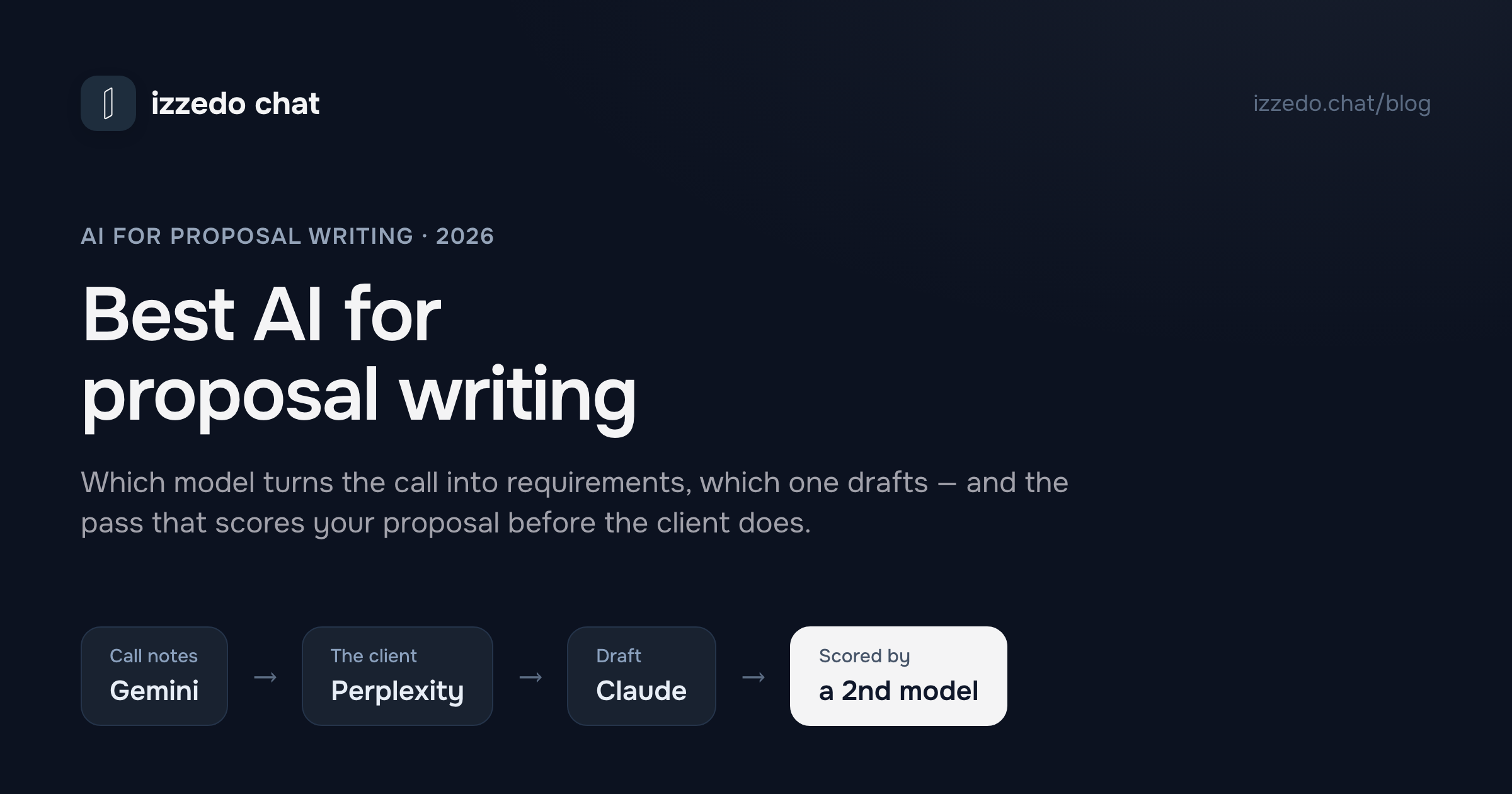
The client asked three people for a proposal. They'll read all three in the same twenty minutes, probably on a phone, and they are absolutely comparing you against the other two on a short list of things they care about.
They will never tell you what those things are.
That's the gap in every tool list ranking for this query. They all sell the same promise — a finished proposal in less time — and slow drafting was never why you lost the job. You lost it because the proposal answered the service you sell rather than the problem they described, or because it looked interchangeable with the other two and the client fell back on price.
So this guide is organised around the actual sequence of a client proposal: understanding what they asked for, researching who's asking, drafting, pricing, and the step almost nobody does — scoring your own draft against the client's criteria before you send it.
The Short Answer: Which Model for Which Part of a Proposal
| Stage | Reach for | What it gets you |
|---|---|---|
| Turning call notes into requirements | Claude or Gemini | The client's own words, pulled out and listed |
| Reading a long RFP document | Gemini or Claude, long context | Every requirement found, none missed |
| Researching the client | Perplexity Sonar | Who they are and what changed, with sources |
| The repetitive sections | ChatGPT | Your standard blocks, adapted per client |
| The persuasive sections | Claude | One voice across the whole document |
| Pricing and scope tables | Gemini, then your own arithmetic | Structure and a consistency check, not the numbers |
| Scoring the draft | A model that didn't write it | Your weakest section, before the client finds it |
| Sending it | Document generation | A clean PDF or DOCX without a manual rebuild |
The highlighted row is the one that isn't in the competing guides, and it's the one I'd keep if I had to drop the rest.
You Are Being Scored. You're Just Not Being Told the Criteria
It's worth seeing the formal version of this once, because it makes the point unarguable.
In US government contracting, the buyer isn't allowed to keep the scoring secret. The Federal Acquisition Regulation states that "all factors and significant subfactors that will affect contract award and their relative importance shall be stated clearly in the solicitation," and that the solicitation must say whether the non-price factors combined are more important than price, roughly equal to it, or less important. Bidders get told what's being marked and roughly what each part is worth.
Your client has the same thing. They just have it in their head, and nobody writes it down.
That's the whole idea behind everything below. A proposal isn't an essay to be admired; it's a document being marked against a handful of criteria by someone who is busy. If the criteria exist whether or not you know them, then the highest-leverage thing you can do is reconstruct them and mark your own paper first.
For most small proposals the list is short and boringly predictable:
- Do they understand my actual problem?
- Can I afford this, and do I know what I'm getting for it?
- Have they done this before, for someone like me?
- Will this be a hassle?
Those four cover most client decisions under about $50k. Notice that "is the writing good" isn't among them, and neither is "did they describe their methodology in depth." Effort spent on the wrong row is effort spent losing politely.
Stage One: Turn the Conversation Into Requirements
Most proposals a freelancer or small agency sends are not responses to a formal document. They follow a call. Someone described a problem for forty minutes, you took messy notes, and now you have to turn that into something that sounds like you were listening.
This is the highest-value AI step in the whole process, and almost nobody uses it for this. Before you ask for a single sentence of prose, paste in your raw notes and extract:
Here are my raw notes from a client call. Do not write a proposal yet.

Pull out, using THEIR words wherever possible:
- the problem as they described it (quote their phrasing)
- what they said they'd already tried, and what went wrong
- any deadline, event or date they mentioned
- constraints: budget hints, team size, tools they're stuck with
- who else is involved in the decision
- anything they repeated more than once

Then list what I still don't know that would change the proposal.
The last line is the one that pays. Half the time it surfaces something worth a two-line email before you write — and a client who gets a clarifying question reads your proposal differently than one who gets a document that guessed.
Then write to those words. If they said "our bookings drop off a cliff after the first email," your proposal says that, not "optimising your customer lifecycle touchpoints." The single most common failure in small proposals is describing the service you sell instead of the problem they described, and this step is a direct fix for it.
When It Is a Formal RFP
Sometimes you get a real document — a tender, a procurement pack, a fifty-page brief from a larger client's purchasing team. Different job: now the risk is missing a requirement rather than misreading a conversation.
Feed the whole thing to a long-context model and get a checklist out. Bid teams call this a compliance matrix; it's a table with one row per requirement, quoted exactly, with the section it came from and a blank column for where you answer it.
Here is an RFP document. Do not summarise it and do not write any response.

Extract every requirement into a table:
requirement (quoted verbatim) | section | mandatory or scored | weight if stated | where we answer it (leave blank)

Include anything phrased as shall, must, will, or is required to.
Separately list: the deadline, format and page limits, the stated
evaluation criteria and weights, and anything that reads like a disqualifier.

Flag anything ambiguous enough to be worth asking about.
Ask for verbatim quotes, not summaries — a paraphrased requirement is one you'll answer approximately. Then use the blank column as your gap list at the end, and re-check it against the finished document rather than against your memory of it. Sections get cut for length at the last minute, and whatever they answered goes with them.
If there's a questions period, use it. Most bidders don't, and the answers usually go to everyone.
Stage Two: Research Who You're Pitching
The generic proposal is the natural output of a model that knows the service and nothing about the buyer. Fixing that is a research job, and it wants live web access and citations rather than a model working from memory.
You're after things you can legitimately reference: what the business actually does, recent changes worth noticing, how they talk about themselves, who's doing the work now if someone is. For a small client, ten minutes here is often enough to replace one paragraph of filler with one sentence that proves you looked — and that sentence does more for the "do they understand us" criterion than another page of capability boilerplate.
Verify anything you plan to quote. A confidently wrong fact about the client's own business, in the document where you're asking them to trust you with money, is worse than saying nothing. Same discipline as the claim ledger for published content — different stakes, same rule that unverified facts don't ship. For the deeper version, the multi-model approach to research and analysis goes further.
Stage Three: Drafting, Split Two Ways
Proposal drafting is two jobs that suit different models.
The parts you rewrite every time. Your process description, your terms, the "about us" block, the standard scope language. This is volume work on a stable format and ChatGPT handles it well. The trick is that the input shouldn't be the question — it should be your last approved version plus this client's requirements, with instructions to adapt rather than invent. A model given only "write an about us section" writes the market-average one, which is what your competitors are sending.
The parts that have to persuade. The opening, the approach, the reason it's you. These are argument rather than information, and they need one voice across the document. Claude is the stronger pick here — it holds tone and follows detailed style instructions across length, which matters when you've assembled a document from three older ones.
The handoff between them is where a shared thread pays for itself: the call notes, the requirements and the client research are already in the conversation, so passing a draft to the second model costs one sentence instead of re-pasting everything.
Two rules worth enforcing on every draft. No claim without a number or a named example behind it — "extensive experience" is a sentence that scores zero. And cut anything that would still be true with a competitor's logo on the cover, because a client can't choose you based on a description of your entire industry.
Write the opening last, and write it about them. It's the part most likely to be read properly and the part most likely to have been drafted first, when you knew the least.
Stage Four: Pricing, With the Arithmetic Done by You
Models are useful for the shape of a pricing section: laying out the options, breaking work into phases, building the assumptions list that protects you when the scope drifts, and checking that your scope narrative and your numbers describe the same project.
They are not where the numbers come from. Your rate, your margin and your contingency are commercial decisions with your money behind them. Have the model build the table and check it for internal contradictions, then verify every figure yourself.
The genuinely useful catch here is the mismatch: page two promises weekly on-site workshops while the price assumes remote delivery. That's easy to create when a proposal is assembled from older ones, and expensive when the client notices first — or worse, when they don't, and you deliver it.
One more thing worth asking a model to do: write the assumptions and exclusions list. It's the section every freelancer skips and the one that decides whether "one more small change" is a favour or a change order.
Stage Five: Score the Draft With a Model That Didn't Write It
Here's the step the tool lists skip.
You have a draft, and you have a decent idea of what this client cares about — from the call, from the brief, or from the four questions further up. Nothing stops you from running their evaluation yourself, while there's still time to act on it.
The one rule that makes it work: the scoring model must be a different model from the one that drafted the text. A model asked to grade its own output reads its own reasoning rather than the page, and marks generously — it knows what it meant. A model seeing the draft cold has no such attachment, which is exactly the position the client is in.
You are the client who requested this proposal. You did not write it,
you are busy, and you have two other proposals to compare it against.

Here is what I believe you care about, in priority order:
1. [understanding the problem]  2. [price and what's included]
3. [proof I've done this before]  4. [how easy this will be]

Here is the draft.

For each criterion: score it out of 10, quote the specific sentences that
earned the score, and say what a 10/10 answer would have contained that
this one doesn't.

Then tell me: the weakest section, every claim made with no evidence
behind it, and the one thing most likely to make me pick someone else.

Be harsh. Do not rewrite anything.
What comes back isn't a rewritten draft you'd have to re-edit. It's a ranked list of where you're losing points, which is the only output that helps the night before it's due. The "what a 10/10 answer would have contained" line consistently earns its keep — it's the difference between knowing a section is weak and knowing what's missing from it.
If the job is worth the effort, run it on two different models. Where they agree, you have a real problem. Where they disagree, you've found something genuinely ambiguous — which usually means the client would be unsure too, and it's worth an explicit sentence. Treating disagreement between models as signal rather than noise is a general-purpose technique, and why one model isn't enough is the argument behind it.
Running the Whole Thing in One Place
Every stage above uses a different model, and that's the practical problem. Four subscriptions means four tabs, four context windows, and the client's brief pasted into each one.
izzedo chat puts every leading model behind one login and lets you switch models inside a single thread without losing the conversation. The call notes, the research and the draft stay in context when the drafting model hands off to the scoring model.
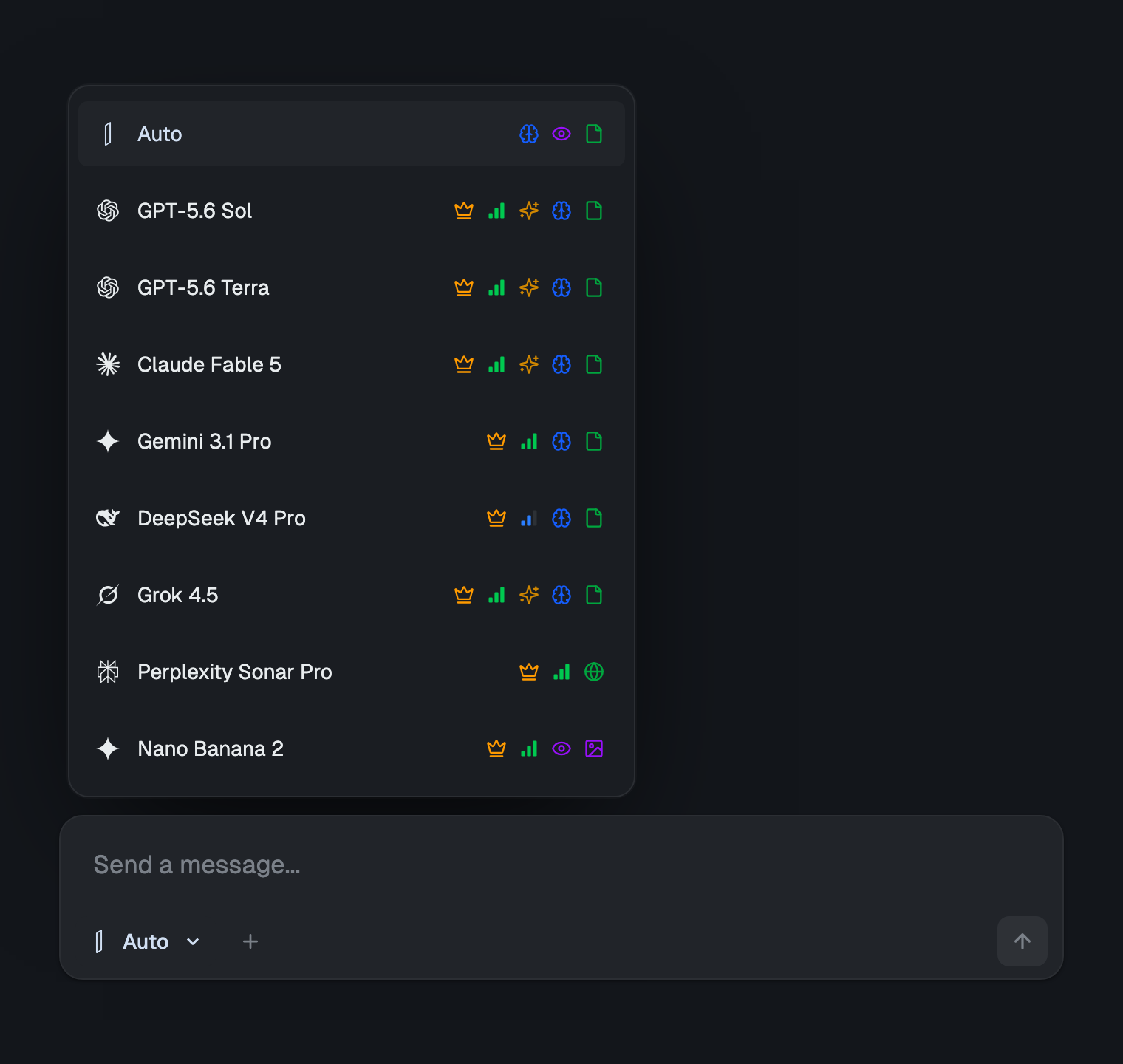
A few things map well onto proposal work:
- Projects and folders — one project per client, so the brief, the research and the drafts stay together instead of scattered across threads.
- Knowledge Base — load your past proposals and case studies and they become searchable by question, so "what did we quote for the last site migration" is a question rather than a folder hunt.
- Skills — turn your house style and standard terms into something reusable, so the next proposal starts where the last one ended.
- Document generation — export to PDF, DOCX or XLSX directly.
- Multiple model opinions — the same question to several models side by side, which is the scoring pass in one step.
- Privacy — no training on user inputs, zero data retention with providers, GDPR compliance, and permanent deletion of history.
The cost argument is straightforward. ChatGPT, Claude, Gemini, Perplexity and Grok bought separately run about $110 a month, with DeepSeek free. izzedo is $6, with a free plan that needs no card, and the pricing page has the current usage detail per tier.
The honest limit: this isn't proposal software. If what you want is a template gallery, e-signature, and a notification when the client opens page four, the dedicated tools do that and izzedo doesn't. What it replaces is the four subscriptions behind the thinking.
What Not to Hand Over
The concession the vendor listicles don't make: AI cannot make you the right choice for the job. It can make you clear, fast and well-organised, and those are table stakes.
It can't supply the case study with real numbers, the reference who'll take the call, or the portfolio piece that makes this particular client relax. It can't tell you whether to bid at all — and for small operators that's the expensive one. Chasing every proposal is the most common way to spend a month working for free, and a model asked "should I go for this" will find reasons to encourage you, because you asked in a hopeful tone.
It also can't fix the two most common losses, which are worth naming because no listicle does: they went with someone cheaper, or they didn't do the project at all this year. Neither of those is a writing problem. Better proposals win more of the remainder — the ones where the client genuinely couldn't decide — and that's a real gain, but it isn't the same as winning everything.
Two practical cautions. Check what you're allowed to paste in, since NDAs often restrict sharing the client's material and some briefs now carry AI-use language of their own. And don't send anything you haven't read end to end. Clients have become good at spotting the fluent paragraph with nothing in it, and the cost isn't just that section — it's the credibility of the numbers next to it.
The Bottom Line
The best AI for proposal writing isn't a proposal tool. It's a model to turn the call into what the client actually asked for, a research model to learn who they are, a drafting model for the repeatable parts and a sharper one for the persuasive parts — and, the step almost nobody takes, a model that didn't write the draft, scoring it against the client's criteria while you can still fix what it finds.
Speed was never the constraint. The constraint is that someone is quietly marking this against two other documents, and you can make a very good guess at the list.
If you want to run that sequence without four subscriptions and four copies of the same brief, izzedo chat has every model in one thread. The free plan needs no card, and if you want the full argument for working this way, using multiple AI models at once is where it starts.
Frequently asked questions
What is the best AI for proposal writing?
No single model wins the whole job, because a proposal is three different tasks in one document. Use Claude for the narrative sections where voice and persuasion matter, ChatGPT for the repetitive parts you rewrite for every client, and Perplexity Sonar to research the client with citations before you write a word. Then have a model that didn't write the draft score it against what you think the client cares about. The dedicated proposal tools are mostly templates and e-signature wrapped around these same models — useful if you want the send-and-track workflow, unnecessary if you already have a way to send a PDF.
Can AI write a client proposal for me?
It can write most of the words, and the words were never why you won. A model can structure the document, turn your call notes into clean prose, adapt your last proposal to a new client and keep your pricing table consistent. What it cannot do is know what the client said in the meeting, what your actual capacity is next month, or which of your past projects will make this particular buyer trust you. A proposal written entirely from a prompt reads like every other proposal in the client's inbox, and looking interchangeable is how you end up competing on price alone.
How do I write a proposal after a discovery call using AI?
Feed the model your raw call notes before you ask for any prose, and have it pull out the client's own phrasing — the words they used for the problem, the deadline they mentioned, the thing they said had gone wrong before. Then write the proposal back to those words rather than to your standard service description. Most small proposals are lost by describing what you do instead of what they said they needed, and the fix is a transcription and extraction job, which is exactly what models are reliably good at.
Should I use AI to check my proposal before sending it?
Yes, and it's the highest-value use of AI in the whole process. Write down the three or four things you believe the client will judge on — price, timeline, relevant experience, confidence you'll deliver — then hand those criteria and your draft to a model and ask it to score you and say what a better answer would have contained. One rule: use a different model than the one that drafted the text. A model asked to grade its own writing marks it generously, because it re-reads what it meant rather than what's on the page.
Is it safe to put a client's brief into an AI tool?
Check your NDA first, since plenty of them restrict sharing the client's material with third parties, and some briefs now carry their own AI-use language. Beyond permission, check what the tool does with the text — whether your inputs train models and whether prompts are retained. izzedo chat has a strict no-training policy on user inputs, zero data retention with providers, GDPR compliance and permanent history deletion, which is the baseline worth demanding anywhere you paste a client's confidential material.
Do I need a dedicated AI proposal tool or is a general AI workspace enough?
It depends on what you're missing. If you want templates, e-signature and open-tracking in one place, a proposal tool like the ones ranking for this query does that job. If what you actually need is better thinking — research on the client, a sharper argument, a second opinion on a draft — that's the frontier models, and the proposal tool is a thin layer over them. Paying separately for ChatGPT, Claude, Gemini, Perplexity and Grok runs about $110 a month, with DeepSeek free; izzedo chat is $6, with a free plan and no credit card to start.
Ready to try multi-model AI workflows?
Access GPT, Claude, Gemini, Perplexity, and more — all in one place.
Start for Free →