The Best AI for Writing in 2026 — and Why It Still Sounds Like AI
Every ranking of the best AI for writing answers a question nobody asked. Here's which model wins each kind of writing — and the three fixes that stop the output from reading like a machine.
Search for the best AI for writing and you get handed two answers, neither of which is the one you wanted.
The first is a leaderboard: a model name and a score to one decimal place, taken from a test that graded exam questions and programming puzzles. The second is a listicle of twelve writing products with affiliate links attached. One measures the wrong thing, the other sells you a wrapper around the same three models everyone else is using.
The question people are actually asking is smaller and more practical: I have this specific thing to write — which one should I open? And underneath it sits a second question that no ranking addresses, even though it's the reason most people go looking in the first place: why does the output still sound like a machine wrote it, and can that be fixed?
Both answers are below. The short version: writing isn't one job, the winner changes depending on which job you're doing, and the machine-sounding problem is mostly a briefing problem rather than a model problem.
The Short Answer: Best AI for Writing, by What You're Writing
Skim this table and you have the useful 80% of the article.
| What you're writing | Best model | Why it wins here |
|---|---|---|
| Long-form articles, reports, essays | Claude | Holds a voice and an argument across thousands of words without drifting |
| Headlines, subject lines, ad copy | ChatGPT | Fastest at producing many genuinely different options to choose between |
| Fiction and creative prose | Claude | The most range in register; Anthropic even ships a model tuned for prose specifically |
| Anything containing facts, prices or dates | Perplexity Sonar first, then a writer | Sourced claims you can click and check, instead of confident invention |
| Email and docs, written where they live | Gemini | It's inside Gmail and Docs already — no copying between two windows |
| A blunt, opinionated, contrarian voice | Grok | Doesn't sand every edge off in the name of balance |
| Editing a draft you already wrote | Claude | Changes the thing you asked about and leaves the rest of your writing alone |
| High-volume drafting on no budget | DeepSeek | Functional prose and solid structure, free |
Eight rows, four different winners. That's the finding, not a dodge: the model that gives you twenty headline options in fifteen seconds is not the model you want holding a 3,000-word argument together, and neither of them is the one that already sits next to the document.
How I Judged This
I gave the models the same real jobs, in parallel, and compared what came back: a long explanatory article from a messy pile of notes, a landing page and a set of subject lines, a short scene of fiction with a specified narrator, a client proposal that had to hit a list of required points, and an editing pass on a piece I'd already written and was unhappy with.
Then I graded on the only four things that matter once you're doing this for work: how much of the draft survived to the final version untouched, whether it followed the whole brief or quietly dropped the awkward parts, whether the facts it stated were real, and how much it sounded like a person with a point of view rather than a summary of the internet.
These are hands-on impressions from ordinary work, not lab scores. Change the subject matter and some of the edges move. The pattern below repeated often enough that I'd bet on it.
The Best AI for Writing, Job by Job
Long-form: articles, reports, essays
Claude, and the gap widens the longer the piece gets. Most models can produce a good paragraph; the difficulty is 2,000 words later, when the voice has quietly reverted to house style and the argument has flattened into a list of considerations. Claude keeps the thread — a register established in the opening is still there at the close, and a point made early actually gets paid off.
It's also the one that will write with restraint. Ask for something plainer and it gets plainer, rather than swapping ornamental words for slightly different ornamental words.
ChatGPT drafts long pieces perfectly competently and faster, so if the deliverable is an internal summary nobody will scrutinize, the difference doesn't earn its keep. When the piece carries your name, it does.
Copy: headlines, subject lines, ad copy
ChatGPT, and here the reasoning inverts. Short-form copy isn't a quality problem, it's a search problem — you don't need one good headline, you need thirty so you can find the two that work. ChatGPT is the best idea generator of the group: ask for twenty options and you get twenty that are actually different from each other, rather than twenty rephrasings of the first one.
The workflow that beats either model alone: generate the spread with ChatGPT, shortlist three yourself, then hand those three to Claude to sharpen. Idea volume from one, final polish from the other. (For the wider set of free marketing jobs and which model owns each, I broke that down in the best free AI tools for marketing.)
Fiction and creative prose
Claude, comfortably, and it's the category where the difference between models is most obvious to anyone who reads much. Dialogue that sounds like two different people, a narrator who stays in character, description that doesn't reach for the nearest cliché — this is the hardest thing to fake and the easiest to spot. Anthropic has gone as far as shipping a model tuned specifically for creative prose, which tells you where they think the demand is.
The others aren't unusable, they're just tonally safer. ChatGPT writes competent genre pastiche. Gemini writes clean, correct prose that reads like it was checked rather than composed. Grok is the interesting outlier for anything meant to be funny or rude, since it's the least likely to apologize mid-joke.
Anything with facts in it
This row isn't a writing choice, it's a sequencing one. Any model will state a false price, a wrong date or a citation that doesn't exist, in exactly the same confident register it uses for things that are true. The prose quality of a fabricated statistic is excellent.
So for anything with checkable claims — a report, a comparison, a piece of thought leadership with numbers in it — start with Perplexity Sonar, which searches live and links its sources, gather the material with the links intact, and only then hand it to a writing model. That order costs nothing and removes the failure mode that actually embarrasses people. (The research-first version of this is in Perplexity vs ChatGPT.)
Where a wrong number costs actual money rather than face, the sequencing goes further: extract every checkable claim from the finished draft and audit it with a model that didn't write it. That's the routine behind the AI tools for affiliate marketing workflow, where a stale price in a review is a commission that never arrives.
Email, docs and everything written where it already lives
Gemini wins this one on geography rather than talent. If the thing you're writing is a document in Google Docs or a reply in Gmail, Gemini is already there, with your files reachable and no copy-paste round trip. A slightly plainer sentence produced in the right window beats a better sentence that has to be ferried between two tabs.
This is a real advantage and worth being honest about, since it has nothing to do with which model writes better. It's also the reason plenty of people who prefer Claude's prose still do their day-to-day writing in Gemini. (Claude vs Gemini covers that trade-off properly.)
A voice with an actual opinion
Grok, for the narrow but real category of writing that's supposed to take a side: an opinion column, a contrarian LinkedIn post, a launch announcement with some swagger. The big models are trained toward balance, and balance is death in persuasive writing — you ask for a strong argument and get "there are compelling considerations on both sides."
Grok is the least allergic to a position. Its drafts usually need a human pass to tone down rather than to warm up, which is a much easier edit than trying to talk a cautious model into having a point of view.
Editing something you already wrote
Claude, and this is its most underrated column. The failure mode of AI editing is that you ask it to tighten paragraph three and get back a full rewrite in the model's own voice, with your best line silently removed. Claude is the most surgical: ask it to cut a third, fix the rhythm, or make the second section land harder, and it does that specific thing while leaving your sentences recognizably yours.
It's also the most useful critic. "Tell me what's weak here and don't fix it" gets a genuinely useful list rather than reflexive praise, which is the single highest-value prompt in this entire article.
Volume drafting on no budget
DeepSeek deserves the last row. The prose is functional rather than elegant, but the structure is sound and the reasoning behind it is strong, and it costs nothing. For first drafts you're going to rewrite anyway, internal documents, or simply a lot of words at once, it's the value pick — and a perfectly good second reader when you want a cheap opinion on something. (DeepSeek vs ChatGPT has the full picture.)
Why AI Writing Still Sounds Like AI
Here's the part the rankings skip, and it matters more than the choice between the top two models.
Models are trained toward output that's acceptable to the largest possible number of readers, and the most acceptable version of any sentence is the average one. Average is exactly what you don't want. That produces four tells, and once you can name them you'll see them everywhere:
- The warm-up. A paragraph of context before the actual point. "In today's fast-moving landscape, businesses are increasingly turning to…" Nothing has been said yet, and something is already being restated.
- Everything in threes. Three adjectives, three examples, three clauses in a sentence, three bullets in every list. Human writing is lumpier — sometimes two, sometimes seven.
- The reversal used as a substitute for a point. "It's not about the tools — it's about the mindset." It reads like insight and contains none. One per article is a rhetorical move; four is a tic.
- The closing bow. A final paragraph summarizing the thing the reader has just finished reading, often with a note about how it's a journey.
Add the vocabulary: delve, leverage, robust, seamless, tapestry, testament, navigate the complexities. None of these words are crimes. The frequency is the tell.
Three fixes, in order of how much they help.
Give it a voice sample, not adjectives. "Write in a friendly, professional tone" is an instruction every model already follows by default — it's a description of the average. Instead, paste two or three paragraphs of your own writing and say: match this rhythm, this sentence length, this vocabulary. This one change does more than switching models.
Ban the tells explicitly. Negative constraints work, they just have to be specific. Something like: No introductory context paragraph — open on the point. Vary sentence length. No "it's not X, it's Y" constructions. Don't summarize at the end. Don't use "delve", "leverage", "seamless" or "landscape". Keep that block and reuse it; it's the single most reusable piece of prompt you'll write.
Get a cold read from a different model. This is the one almost nobody does, and it's the most effective. A model asked to check its own writing will defend it — the same statistical instincts that produced the sentence rate it as good. A different model has no such attachment. Paste the draft and ask: which lines here sound machine-written, and which claims would you want checked? It will mark things you'd stopped being able to see, which is the same reason human writers hand drafts to other humans.
One honest caveat, since it's the neighbouring search: this is about quality, not about defeating detection. AI detectors are unreliable in both directions and regularly flag human writing, and "humanizer" tools mostly swap words for thesaurus entries and make the prose worse. If the writing is for a graded assignment, the rules are different and the line is worth understanding properly — I covered it in Best AI for Writing Essays.
AI Writing Tools vs AI Models: What You're Actually Paying For
The other half of the search results is dedicated writing products, and it's worth being clear about what they are. Jasper, Copy.ai, Writesonic and the rest don't have their own writing models — they run on the same ones discussed above, and sell templates, brand-voice memory, team permissions and publishing integrations on top.
Here's roughly what that costs, checked at the start of August 2026 for US pricing. These figures move, so treat them as a snapshot rather than gospel.
| Tool | Typical individual price | What you're buying on top of the model |
|---|---|---|
| Jasper | Marketing templates, brand voice, campaign workflows | |
| Copy.ai | ~$49/mo | Copy templates, go-to-market workflows |
| Writesonic | ~$19–$99/mo by tier | Article generation, SEO tooling |
| Grammarly | Correction and rewriting inside every app you type in | |
| The models directly | ~$20/mo each | The actual writing ability |
One question decides it: are you buying a better writer, or a workflow?
If you're a marketing team that needs a brand voice enforced across eight people, templates non-writers can operate, and an approval trail, a dedicated tool genuinely earns its price — that's a process product, and the models don't ship one. If you're an individual writer or a small team, you're paying two to three times the price of the underlying model for template menus you'll use twice.
Worth noting on Grammarly specifically: it's the odd one out, because it isn't competing for the drafting job at all. It sits in your browser and fixes what you type everywhere. Plenty of people sensibly pay for it and use a model for drafting.
The features that actually justify a writing tool — a saved voice, reusable instructions, source material the model can reference — turn out not to require one. In izzedo chat they're built into how projects work: a project-level system prompt holds your voice brief and your banned-phrases list so every chat in that project starts with them already applied, Skills turn a set of instructions you keep retyping into something reusable, and a project knowledge base lets the model reference your style guide, past work or product details without you pasting them again. Same outcome as brand voice, minus the $49.
The Setup That Makes This Practical
Read back over the job-by-job section and the problem is obvious. The best answer for most people is three or four models: options from one, prose from another, sources from a third, a cold read from a fourth. Bought separately that's ChatGPT at $20, Claude at $20, Gemini at $20, Perplexity at $20 and Grok at $30, with DeepSeek free — $110 a month, most of it idle on any given day, plus the tab-juggling that makes you skip the cold read exactly when you're busy.
The alternative is putting them in one place. In izzedo chat, every model above lives in a single conversation for $6/month, with a free plan that needs no card to start. The honest fine print: fair-use limits exist here like everywhere in AI. The difference is that you never manage them — no credits, no points to ration, one flat bill. A heavy run on the most expensive models means a short wait while the rolling window clears; a heavy week can also reach the weekly pool underneath it, which takes longer to come back.
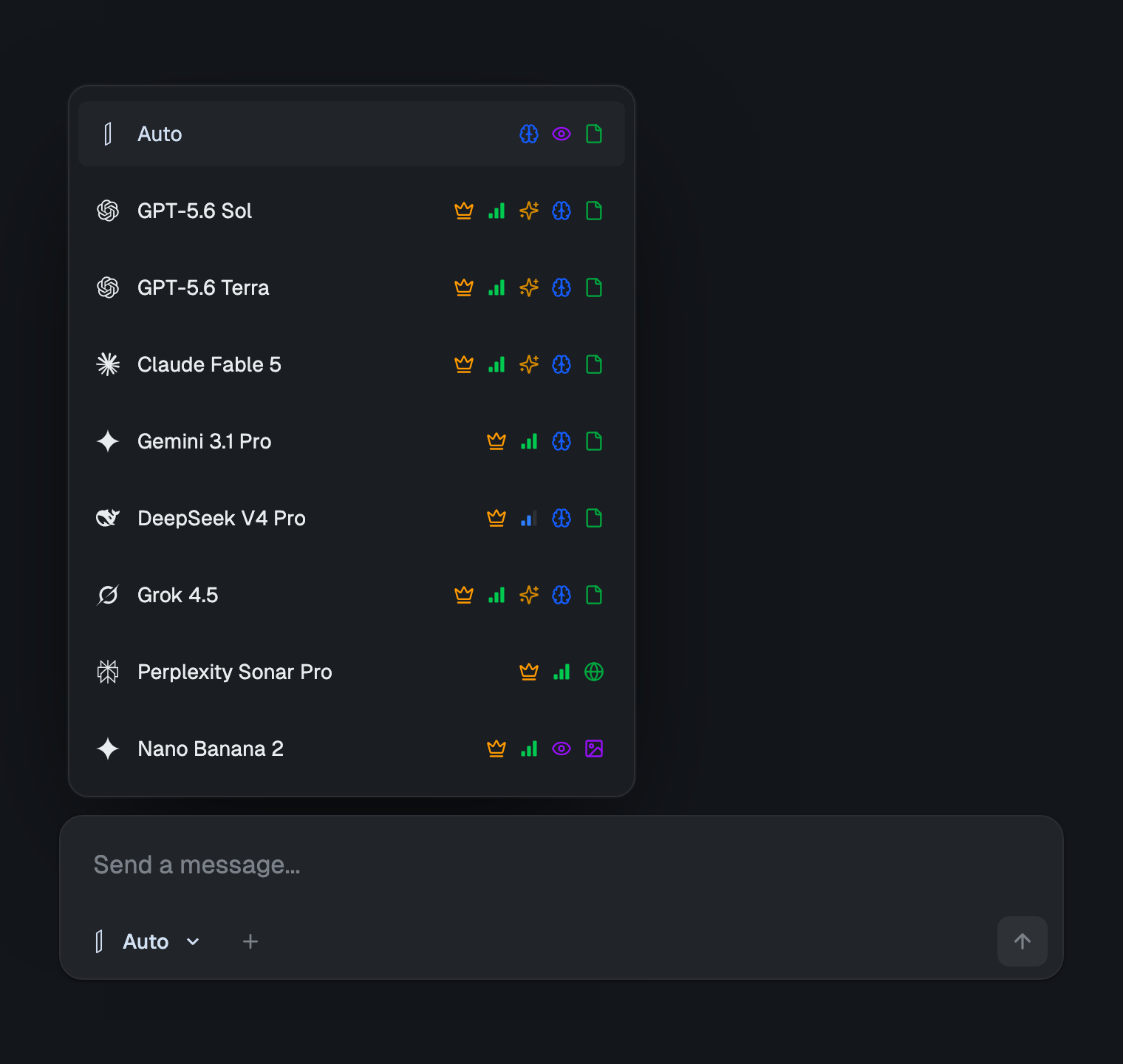
Because they share one thread, the handoffs stop costing anything. You can brief once, draft with one model, and pass the same draft to another for the rewrite without re-pasting a word of context:
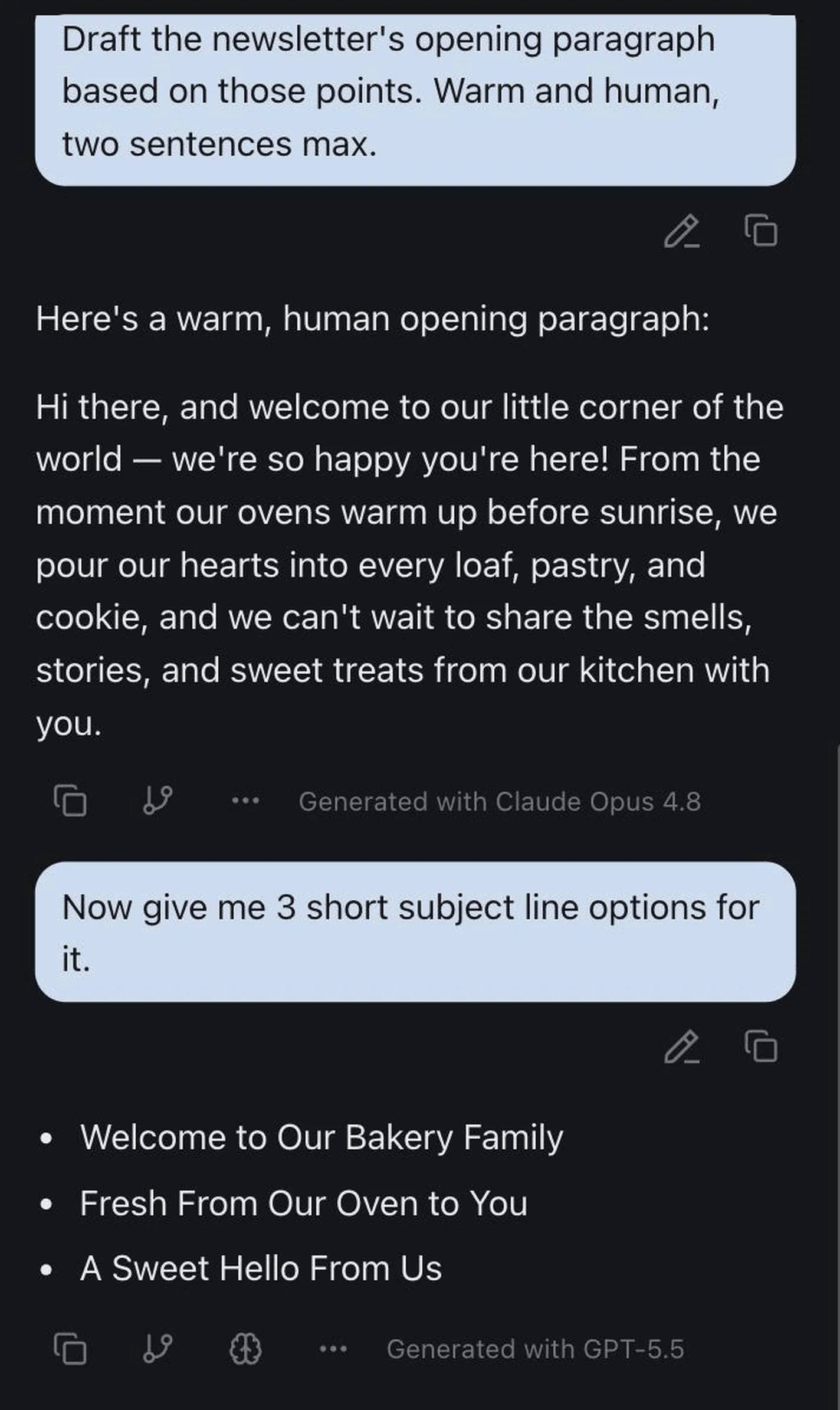
The writing loop this enables is short enough to actually stick to:
- Brief once. Voice samples and banned phrases go in the project system prompt, so you're not retyping them every session.
- Generate options with the model that's good at volume, and pick.
- Draft and edit with the model that's good at prose, in the same thread.
- Cold read by a different model — what sounds machine-written here, and what should I check?
- Export to Word or PDF when it's done.
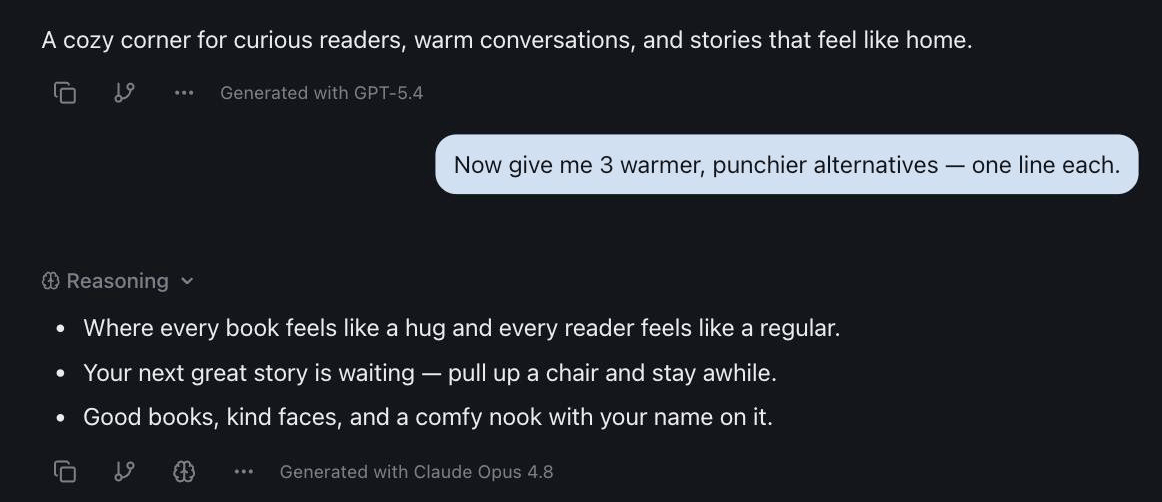
Two smaller things worth knowing, because they're specific to writing. Branching lets you fork a conversation from any point, so you can try three different openings from the same brief and compare them side by side instead of losing the first one. And Multiple Model Opinions puts the same question to several models at once — which turns the cold read from a chore into a single click. I wrote up the one-minute version of that move separately, and four full multi-model workflows if you'd rather steal a finished one.
So Which AI Should You Write With?
If you want one recommendation and no table, pick by what you produce most:
- Writers, editors and anyone with a byline: Claude. Fewer rewrites, and it edits without repossessing your voice.
- Marketers and copywriters: ChatGPT for the option spread, Claude for the final version. The two-step is worth more than either subscription alone.
- Anyone writing inside Google Docs and Gmail all day: Gemini, on proximity alone — then a second model for anything that has to be genuinely good.
- Anyone whose writing contains numbers: start with Perplexity Sonar, always. Sources first, prose second.
- Novelists and hobbyist fiction writers: Claude, and it isn't close.
- Anyone on no budget: DeepSeek for drafting, plus a free tier of something else for the second read.
Every line ends up pointing at a second model, which is the honest shape of this. There's no configuration where one model is the right answer to all of your writing.
The Bottom Line
The best AI for writing in 2026 is Claude if you have to name one — it writes and edits closest to publishable, and it holds a voice over length better than anything else. But naming one is the wrong exercise. ChatGPT wins the idea-generation half, Gemini wins wherever the document already lives, Perplexity wins the facts, Grok wins the opinion, and DeepSeek wins the budget.
And whichever you pick, the thing that decides whether the output reads like a person isn't the model. It's whether you gave it your voice instead of adjectives, banned the tells by name, and let a second model read the draft cold before you sent it. Do those three things and a good model gets noticeably better. Skip them and the best model in the world still writes like the internet's average.
Want to draft with one model, edit with another and get a cold read from a third — in one thread, without three subscriptions? Start with izzedo chat for free — no card required.
Frequently asked questions
What is the best AI for writing in 2026?
Claude, for most writing that a person will read closely — long-form articles, reports, fiction and editing. But the answer changes with the job: ChatGPT is better when you want twenty headline options in one go, Gemini is better when the writing happens inside Google Docs or Gmail, Perplexity Sonar is the one to start with when the piece contains facts, and Grok is the one that will hold a blunt opinion. There is no single winner because 'writing' is at least six different jobs.
Which AI writes the most human-sounding text?
Claude, by a consistent margin in ordinary use — its default prose has less filler and more sentence variety, so it needs fewer editing passes. But no model sounds human out of the box, because none of them know what you sound like. The reliable fix is to paste two or three samples of your own writing into the brief, name the habits you want banned, and then have a second model read the draft cold and mark the lines that still sound machine-written.
Is ChatGPT or Claude better for writing?
Claude for quality, ChatGPT for quantity. Claude produces prose closer to publishable and takes editing direction more faithfully, which makes it the better choice for anything long or anything with a byline. ChatGPT is faster at producing many distinct options — headlines, subject lines, angles, hooks — which is exactly what you want at the start of a piece. The strongest workflow uses both: generate options with ChatGPT, write and edit with Claude.
What is the best free AI for writing?
The free tiers of the major models all handle everyday drafting, and open models like DeepSeek and Qwen are genuinely capable for volume work at no cost. The catch with free tiers is that you get one model, so you lose the part that matters most — handing a draft to a second model for a cold read. izzedo chat has a free plan with no credit card that includes the free models, with usage details on the pricing page.
Are AI writing tools like Jasper worth it compared to using the models directly?
Only if you're buying the workflow rather than the writing. Jasper, Copy.ai and Writesonic run on the same underlying models you can reach directly for $20 a month, and charge $49 to $69 for templates, brand-voice memory, team approvals and integrations on top. For a marketing team that needs enforced brand voice and a review process, that can be money well spent. For an individual writer, you're paying two to three times as much for a wrapper around a model you could be using yourself.
Why does AI writing sound like AI?
Because models are tuned to produce output that is acceptable to everyone, and the safest version of any sentence is the average one. That produces four recurring tells: a warm-up paragraph before the actual point, everything arriving in threes, the 'it's not X, it's Y' reversal used in place of a real argument, and a closing paragraph that summarizes what you just read. All four are fixable in the brief — and easiest to catch by asking a different model to flag them.
Can AI write a whole article for me?
It can produce a complete draft, and it will read like a complete draft written by nobody in particular. The output improves sharply when you supply the things a model cannot invent: your angle, your evidence, your voice samples and your specific objections to the first attempt. Treat the model as a fast writer who has never met you and doesn't know your subject, and the division of labor becomes obvious.
Ready to try multi-model AI workflows?
Access GPT, Claude, Gemini, Perplexity, and more — all in one place.
Start for Free →