Meta AI vs ChatGPT in 2026: Meta AI Doesn't Run Llama Anymore
Almost every comparison you'll read says Meta AI runs on Llama. It hasn't since April. What replaced it is very good, closed, and only reachable inside apps that turn your chats into ad targeting — which changes the question entirely.
Ask Meta AI what model it runs on, then read the first page of Google results for this comparison. They do not agree.
I did exactly that in August 2026. The top-ranking result was published in May 2025 and never names a model. The three below it all say Llama — and one says Llama 3.1, which was already two generations stale on the day that article went up. These are real, competently written comparisons. They are also all describing a product that stopped existing in the shape they describe it.
Meta AI hasn't run on Llama since April 2026.
That's not a trivia correction, and it isn't me being pedantic about model names. It's the whole comparison. Once you know what actually sits behind Meta AI now — and, more importantly, what Meta will and won't let you take out of the building — the question "Meta AI or ChatGPT?" turns into a much more useful question with a much less obvious answer.
The Short Answer: Meta AI vs ChatGPT
| What you need | Better pick | Why | The catch |
|---|---|---|---|
| A quick answer mid-conversation | Meta AI | It's already inside the chat you're in; nothing to open, nothing to pay | The answer is short by design and hard to push deeper |
| Work you'll put your name on | ChatGPT | Holds a long thread, follows structure, doesn't drift over a session | Costs $20/month to get the version without ads |
| Documents, files, messy inputs | ChatGPT | Built to take a file and do something specific with it | The free tier keeps you on the lighter model |
| Casual image generation | Meta AI | Fast, free, right where you'd share it anyway | Watermarked, and less steerable than a dedicated image model |
| Anything you'd rather not be profiled on | Neither free tier | Both now read your chats to target advertising | Paying either vendor is the only exit |
| Getting Meta's model into real work | Not Meta AI | Its flagship is only reachable inside Meta's own apps | You need someone other than Meta to host it |
| Choosing the best tool per task | Neither, alone | Both are one vendor's answer to every question | A workspace that holds several models solves it directly |
Notice the last three rows. In every other comparison in this family the answer is "it depends on the job." Here, three of the seven rows aren't answered by either contender — and that's not me stacking the deck. It falls out of a structural change Meta made this year that almost nobody writing about Meta AI has caught up with.
Meta AI Doesn't Run Llama Anymore
In April 2026, Meta announced Muse Spark, the first model from its new Meta Superintelligence Labs. The announcement is unambiguous about where it went: "Muse Spark now powers the Meta AI assistant in the Meta AI app and meta.ai" — and it rolled out from there to WhatsApp, Instagram, Facebook, Messenger and Meta's glasses. By July, Meta was describing an assistant that "can now make plans, connect to email and calendar apps, create slides, and handle tasks on your behalf."
Read that announcement looking for the word Llama and you won't find it. It isn't mentioned.
Then, in July 2026, Meta wound down the Llama API — the service that let developers call Meta's open models directly. The tell is small and very clear: Meta's Llama developer domain now redirects to a generic AI developer domain. The name that defined open-weight AI for two years got folded into a URL that doesn't mention it.
Llama itself isn't gone. The weights are still downloadable, and third-party hosts still serve them. But Llama has been moved out of the product and into the archive, and the assistant a billion people use answers with something else entirely.
This matters for a practical reason. "Meta AI runs Llama" used to be a genuinely useful sentence, because it meant the thing you liked about Meta's assistant was a thing you could go and get elsewhere. That sentence is now false, and nothing in the search results has noticed.
Meta Now Ships Two Different AIs
Here's the part that took me a while to see clearly. Meta doesn't have one AI strategy in 2026. It has two, pointed at two different people, and they are separated by a very deliberate gap.
There's the assistant model — the one behind Meta AI. It's closed. You cannot download it, and outside a developer API you cannot reach it anywhere except inside Meta's own apps.
Then there's the open model. In August 2026 Meta released Muse Glimmer under Apache 2.0 — genuinely permissive, more so than any Llama licence ever was, with the old monthly-active-user threshold and acceptable-use annex dropped entirely. It's a 30-billion-parameter model built to run locally on a laptop.
Credit where it's due: that's a real reopening, and I'd rather Meta did it than didn't. But look at what the two halves actually score. These are Artificial Analysis's intelligence index numbers, an independent third-party benchmark, as of late August 2026:
| Model | Open weights? | Intelligence index |
|---|---|---|
| Muse Spark 1.2 — powers Meta AI | No | 56.8 |
| Muse Glimmer — the open release | Yes, Apache 2.0 | 35.1 |
| Llama 4 Maverick — the old open flagship | Yes | 14.5 |
Scores from Artificial Analysis, checked August 2026. Benchmarks move; the shape of the gap is the durable part.
Twenty-one points, between two models from the same company released five days apart. And Glimmer isn't a smaller cousin that happens to be worse — it's distilled from the flagship. It's a compressed impression of the good model, designed to fit on your hardware.
So the summary that fits the facts is this: the Meta model that's genuinely competitive is the one you can only use where Meta can see you, and the one you're free to take away is the one built to be smaller. In 2024 Meta open-sourced the model it had. In 2026 it open-sources the model it doesn't mind you having.
One caveat, stated plainly because it could date this section: Meta has said it intends to publish the flagship's weights too, "in the coming weeks." As I write, no date and no licence have been named. If it lands, that's a real reversal and I'll say so — but as you'll see below, it doesn't move the part of this comparison that actually costs you something.
Meta AI vs ChatGPT, Task by Task
With that established, the head-to-head gets easier, because you can stop asking which is smarter and start asking what each one is for.
Quick questions in the middle of something else
Meta AI wins this outright and it isn't close. It's in the WhatsApp thread, the Instagram DM, the Messenger conversation — no tab, no login, no thinking about it. The answers come back fast and short. For "what's that word," "roughly how far is it," "summarise this in a line," that's the correct shape of product, and ChatGPT's separate-destination model is pure friction by comparison.
Long, structured work
ChatGPT. Not because Meta's model is weak — on the numbers above it plainly isn't — but because the assistant wrapped around it is tuned for brevity and interruption. A conversational assistant inside a social app is designed to answer and get out of the way. ChatGPT is designed to be lived in for an hour: it holds context across a long thread, follows instructions about format, and doesn't drift when you're twelve turns deep in a document.
Files and real inputs
ChatGPT, comfortably. Give it a document, a spreadsheet, a pile of notes and ask for something specific back, and it's built for that. Meta AI can look at what you send it, but the workflow around files is not what a chat app inside a social network is for.
Images
Meta AI is the better free experience — fast, right next to where you'd post the result, and free. It also watermarks output and gives you less control than a dedicated image model. ChatGPT's image generation is slower and cleaner. If images matter to you more than occasionally, both are the wrong tool and you want an actual image model.
Knowing what's happening right now
Meta AI has genuine social context and a live connection to what's circulating, which makes it decent on trending topics and local recommendations. But if live information is the reason you're picking a model, this comparison is the wrong one — Grok, ChatGPT and Gemini each read a different live source, and that difference matters far more than anything here.
Writing that has to sound like a person
Neither, honestly. ChatGPT is the better of the two and steerable if you work at it. But the best writer among widely available models is Claude, and it's not in this matchup — which is worth knowing before you conclude that your only options are the two names in the title.
The Part Neither Free Tier Advertises
Every comparison of these two products is built on one assumption: Meta AI is free and ChatGPT costs $20. In 2026 that framing is out of date on both sides.
Meta, in its own words, effective 16 December 2025: "We will soon use your interactions with AI at Meta to personalize the content and ads you see." Not the content only — the ads. There's no full opt-out; Meta points to existing ad preference controls instead. To its credit, it does exclude sensitive categories, and it names them: "religious views, sexual orientation, political views, health, racial or ethnic origin, philosophical beliefs, or trade union membership."
OpenAI started showing ads on its Free and Go tiers to logged-in adults in February 2026, targeted using conversation topic, past chats and previous ad interactions. Plus, Pro, Business, Enterprise and Education stay ad-free. (I've broken down what each ChatGPT tier actually buys you separately, and whether a Business seat beats Plus for one person.)
So the real line in 2026 doesn't run between Meta AI and ChatGPT. It runs between the ad-supported tiers of both and the paid tiers of either. If your objection is to your conversations becoming targeting signal, picking the other free assistant doesn't solve anything — you've swapped which company builds the profile.
There's an asymmetry worth naming, though. ChatGPT sells you an exit for $20. Meta has started testing paid AI plans at $7.99 and $19.99 a month — but only in a handful of test markets. For nearly everyone reading this, there is currently no ad-free Meta AI available to buy at any price. The free one is the only one.
What Meta's Best Model Actually Costs
Line up every way Meta will let you reach its flagship model and a pattern shows up that you only see if you look at all of them at once:
| How you get it | What you pay in money | What you pay in data |
|---|---|---|
| Meta AI, in Meta's apps | Nothing | Your interactions personalise the ads you see |
| Meta's API, discounted tier | About a twelfth of standard rates | "Your prompts and outputs may be used to improve Meta's products" |
| Meta's API, standard tier | Full published rates | Nothing extra |
| The open weights (Muse Glimmer) | Nothing | Nothing — but it's the distilled model, not the flagship |
That second row is the one that made this click for me. Meta publishes a "contributor" tier of its flagship model priced at roughly a twelfth of the standard rate, and it states the trade in plain language on the listing: your prompts and outputs may be used to improve Meta's products. It's not hidden and it's not sinister — it's just unusually honest about a bargain that the consumer product makes silently.
Read the table top to bottom and the rule is consistent: every cheap door into Meta's best model is paid for in data. The one door that isn't, is simply priced.
That's the sentence I'd want someone to take away from this comparison, and it's why Meta's promised open-weights release doesn't really change the verdict. Weights or no weights, the consumer assistant is still ad-personalised, and the discounted API tier still trades on prompts. The pricing structure tells you what the product is.
The Two Decisions I Made This Month
I run a multi-model workspace, which means I decide what goes in the model list. Meta gave me two chances to add something this month and I took exactly one of them. The reasoning is the same reasoning I'd want you to apply.
I added Meta's flagship, and I'm glad it's there. At 56.8 on the index above it outperforms models I already carry that cost more than twice as much per token to run. It's strong at reasoning, takes text, images and documents, and holds an enormous context window. Adding it closed a genuine hole: until now the only Meta model in the list scored 14.5, which is worse than having no Meta option at all — someone picks the one brand name they recognise, gets the weakest answer in the product, and concludes the workspace is bad.
I run it on the standard tier, not the discounted one. The twelve-times saving is real and I'm not taking it, because the thing it's discounted against is your prompts. Every model routed through a third party in izzedo is called with data collection explicitly denied, and a cheaper tier isn't worth making that untrue.
I declined the open one. Muse Glimmer is a perfectly respectable model and I have no complaint about it. It's just dominated. At 35.1 it sits below every general-purpose text model already in the list, and the open models I do carry beat it by 18 and 23 points for a dollar or two more per million tokens. Its actual advantage — 30 billion parameters, quantised to under 20GB, runs on your own laptop with no network — is an advantage you cash in by running it yourself. Hosted behind an API, an open model isn't open in any way you can feel. It's just a smaller model.
That's the whole test, and it's worth stealing: open weights are a deployment property, not a quality one. They matter enormously if you're the one deploying. If you're typing into a box, they're a fact about someone else's infrastructure.
I'm aware how it looks for a workspace that sells access to models to tell you it turned one down. That's rather the point. A list that only ever grows is a catalogue, not a recommendation.
Which Should You Use? Pick by the Job
- You want an assistant in the app you're already in. Meta AI. It's free, it's there, and nothing else is competing for that slot.
- You want one AI subscription for real work. ChatGPT Plus. It's the most complete single AI product available, and the $20 is what removes the ads.
- You mainly want free image generation to share. Meta AI, with the watermark as the price.
- You want the best model for each task rather than one vendor's answer to everything. Neither, on its own — see below.
- You want Meta's model in actual work. You'll need somebody other than Meta to host it, because Meta's own route to it runs through the ads.
For how Meta's rivals stack up against each other, every head-to-head is on one page.
When Meta AI Is Simply the Right Answer
I'd rather say this clearly than let the rest of the post imply otherwise.
If what you want is an assistant inside the conversation you're already having, Meta AI wins and nothing here changes that. That's a distribution advantage built on a billion people's existing habits, and no workspace — mine included — can match it. There's no login, no subscription decision, no new app. For a huge number of people that convenience is worth more than any benchmark difference, and they're not wrong.
Meta's flagship is also genuinely good. On the index above it beats a model I sell access to. Anyone telling you Meta is behind in 2026 hasn't looked at the numbers recently.
And the reopening deserves acknowledgement. Apache 2.0 with the user threshold and use restrictions dropped is more permissive than Llama ever was. If Meta follows through on opening the flagship's weights, that's a meaningful reversal of the direction it set in April.
The argument here isn't that Meta's AI is bad. It's that the good one is only available where the ads are.
Using Meta's Best Model Without Meta's Ads
Which brings me to the version of this I actually use.
A multi-model workspace like izzedo chat puts Meta's flagship alongside ChatGPT, Claude, Gemini, Grok, Perplexity and DeepSeek — more than twenty models — behind one login for $6/month, with a free plan that needs no card. No ads on any tier. Billing stays deliberately boring: one flat price, with usage-based billing off unless you turn it on. Fair use applies, as it must anywhere real models are running, but it sits in the background on a short rolling window with a weekly pool behind it, rather than an allowance you count down message by message — the current numbers live on the pricing page.
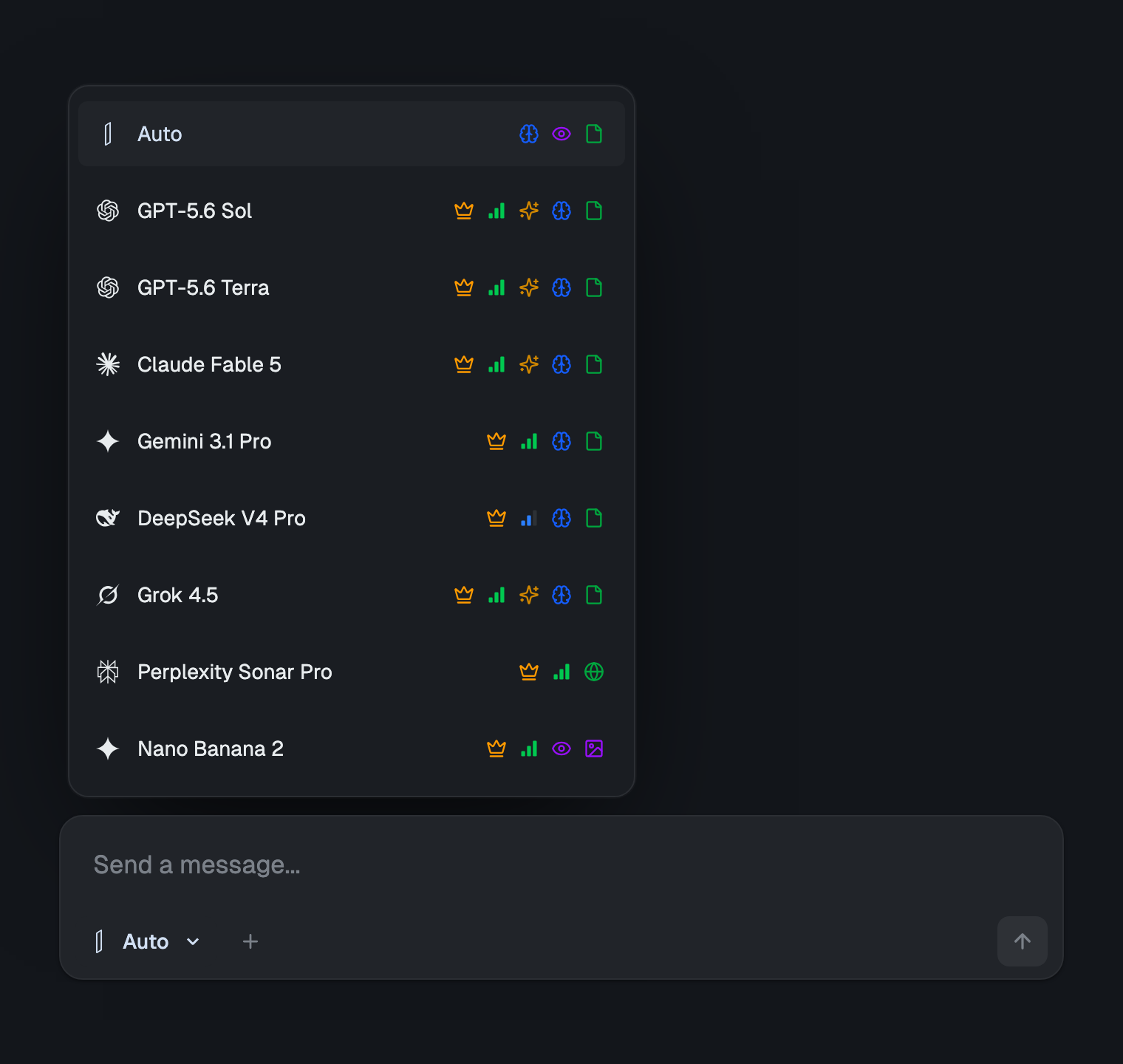
The part that matters more than the bundle is that they share a thread. Switching models mid-conversation keeps the context, so the comparison this article is about stops being a decision and becomes a habit: ask Meta's model, switch to Claude in the same conversation to sharpen the language, switch to Perplexity to check a claim that looked shaky. Nobody gets re-briefed. Nothing gets re-pasted.
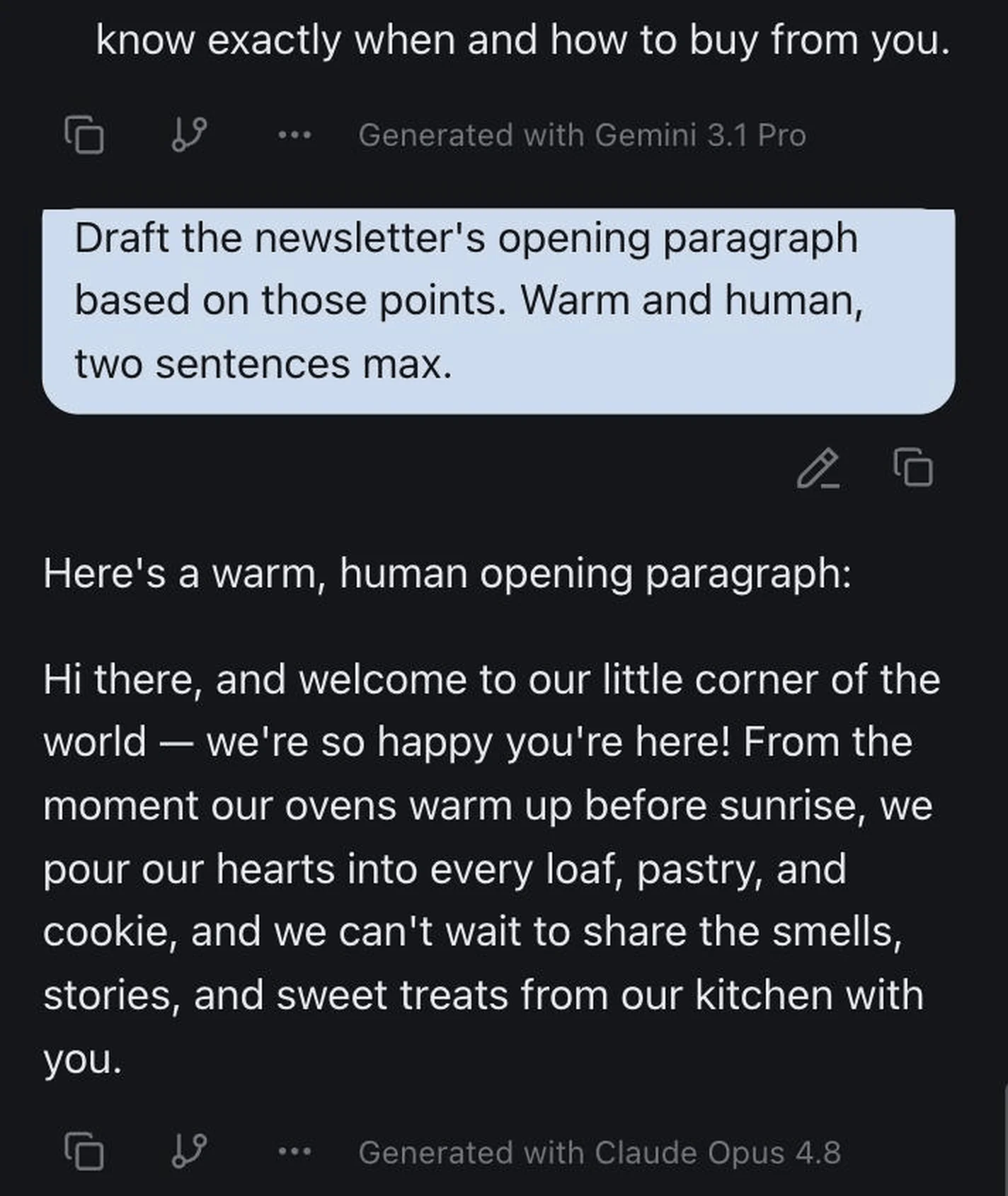
That's also the cheapest way to stop trusting any single model too much. Same question, second model, one click — and when two good models disagree, you've found the claim worth checking. There's a one-minute version of that habit here. If you're weighing this against paying a single vendor, I've also written up whether ChatGPT Plus is worth it and the wider field of ChatGPT alternatives.
The Bottom Line
Meta AI vs ChatGPT isn't a fight between a free assistant and a paid one, and it stopped being a fight about Llama in April.
What Meta built in 2026 is a very good closed model with a deliberate distance around it. You can have it free, inside the apps, where your conversations shape the ads you see. You can have it cheaply through the API, where your prompts help improve Meta's products. You can have the open version, which is a smaller distillation of it. Or you can pay standard rates, and get it clean.
ChatGPT is a simpler proposition: the most complete single AI product on the market, ad-supported at the bottom, ad-free from $20.
Both are one company's answer to every question you might have. That's the limitation neither can fix, and it's the one I'd actually plan around — because the model that's best at your next task is very often not the one you're already logged into.
Want Meta's flagship in one thread with ChatGPT, Claude, Gemini and Perplexity — no ads, on one $6 plan? Try izzedo chat free — no card needed.
Frequently asked questions
Does Meta AI still use Llama?
No. Since April 2026, the Meta AI assistant in the Meta AI app and on meta.ai has run on Muse Spark, a new model from Meta Superintelligence Labs — the announcement doesn't mention Llama at all. Meta then wound down the Llama API in July 2026, and its old Llama developer domain now redirects to a generic AI one. Llama weights are still downloadable and still hosted by third parties, but Llama is no longer the model behind the assistant. Most comparison articles you'll find still say otherwise.
Which is better, Meta AI or ChatGPT?
For work you'd put your name on, ChatGPT — it holds a longer thread, handles files and structured tasks more reliably, and its paid tiers carry no ads. For a fast answer inside a conversation you're already having, Meta AI, because it's already there and costs nothing. The honest framing is that they're not really competing for the same slot: ChatGPT is a place you go, Meta AI is something that arrives where you already are.
Is Meta AI really free?
It costs no money. Since December 2025 Meta uses your interactions with its AI to personalise the content and ads you see, with no full opt-out, though it excludes sensitive categories like health, religion and political views from ad targeting. Meta has begun testing paid Meta One AI plans at $7.99 and $19.99 a month, but only in a handful of countries, so for most people the free, ad-personalised version is the only version available.
Does ChatGPT show ads now?
On the Free and Go tiers, yes — OpenAI began showing ads to logged-in adults in February 2026, targeted using conversation topic, past chats and past ad interactions. Plus, Pro, Business, Enterprise and Education remain ad-free. So in 2026 the meaningful line isn't Meta AI versus ChatGPT, it's the ad-supported tiers of both versus the paid tiers of either.
Can I use Meta's best model without the Meta app?
Yes, through a workspace that hosts it rather than through Meta's own apps. That matters because Meta's assistant is only reachable inside Facebook, Instagram, WhatsApp, Messenger and the Meta AI app, where interactions feed ad personalisation. izzedo chat includes Meta's flagship model alongside ChatGPT, Claude, Gemini, Grok, Perplexity and DeepSeek for $6/month, with no ads and a free plan that needs no card.
Is Meta's open model any good?
It's honest work, but it isn't the model powering Meta AI. Muse Glimmer, released in August 2026 under a permissive Apache 2.0 licence, is a 30-billion-parameter model distilled from Meta's flagship and designed to run locally on a laptop. On Artificial Analysis's intelligence index it lands far below its closed sibling. That gap is the point: it's built to run on your hardware, and open weights only pay off if you're actually the one running it.
Ready to try multi-model AI workflows?
Access GPT, Claude, Gemini, Perplexity, and more — all in one place.
Start for Free →