Kimi vs ChatGPT: Kimi Gives Away the Model, ChatGPT Gives Away the Chat
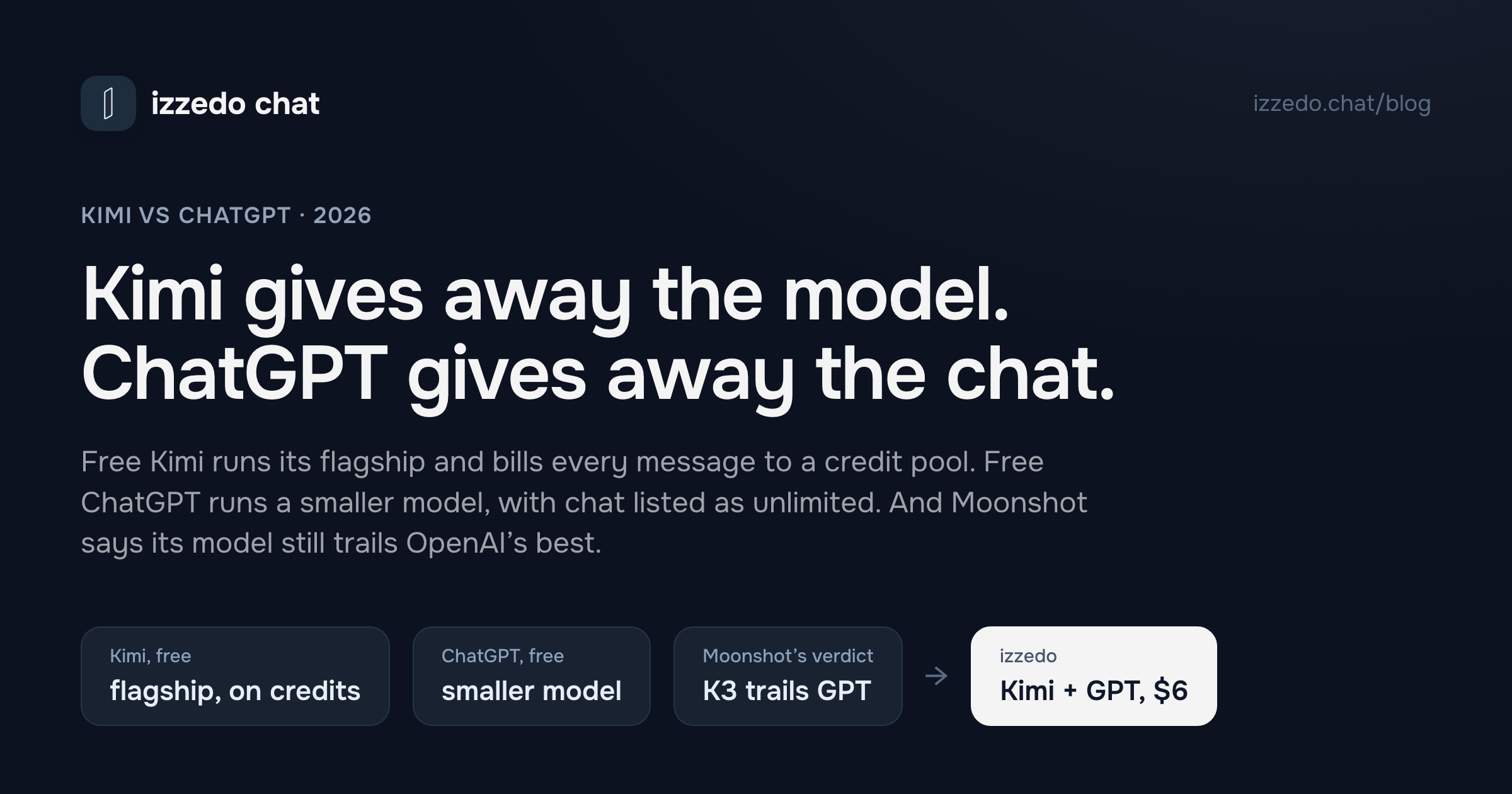
Kimi puts its strongest model on the free plan and bills every message, chat included, against one pool of credits. ChatGPT lists everyday chat as unlimited and charges for its better models. Moonshot's own launch post says its model still trails the strongest closed models. Here is what each one sells, what it costs, and which to use for what.
Most Kimi vs ChatGPT comparisons tell the same story. Kimi is the cheap, open alternative with the enormous context window. Two of those three claims need an asterisk now.
Moonshot AI released K3, its new flagship, on 16 July 2026. It is open like the models before it, but it lists at five times the price of the K2 generation that earned Kimi its reputation, and in Kimi's own app the 1 million token context now needs the $99 plan. The bigger change is in how the two apps charge you. ChatGPT lists everyday chat as unlimited on every plan, free included, and charges for its better models. Kimi puts its best model on the free plan and bills every message, chat included, against one pool of credits that the paid plans refill monthly. For the same $20 or so, you are buying different things.
I checked every figure below on 28 September 2026 against Kimi's pricing page, help centre and privacy policy, Moonshot's K3 launch post, OpenAI's pricing page and help centre, and the independent benchmarks at Artificial Analysis. The most useful of them turned out to be Moonshot's launch post, because it says plainly where Kimi falls short.
The Short Answer: Kimi vs ChatGPT in 2026
- A few hard questions a week, for free: Kimi. Its free picker includes K3, which scores 44 on Artificial Analysis's index. ChatGPT's free model scores 37.
- Chatting all day, for free: ChatGPT. OpenAI lists everyday text chat as unlimited, within reasonable use. Kimi draws every message, on every plan, from a pool of credits.
- Paying about $20: ChatGPT Plus, by less than you might expect. Plus's regular chat runs at settings that score just below K3 on Artificial Analysis's index. Its lead comes from ChatGPT Work, where OpenAI's newest models run, and from chat that isn't billed against credits.
- Documents, decks and spreadsheets: whichever you already use. Kimi's agent and ChatGPT's Work mode both return editable files, and an independent test of that kind of work scores K3 level with OpenAI's newest model. On a free plan, only Kimi does it outside a desktop app.
- Very long documents: Kimi Max at $99. It opens a 1 million token context. OpenAI's pricing page lists 400K for ChatGPT Pro at $100.
- Anything confidential: not Kimi's consumer app. Its policy trains on your prompts and describes no opt-out. ChatGPT has one on every plan.
| Kimi | ChatGPT | |
|---|---|---|
| Made by | Moonshot AI, Beijing, founded 2023 | OpenAI, US |
| Flagship in the app | K3, open weights | OpenAI's Sol and Astra models, closed |
| Free plan gets | The flagship, metered by a credit pool | A smaller model, with text chat listed as unlimited |
| Cheapest paid plan | Plus, $19 a month, or $15 billed annually | Go, $6 a month |
| How usage is metered | One pool for chat, agent, research and code | Per model and per feature. Work has its own allowance |
| Makes editable files | The agent, on every plan | ChatGPT Work, Plus and up. Limited, desktop only, on Free and Go |
| Longest context in the app | 1M tokens, Max at $99 and up | 400K listed for Pro at $100 |
| Trains on your chats | Yes, per its policy. Business is off by default | Opt-out available on every plan |
What Is Kimi, and Who Makes It?
Kimi is Moonshot AI's assistant. Moonshot was founded in spring 2023 and lists its address on Zhichun Road in Beijing's Haidian district. Besides the web and phone apps, there is a desktop agent called Kimi Work that can handle files on your computer, a coding tool, and a cloud bot called Kimi Claw that plugs into chat platforms. For users outside China, the privacy policy names a company called NOVASCENT PRIVATE LIMITED as the provider of the service.
Kimi's model picker currently offers three choices. K3 is described as the "flagship all-rounder" for chat and agent work, a lighter preview model handles everyday tasks, and Instant is for "fast chat, quick replies". Instant is the one the picker selects by default, so a new visitor is not talking to K3 until they switch.
K3 is the reason anyone is comparing Kimi with ChatGPT this year. Moonshot describes it as a 2.8 trillion parameter model with native image understanding and a 1 million token context window, and it published the weights on Hugging Face under its own licence. That licence works like MIT for almost everyone. The extra conditions only apply to very large operators: companies reselling model access with more than $20 million a year in revenue, and products with over 100 million monthly users or $20 million a month in revenue.
One note if you are reading older guides. Kimi has renamed its paid plans. The help centre still calls them Moderato, Allegretto, Allegro and Vivace, while the pricing page now says Plus, Pro, Max and Ultra, at the same prices.
Moonshot's Own Verdict: K3 Still Trails
The most candid Kimi vs ChatGPT comparison I found was written by Moonshot. Its K3 launch post says the model's overall performance "still trails the most powerful proprietary models", and it names two of them. One is from Anthropic. The other is the previous generation of OpenAI's Sol, the model behind ChatGPT Plus's regular chat, although Moonshot tested it at a higher setting than Plus offers there.
The post also has a Limitations section, which more launch posts should. Three lines from it matter if you are choosing between the two apps.
- The experience lags. Moonshot writes that "K3 nonetheless exhibits a noticeable gap in user experience" compared with those same two models.
- It improvises. When K3 meets "minor issues or ambiguous user intent" during a task, Moonshot says "it may make unexpected decisions on the user's behalf", and suggests putting firmer instructions in the prompt.
- It does not like being handed a conversation. "If an ongoing session with another model is switched over to K3, generation quality may become highly unstable." Moonshot recommends "avoiding switching to K3 in the middle of a session".
I ran into the second one on my first test. I asked K3 for a short email telling a bookkeeping practice's clients that the monthly fee was going up, and I deliberately gave it no reason. It supplied one. It also wrote that this was the practice's "first increase in two years", which I had never said. One test is not a benchmark, but it is the behaviour Moonshot describes, and it is exactly the kind of line a client remembers and a business owner has to take back later. The third limitation shapes how to use Kimi alongside other models, which I come back to at the end.
The Benchmarks: Close on Price, Not on Score
Artificial Analysis scores models on one shared battery of tests, and for each model it also reports the bill for the full run and the number of tokens the model produced. OpenAI names its models by tier rather than size. The previous generation came as Luna, Terra and Sol, from lightest to strongest, and the current one as Luna, Sol and Astra. In ChatGPT, what you get depends on both your plan and the mode. Plus's regular chat runs the previous-generation Sol at Medium or High. OpenAI's newest models run in ChatGPT Work, its agent mode for longer jobs. OpenAI's chat levels share their names with the API settings Artificial Analysis tests, though OpenAI does not say they are identical. Read one page at a time on 28 September 2026:
| Model and setting | Where ChatGPT or Kimi offers it | Intelligence Index |
|---|---|---|
| Kimi K3, maximum | Kimi, free plan included | 44 |
| Kimi K3, low | Kimi | 34 |
| Luna, previous generation | ChatGPT Free and Go, in chat | 37 |
| Sol, previous generation, Medium | ChatGPT Plus, in chat | 39 |
| Terra, previous generation, maximum | ChatGPT Work and Codex, Plus and up. Limited on Free and Go desktop | 42 |
| Sol, previous generation, High | ChatGPT Plus, in chat, the highest level Plus gets there | 42 |
| Sol, previous generation, Extra High | ChatGPT Pro, in chat | 44 |
| Sol, previous generation, maximum | The setting Moonshot's benchmarks used | 47 |
| Sol, current generation, maximum | ChatGPT Work and Codex, Plus and up. Not in regular chat | 48 |
| Astra, maximum | ChatGPT Pro in chat. Plus in Work and Codex, in limited amounts | 53 |
Three things stand out.
Free against free, Kimi has the stronger model. ChatGPT's free plan runs Luna, which scores 37. Kimi's free picker includes K3, which scores 44. The catch is that these are API scores at the highest reasoning setting, and neither app says how its own settings map onto them. On low reasoning, K3 scores 34, which is below free ChatGPT.
At $20, the gap is smaller than Moonshot's own post suggests. Moonshot's benchmarks ran every model at maximum reasoning effort, and at that setting the previous-generation Sol scores 47 to K3's 44. ChatGPT Plus does not offer that setting in regular chat. Its Medium and High score 39 and 42, both below K3 at full effort. Plus pulls clearly ahead only in ChatGPT Work, which runs the current Sol and a limited allowance of Astra, and Astra scores 50 even at Medium. On Pro, Astra is in regular chat too.
K3 is not the cheap option. Kimi's reputation for low prices came from its K2 generation, which Artificial Analysis lists at $0.60 per million input tokens and $2.50 per million output. K3 lists at $3 and $15, five and six times as much. It is still cheaper per token than the Sol it was compared with, which lists at $4 and $20. But K3 wrote 160 million tokens across the test to that Sol's 90 million, so per task the two came out the same, $2.00 against $1.99. The current Sol scores higher than both at about half K3's cost per task. Artificial Analysis's own summary calls K3 "particularly expensive when comparing to other open weight models of similar size".
That token count matters beyond the API, because Kimi's app bills you in tokens too.
ChatGPT Charges for the Model. Kimi Charges for the Work.
The two apps meter usage in opposite directions, and this is what decides which one suits you.
OpenAI's pricing page lists "everyday text chats" as unlimited on Free, Go, Plus and Pro, with a footnote that usage "must be reasonable and comply with our policies". What changes as you pay is which models you can reach and how much of the extras you get. Free runs Luna, with limited uploads, image generation and deep research. Go, at $6, adds more of those extras and may show ads, and still runs Luna. Plus, at $20, is the first plan with Sol in regular chat, full deep research, and full access to ChatGPT Work, the agent mode where OpenAI's newest models run. The price tracks the model.
Kimi works the other way round. Its free picker has the flagship. What it meters is everything you do with it. Kimi's help centre says all membership features, including the agent, Deep Research, Slides, Docs, Sheets, Kimi Code and Kimi Work, "share a single credit pool", charged by the tokens each task consumes. Its model guide marks each model it lists "Billed against credits", so ordinary chat draws from the same pool as a 20-minute research job.
A few details from the help centre show how that plays out.
- Paid pools refresh monthly. Members' credits renew on the monthly anniversary of their subscription, not every few hours, and whatever they have not used disappears at renewal.
- Big jobs take a visible share. Kimi's rough guide for free accounts puts a deep research report at 5 to 10 percent of the month's credits, and a simple slide deck at 1 to 2 percent.
- There are short-term brakes as well. Send too much too quickly and Kimi asks you to wait two to three hours. At busy times you may see "Kimi is a bit tired", which the help centre describes as a peak-hour limit that paying members get priority around.
- Things left running keep spending. A deployed Kimi Claw cloud host costs about 0.6 percent of a member's credits every day, and a published website takes a smaller ongoing cut.
- When the pool is empty, new tasks stop. Anything already running finishes. After that you wait for the renewal date, upgrade, or switch on pay-as-you-go Extra Usage.
This is where K3's token count comes back. A model that writes 160 million tokens where a rival writes 90 million spends your pool faster for the same job, and Kimi's own guide to thinking effort warns that a higher setting "also uses more tokens". On Kimi, a long answer costs you more than a short one, even on a subscription.
So the two free plans suit different people. If you ask a few hard questions a week, free Kimi gives you the better model for them. If AI sits open in a tab all day, free ChatGPT does not count your ordinary chat against a credit budget, even though the model behind it is smaller. I went through how ChatGPT's own limits work in more detail in a separate post.
Kimi Pricing vs ChatGPT Pricing
Side by side, the two ladders roughly line up at the bottom and the top, and split in the middle.
| Monthly price | Kimi | What it adds | ChatGPT | What it adds |
|---|---|---|---|---|
| $0 | Adagio | K3 on a small credit pool, one agent task at a time, 2 projects | Free | Unlimited text chat on Luna, limited uploads, images and deep research |
| $6 | nothing | Go | More uploads, images, memory and voice. May include ads | |
| $19 to $20 | Plus, $19, or $15 annually | A bigger pool, 4x agent queue priority, websites with a database | Plus, $20, monthly only | Sol in chat, Work with the newest models and limited Astra, full deep research |
| $39 | Pro, $39, or $31 annually | Twice Plus's credits, Goal mode, Kimi Claw | nothing | |
| $99 to $100 | Max, $99, or $79 annually | Five times Plus's credits, 1M token context | Pro, from $100 | 5x Plus's usage, Astra in chat, 400K reasoning context listed |
| $199 to $200 | Ultra, $199, or $159 annually | Ten times Plus's credits, four agent tasks at once | Pro at $200 | Closed to new sign-ups since 10 September |
Three things in that table are easy to miss.
Kimi discounts annual plans and ChatGPT Plus cannot be paid annually. Kimi's annual prices come to about 20 percent off, up to $480 a year saved on Ultra. OpenAI's help centre says it does not "support annual billing or the option to pay for multiple months in advance" for Plus.
Kimi has nothing between free and $19. ChatGPT Go at $6 has no Kimi equivalent.
The long context is where Kimi is most generous and where it charges most. K3 handles 1 million tokens natively and its weights are free, but in Kimi's app the "K3 Extra Long chat capacity (up to 1M tokens)" row is ticked only for Max and Ultra. At around $100 that still beats ChatGPT on paper. Kimi Max opens 1 million tokens, while OpenAI's pricing page lists 400K for Pro's reasoning models and puts the part left for your own input at about 680 pages of text, because the same window also holds system instructions, memory and the model's reasoning. OpenAI publishes no figure for ChatGPT Work. Below Max, Kimi does not publish K3's window at all. Its help centre only gives a figure for an older model, about 128K tokens.
Teams have one more Kimi option. Kimi Business costs $600 per seat per year, billed annually, with at least two seats, and it matters mainly for the privacy reason covered below. If you are weighing OpenAI's own ladder instead, I compared ChatGPT Go, Plus and Pro on their own.
What Each One Actually Makes
Chat quality is half of this comparison. The other half is what each app hands back to you.
Kimi's agent sits at the centre of the product. With K3 selected, Kimi says it can produce "editable documents end to end, such as .pptx, .docx, .xlsx, and .pdf", and it also builds websites with a database behind them and runs Deep Research. An agent task usually takes 5 to 20 minutes and keeps running in the background, and the swarm mode splits bigger jobs across sub-agents, up to eight at once on Max and Ultra. Images, video and audio come through plugins rather than the chat itself, and the audio plugin's text-to-speech voices are listed as Mandarin. The agent is on the free plan too, one task at a time.
ChatGPT's answer is Work, a mode that sits next to regular chat and that OpenAI describes as "an agent designed for longer, multi-step work and finished deliverables". You switch to it to "create a document, spreadsheet, presentation, report, or Site". It runs on the web, phones and desktop from Plus up, and in a limited form in the desktop app on Free and Go. It is also where OpenAI's newest models live. The current Sol and Luna are "not available in regular ChatGPT conversations", and Plus gets Astra there in limited amounts, with credits on sale for more. OpenAI calls Astra "our best model for adhering to existing templates and producing slides", which matters if your decks have to match a company template. Work draws on its own allowance, separate from chat.
The one independent test built around this kind of output puts the two closer than either company's pitch. GDPval-AA is Artificial Analysis's run of OpenAI's GDPval benchmark, 220 tasks from 44 occupations in which models have to produce "documents, slides, diagrams, and spreadsheets", ranked by blind pairwise comparison. The relevant scores, read on 28 September:
| Model and setting | GDPval-AA score |
|---|---|
| Sol, previous generation, maximum | 1588 |
| Astra, maximum | 1542 |
| Kimi K3, maximum | 1524 |
| Sol, current generation, maximum | 1487 |
| Sol, previous generation, High, the top level in Plus chat | 1480 |
| Luna, previous generation, ChatGPT's free model | 1443 |
| Terra, previous generation, maximum, in Work on Plus and limited on Free and Go desktop | 1432 |
Each score carries a margin of about 25 points either way, so K3 and Astra are effectively level, and the previous-generation Sol at full effort is the one clear step ahead. Anthropic's models sit well above all of these, with its top entry at 1846, which is worth knowing if documents are your main job.
So I would not pick either app on file quality alone. If you already pay for Plus, use Work, since it comes with the subscription and with Astra's template handling. If you pay nothing, Kimi is the one that will build the file in a browser.
Around the conversation, ChatGPT covers more. Image generation, voice, memory of past chats, projects and search are on every plan in some amount. Voice with video starts at Go, and full deep research and Sites start at Plus. If you want an assistant that talks, looks at photos, remembers you and draws, ChatGPT is the broader product.
Moonshot's warning about improvising applies most to the agent, because agent tasks run unattended for minutes at a time. Give Kimi the facts it needs and a narrow brief. It will fill whatever gaps you leave, and you will not be watching when it does. I wrote more generally about what agent mode does in each assistant in an earlier post.
Is Kimi AI Safe to Use?
The question splits in two, because Moonshot's app and Moonshot's model come with different terms.
Kimi's English privacy policy, last updated on 13 August 2026, lists "prompts, audio, images, videos, files" among the content it processes "to provide and improve the Services, including training and optimizing" its AI models. It gives the legal basis as "legitimate interests or your consent, depending on your jurisdiction", and I read the whole policy without finding a setting described for switching training off. It says your information "may be transferred to and stored on servers located outside of your country of residence", without saying where. Moonshot itself is based in Beijing, and Kimi's help article on account deletion says some data is kept afterwards as required by "the Cybersecurity Law, the Personal Information Protection Law", which are the names of two Chinese data laws.
The one Kimi plan that promises otherwise is Business, whose pricing card says "No model training on your business data by default". OpenAI's pricing grid, for comparison, marks training as "Opt-out available" on Free, Go, Plus and Pro.
None of that makes Kimi unusable. It makes the consumer app a poor home for client records, contracts, or anything under an NDA, and a reasonable one for work you would be happy to publish anyway. And because K3's weights are public, the model is also offered by services that are not Moonshot, each under its own privacy terms. I made the same point about DeepSeek and Qwen, where the warnings are also about the apps rather than the models.
Kimi vs ChatGPT by Job
| Job | Pick | Why |
|---|---|---|
| A few hard questions a week, no budget | Kimi free, with K3 selected | The stronger free model, and light use fits inside the free pool |
| All-day drafting and questions, no budget | ChatGPT Free | Ordinary chat is not counted against a credit budget |
| A deck or spreadsheet, no budget | Kimi free | Its agent builds editable files in the browser. ChatGPT's free Work is limited and desktop-only |
| A deck that has to follow your company template | ChatGPT Plus, in Work | OpenAI says Astra is its best at templates, and the independent scores are level |
| Analysis where a wrong answer costs money | ChatGPT with Astra, in chat on Pro or in Work on Plus | Astra scores 53 to K3's 44. Plus's regular chat scores 39 to 42 |
| Reading a very long contract or a stack of reports at once | Kimi Max | 1M tokens at $99, against the 400K OpenAI lists for Pro at $100 |
| Voice conversations and image generation | ChatGPT | Built in on every plan. Kimi routes both through plugins |
| Client data, contracts, anything confidential | ChatGPT with training off, or Kimi Business | Kimi's consumer policy trains on prompts |
Using Kimi Without Picking a Side
Put the findings together and a pattern shows up. Kimi's model is strong enough to be worth asking, especially for free. Its maker says it trails the strongest closed models, that it improvises, and its app meters you by the token. That makes it a good first draft and a good second opinion, and a risky only opinion.
That is how it works in izzedo chat. K3 sits in the same model picker as OpenAI's models, Claude, Gemini, Grok, DeepSeek and the rest, with a Reasoning effort menu next to it offering Low, High and Max. The screenshot below is the email test from earlier. Kimi wrote the draft in a new chat. Then I switched the same thread to OpenAI's current Sol and asked what the email claimed that I had never told it.
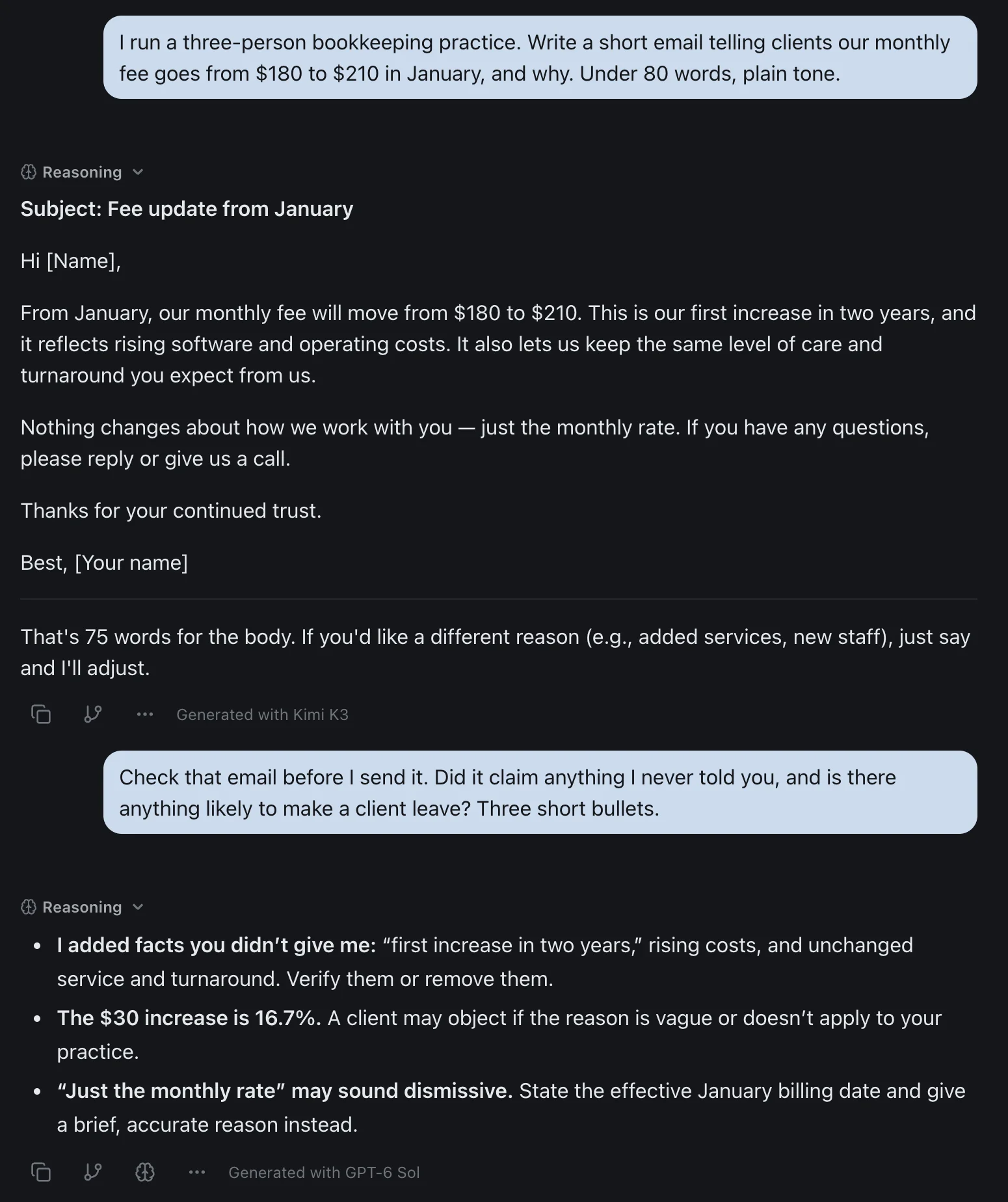
The review caught all three things Kimi had added, starting with the "first increase in two years", and warned that a client may object to a 16.7 percent rise if the reason is vague. It took two messages in one thread, and nothing had to be copied between apps.
The order matters here, because of Moonshot's warning. Start Kimi in a new chat rather than switching into it halfway through a conversation another model started. The warning is about switching into K3, and says nothing against switching away from it, which is the direction a second opinion goes. When two models from different companies agree on a draft, you can send it. When they disagree, you know which sentence to check. That is the whole argument for not relying on one model.
Using Kimi this way also takes Moonshot's consumer app, and its privacy policy, out of the picture. Your prompts go through izzedo, which does not train models on your inputs, and the model providers do not store what you send through it.
You can try K3 on izzedo's free plan, without a card, where it runs at Low. For $6 a month, Hobby unlocks High and Max along with the rest of the chat models, OpenAI's Sol and Astra among them. izzedo meters cost per answer too, but its allowance refills over a rolling five hours with a weekly cap behind it, not once a month. K3 is one of the more expensive models on that meter, so it draws the allowance down faster than the light ones do. The exact allowances live on the pricing page.
The Bottom Line
Kimi used to win this comparison on price. With K3 it wins on access instead. The best model Moonshot makes is on the free plan, and its agent builds editable files there too. ChatGPT wins once you pay, though less because of its regular chat, which on Plus runs at settings that score just below K3, than because of Work, where its newest models and its file-making live, and because ordinary chat is never billed against credits.
So choose by how you work. For a few hard questions, or a deck on no budget, try free Kimi, and keep anything confidential out of its app. For all-day use, or for documents and analysis you are paying to get right, ChatGPT Plus is the better $20, as long as you use Work for the heavy jobs. And when a draft matters, have a model from a different company read it before you send it. In my test, that second read found a claim I would have had to take back.
Frequently asked questions
Is Kimi better than ChatGPT?
Not at the top end, and Moonshot AI, the company behind Kimi, says so itself. Its launch post for K3, Kimi's current flagship, says the model's overall performance 'still trails the most powerful proprietary models', and one of the two it names is an OpenAI model. The gap is smaller on a $20 plan than that suggests. On Artificial Analysis's Intelligence Index, K3 scores 44 at maximum reasoning, while ChatGPT Plus runs its regular chat at settings that score 39 and 42. OpenAI's newest models, which score 48 and 53, run in ChatGPT Work from Plus up, and Astra, the stronger of the two, is also in regular chat on Pro. On the free plans Kimi is ahead, since its free picker includes K3 and ChatGPT's free model scores 37.
What is Kimi AI?
Kimi is the AI assistant made by Moonshot AI, a company founded in Beijing in spring 2023. It runs on the web, on phones and as a desktop app, and it combines chat with an agent that builds slide decks, documents, spreadsheets, websites and deep research reports. Its flagship model, K3, launched on 16 July 2026 with 2.8 trillion parameters and a 1 million token context window, and Moonshot publishes its weights on Hugging Face. For users outside China, Kimi's privacy policy names NOVASCENT PRIVATE LIMITED as the provider of the service.
Is Kimi AI free?
Yes. Kimi's free plan, which it calls Adagio, has K3 in the model picker with no membership marker on it, and includes the agent, one task at a time. Everything you do on Kimi draws from a pool of credits, ordinary chat included. Kimi's help centre estimates that a single deep research report uses about 5 to 10 percent of a free account's credits. The 1 million token context is reserved for the $99 and $199 plans.
How much does Kimi cost?
Kimi has four paid plans: Plus at $19 a month, Pro at $39, Max at $99 and Ultra at $199. Paying annually brings them down to $15, $31, $79 and $159 a month. Each tier buys a bigger share of the same credit pool, which Kimi describes as twice Plus's agent credits on Pro, five times on Max and ten times on Ultra, and Max and Ultra add the 1 million token context. Kimi Business costs $600 per seat per year with a two-seat minimum. ChatGPT, for comparison, costs $6 for Go, $20 for Plus and from $100 for Pro, and Plus has no annual option.
Is Kimi AI safe to use?
It depends on what you put into it. Kimi's privacy policy lists your prompts and files as content it uses for 'training and optimizing' its models, and it does not describe a way to switch that off. The Business plan is the one Kimi advertises with no training on your data by default. Kimi's help centre says some data is kept after account deletion as required by 'the Cybersecurity Law, the Personal Information Protection Law', which are the names of two Chinese data laws, and Moonshot is based in Beijing. ChatGPT offers a training opt-out on every consumer plan. Because K3's weights are public, you can also use the model through services that are not Moonshot's app, under their own privacy terms.
Is Kimi better than Claude?
Moonshot says no. The same launch post that places K3 behind an OpenAI model names an Anthropic model as ahead of it too, and admits 'a noticeable gap in user experience' against both. On Artificial Analysis's index, Anthropic's top two models score 53 and 58 to K3's 44, and on its test of document, slide and spreadsheet work the top Anthropic model scores 1846 to K3's 1524. Kimi's case against Claude is the same as its case against ChatGPT. Its flagship is available on the free plan.
Is Kimi cheaper than ChatGPT?
Not in the way its reputation suggests. Kimi earned the cheap label with its K2 generation, which Artificial Analysis lists at $0.60 per million input tokens and $2.50 per million output. K3 lists at $3 and $15, five and six times as much. Per token it is still cheaper than the OpenAI model Moonshot compared it with, which lists at $4 and $20, but K3 writes far more tokens, so across Artificial Analysis's full test the two cost the same, $2.00 a task against $1.99. On the consumer plans, Kimi Plus is $19 and ChatGPT Plus is $20.
What happened to Kimi's Moderato, Allegretto, Allegro and Vivace plans?
They were renamed. Kimi's pricing page now lists Plus, Pro, Max and Ultra at the same $19, $39, $99 and $199 monthly prices, keeps the name Adagio for the free plan, and says 'the new membership plan is now available'. Kimi's help centre still uses the musical names, and some of its tables no longer match the pricing page, so trust the pricing page where the two disagree.
Ready to try multi-model AI workflows?
Access GPT, Claude, Gemini, Perplexity, and more — all in one place.
Start for Free →