Grok vs Claude: The Answer Flips When You Pay
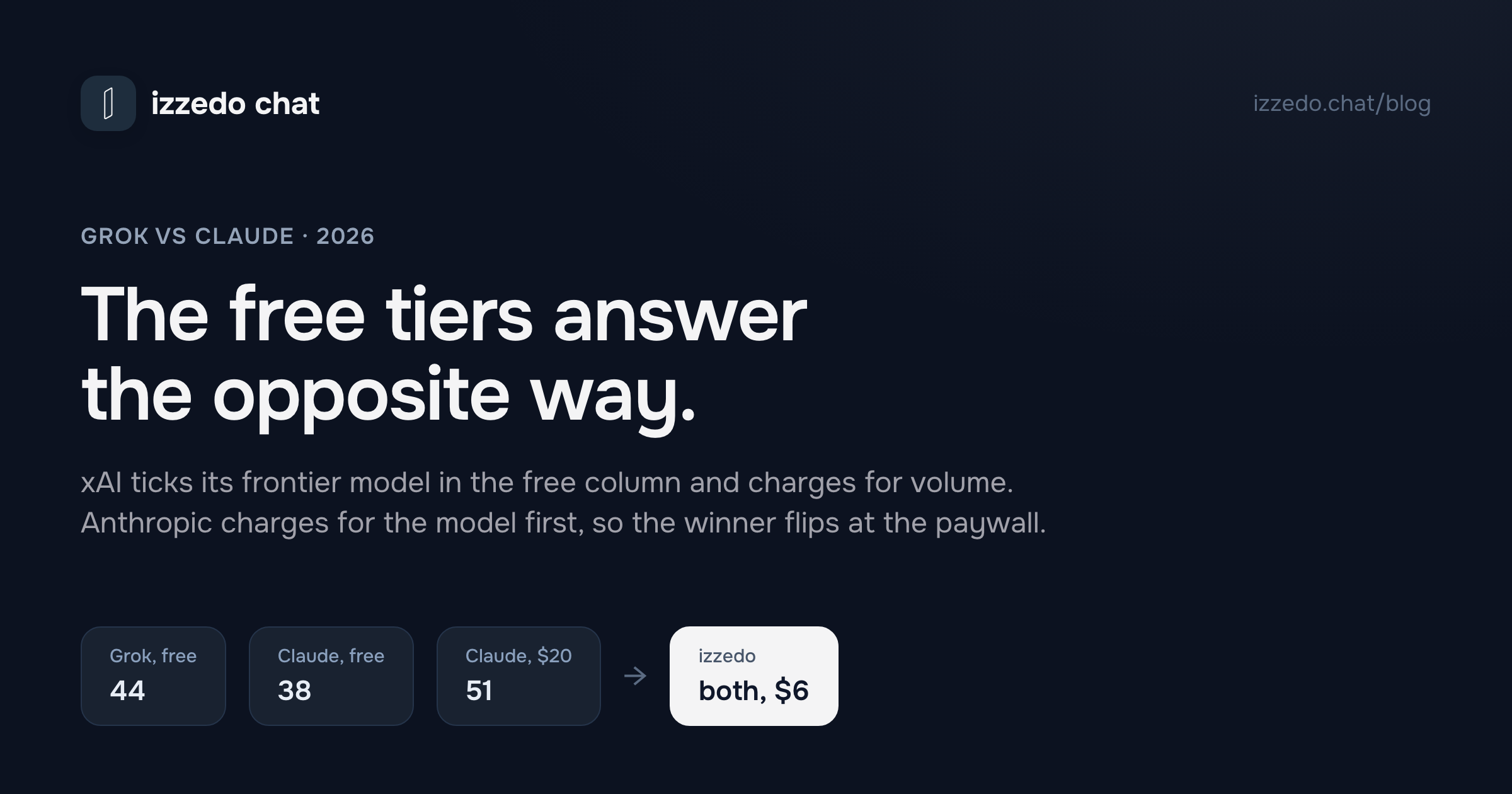
Every Grok vs Claude comparison benchmarks the flagship models. Almost nobody is using those. Read each company's own plan table instead and the answer changes twice: xAI puts its best model in the free column and charges for volume, Anthropic charges for the model first. So free Grok beats free Claude, and paid Claude beats paid Grok.
Most comparisons of these two run the flagship models against each other and publish the scores. It is the wrong test for almost everyone reading, because the flagship is usually not the model you have. What you have is whatever your plan gives you, and the two companies have made opposite decisions about what a plan gives you.
So I did the boring version instead. I read xAI's plan comparison and Anthropic's plan comparison side by side on 17 September 2026, counted what each one puts in the free column, then checked the models named there against an independent benchmark. The answer came out backwards from the usual one, twice.
Free Grok gives you a better model than free Claude. Paid Claude gives you a better model than paid Grok. Both of those are true at the same time, and nobody writes them down because everybody is busy benchmarking the top of each lineup.
The Short Answer: Grok vs Claude at Each Price
| If this is you | Pick | Why |
|---|---|---|
| You are not paying anything | Grok | xAI's table ticks its current model for free users. Anthropic's marks Opus No |
| You need what happened this morning | Grok | It searches X natively. Claude has no equivalent, at any price |
| You write long documents | Claude | A million tokens of context on paid plans against 500K, and it reads PDFs |
| You are paying about $20 | Claude | Pro unlocks Opus at 51 on the intelligence index, past Grok's 44 |
| You generate images in the same chat | Grok | Claude's consumer comparison has no image generation row at all |
| You care about cost per finished task | Grok | $1.86 against $5.86 to complete the same benchmark set |
| You want a plan that does not train on you | Neither | Both reserve that for their business tiers |
| You want both halves | Neither, alone | See the last section |
Everything under here is the working, with each figure read from a vendor page or a benchmark on 17 September 2026.
What Every Grok vs Claude Comparison Gets Wrong
The genre has settled into one shape. Test the top model against the top model, arrive at "Claude for reasoning, Grok for real-time", stop. It is not wrong. It is just an answer to a question about two models rather than two products, and you are buying a product.
There is a second habit worth naming, because this is the one that costs money. These comparisons benchmark the models and skim the pricing pages, when the models are the part both companies hand out most freely and the pricing pages are where the two of them actually disagree.
Here is the part that actually decides it. xAI and Anthropic charge for different things:
- xAI sells volume. Its current model is ticked in every column of the comparison table, including Free. The $30 plan buys higher rate limits, video generation, Grok Bot and Expert mode.
- Anthropic sells the model. Opus is No on Free and Yes on Pro. Fable, the tier above Opus, is not really included even at $20, because Pro reaches it through usage credits billed at API rates.
One company treats its best model as a loss leader and meters how much you can use it. The other treats the model as the product and puts the good one behind the till. That single difference explains almost everything people find confusing about these two.
How I Checked This
I read x.ai/pricing, the xAI privacy policy, xAI's consumer FAQ, the Grok documentation FAQ, X's Premium help page, claude.com/pricing and Anthropic's context window article, all on 17 September 2026. Both plan tables answer in ticks and dashes rather than words, which is easy to misread at a glance, so I checked the rows this post rests on twice.
For capability I used the Artificial Analysis intelligence index, which is independent of both vendors, runs the same evaluation set on every model and publishes what each run cost. Benchmarks move. Prices and plan rows move faster, as the last section shows. Every number here carries the date I read it.
Where Each Company Puts the Paywall
Take the two comparison tables and line up what a non-paying person gets.
| Grok, Free | Claude, Free | |
|---|---|---|
| Current frontier model | Ticked | No. Opus is Pro and up |
| Mid-tier model | Ticked | Yes, Sonnet and Haiku |
| Image generation | Ticked | No row exists on any plan |
| Video generation | No | No row exists on any plan |
| Connectors | Ticked | Yes |
| Web search | "Limited" | Yes |
| Live social posts | "Limited" | Never, on any plan |
| Projects | Not a listed row | Up to 5 |
| Published allowance | None published | None published |
Two things jump out of that table.
The first is that xAI's free plan is unusually generous on capability and silent on quantity, while Anthropic's is the reverse shape: honest about what you get, restrictive about which model you get it from. Anthropic states plainly that Pro gives "at least 5x more usage per 5-hour session than Free" and that there is "no fixed message count". xAI publishes no figure for free usage anywhere, which I went through in detail in the piece on Grok's limits.
The second is the image row. Claude has no image generation on any consumer plan, and Anthropic does not pretend otherwise. There is no row for it in the comparison at all. If generating a picture inside the same conversation matters to you, that is a settled question before you look at a single benchmark.
xAI's Pricing Page Argues With Itself Three Times
This one is worth doing carefully, because my whole free-tier claim rests on it.
The SuperGrok card at $30 says: "Unleash the full power of Grok with higher rate limits and access to frontier models." Its first bullet is the current model by name. Its bullets also include image and video generation, and connectors.
The comparison table sitting directly underneath that card ticks the current model in the Free column. It ticks image generation in the Free column. It ticks connectors in the Free column, which is also a bullet on the free card two inches to the left.
So three of the seven things the $30 card advertises are, according to the table below it, already yours for nothing. The only one of the three that holds up is video, which is genuinely unticked for free users.
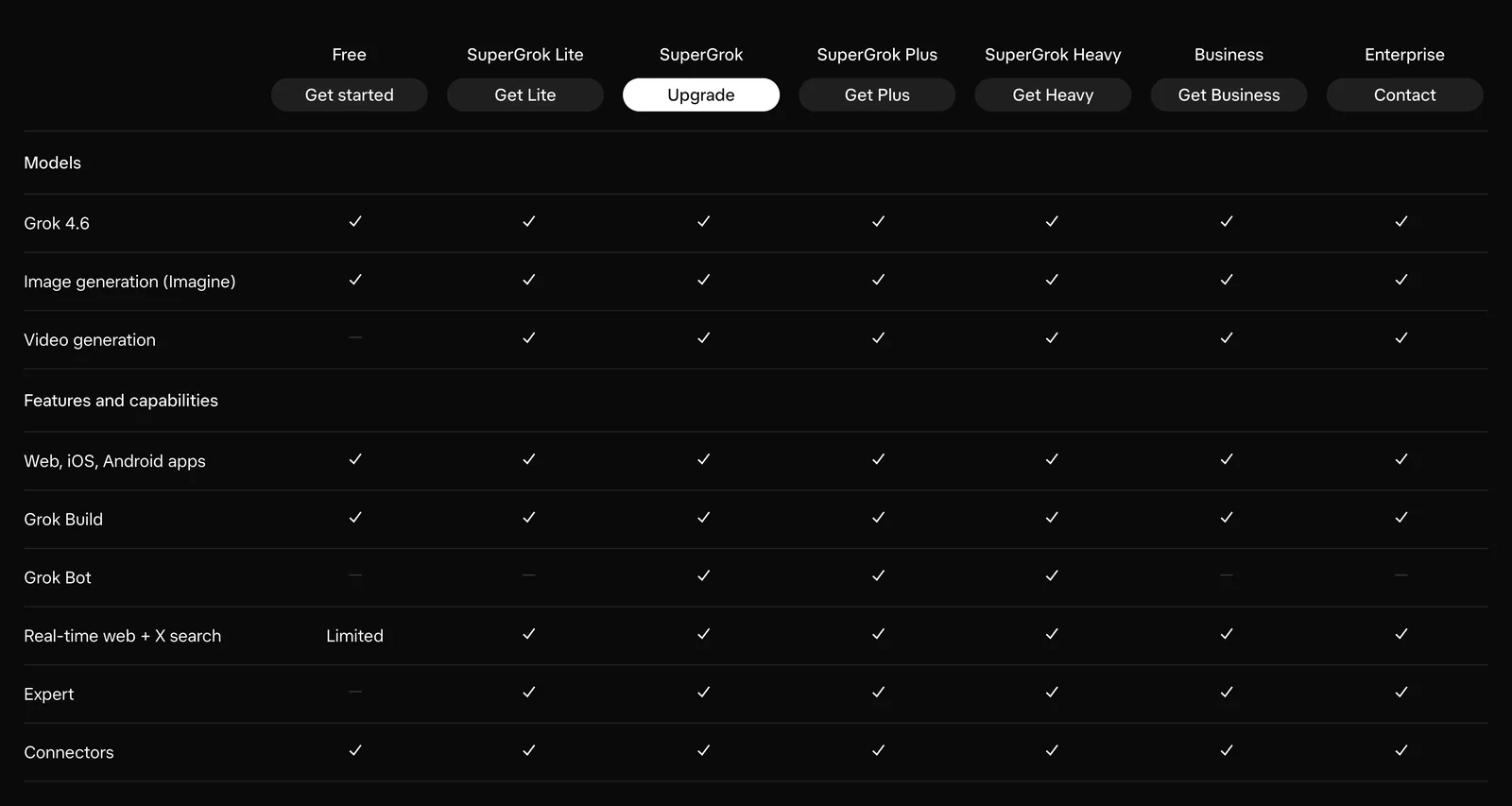
That is the table, read on 17 September 2026. The model row is ticked across all seven columns. Look at the Grok Bot row too, four lines down, because it is quietly strange: ticked for the three SuperGrok tiers, unticked for Business and Enterprise. The $30 consumer plan gets a feature the company's business plans do not.
I have no way to tell you which of those two page elements is correct, and neither does xAI, since its consumer FAQ and its documentation FAQ both decline to say which model the free plan serves. I checked Products and Models, Usage and Limits, and Billing and Subscriptions. Nothing. The table is the only place xAI commits to an answer, so the table is what I used, and you should know the card disagrees.
If that sounds like a small thing, it is the same species of problem I hit on Anthropic's own pricing page, where the plan table and the help centre gave different answers about context. These pages are marketing assets that happen to be the only public specification of what you are buying, and they are maintained like marketing assets.
Grok vs Claude Free: Grok Has the Better Model
Here is the comparison nobody runs, because it requires caring which model is actually on the free tier.
| Model | On which free plan | Intelligence index | Context |
|---|---|---|---|
| Grok's current model | Grok, Free | 44 | 500K |
| Claude Sonnet | Claude, Free | 38 | 1M, on paid plans |
Scores from Artificial Analysis, checked 17 September 2026, out of a 199-model field where the median is 25. Both are well above that median. The gap between them is six points, which on this index is the difference between 21st place and 42nd.
I want to be careful about what this does and does not mean. It does not mean Grok writes better. It means that of the two models the vendors put in front of non-paying users, xAI's scores higher on a third-party reasoning benchmark. Allowance is a separate question, and xAI's free allowance is unpublished, marks web and X search as "Limited", and could be small enough to make the point academic. You will find out by using it, which is not a satisfying answer, but it is the true one.
Still, it inverts the received wisdom. The received wisdom is that Claude is the careful one and Grok is the fast, snarky one, so Claude must be the better free option for serious work. On the models each company hands out at $0, that is backwards.
What $20 to $30 Changes
Now pay, and it flips again.
| Model | Plan | Index | Cost to finish the benchmark set | Speed |
|---|---|---|---|---|
| Claude Opus | Pro, $20/month | 51 | $5.86 | 50 tokens/sec |
| Grok's current model | SuperGrok, $30/month | 44 | $1.86 | 62 tokens/sec |
| Claude Sonnet | Free and up | 38 | $5.09 | 70 tokens/sec |
Same source, same date. Three things in that table are worth sitting with.
Claude Pro buys a genuinely better model. Seven index points is a real gap, and Opus is the reason people who pay for Claude are usually happy about it. Anthropic's top tier, Fable, scores 53, but Pro subscribers reach it on usage credits at API rates rather than as part of the plan, which I covered in the Claude model tier breakdown.
Grok costs about a third as much to run. Artificial Analysis publishes the total cost of completing its evaluation set on each model. Grok finished for $1.86. Opus took $5.86, partly because it is priced at $5 and $25 per million tokens against Grok's $2 and $6, and partly because it wrote 140 million tokens to Grok's 94 million getting there. Opus thinks out loud more.
That cost gap is the mechanism behind everything above. A model that costs a third as much to serve is a model you can afford to put on a free tier. Anthropic cannot do the same thing with Opus at those rates, so it does not. The pricing structures are not philosophy, they are unit economics, and once you see that the rest of both pricing pages reads much more sensibly.
The subscription prices themselves run the other way, which is the detail people get wrong. Claude Pro is $20 a month, or $200 billed up front for a year that Anthropic advertises as $17 a month. SuperGrok is $30. So Claude is the cheaper subscription and the more expensive model, while Grok is the pricier subscription and the cheaper model. If you want the full spread of Grok tiers, including the two that have a column in the table and no price anywhere on the page, I went through all of them in how much Grok costs.
Grok Has Three Front Doors. Claude Has One.
This is the part I would want to know before subscribing to either, and I have not seen it on a single comparison page.
You can reach Grok three ways, and they are not the same purchase:
- grok.com and the mobile apps. $30 for SuperGrok, $100 for SuperGrok Plus. Your terms are with SpaceXAI LLC, which is the company now behind Grok, and which the privacy policy describes as "a separate company from X Corp."
- Grok on X. X Premium+ is $40 a month in the US, or $395 a year, and includes SuperGrok access and Grok Bot. The mid X Premium tier at $8 gives "increased usage limits on Grok" instead. xAI's consumer FAQ is explicit that this is a different legal arrangement: "If you use Grok on X, please see the X help center for your questions. Your access on X is subject to the X Terms of Service and X Privacy Policy."
- The API. Pay per token, no subscription, non-refundable credits.
Read that middle option again. Buying Grok through X costs $40 against $30 direct, and puts your chats under a different company's privacy policy. The documentation says the split runs all the way through to refunds: "If you have subscribed to X Premium, X (not xAI) would be responsible for processing refund where required by law."
There is also a data detail worth a sentence. If you sign into Grok with your X account, the privacy policy lists what X passes over at your direction, and the list ends with "whether you are subscribed to X Premium, and your Grok on X conversation history". Two of the three doors are joined at the back.
Claude has one door. One company, one privacy policy, one set of terms, whether you use the web app, the desktop app or the phone. For anyone putting client work into an assistant, that simplicity is worth something real, and it is the kind of thing that never shows up in a benchmark.
What Neither Subscription Buys
Both companies sell a private default. Neither sells it to you.
xAI's comparison table has a row called No training. It is unticked for Free, SuperGrok Lite, SuperGrok, SuperGrok Plus and SuperGrok Heavy. It ticks for Business and Enterprise only. A $100-a-month consumer plan does not get it.
Anthropic's table has a row called Model training. It prints Opt-out for Free, Pro, Max 5x and Max 20x alike, so the $200 plan is on the same footing as the $0 one. Switch to the Team and Enterprise tab and the same row reads None by default.
Two companies, opposite pricing philosophies, identical conclusion: individuals opt out, businesses are opted out, and the gap between those two things is a form you have to remember to fill in.
xAI adds a line I have not seen any other vendor print. The privacy policy, in the first sentence of the section on what it collects, asks you not to give it anything sensitive: "We ask that you do NOT include personal information in your prompts and inputs into our Service; however, we cannot control what you provide to us." I respect the candour. I also think most people who read it will be surprised, because it is not how any of these products are advertised.
Grok does give you a genuine control that runs the other way. Private Chat keeps a conversation out of your history and deletes it from xAI's systems within 30 days, with the usual legal and safety exceptions. Anthropic's equivalent is incognito chats, free on every plan. Both are per-conversation switches you have to remember, not defaults.
The Pages Moved While I Was Writing This
Three days before this post, I published a piece on whether Claude Pro is worth it. One of its findings was that Anthropic's plan comparison listed the context window as 200k for every consumer tier, from Free to $200 Max, while Anthropic's own help article said the newest models run at a million tokens on paid plans. I wrote that I would not build a workflow around a million tokens until the number appeared on the page you pay from.
It now does. On 17 September the row reads "Up to 1M, varies by model" in all four columns. The same table also now shows Projects as "Up to 5" for free users, where it had been a flat No.
Which is good news, and also a small warning about the other direction, because the help article did not change with it. That article is now titled "How large is the context window on paid Claude plans?", and it still scopes the million-token window to paid plans. The pricing table advertises it in the Free column. "Varies by model" is carrying the weight there, and the two pages have swapped which one is too generous.
I am flagging it because it is the honest lesson of writing these comparisons, and it applies to this one. Any piece like this is a photograph of a pricing page on the day someone looked at it. Mine included, and mine will age the same way. Check the date on whatever you are reading, then open the vendor's own table, because on this evidence a load-bearing row can move inside of 72 hours.
Which One Should You Use? Pick by the Job
Skipping the benchmark talk, here is where each one earns its place.
Use Grok when the answer depends on the last few hours. It reads live X posts natively, with citations, and no amount of prompting gets Claude to do that. Breaking news, what people are saying about a product launch, whether an outage is real or just your connection, how a story is being received. This is its one genuine monopoly among the big assistants and it is a bigger deal than the benchmark gap.
Use Grok when you want an image in the same thread. Claude has no answer here. Grok generates images on the free plan and video from the paid ones, up to 15 seconds.
Use Claude for anything long. Reports, proposals, contracts, research summaries, a document you will still be editing next week. It takes PDFs directly, runs to a million tokens of context on paid plans against Grok's 500K, and keeps a consistent voice over thousands of words. If you are choosing an assistant mainly to write with, this is the one, and I would not pretend the decision is close.
Use Claude when the reasoning has to hold up. Seven index points is the measurable version. The felt version is that Opus is more willing to say the thing you asked for does not work.
Use Claude when one company, one policy matters. See the three doors above.
If the job is coursework, check the file before the model. Neither of these two accepts an audio upload, Claude stops reading the charts inside a PDF after page 100, and xAI publishes no upload limits at all. I put both of them against Gemini on those terms in Claude vs Grok vs Gemini for school.
The blunt version: Grok knows what happened this morning, Claude thinks more carefully about what it means. Those are different jobs and the split is stable enough to plan around.
The Version Where You Don't Choose
Everything above assumes you are picking one, which is the assumption the whole comparison genre is built on, and it is the weakest part of it. The free-tier flip and the paid-tier flip only matter if you are locked to one vendor's ladder.
That is what izzedo chat is for. Grok and the Claude lineup sit in the same model picker, in the same conversation, behind one login and one bill from $6 a month. That includes the Grok variant with native X search, which is the single strongest argument for Grok in this entire post, next to Claude's Opus and Sonnet tiers, which are the strongest argument for Claude.
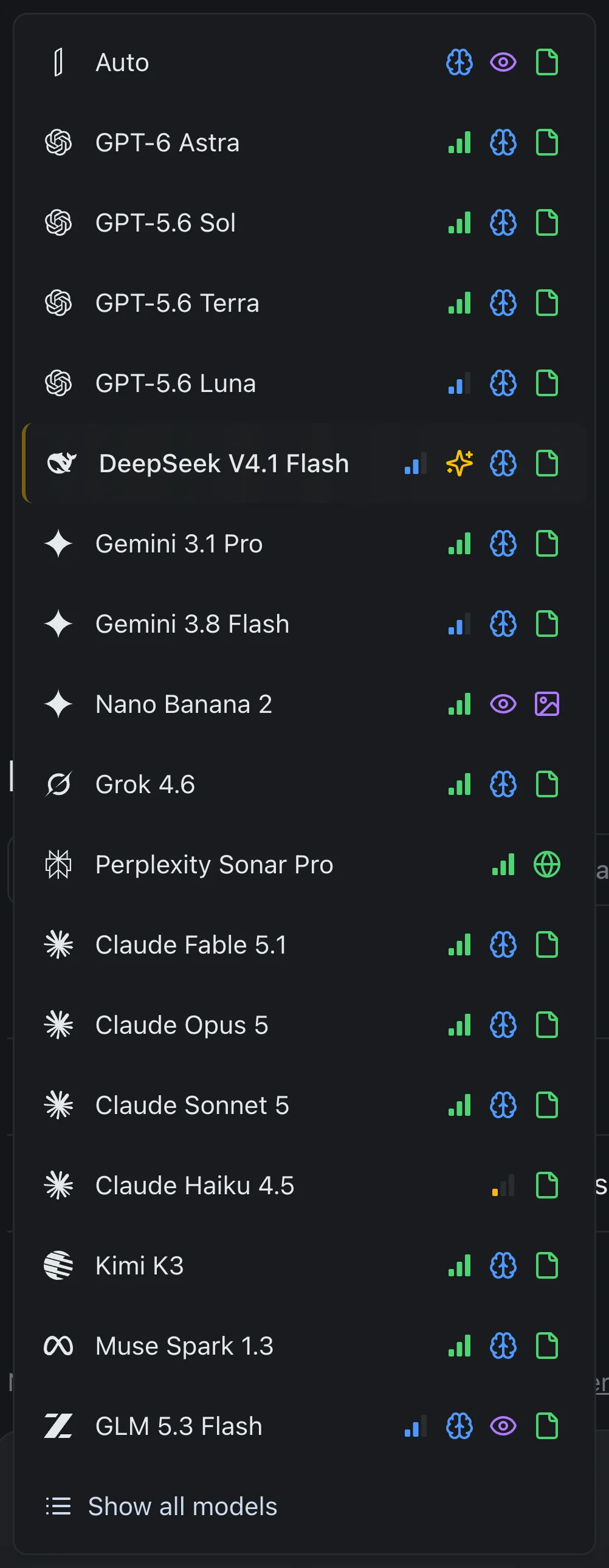
Both vendors' lineups, one dropdown, one bill. So the workflow that reads as a compromise on one subscription is just normal here. Ask Grok with X search what is being said about something today, then switch models in the same thread and have Claude turn it into the brief, working from the same conversation it just watched. Neither vendor can do the second half of that, because neither of them sells the other one's model.
The free plan needs no card and covers the free model lineup. The paid plans from $6 a month are where Grok and the Claude tiers live, which is still less than either company charges for one of them. And a strict no-training policy with zero data retention by providers applies on every plan, including the free one, which as the section above established is not something $30 or $200 buys you anywhere else.
The habit worth stealing, whatever you use, is in not running one model on everything. Ask the second one when the first gives you something that matters.
The Bottom Line
Grok vs Claude has two correct answers and the price tag decides which one applies.
Not paying? Take Grok. xAI's own table hands free users its current model, which benchmarks six points above the best model Anthropic puts on its free tier, plus image generation and live X search that Claude does not offer at any price. The catch is that xAI has never published what "generous limits" means.
Paying about $20? Take Claude. Pro unlocks Opus at 51 against Grok's 44, with double the context, native PDFs, and the better writing by a margin that no benchmark really captures. It is also the cheaper subscription of the two, at $20 against $30.
Paying attention to the fine print? Neither plan stops the training, both companies have a business tier that does, and Grok has three separate front doors with different prices and different privacy policies while Claude has one.
And if what you actually want is this morning's X conversation turned into a document that reads well next week, that is not a Grok decision or a Claude decision. It is a decision to stop treating them as alternatives.
Frequently asked questions
Is Grok better than Claude?
It depends entirely on whether you are paying, and that is not how the question is usually answered. On the free plans, xAI's own comparison table puts a tick next to its current model in the Free column, while Anthropic's table marks Opus as No for free users. Artificial Analysis scored those two at 44 and 38 on its intelligence index when I checked on 17 September 2026, so the free Grok model is ahead. Pay $20 for Claude Pro and Opus unlocks at 51, which passes Grok. The winner changes at the paywall, in both directions.
How is Claude different from Grok?
Beyond the writing style, the difference is what each company sells you. xAI gives everyone the frontier model and charges $30 a month for volume, video generation and higher rate limits. Anthropic charges $20 for access to a better model first, and usage second. That is why the free tiers feel so different: free Grok is a good model with a small allowance, free Claude is a smaller model with a small allowance. Grok also reads live X posts natively, which Claude cannot do at all.
Grok vs Claude for writing, which is better?
Claude, and it is not close on longer pieces. Anthropic's models handle PDFs and long documents natively, run up to a million tokens of context on paid plans against 500K for Grok, and hold a consistent register over thousands of words. Grok is better when the writing has to reflect something that happened this morning, because it searches X directly. The honest split is Grok for what is happening now, Claude for anything that has to read well in a week.
How much do Grok and Claude cost?
SuperGrok is $30 a month and SuperGrok Plus is $100, read from x.ai on 17 September 2026. Claude Pro is $20 monthly or $200 billed up front for a year, which Anthropic advertises as $17 a month, and Max starts at $100. There is a third route to Grok that catches people out: X Premium+ at $40 a month in the US includes SuperGrok access, so buying Grok through X costs $10 more than buying it from xAI.
Is Grok free?
There is a free plan, and xAI's comparison table is more generous about it than its own upgrade card. The table ticks the current model, image generation and connectors in the Free column. The $30 card sells all three as reasons to upgrade. What Free genuinely does not get is video generation, the Expert mode, Grok Bot and anything resembling a large allowance, since real-time web and X search is marked Limited. xAI has never published a number for free usage.
Does paying for Grok or Claude stop them training on your chats?
No, on both. xAI's plan comparison has a row called No training, and it is unticked for Free, SuperGrok Lite, SuperGrok, SuperGrok Plus and SuperGrok Heavy. It only ticks for Business and Enterprise. Anthropic's table prints Opt-out in all four consumer columns, including $200-a-month Max, and reserves None by default for Team and Enterprise. Neither company sells a private default to individuals at any consumer price.
Ready to try multi-model AI workflows?
Access GPT, Claude, Gemini, Perplexity, and more — all in one place.
Start for Free →