Is Claude Pro Worth It? What $20 Actually Buys
Anthropic's comparison table has 24 feature rows. Twelve are already yes on the free plan, three are no on every consumer plan including $200 Max, and nine flip when you pay. Here is what those nine are worth, what the pricing page gets wrong about context, and why the annual plan is a bet you cannot unwind outside Europe.
Two twenty-dollar bills a month is not a large amount of money, which is exactly why this question is hard. Nobody agonises over $20. People agonise over $240 a year for something they might open eleven times.
I went through every page Anthropic publishes about the Pro plan this week: the pricing page, the plan comparison, nine help centre articles, the refund policy, the model documentation. The short version is that Anthropic is unusually honest about what Pro is for and unusually bad at describing it. Its own comparison table understates the single most valuable thing the plan buys, and the feature it charges for at the top of the lineup is not really included at all.
So this is not a review of whether Claude is good. Claude is good. This is about whether the specific transaction is worth it, which turns out to depend on three things almost nobody mentions: how many rows actually change when you pay, what the fine print says about getting your money back, and whether the thing you want Pro for is a feature or a product.
The Short Answer: Who Claude Pro Is Worth It For
| If this is you | Verdict | Why |
|---|---|---|
| You hit the free plan's wall most weeks | Yes, monthly | Pro is at least five times the free allowance per session. That is the product |
| You write or edit long documents daily | Yes | The newest models run at a million tokens of context on paid plans, five times what the pricing page claims |
| You want the smartest Claude there is | No | Pro's ceiling is the Opus tier. The tier above it bills per token from the first message |
| You use Claude a few times a week | No | Anthropic's own plan chooser calls Free "occasional use" and Pro "regular use". Believe it |
| You want Claude plus other models | No | $20 buys one vendor. See the last section |
| You are about to buy the annual plan | Careful | Non-refundable outside the EEA and the UK. Pay monthly for two months first |
| You need a privacy default | No | Model training is opt-out on Free and Pro alike. Only Team and Enterprise are off by default |
Everything below is the reasoning, with the figures read from Anthropic's own pages on 14 September 2026.
Nine Rows: What Claude Pro Actually Adds to the Free Plan
Anthropic's plan comparison has 24 rows under Features and capabilities. I counted them in the page rather than eyeballing the ticks, because the shape of that list is the whole answer.
Twelve of the 24 are already yes on the free plan. Chat on every platform, desktop extensions, voice mode, incognito chats, user preferences, artifacts, creating and editing files with code execution, memory, skills, connectors, and two separate rows that both mean searching the web, because the table lists "Ability to search the web" and "Web search" as different things. Connectors being free is the one that surprises people who remember when integrations were the reason to upgrade. They are free now on almost every assistant, Claude included.
Three rows are no on every consumer plan, including the $200 one. @Claude, project sharing and collaboration, and enterprise search are Team and Enterprise features, and the table says so honestly by printing four columns of "No".
That leaves nine rows that flip when you pay $20:
- Claude Code, included in every paid plan, sharing one usage pool with your chats
- Claude Cowork, the agentic one, still in beta on web and mobile
- Claude Design and Claude Science, two more separate products
- Projects, unlimited, though without the sharing and collaboration that stays off
- Research, the multi-step search mode
- Claude in Chrome
- Claude for Microsoft 365 and Claude for Microsoft Outlook
Add the models section and you get two more: the Opus tier, and usage credits, which is the right to keep paying after you run out.
Sort those eleven by what they actually are and the shape gets clearer. Four are separate products with their own names and their own documentation: Code, Cowork, Design, Science. Three are integrations with software owned by Microsoft and Google. One is a model tier. One is the right to spend more money. Two, Projects and Research, are features of the chat you were already using.
This is the part page-one reviews get wrong when they say Pro makes Claude smarter. It does not. The same Sonnet and Haiku models answer free users. What Pro buys is more room, more places to use Claude, and one tier of model above the free ones. Whether that is worth $240 a year depends entirely on how many of those eleven you will open twice.
The Usage Number Anthropic Will Not Publish
Here is the sentence Anthropic uses, verbatim, in the Pro plan article: "During peak hours, the Pro plan offers at least five times the usage per session compared to our free service."
That is the whole number. There is no message count anywhere on Anthropic's site, and the pricing FAQ says why in one line: "How much you can do depends on the length and complexity of your conversations, the model you choose, and the features you use, so there's no fixed message count."
This matters because several pages ranking for this exact question still quote one. One of them, sitting on page one of Google as I write this, tells you Pro "allows about 45 messages per 5-hour window". That figure comes from documentation Anthropic retired. Quoting it today is like quoting a menu from a restaurant that changed hands. If a review gives you a precise message count for Claude Pro in 2026, it did not check.
What you actually get is two clocks, a rolling five-hour session limit and a weekly cap that resets at a fixed time your account was assigned, and both apply across every Claude model. I took that system apart in detail in Claude limits, including which error message means which thing. For the purposes of deciding whether to pay, you only need the one honest conclusion: Pro's value is entirely a function of how often the free plan stops you. If the answer is never, there is nothing here to buy.
One footnote worth knowing before you subscribe. The Pro plan does not include API usage through Anthropic's Console. Those are separate bills, and the help centre spells it out so people stop being surprised by it.
The Best Thing Pro Buys Is Not on the Pricing Page
This is the finding that changed my view of the plan.
Anthropic's plan comparison has a row labelled Context window. It reads 200k for Free, 200k for Pro, 200k for Max 5x and 200k for Max 20x. Four identical cells. Read that table and you would conclude that $200 a month buys exactly as much working memory as $0.
Now open Anthropic's dedicated help article on the same subject. First sentence: "Claude Fable 5.1, Opus 5, and Sonnet 5 support a 1M token context window on all paid plans when chatting with Claude." The previous generation of Opus and Sonnet models run at 500K on paid plans. Everything else is 200K.
So the pricing page is understating the paid plans by a factor of five on the models most people use, and the single best reason to buy Pro is a row that page prints as unchanged. If your work is long documents, and Claude's reputation is built on long documents, that is not a detail. That is the purchase.
Two qualifications, because the same article is careful about them. In Claude Code, Pro users have to enable usage credits to get the million-token window on Opus models, so the free-with-the-plan version applies to chat rather than the terminal. And in Cowork, Sonnet automatically compacts the conversation at 500K.
I would still not build a workflow around a million tokens until the number appears on the page you actually pay from. But if you have been avoiding Pro because you thought the context window was identical to free, that was Anthropic's own table telling you something wrong.
The Model Your $20 Does Not Reach
Anthropic sells five model lines. Pro gets you three and a half of them.
Haiku and Sonnet are on the free plan. Opus is the tier Pro unlocks, and the pricing page bullet "ability to use more Claude models" means precisely that one row. Above Opus sits Fable, and the Fable row in the comparison table reads: Free, No. Pro, "Usage credits". Max, "50% of weekly limits".
The help centre translates the middle cell without euphemism. On Pro plans, Fable models "aren't included in your plan's usage limits" and "run on pay-as-you-go usage credits from the start". Not after you run out. From the first message.
It was not always like this. A promotion let Pro subscribers spend up to half their weekly allowance on the Fable tier at no extra cost, and it ended on 19 July 2026. A one-time credit softened the change for the older Fable model, and Anthropic notes there is "no equivalent credit" for the newer one. If you subscribed in spring and feel like the plan quietly got worse, you are right, and that is the date.
Above Fable there is a fifth line, Mythos, which is not for sale at any consumer price. Anthropic describes it as its most capable model for cybersecurity and biology research, available only to vetted organisations through trusted access programmes, currently US-only, priced at $10 per million input tokens and $50 per million output tokens for those who can get it. The relationship between the two is stated plainly on Anthropic's own page: Fable 5.1 "is the same underlying model as Claude Mythos 5.1 with safeguards for cybersecurity and biology".
Put the ladder together and the $20 question gets sharper. Pro's real ceiling is Opus. The tier above it is a metered purchase with a subscription attached, and the tier above that is not a product you can buy. Anyone telling you Pro gets you Anthropic's best model is describing a plan that stopped existing in July.
The per-tier differences that follow from this, context, effort control, what each tier is actually good at, are in Claude Opus vs Sonnet vs Haiku. The short version for a buying decision: Opus is a genuinely strong model and the reason most Pro subscribers stay.
Where Anthropic's Own Pages Disagree About Pro
While checking the comparison table I found a second contradiction, smaller but more annoying.
The plan comparison has a row called "Priority access at high traffic times". Free: No. Pro: No. Max 5x: Yes. Max 20x: Yes. Priority access is one of the four bullets on the Max card, sold as a reason to spend $100.
Anthropic's help centre article "What is the Pro plan?", updated 10 June 2026, lists the plan's key benefits. Second bullet: "Priority access to Claude during high-traffic periods."
Both pages are live right now. One of them is selling priority access as a Max feature and the other is selling it as a Pro feature. I cannot tell you which is current, and neither can you, which is the actual problem. When a vendor's sales page and its support documentation disagree about what a $240-a-year plan includes, the honest advice is to buy for the things both pages agree on and treat everything else as a bonus that may not arrive.
$20 Does Not Buy You a Privacy Default
The Model training row in the comparison table is one word, repeated four times: Opt-out, Opt-out, Opt-out, Opt-out. Free, Pro, Max 5x, Max 20x.
The tooltip explains the asymmetry. Training is "off by default for Team and Enterprise plans". Which means it is on by default for you, whether you pay Anthropic nothing or $200 a month, until you go into settings and turn it off.
I do not think this is scandalous. Every consumer AI plan works roughly this way and Anthropic at least publishes it in a table rather than burying it in a policy PDF. But it kills one of the more common reasons people give for upgrading. If you are paying $20 because you assume the paid tier treats your conversations differently, it does not. Go and switch the setting instead, which is free.
The Terms Matter More Than the Features
Here is where Claude Pro is genuinely unusual among $20 plans, and where I think most reviews stop reading too early.
There is no trial and there are no discounts. The Pro article states it directly: "We do not offer standard discounted pricing any of our paid plans, including Pro plans." Promotions happen occasionally and get announced publicly, and support "cannot issue one-off discounts or coupons". No student rate either, which I confirmed against every vendor's offer when I mapped who actually discounts AI subscriptions.
Refunds start from no. Anthropic's refund article opens with this: "Except as expressly provided in our Consumer Terms of Service or where required by law, all payments are non-refundable." Then the exception, which depends entirely on your address. In the European Economic Area and the United Kingdom you can get a refund within 14 days of purchase, prorated to what you used. Everywhere else, you are asking rather than claiming.
Read those two together and the annual plan changes character. Yes, $200 billed up front beats $240 paid monthly, and Anthropic advertises the result as $17 a month. The true figure is $16.67, and you save $40 over the year. But outside Europe that $200 is a one-year bet with no exit. If you are wrong about how much you will use Claude, being wrong costs you $200 rather than $20, and the thing you are betting on is your own future behaviour, which is the least reliable quantity in this entire article.
My advice is boring and I stand by it. Pay monthly for two months. If both months hit the ceiling, switch to annual and bank the $40.
Two more pieces of fine print worth knowing. If you subscribed through the iOS app, Apple processed the payment and only Apple can refund it, through reportaproblem.apple.com. And requesting a refund does not cancel the subscription, which is a trap Anthropic flags on its own page and people still fall into.
The gift route is the only card-free way in. Anthropic sells gift subscriptions in one, three, six and twelve month blocks, for Pro or either Max tier. The recipient needs no credit card to redeem, gifts expire 365 days after purchase, and they cannot be stacked. The catch is who can buy them: Pro and Max subscribers only. Free users and members of Team or Enterprise organisations cannot. So the one way to try Pro without handing over a card requires knowing somebody who already pays.
Claude Pro vs Max vs the Team Plan Nobody Suggests
Anthropic's plan chooser is refreshingly blunt about who each tier is for. Free is "occasional use". Pro is "regular use". Max 5x is "frequent users who work with Claude on a variety of tasks". Max 20x is "daily users who collaborate often with Claude for most tasks".
Read that ladder carefully. Anthropic does not claim Pro is the daily-driver plan. It claims Pro is the regular-use plan and puts daily users two rungs up, at $200 a month. Max 5x is $100 and Max 20x is $200, both monthly only, no annual option. The full ladder including the API is priced out here.
The interesting option is the one nobody suggests to individuals, because it has "Team" in the name.
A Team standard seat is $20 per seat per month on annual billing, $25 monthly. Anthropic describes that seat as "All Claude features, plus more usage than Pro". The Team card also carries a bullet the individual plans do not have at any price: "No model training on your content by default."
So for $3 a month more than annual Pro, a Team seat gets you more usage than Pro, project sharing, enterprise search, central billing, single sign-on, @Claude, and training off by default. The catch is in the plan description: "For teams of 2 to 150." You cannot buy one seat. The floor is $40 a month.
If there are two of you, and I mean any two, a co-founder, a business partner, a spouse who also uses Claude, that comparison is worth five minutes. Two annual Pro plans are $400 a year for two isolated accounts with training on. Two Team seats are $480 for a shared workspace with training off by default. Eighty dollars a year, for two people, to stop copy-pasting context between two accounts and to have the privacy default you cannot buy as an individual at any price.
Is Claude Pro Worth It for Your Work?
Verdicts by the kind of work people actually describe when they ask this question.
Writers and editors. Yes, and this is the strongest case on the list. Long-document work is where Claude's reputation was earned, the million-token context on paid plans is real even if the pricing page hides it, and projects with their own instructions save you re-explaining a house style every morning. If you write for a living, $20 is not the interesting number in your month.
Researchers and analysts. Probably, with a caveat. Research mode is a Pro feature and it works, but it consumes the allowance fast enough that heavy research users are the group most likely to discover Pro's ceiling in week one. Budget for hitting it.
Students. Only if you hit the free wall during term. Claude has no student pricing, so the decision is the full $20 against a free plan that already includes memory, web search, artifacts and file uploads. I would run the free plan through one assignment cycle before paying, and I said the same thing about ChatGPT Plus for students.
Small business owners. Look at the Team maths above before you buy Pro. If anyone else in the business touches AI, two seats beat two subscriptions.
People who want an agent. This is where the beta warnings matter. Cowork is a Pro feature, it is in beta on web and mobile, and the Chrome side panel version is live on Max and Team but only "on Pro plans as it rolls out". You would be paying full price for a feature still arriving. I compared what every vendor's agent actually does, and what happens when you close the laptop, in AI agent mode.
Occasional users. No. Anthropic agrees with me and prints it in the plan chooser.
How to Decide Before You Pay
A test that costs nothing and takes a week.
Use the free plan deliberately for seven days, and each time Claude stops you, write down what you were doing. At the end of the week you will have one of three lists.
An empty list means the answer is no, and no review is going to change that.
A list full of "I ran out mid-task" means yes, and Pro is straightforwardly the right purchase.
The third list is the interesting one. If your notes say things like "Claude refused this", "this needed a picture", "I wanted a second opinion on the answer", or "I needed something current", then your problem is not the allowance. It is the model. Paying Anthropic more money buys you more Anthropic, and more Anthropic is not the fix for any of those four complaints. Claude generates no images at any price, on any plan.
The Question $20 Cannot Answer
Every version of this question assumes the decision is Claude or no Claude. That assumption is doing a lot of work, and it is the reason the $20 plans across this industry all look reasonable in isolation and absurd in aggregate.
Priced separately, the full lineup of major assistants runs to roughly $110 a month. Almost nobody pays that, so most people pick one vendor, pay $20, and quietly send half their work to the wrong model because switching would mean a second subscription. That is why the question usually arrives as a fork, Claude Pro or ChatGPT Plus, with both plans priced at exactly the number that makes holding two feel indulgent.
izzedo chat exists for that specific problem. It puts all four Claude tiers in the same picker, alongside the flagships from OpenAI, Google, xAI, DeepSeek, Moonshot and the rest, for $6 a month.
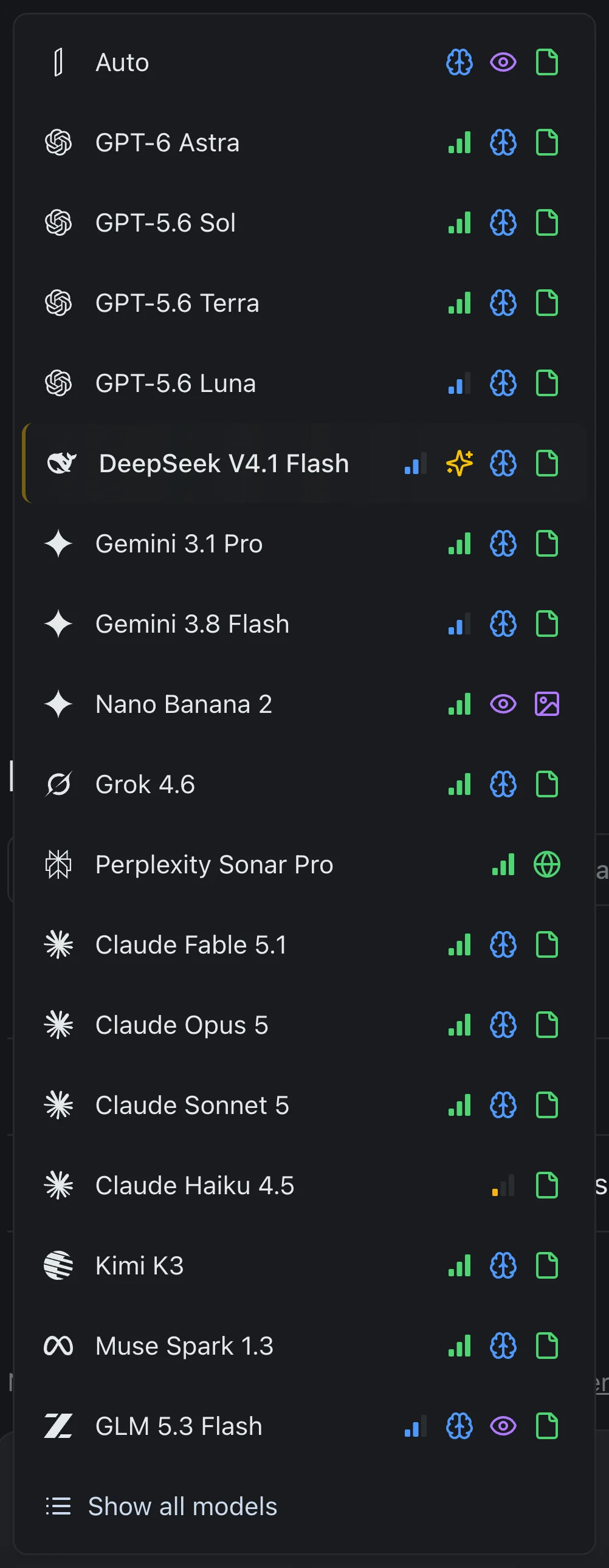
That screenshot is worth comparing against what you just read about Anthropic's own ladder. The Fable tier, the one Anthropic meters at API rates from your first message on the $20 plan, is a row in that list on a $6 plan. The Opus tier that Pro unlocks is the row under it. Claude Haiku is on the free plan here, with no card.
I want to be precise about what that does and does not mean, because the whole point of this article is reading the fine print.
It is one allowance, metered by what each model costs to run, so a heavy model spends it faster than a light one. It is fair use, not unlimited, and the numbers live on the pricing page rather than in a blog post. Usage-based billing exists as an option if you want to keep working past the allowance, the same shape as Anthropic's usage credits, and it is off unless you turn it on.
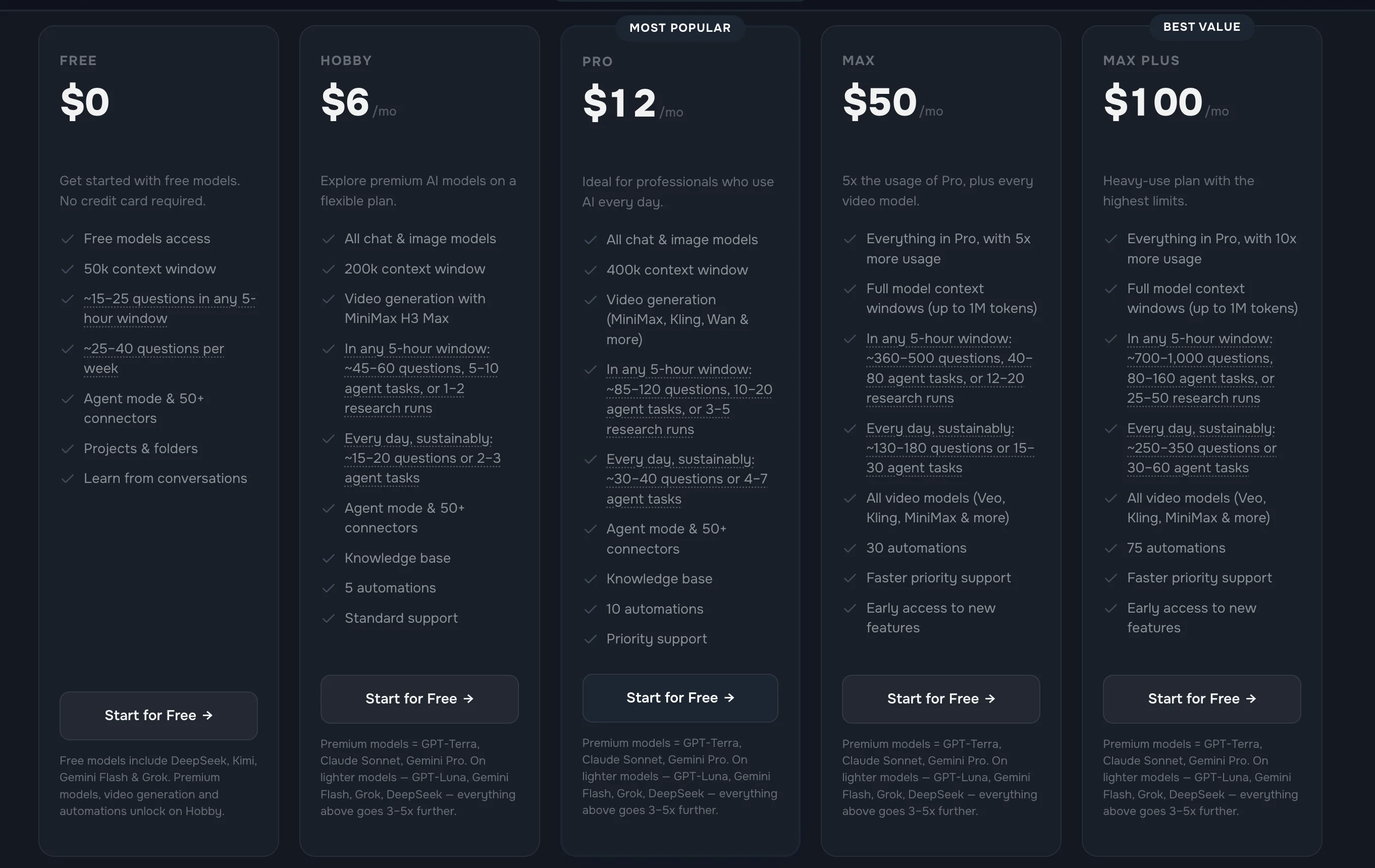
What you get that no single-vendor $20 plan can sell you is the second answer. When Claude hedges, you ask the same question of a different model in the same thread and compare, which is the habit I made the whole argument for in stop using one AI model. Agent mode, connectors and projects are there too, on the free plan, which is a different line than the one Anthropic draws.
None of that makes Claude Pro a bad product. It makes it a single-vendor product, sold at a price that assumes you only need one vendor.
The Bottom Line
Claude Pro is worth $20 a month if the free plan stops you most weeks, and it is not worth it for any other reason. That is the whole test, and the nine feature rows are mostly noise around it.
What surprised me after a week inside Anthropic's documentation is how much of the decision is buried in pages nobody reads. The pricing page says your context window does not change when you pay, and Anthropic's own help centre says it goes up five times on the newest models. The pricing table says priority access is a Max feature and the Pro article says it is a Pro benefit. The bullet that says "ability to use more Claude models" means one tier, not the top one, and the top one has billed per token since July.
The terms matter more than any of that. No trial, no discounts, no coupons, and no refund outside the EEA and the UK. Which makes the annual plan a genuine commitment rather than a rounding error, and makes "pay monthly until you are sure" the only advice I would give anyone with a straight face.
And if your week of notes came back saying the problem was the model rather than the meter, the answer was never a bigger Claude plan. izzedo's free plan has Claude in it, takes no card, and lets you put the same question to three labs before you commit $240 to one of them.
Frequently asked questions
Is Claude Pro worth it, or is the free version enough?
Count how often the free plan stops you. Anthropic's own comparison table has 24 rows under Features and capabilities, and 12 of them are already yes on the free plan: web search, voice mode, memory, artifacts, connectors, skills, incognito chats, file creation with code execution, and the rest. Nine rows flip when you pay, and most of them are separate products rather than a better chatbot. If the free plan has never told you to wait, Pro is selling you headroom you are not using.
How much better is Claude Pro than Claude Free?
On answer quality for everyday work, barely. The same Sonnet and Haiku models serve both plans. What Pro adds is the Opus tier, unlimited projects, Research, Claude in Chrome, the Microsoft 365 and Outlook integrations, Cowork, Claude Code, Design, Science, and at least five times the usage per five-hour session. Anthropic publishes that multiplier and refuses to turn it into a message count, because the count depends on conversation length, model and features.
Does Claude Pro have a free trial?
No. Anthropic's help centre states it does not offer standard discounted pricing on any paid plan, that promotions are occasional and announced publicly, and that its support team cannot issue one-off discounts or coupons. The only card-free way into Pro is a gift subscription, which has to be bought by someone who already pays for Pro or Max. Free users cannot buy gifts.
Can I get a refund on Claude Pro?
Usually not. Anthropic's refund article opens with the line that except as provided in its consumer terms or where required by law, all payments are non-refundable. The exception is the European Economic Area and the United Kingdom, where you can get a prorated refund within 14 days of purchase. If you subscribed through the iOS app, only Apple can refund it, and requesting a refund does not cancel the subscription.
Is Claude Pro or ChatGPT Plus better value at $20?
They are priced identically and sell different things. Claude Pro is a writing and long-document plan with a hard usage ceiling and no image generation. ChatGPT Plus covers more surface area for the same money. If the deciding factor is which one writes better prose or reads a long document more carefully, Claude usually wins that, which is the whole reason the question keeps getting asked.
Is the annual Claude Pro plan worth it?
It is $200 billed up front against $240 paid monthly, so you save $40 and Anthropic advertises the result as $17 a month. The real number is $16.67. Whether it is worth it depends far more on where you live than on the arithmetic, because outside the EEA and the UK you cannot get that $200 back if you stop using Claude in month three.
Ready to try multi-model AI workflows?
Access GPT, Claude, Gemini, Perplexity, and more — all in one place.
Start for Free →