Is Claude Free? Yes, and the Free Plan Runs the Same Sonnet as Pro
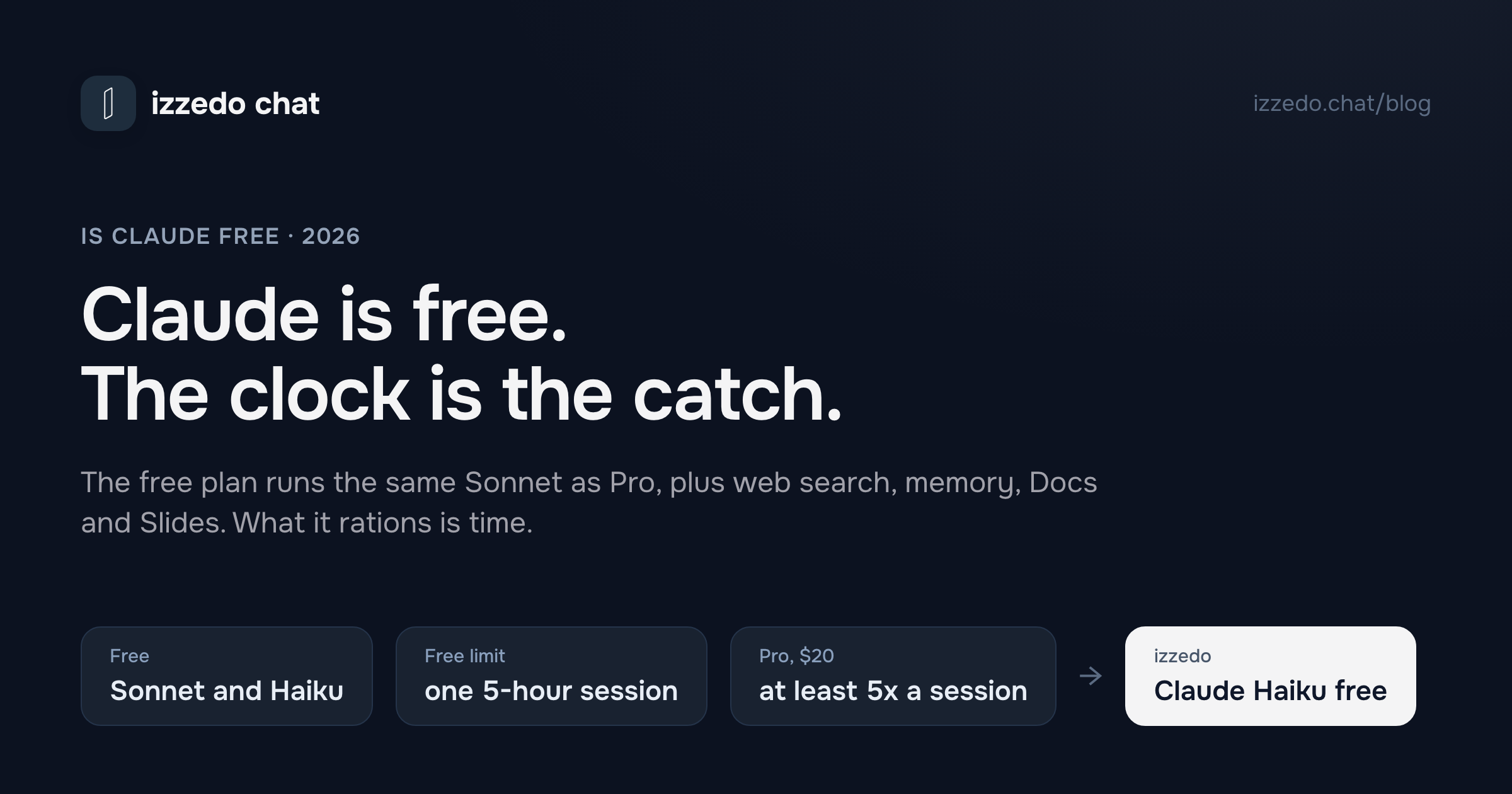
Claude's free plan is bigger than its reputation. It runs the same Sonnet model a $20 Pro account gets, and since September it makes documents, slide decks and designs. What it rations is time: one five-hour session clock that Anthropic sizes for everyday questions, and no way to buy more without upgrading.
Yes. Claude has a free plan, it costs nothing, and you don't need a card. That part of the answer takes one line.
The useful part is what $0 gets you, because the free plan changed a lot in four weeks. On 16 September, Anthropic put Claude Docs, Claude Slides and Claude Design on every plan, Free included. On 28 September it released Sonnet 5.5, and its model page says anyone can chat with it. On 7 October Haiku 5.5 arrived, on the free plan as well. So free Claude now runs the same Sonnet a $20 Pro account gets, and it can turn a chat into a document, a deck or a design.
What it rations is time. The free plan runs on a single five-hour session clock, and Anthropic's own pricing FAQ describes it in four words: "Free covers everyday questions." When Anthropic raised its five-hour limits on 22 September, it raised them for the paid plans.
I read Anthropic's pricing page, about twenty of its help-centre articles, its privacy centre, its consumer terms and its last month of launch posts on 13 October 2026. Where two of those pages disagree, I say which one I'm going by.
The Short Answer
| Question | Answer |
|---|---|
| Is Claude free? | Yes. The Free plan is $0, needs no card, and works on the web, desktop and mobile |
| Which models are free? | Sonnet 5.5 and Haiku 5.5. Opus and Fable aren't on the free plan |
| Is it unlimited? | No. A session limit resets every five hours, and Anthropic publishes no message count |
| What does Pro add? | At least 5x the usage per session, Opus, Research, Claude Code and more, for $20 a month or $17 on an annual plan |
| Is there a free Pro trial? | No standing trial. Anthropic runs occasional promotions and gives no discounts on request |
| Is it free for students? | No student discount. A free upgrade only comes through a university with a Claude for Education agreement |
| Is the API free? | No. It bills per token, separately from any chat plan |
| Are there ads? | No. Anthropic said in February that Claude will remain ad-free |
If you want Claude next to other models rather than on its own, izzedo chat has Claude Haiku 5.5 on its free plan, in the same picker as GPT-6 Luna, Gemini 3.8 Flash, Grok and DeepSeek, with no card. On izzedo, Sonnet, Opus and Fable come with the $6 Hobby plan. I come back to it near the end.
What Claude's Free Plan Includes in 2026
Anthropic's plan card for Free says "Free for everyone" and lists six things. Chat on the web, desktop and mobile. Searching the web, creating files and running code. Memory across conversations. Connecting your apps and tools. Creating artifacts. And Claude Design, Slides and Docs. The comparison table under the cards fills in the detail.
- Two current models. The table ticks Sonnet and Haiku for Free. Anthropic's Sonnet page says "Anyone can chat with Claude using Sonnet 5.5", and its Haiku page names Free first among the plans that can select Haiku 5.5.
- Web search, with citations. Free accounts can search the web and fetch a page from a link. Anthropic attaches a warning for free users, covered in the limits section below.
- Docs, Slides and Design. Anthropic's release notes for 16 September say artifacts, Claude Design, Claude Slides and Claude Docs "are available on every plan, including Free." That's a document editor, a deck builder and a design canvas at $0. They need code execution and file creation switched on in Settings under Capabilities.
- Memory. Anthropic's memory article says it's on by default for Free, Pro and Max. Claude carries context from earlier chats into new ones, and you can see and edit what it keeps under Settings, Memory.
- Up to five projects. "Free users can create a maximum of five projects," says the projects article. Each one holds its own files and instructions. The retrieval mode that lets a project hold far more material is for paid plans.
- Connectors, with a cap. Free accounts can use connectors, and Anthropic's connector articles limit free users to one custom connector. Its voice-mode article puts the cap more broadly: "On the Free plan you can connect one tool, and paid plans can connect more." Read together, plan on one.
- File uploads. The upload article gives one set of limits for everyone. Up to 20 files in a chat, 500MB each, and PDFs up to 1,000 pages, with charts and images read only in PDFs of 100 pages or fewer.
- Voice mode, incognito chats and skills. All three are ticked for Free. Voice mode is a beta on every plan.
Two things on that list surprised me. The first is that the free model isn't a held-back older one. The Sonnet on Free is Sonnet 5.5, the version Anthropic released on 28 September. The second is that Anthropic introduced Claude Docs on 16 September and, in the same release note, made Docs, Slides and Design available on Free.
Anthropic explained the reasoning in February, when it promised Claude would stay ad-free. It said its revenue comes from "enterprise contracts and paid subscriptions," and added: "We continue to invest in our smaller models so that our free offering remains at the frontier of intelligence." With no ads, subscriptions and enterprise contracts pay for the free plan, so it has to be good enough to make you want more of it. That explains why it's generous with features and strict about time.
What Claude Free Doesn't Include: Claude Free vs Pro
| Free | Pro | |
|---|---|---|
| Price | $0 | $20 a month, or $17 a month on a $200 annual plan |
| Usage per five-hour session | Sized for "everyday questions" | "At least 5x" Free |
| Weekly limit | None published | Yes, resets at a fixed time each week |
| Models | Sonnet, Haiku | Sonnet, Haiku, Opus. Fable on usage credits |
| Research | No | Yes |
| Projects | Up to 5 | Unlimited, with retrieval for large ones |
| Custom connectors | 1 | More |
| Claude Code | No | Yes |
| Claude in Chrome, Microsoft 365 and Outlook | No | Yes |
| Claude in Google Docs, Sheets and Slides | No | Yes, in beta |
| Task hand-off and scheduling | No | Yes |
| Usage credits when you run out | No | Yes, at API rates |
| Support | Help articles and an AI bot | Adds Anthropic's support team |
| Model training | Opt-out | Opt-out |
Most of the Pro column is about where Claude can work. Claude Code, Chrome, Microsoft 365, the Google sidebar and scheduled tasks put Claude into other software or let it work while you're away. Two rows change the answers you get in the chat window itself, Opus and Research. And the row that decides it for most people is the second one, more time with the same models.
Fable deserves a sentence. It's Anthropic's top tier, and it isn't on Free or inside Pro's allowance. Anthropic's help centre says that on Pro, Fable models "run on pay-as-you-go usage credits from the start." To get Fable as part of a plan, you need Max, from $100 a month.
I went through every row of the Pro column, and what each is worth to a working person, in is Claude Pro worth it. For this question the short version is enough. If the free plan answers you well and rarely stops you, paying doesn't buy a better Sonnet. It buys more hours of it.
Is Claude Free Unlimited? How the Free Limit Works
No, and there's no message count to quote, because Anthropic doesn't meter messages.
The pricing FAQ sets the system out in one sentence: "Every plan has usage limits that reset on a rolling five-hour session window, and paid plans add weekly limits on top." On Free that means one clock. Anthropic's getting-started article adds that on the free plan "the number of messages you can send will vary based on demand," and that Anthropic "may impose other types of usage limits to ensure fair access to all users." The pricing FAQ goes further for every plan, mentioning "weekly and monthly caps or model and feature usage, at our discretion." So the free plan has one published clock and a clause that allows more.
Anthropic's best-practices article lists what fills the session: message length, attachment size, how long the conversation already is, tools such as web search, which model you pick, the effort level, artifacts, and multi-step jobs like running code or browsing. Three of them catch free users most often.
Long conversations. Anthropic's limits article ties usage to "the length and complexity of your conversations" and advises: "Try starting a new conversation if you're approaching your usage limit in a longer chat." A fresh chat that opens with a one-paragraph summary of the old one usually costs less than message forty of a long thread.
Links to long articles. The web-search article has a note written for free accounts. If you hand Claude a URL and ask for a summary, it pulls the whole article into the conversation, and that "can consume a significant portion of your usage limit." Its example is a 10,000-word article. Paste the section you need instead.
Tools you aren't using. "Tools and connectors are token-intensive," the limits article says. It recommends switching off connected apps and web search when a chat doesn't need them.
Model choice and effort are on Anthropic's list too. Anthropic built Haiku 5.5 for "high-volume, cost-sensitive" work, and its settings article says the Low and Medium effort levels "stretch your usage further." Anthropic publishes no ratio between Haiku and Sonnet, but routine jobs belong on the lighter setting.
When the session runs out, the free plan has fewer exits than the paid ones. Anthropic's pricing FAQ lists three. Wait for the reset, move to a higher plan, or, on paid plans, turn on usage credits and keep working at API rates. Free gets the first two.
And the gap between the plans is growing. When Anthropic launched Opus 5.5 on 22 September, it raised five-hour limits on Pro, Max, Team and seat-based Enterprise plans, and gave subscribers a limit reset they can save and use when they choose. Neither applies to the free plan. The full mechanics of both clocks, every error message and the usage-credit meter are in my Claude limits guide.
Is Claude Free for Students?
Not in any special way. Anthropic's Pro and Max articles both say it doesn't "offer standard discounted pricing" on any paid plan, and that its support team "cannot issue one-off discounts or coupons." There's no student rate and no student trial. Students get the same free plan as everyone else, as long as they're 18 or older, which is Anthropic's minimum age for Claude.
The one free upgrade open to a student comes through their university. Claude for Education is a plan an institution buys for its students, faculty and staff. If your university has one, you sign in at claude.ai with your university email, and Anthropic's student guide says the plan includes "the newest, most advanced Claude models," projects, more messages per day than individual plans and priority access. Your university's IT pages will tell you whether it has a deal. If it doesn't, there's nothing you can apply for on your own that gets you the same thing.
Anthropic also runs campus programmes that pay selected students a $3,600 stipend to lead clubs, discussion groups and workshops. That's a role you apply for, in a window Anthropic's page lists as 1 to 12 September. It isn't a discount.
Two groups do get paid Claude at no cost, and neither of them is students.
- Teachers at US schools. Claude for Teachers gives verified educators a full year of Pro-level features free if they sign up by 30 June 2027. Anthropic's terms page for it says it "is not for students."
- Research groups. The Claude Team plan for scientists makes Standard seats $0 for 12 months for verified groups at accredited universities and nonprofit research institutes, with Premium seats at $15 a month. The principal investigator applies, and once approved can add postdocs and graduate students. Anthropic says it's offered to a limited number of groups.
How Anthropic's position compares with what OpenAI, Google and the others give students is in every AI student discount in 2026.
Is Claude Free for Personal Use, and for Work?
Yes for personal use. Anthropic's Pro article says anyone in a supported location can use the free version "by navigating to claude.ai and signing up using an email address." Free, Pro and Max all sit under the same consumer terms, which set the minimum age at 18. One catch is that Anthropic's sign-up article says it requires "a phone number from a supported location to create an account."
For a freelancer or a small business, the question that matters is what happens to client material, and on that the free plan and the paid personal plans are identical. Anthropic's pricing table marks model training as opt-out on Free, Pro and both Max plans. The switch is in Settings under Privacy, labelled Help improve our AI models. If you leave it on, Anthropic's privacy centre says it may keep de-identified data from your chats "for up to 5 years" in its training pipelines. Incognito chats aren't used to improve Claude even with the setting on. Paying $20 changes none of this.
Team and Enterprise are different. Anthropic's privacy centre says that by default it won't use inputs or outputs from its commercial products, Claude for Work included, to train its models. If client confidentiality is the reason you're thinking of paying, a Pro subscription won't get you that default. Switch the setting off instead, which is free.
One more difference only shows up when something breaks. Anthropic's support article gives free users the help articles, Fin, its AI support bot, and help deleting an account. Pro and Max add "further assistance from our Product Support team." If a login problem locks you out of a free account with client work in it, there's no person to write to.
Free Ways to Use Claude
The list is short, because Anthropic doesn't hand Claude out many other ways.
- Claude's own free plan. On claude.ai in a browser, in the desktop app for Mac and Windows, or in the iPhone and Android apps, all on one account.
- Your university's plan, if it has a Claude for Education agreement.
- Claude for Teachers or the Team plan for scientists, if you qualify.
- Apps that include Claude on their free plan. Some multi-model apps run Claude through Anthropic's API and set their own limits. izzedo chat is one, with Claude Haiku on its free plan. Before you sign up for any of them, check which Claude model the free plan includes, because it's usually the small one.
Two things people search for aren't free. Claude Code is part of Pro and Max, and Anthropic's table marks it No on Free. The API bills per token through the Claude Console, separately from any chat plan. On 13 October, Anthropic's API price list put Haiku 5.5 at $0.10 per million input tokens and $0.50 per million output tokens for prompts up to 100K tokens. That's cheap, but it's a bill, and building your own chat app on it to avoid a subscription is more work than most people want.
When Paying for Claude Makes Sense
You hit the five-hour wall more than once a week. That's what Pro is for, since at least five times the session allowance is the main thing $20 buys. Pay monthly for the first couple of months. Anthropic's refund article says payments are non-refundable except where its terms or the law require it, and the 14-day prorated refund applies in the EEA and the UK.
You need Research or Opus. Both start at Pro. Research runs many searches to build one cited answer, and Opus is the tier above Sonnet. What actually changes between the tiers is in Claude Opus vs Sonnet vs Haiku.
You want Claude inside Microsoft 365, Outlook, Chrome or Google Docs. That's Pro too. The free plan has no Claude inside other companies' software.
You want Fable. Max, from $100 a month, includes it up to half your weekly limit. On Pro it bills at API rates from the first message. Claude Pro vs Max does that arithmetic.
You use Claude a few times a week. Stay on Free. Anthropic sizes it for everyday questions, and you're already talking to the same Sonnet.
You want Claude plus ChatGPT, Gemini or Grok. No single vendor's plan sells that at any price. That's the next section.
Every price on Anthropic's ladder, from Free to Enterprise and the API, is in how much does Claude cost.
Where izzedo Fits
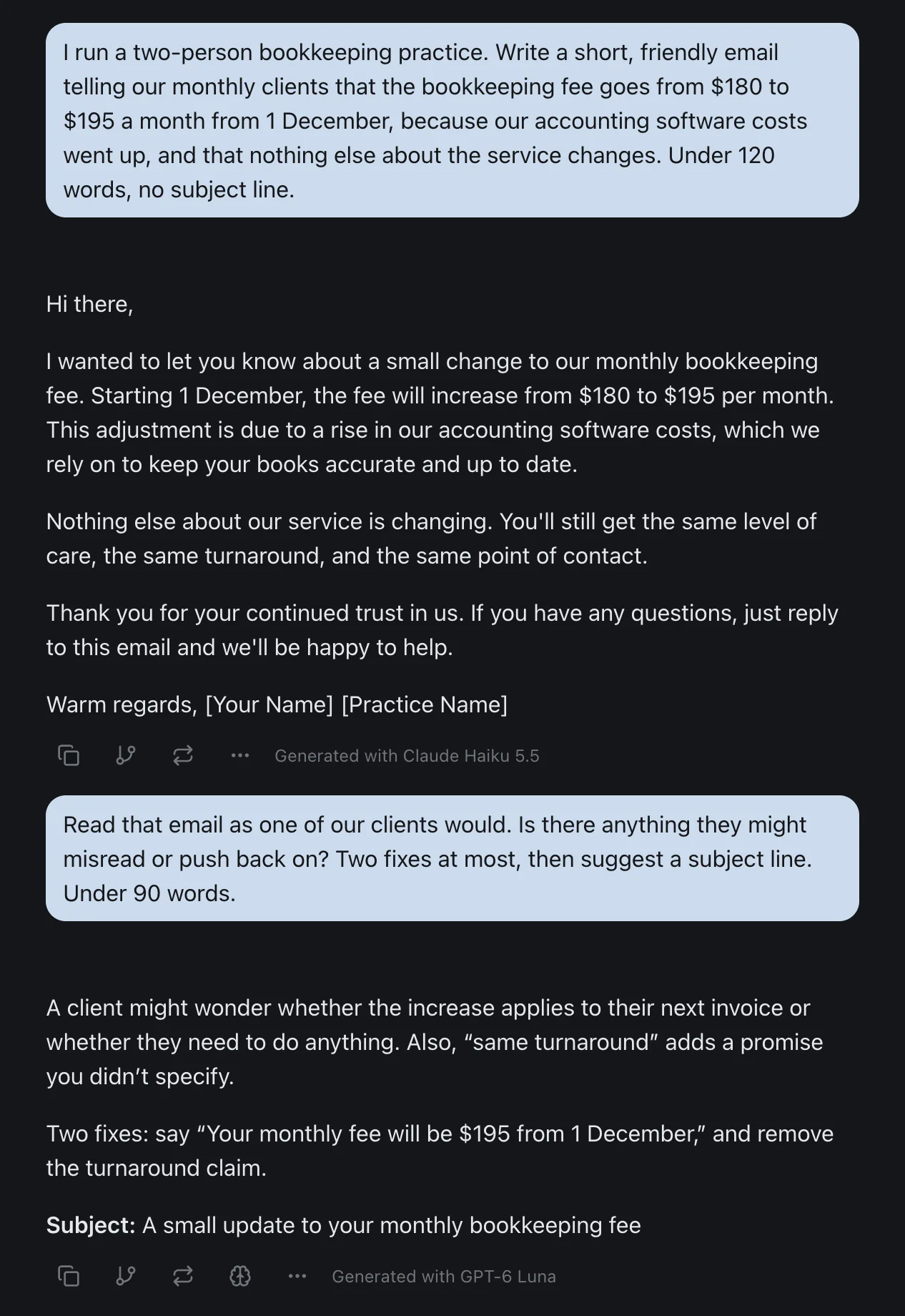
izzedo chat's free plan puts Claude Haiku 5.5 in one thread with other labs' models, with no card. GPT-6 Luna, Gemini 3.8 Flash, Grok 4.7, DeepSeek, Kimi and Qwen are on the free plan too. In the thread below, Claude Haiku 5.5 drafted a fee-increase email for a two-person bookkeeping practice. Then GPT-6 Luna read it the way a client would, and flagged that "the same turnaround" promised something the request never mentioned.
Agent mode and the 50+ connectors are on the free plan as well, including Gmail, Google Drive and Notion. Unless you change the setting, izzedo asks before each tool action.
Claude Sonnet 5.5, Opus 5.5 and Fable 5.1 come with the $6 Hobby plan, alongside every other chat model. It's one shared allowance across all of them, and top models like Opus and Fable use it several times faster than the everyday ones. So Hobby is a way to put a few hard questions to Fable each day, not to live on it. The current allowances are on the pricing page.
The Bottom Line
Claude is free, and the free plan is better than its reputation. It runs the same Sonnet as Pro, searches the web, remembers you, reads your files, and since September writes documents and builds decks.
What you give up is time. You get one five-hour clock, sized for everyday questions. The paid plans just got more hours and Free didn't. There's no student rate, no trial, and no way to buy more without upgrading.
So use the free plan until it stops you more than once a week. Then work out whether you need more Claude or more models, because those are different purchases. And check the date on this post, and on anything else you read about it. Anthropic changed three things about the free plan in the four weeks before I wrote it.
Want Claude and a second opinion in the same thread? Try izzedo chat free, no credit card required.
Topics
- is claude free
- claude free vs pro
- claude free plan
- claude free limits
Start on the free plan. Pay when you want the premium models.
Free
$0
Claude Haiku, Gemini Flash, Grok and more, with agent mode and 50+ connectors
Hobby
$6/mo
Every chat and image model
Pro
$12/mo
Higher limits, 400k context and more video models
Max
from $50/mo
5x or 10x Pro's usage, and every video model
Frequently asked questions
Is Claude free to use?
Yes. Anyone 18 or older in a country Anthropic supports can sign up at claude.ai with an email address and use the Free plan for $0, with no card. Anthropic's sign-up article adds that it requires a phone number from a supported location to create an account. The free plan includes the Sonnet and Haiku models, web search, memory, file uploads, artifacts including Claude Docs and Slides, and up to five projects, on the web, desktop and mobile. Usage resets on a rolling five-hour session window.
What is the difference between Claude Free and Pro?
Pro costs $20 a month, or $17 a month on a $200 annual plan, and Anthropic's pricing FAQ says it gives at least 5x more usage per five-hour session than Free. It adds the Opus models, Research, unlimited projects, Claude Code, Claude in Chrome and Microsoft 365, task hand-off and scheduling, usage credits, and access to Anthropic's support team rather than only its AI bot. Both plans get the same Sonnet and Haiku models, and model training is opt-out on both. Fable, the top tier, isn't inside Pro's allowance and runs on pay-as-you-go usage credits.
Is Claude free unlimited?
No. The free plan has a session limit that resets every five hours, and Anthropic publishes no message count. Its help centre says the number of messages you can send on Free will vary based on demand, and its pricing FAQ says how much you can do depends on the length and complexity of your conversations, the model and the features you use. Anthropic also reserves the right to limit usage in other ways, such as weekly and monthly caps. When you hit the limit on Free, you wait for the reset or upgrade.
Is Claude free for students?
Claude has no student discount. Anthropic says it doesn't offer standard discounted pricing on any paid plan, and its support team can't issue coupons. Students 18 and over can use the same free plan as everyone else. If your university has a Claude for Education agreement, you sign in with your university email and get the university-sponsored plan, which Anthropic says includes its newest models, projects and more usage than individual plans. Claude for Teachers is for educators only, and Anthropic says it is not for students.
Is there a free trial of Claude Pro?
Not a standing one. Anthropic's Pro article says it occasionally runs limited-time promotions, announced through its official channels, but has no standing discounts and its support team cannot issue one-off coupons. In practice the free plan is the trial, since it runs the same Sonnet model. If you subscribe, start monthly. Anthropic's refund article says payments are non-refundable except where its terms or the law require, with a prorated refund within 14 days in the EEA and the UK.
Does Claude cost money for the API or Claude Code?
Yes. Claude Code comes with Pro and Max but isn't on the free plan. The API bills per token through the Claude Console, separately from any chat plan. On 13 October 2026, Anthropic's API pricing listed Haiku 5.5 at $0.10 per million input tokens and $0.50 per million output tokens for prompts up to 100K tokens, Sonnet 5.5 at $2 and $10, Opus 5.5 at $4 and $20, and Fable 5.1 at $10 and $50.
Can I use Claude Opus or Fable for free?
Not on Anthropic's free plan. Its pricing table lists Opus and Fable as unavailable on Free. Opus comes with Pro. Fable is part of the Max plans, up to 50% of the weekly limit, and on Pro it runs on usage credits billed at API rates. Apps that host Claude set their own rules. On izzedo chat, for example, Claude Haiku is on the free plan, and Sonnet, Opus and Fable come with the $6 Hobby plan.
Does Claude's free plan use my chats for training?
The free plan has the same training setting as Pro and Max. Anthropic's pricing table marks model training as opt-out on all of them. You can switch it off in Settings under Privacy, and Anthropic says incognito chats aren't used to improve Claude even when the setting is on. If you leave it on, Anthropic may keep de-identified data from your chats for up to five years in its training pipelines. On its commercial products, Team and Enterprise included, Anthropic doesn't train on your inputs or outputs by default.