Claude Pro vs Max: Is 5x the Usage Worth 5x the Price?
Max 5x costs five times what Pro costs and gives you five times the usage, which means the $100 plan charges the exact same rate as the $20 one. Here is what the extra $80 actually changes, why the multiplier only applies to one of Claude's two clocks, and the one row on the pricing table that is worth real money.
Anthropic sells three prices for one chatbot. Twenty dollars, one hundred dollars, two hundred dollars. The middle rung is the one people write in to ask about, because $100 a month is where a subscription stops feeling like a subscription and starts feeling like a line item.
So here is the arithmetic that nobody puts at the top of these comparisons. Max 5x costs five times what Pro costs. Max 5x gives you five times the usage of Pro. Those two sentences describe a plan that charges you exactly the same rate you were already paying, in a bigger block, with no discount for buying in bulk.
That is not a criticism of Claude, which remains very good. It is a description of what the transaction is. And once you see it, the question stops being "is Max better than Pro" and becomes something much easier to answer: do you need five of the thing you already have?
The Short Answer: Who Should Move From Pro to Max
| If this is you | Verdict | Why |
|---|---|---|
| You hit the five-hour limit most working days | Yes, Max 5x | This is the only problem Max is built to solve, and it solves it |
| You want the Fable tier without a token meter running | Yes, Max 5x | The one row on the table that genuinely changes value |
| You hit the limit once or twice a month | No, usage credits | $80 of credits goes a long way at Anthropic's own rates |
| You want better answers than Pro gives you | No | Same models, same context window, no capability row changes |
| You are on annual Pro | Check your billing address first | The credit for your unused year depends on it matching |
| You want twenty times more Claude | Max 20x, and only then | The $200 rung is the only one with a volume discount |
How Much Claude Max Costs
Max 5x is $100 a month. Max 20x is $200 a month. Both are monthly only, with no annual option and no discount at any volume.
Getting those two numbers is oddly hard. Anthropic's pricing page prints "From $100" on the Max card and then shows a comparison table with a column headed Max 20x that has no price above it anywhere on the page. The actual split lives in a help centre article, which also adds a caveat worth knowing before you subscribe on your phone: those are web prices, and "mobile pricing may vary depending on your app platform."
There are no discounts on Max either. Anthropic's wording is blunt, and it names the tiers specifically: it does not offer standard discounted pricing on any paid plan, "including Max 5x and 20x plans," and its support team cannot issue one-off discounts or coupons.
The upgrade path has one trap in it. Moving up a tier is charged prorated, which is fine. Moving from an annual Pro plan to Max converts your remaining balance into account credit, which is generous. But that conversion has a condition attached: the billing address on your new Max subscription has to be the same as the one on your old Pro subscription. If it changed, and people move house, Anthropic's instruction is to cancel Pro, wait for the subscription end date, and then sign up for Max with the new address. That means eating the rest of a year you have already paid for.
Five Times the Usage for Five Times the Money
Put the whole consumer ladder in one table and divide. A "unit" here is one Pro plan's worth of usage, which is the only unit Anthropic gives us.
| Plan | Price per month | Usage vs Pro | Cost per unit of Pro usage |
|---|---|---|---|
| Pro, annual | $16.67 | 1x | $16.67 |
| Pro, monthly | $20 | 1x | $20.00 |
| Max 5x | $100 | 5x | $20.00 |
| Max 20x | $200 | 20x | $10.00 |
Read the right-hand column twice. Max 5x charges exactly Pro's monthly rate. Not a fraction less. The $100 plan is five Pro subscriptions, priced at retail, delivered to one login.
And against annual Pro, which is what a lot of people upgrading from are actually on, Max 5x is twenty per cent more expensive per unit of Claude. You move up a tier and every message you send costs you more than it did last month. That is an unusual shape for a pricing ladder. Most products get cheaper per unit as you buy more, because that is the entire argument for buying more.
Only the $200 rung breaks the pattern. Max 20x is twenty times the usage for ten times the price, which halves the rate. It is the one genuinely discounted plan Anthropic sells to individuals, and the catch is that the discount only exists once you use it. Ten Pro plans' worth of Claude on Max 20x works out at $20 a unit, which is exactly what Max 5x charges. Consume less than that and the cheaper rung was the better rate all along, with $100 a month left over for credits in the weeks you actually need them.
I want to be fair about one thing here. Nothing about this is dishonest. Anthropic publishes the multiplier and the price, both in plain language, and the sum is not hidden. It just never appears as a rate, and rates are how people decide whether a bigger package is a bargain.
Anthropic's Comparison Table Has 49 Rows. Three of Them Change.
The compare-features table on the pricing page runs across four sections. I counted the rows in each and checked every cell in the Pro, Max 5x and Max 20x columns against each other.
| Section | Rows | Rows where Pro and Max differ |
|---|---|---|
| Features and capabilities | 23 | 0 |
| Security and administration | 12 | 0 |
| Payment options | 5 | 1 |
| Models and usage | 9 | 2 |
| Total | 49 | 3 |
Zero, in the section that describes what Claude can do. Claude Code, Research, Projects, Connectors, Skills, Memory, Artifacts, voice mode, incognito chats, Claude in Chrome, the Microsoft 365 and Outlook integrations, Design, Slides, Docs, Science, file creation with code execution. Every one of those is identical on the $20 plan and the $200 plan. Twelve more rows under Security and administration are a clean column of No on all four consumer tiers, so they cannot differ either.
That leaves three cells in 49 rows:
Fable. Pro reads "Usage credits." Max 5x and Max 20x read "50% of weekly limits." This is the real one, and it gets its own section below.
Priority access at high traffic times. Free No, Pro No, Max Yes, Max Yes. Worth knowing that Anthropic's own help centre article on the Pro plan lists "priority access to Claude during high-traffic periods" as a Pro benefit, which directly contradicts the table. That contradiction has been live for at least a fortnight and I wrote it up in more detail when it first turned up.
Billing cycle. Pro is "Monthly and annual." Max is "Monthly." This is the third difference between the plans, and it runs the wrong way. The upgrade takes annual billing away from you, which is how Max 5x ends up more expensive per unit than the plan below it.
One row deserves a special mention for not changing: context window. It reads "Up to 1M, varies by model" on all four columns, and that now includes Free. Whatever you are paying Anthropic, from nothing to $200, you get the same working memory. If you came here hoping Max would let Claude hold more of your document at once, it will not.
Both Companies Describe Max the Same Way They Describe Pro
Anthropic writes a "Key benefits" list at the top of each plan's help centre article. The Max article lists six. The Pro article lists five. I put them side by side, and the overlap is the most revealing thing I found all week.
| Max key benefit | Also a Pro key benefit? |
|---|---|
| More usage capacity | Pro says "more usage per session than the Free plan" |
| Fewer interruptions | Restates more usage |
| Scale as needed | Restates more usage |
| Priority access | Yes, Pro benefit two |
| Access to Claude Code | Yes, Pro benefit four, and the table marks it Yes on Pro |
| Longer, multi-step tasks | Yes, Pro benefit five, word for word |
Three of Max's six benefits are the same fact written three ways. The other three appear, in Anthropic's own words, on the Pro page. There is nothing on that list that Anthropic does not also claim for the $20 plan.
Then there is the fourth bullet on the Max card, which is the interesting one because it appears nowhere else: "Higher output limits for all tasks." I went looking for what that means and came back with nothing. It has no row in any of the four comparison tables. It has no number on anthropic.com. The help centre article that exists specifically to explain limits defines exactly two kinds, usage limits and length limits, and length limits turn out to be the context window, which is identical on every plan. Searching Anthropic's support site for an output limit returns a telemetry attribute and an API playground parameter.
So the one Max promise that is not usage, and not something Pro already claims, is undocumented. Maybe Max really does let Claude write longer answers. I cannot tell you by how much, and neither can Anthropic's website.
None of this makes Max a bad plan. It makes Max a quantity plan, sold with the vocabulary of a quality plan, which is why write-ups still circulate claiming Max unlocks the top model. It does not. Opus is marked Yes on Pro.
The One Row That Genuinely Changes: Fable
Anthropic's model lineup has a tier above Opus called Fable, and this is where the $80 actually goes.
On Pro, the Fable cell says "Usage credits." That means Fable is not part of your plan's allowance at all. You turn on usage credits, you prepay, and Fable bills at standard API rates from your first message. On Max, Fable is included, drawing from your regular weekly allowance up to half of it.
Here are the rates that cell is pointing at, from Anthropic's own API pricing.
| Model | Input per million tokens | Output per million tokens |
|---|---|---|
| Fable 5.1 | $10 | $50 |
| Opus 5 | $5 | $25 |
| Sonnet 5 | $2 | $10 |
| Haiku 4.5 | $1 | $5 |
Now you can price the upgrade properly, because the gap between Pro and Max 5x is $80 a month and usage credits are the direct alternative to paying it.
Eighty dollars at Fable rates buys roughly 8 million input tokens, or 1.6 million output tokens, or any mix in between. That upper figure is somewhere around a million words of Claude's writing. For someone whose Fable use is a few genuinely hard problems a week, $80 of credits is not a near thing. It is not close.
The honest qualifier: agentic runs and long conversations burn input tokens far faster than chatting does, because the whole thread gets re-sent with every turn, and reasoning models bill their thinking as output. So treat that as a ceiling rather than a promise. But it does mean the upgrade has a real test attached to it. Turn on credits for a month, put your hard problems on Fable, and look at the bill. If it comes in under $80, Max was never the cheaper option. If it comes in at $150, Max 5x just paid for itself and you should switch.
There is also a rung above Fable that money cannot reach. Anthropic's footer lists five model tiers, and the fifth is Mythos, a cybersecurity and biology model released on 1 September. Access runs through vetted-organisation programmes, currently US only, and it is not on Pro, Max or any consumer plan at any price. Four tiers are all Anthropic sells to individuals, and the differences between the three you can actually pick from matter more day to day than the one you cannot.
The Multiplier Only Applies to One of Claude's Two Clocks
This is the detail that decides whether Max fixes your problem, and it is stated clearly by Anthropic and dropped by nearly everyone who repeats it.
Claude meters you on two clocks. A session limit that resets every five hours, and a weekly limit on paid plans that applies across all models. Read the Max wording with that in mind: "5x or 20x the usage of Pro per 5-hour session." The pricing FAQ says per session. The help centre article says per session. The multiplier is a property of the short clock.
The weekly limit is mentioned in the same paragraph with no multiplier attached to it. Anthropic does not publish one. And sitting above both is a line in the small print that says the company may limit usage "in other ways, such as weekly and monthly caps or model and feature usage, at our discretion."
So the upgrade buys you longer uninterrupted stretches. Whether it buys you more Claude in a month is a question Anthropic's documentation does not answer. That distinction sounds academic until you notice it maps exactly onto two different complaints. If your problem is "I get cut off in the middle of a long afternoon and lose my thread," Max is the correct purchase and you will feel it on day one. If your problem is "I run out by Thursday every week," you are hitting the clock that Max makes no promise about. How both clocks behave, what the error messages mean and when they reset is worth ten minutes before you spend $1,200 a year.
Work out which one is stopping you first. Settings has a Usage section with progress bars for the current session and the week, which is genuinely more than most vendors show you, and it will tell you the answer in about four seconds.
Claude Max vs ChatGPT Pro: The Same Three Prices
I read OpenAI's pricing page on the same day, and the ladders turn out to be identical.
| OpenAI | Anthropic | |
|---|---|---|
| Entry paid plan | Go, $6 | none |
| The $20 plan | Plus, $20 | Pro, $20 |
| The 5x plan | Pro, from $100 | Max 5x, $100 |
| The 20x plan | Pro, $200 | Max 20x, $200 |
OpenAI's Pro card leads with "5x more usage" and prices it from $100. Anthropic's Max card leads with "Choose 5x or 20x more usage than Pro" and prices it from $100. Two companies, no price-fixing implied and none needed, arriving independently at the same two multipliers and the same three numbers.
That convergence tells you something the single-vendor comparison cannot. The $100 tier is not Anthropic's judgment about what five times Claude is worth. It is the industry's standard shape for selling headroom, and the rate stays flat at the middle rung on both ladders. If you find yourself deciding between $100 of Claude and $100 of ChatGPT, neither purchase is the good deal in the room, and the cheaper comparison is one rung down where both companies compete hard for the same $20.
The one difference that matters: OpenAI puts a $6 plan on its ladder and Anthropic does not. Claude's floor for paying anything at all is $20.
Is Claude Max Worth It? Verdicts by How You Work
Writers working on book-length projects. Probably yes, on Max 5x. Long-document work is where Claude earns its reputation, and it is also the fastest way to spend a session allowance, because every turn re-sends the document. If you are editing a manuscript and getting stopped mid-chapter, that is the exact complaint Max fixes.
Researchers. Yes if Research runs are your daily habit, no otherwise. Research mode is on Pro already, and it consumes an allowance quickly enough that heavy users find Pro's ceiling in the first week. This is the group most likely to actually want Max and most likely to also want the 20x rung.
People who want the Fable tier. Do the credits test first. Most of you will find $80 of credits covers a month of hard problems with room left over, and you can stop paying it in any month you do not need it, which Max does not let you do.
Consultants and analysts billing by the hour. Yes, and the maths is not close. If waiting for a reset costs you one billable hour a month, Max 5x has paid for itself. This is the cleanest case on the list and it has nothing to do with features.
Anyone whose complaint is answer quality. No. Not one capability row changes. Claude generates no images on any plan, the context window is identical from Free upward, and the model list is the same apart from Fable. Paying Anthropic more money gets you more Anthropic.
Anyone currently on annual Pro who is merely curious. No, or at least not this month. You would be trading a $16.67 rate for a $20 rate, giving up annual billing permanently, and relying on your billing address not having changed to get your unused balance back as credit.
What Else $80 a Month Buys
Here is the thing about Max 5x being priced as five Pro subscriptions: it is worth asking whether five of the same is what you actually wanted.
Priced separately, the major assistants run to roughly $110 a month all in. At $100, Max 5x costs nearly the whole industry and gives you one vendor's opinion, five times over. That is a fine trade if your bottleneck is genuinely volume. It is a poor one if you have ever asked a model something and thought, I wonder what a different model would say about this.
izzedo chat is built for the second case. It puts Claude's tiers in one picker beside the flagships from OpenAI, Google, xAI, DeepSeek, Moonshot and the rest, and the whole thing starts at $6 a month.
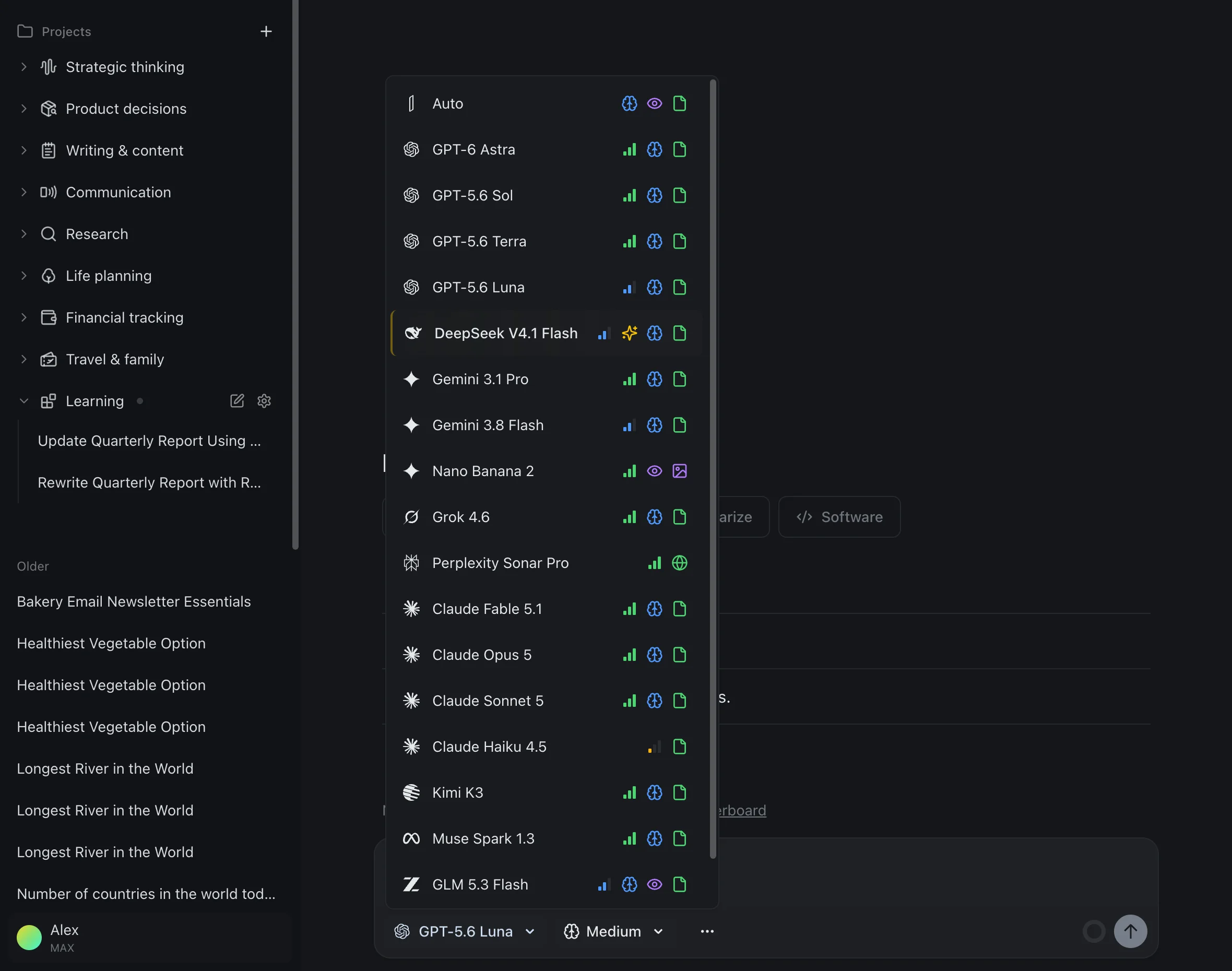
The specific comparison worth making, given everything above: the Fable tier that Anthropic meters at API rates on the $20 plan, and caps at half your week on the $100 plan, is a row in that list on the $6 plan. Claude Haiku is on the free plan with no card.
I want to be precise about the limits, because this article has spent two thousand words reading other people's fine print and it would be poor form to hide my own. There are two clocks here too, a five-hour one and a weekly one, and they live behind the same icon as the context meter rather than three menus deep in a settings page.
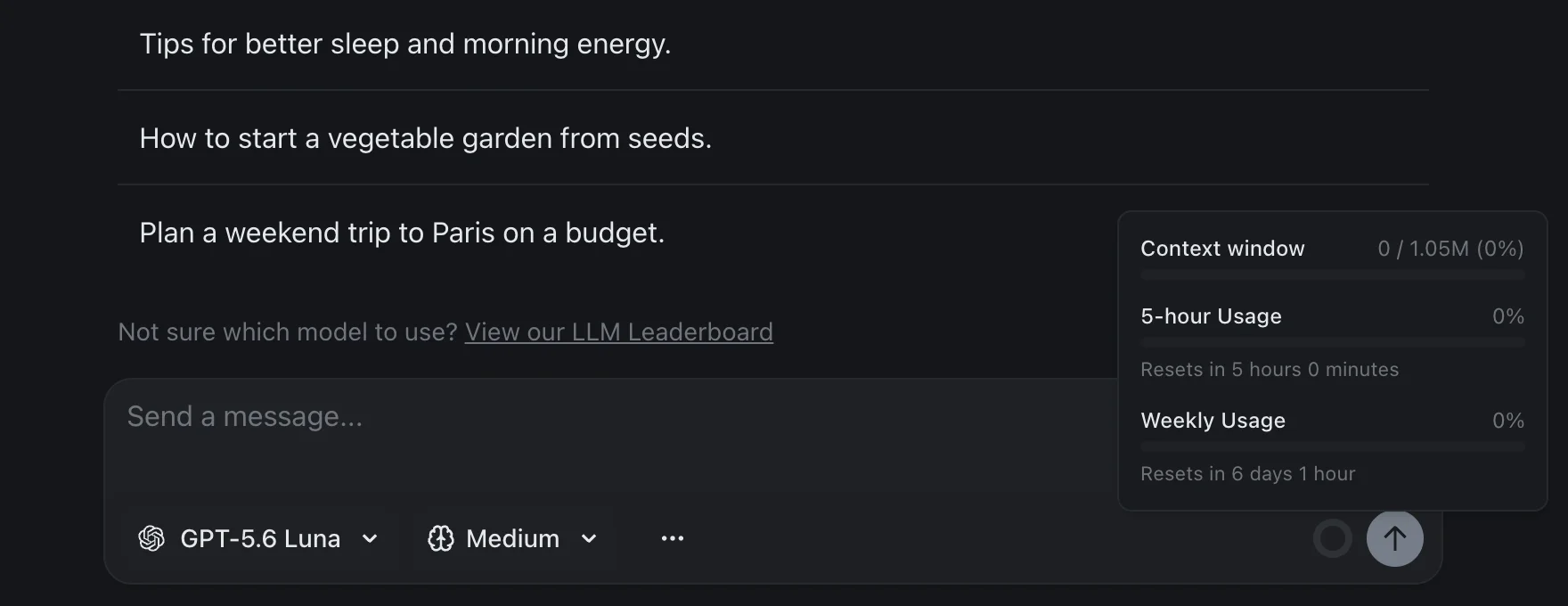
It is one allowance, metered by what each model costs to run, so heavy models spend it faster than light ones. It is fair use rather than unlimited, and the numbers live on the pricing page rather than in a blog post. Usage-based billing exists if you want to keep working past the allowance, the same shape as Anthropic's usage credits, and it stays off unless you switch it on.
What the ladder above cannot sell you at any rung is a second opinion. When Claude hedges on something that matters, you ask the same question of a model from a different lab in the same thread and compare the two answers, which is the habit I argued for at length in stop using one AI model. Max 20x will not do that for $200. Neither will ChatGPT Pro.
The Bottom Line
Claude Max is worth it when the five-hour reset is costing you working hours, and it is worth it for almost no other reason.
The extra $80 buys three cells on a 49-row table. One of them is Fable, which you can price yourself against usage credits in a single month. One is priority access during busy periods, which Anthropic's own Pro article also promises to Pro subscribers. And one is the loss of annual billing, which is how a plan five rungs up ends up charging more per unit of Claude than the plan you are on.
What surprised me, after a day inside Anthropic's pricing pages and help centre, is how consistent the company is about all of it. Every number I used here came from Anthropic. It states the multiplier is per session, every time. It tells you there is no fixed message count. It names the discretionary monthly cap in its own small print. The marketing is not misleading so much as arithmetically quiet, and the one bullet it does not document anywhere is the one about output length.
So run the test that costs nothing. Open Settings, look at the Usage bars, and find out whether it is the five-hour clock or the weekly one that keeps stopping you. If it is the session, Max 5x is a good purchase and you should make it today. If it is the week, no amount of money buys a published answer, and the better move is the one that does not involve a single vendor's ladder at all.
izzedo's free plan has Claude in it, takes no card, and lets you put the same question to three labs before committing $1,200 a year to one of them.
Frequently asked questions
What is the difference between Claude Pro and Max?
Usage, and almost nothing else. Anthropic's comparison table runs to 49 rows across four sections, and exactly three of them differ between Pro and Max. Max includes the Fable tier up to half your weekly limit where Pro bills it at API rates from the first message. Max gets priority access at high traffic times where Pro is marked No. And Max drops annual billing, so it is monthly only. Every one of the 23 rows under Features and capabilities is identical on Pro, Max 5x and Max 20x.
How much does Claude Max cost?
Max 5x is $100 a month and Max 20x is $200 a month, both billed monthly with no annual option. Anthropic's pricing card only says From $100, so the two figures come from the help centre article on the Max plan. Those are web prices. Anthropic notes that mobile pricing may vary depending on the app store you subscribe through.
Is Claude Max worth it over Pro?
Only if you hit Pro's five-hour session limit regularly and the waiting costs you real money. Max buys headroom, not better answers. The same Opus, Sonnet and Haiku models serve both plans, the context window row is identical on every consumer tier including Free, and no capability row on the pricing table changes when you pay the extra $80. If you are upgrading because you want a smarter Claude, you will not get one.
Is Claude Max 5x really five times Claude Pro?
Five times per five-hour session, which is not the same as five times per week. Anthropic is careful about that wording and states the multiplier per session every time. Max plans also carry a weekly limit that applies across all models, and Anthropic publishes no multiplier for it at all. So the thing you are buying five of is the short clock, and the long clock sitting above it is undocumented.
Should I buy Max or just turn on usage credits?
Run the numbers before you upgrade. The gap between Pro and Max 5x is $80 a month, and usage credits bill at standard API rates, where the Fable tier is $10 per million input tokens and $50 per million output tokens. If Fable access is the reason you are looking at Max, $80 of credits is a large amount of Fable for most people. Credits suit spiky months, Max suits a ceiling you hit every week.
Can I switch from annual Claude Pro to Max?
Yes, and the remaining balance on your annual Pro plan becomes account credit, with one condition that catches people out. The billing address on the Max subscription has to match the one on the Pro subscription. If your address changed, Anthropic says you have to cancel Pro, wait for the term to end, and sign up for Max fresh, which means paying out the rest of a year you no longer use.
Ready to try multi-model AI workflows?
Access GPT, Claude, Gemini, Perplexity, and more — all in one place.
Start for Free →