Perplexity vs Claude in 2026: One Answers, One Works
Perplexity or Claude? They look like rivals and mostly aren't. One is built to answer a question with the sources attached, the other to do a piece of work. Here's which gap each one fills, and what the two $20 plans really meter.
Perplexity vs Claude is a comparison that shows up late. Almost nobody makes it their first AI decision. It arrives after months of using something else, and it usually arrives with a specific complaint attached: I can't tell where any of this came from, or I need something that will actually sit with this document instead of skimming it.
Those are two different complaints, and they point at two different products. That's the entire comparison, and reading which complaint is yours is most of the decision. Perplexity fixes the sourcing problem. Claude fixes the depth problem. Neither one is a slightly different take on the other, which is why "which is smarter" turns out to be close to unanswerable once you look at how these two are actually built.
Here's what each is genuinely for, what the two $20 plans meter (they meter completely different things, and it matters), and the setup that makes the choice unnecessary.
The Short Answer: Perplexity vs Claude at a Glance
The whole comparison in one table. Left column is what you're trying to get done, middle is what I reach for, right is why.
| What you're doing | Better pick | Why |
|---|---|---|
| Settling a factual question in 30 seconds | Perplexity | Searches live and numbers every claim, so you can open the link and check |
| Anything with a price, a date or a statistic in it | Perplexity | An answer you can verify is a different product from an answer you must trust |
| Reading a long contract, filing or report closely | Claude | Takes bigger files, stays with them, and notices the clause in the middle |
| Drafting something that goes out with your name on it | Claude | The prose needs the least rewriting, and it takes editing direction well |
| Turning a pile of conflicting evidence into a position | Claude | It argues with the material instead of summarising it |
| Running a project over weeks | Claude | Built around a continuing conversation, not a query box |
| Twenty small look-ups across a working day | Perplexity | Faster to a usable answer, and the citations cost you nothing |
No overlap in that middle column, which tells you something. These two split cleanly because they were built from opposite ends.
Two Products Built From Opposite Ends
Perplexity started as search and added models. Ask it something and it goes out to the live web, reads what it finds, and hands back a synthesis with numbered citations under each claim. Its unit of output is the answer. Everything about the product is shaped around producing one good, checkable answer and then clearing the desk for the next question. Even the free plan is described in those units. Perplexity's own wording is that Free gives you practically unlimited basic searches, a very limited number of Pro Searches, basic file uploads, and no access to advanced AI models at all. You are being rationed by the question, and specifically by the good kind of question.
Claude started as a model and added search. Its unit of output is the work: a draft, an analysis, a decision, a rewritten version of the thing you brought it. It takes up to 20 files per chat at 500MB each and reads the visual content of PDFs up to 100 pages, which is a different promise entirely. Perplexity, by contrast, caps uploads at 40MB per file on every plan, free and paid alike. One of them expects you to arrive with a question. The other expects you to arrive with material.
That 40MB versus 500MB gap is not a rounding difference between two similar tools. It's each company telling you what it thinks you're going to bring.
You Can Run Claude Inside Perplexity, So What Are You Choosing?
Here's the part that breaks the framing, and I think it's the most useful thing to know before you spend $20 on either.
Perplexity Pro lets you pick which model answers a given query, and the selectable list includes frontier models from other labs, Claude among them. Meanwhile Claude searches the web and has a Research mode of its own. The two products have been growing toward each other from opposite directions for two years, and they now overlap in the middle.
So on a Perplexity Pro query, the thing answering you can literally be Claude. Which makes "which is smarter" the wrong question, because sometimes it's the same brain. The real question is which wrapper you want around it:
- Claude direct gives you the model as a working environment. Your projects, your uploaded files, a conversation that remembers what happened forty messages ago, and the model's own character applied to a long job.
- Claude through Perplexity gives you the model as an engine. Perplexity calls it once, feeds it web results, and hands you back one cited answer. Excellent answer. No environment, no continuity, no pile of your documents sitting next to it.
Pick the wrapper, not the brain. If your work is a series of questions, the search wrapper wins and the model underneath barely matters. If your work is one long thing, the environment wins and the wrapper is in the way.
How I Compared Them
Nothing benchmark-shaped here. I ran both on paid tiers through ordinary work over several weeks: market scans for a positioning piece, a supplier contract nobody wanted to read, a set of customer interview transcripts that needed to become a recommendation, and the usual daily stream of look-ups, prices and half-remembered facts. Same questions to both. Same files where both could take them.
Benchmarks tell you which model wins a test. This tells you which one you stop closing the tab on.
Perplexity vs Claude, Task by Task
Looking up something current
Perplexity, and it isn't close. Prices, funding rounds, what a company announced last month, whether a statistic anyone quotes at you is real: Perplexity returns it sourced, numbered and clickable. Claude can search now, and does it competently when it decides to, but its instinct is to reason from what it already knows. That instinct is a strength on hard problems and a liability on fresh ones, because a model reasoning confidently from stale information reads exactly like a model that looked it up.
Perplexity's own failure mode is different and much easier to live with. It sometimes leans on a thin source. But a visibly weak citation is a problem you can see and fix in one click. An unsourced confident paragraph is a problem you find out about later, usually in front of someone else.
Reading a long document
Claude, decisively. Give both a 90-page contract and ask what's unusual in it. Claude reads it as a whole: it finds the auto-renewal buried in a schedule, notices that two clauses contradict each other, and holds the thing in mind while you interrogate it for the next hour. Perplexity handles files, but the 40MB cap and the query-shaped interaction tell you the intent. It's built to extract an answer from a document, not to work through one.
If your job involves documents that arrive as obligations rather than as references, this single difference probably decides the whole comparison for you.
Writing
Claude, by a wide margin, and Perplexity would agree. Perplexity writes like a research analyst filing a brief, which is exactly right for its purpose and wrong for almost anything you'd publish. Claude drafts prose that needs the least de-robotising of any model I use, and more usefully, it takes correction well. Tell it the third paragraph is doing too much and it fixes that paragraph rather than rewriting the whole piece into something new.
I wouldn't hold this against Perplexity. Writing was never on its list. But if you're weighing a $20 subscription and any part of your week involves producing text, this is a large column in one direction.
Judgment on thin evidence
Claude. This is the capability people underrate because it doesn't demo well. Hand over five sources where three agree and two quietly don't, and ask what to conclude. Claude keeps the caveats attached, flags where the evidence is actually thin, and will tell you the honest answer is "not enough to say". Perplexity synthesises fluently, but it's tuned to reconcile and cite rather than to disagree with the pile. When the material is clean, that's fine. When the material is a mess, agreeableness is the failure.
Living with it all day
Split, and it depends on the shape of your day. If your day is forty small questions, Perplexity is faster to useful and the citations cost nothing. If your day is three long jobs, Claude is where you'd rather be, because the query box gets tiring when what you have is a project. Neither is a bad daily driver. They just suit opposite calendars.
Where Each One Wins
Perplexity wins on: current information, verification, source-hunting, competitive and market scanning, quick factual look-ups, and anything you'll have to prove later. Also the honest one nobody mentions: it makes you less likely to publish something wrong, because the receipts are right there and checking takes one click.
Claude wins on: long documents, writing and editing, reasoning through messy or contradictory material, extended projects, and anything where you want the model to push back rather than comply. Also the one that shows up after a month: it's the better thinking partner, because it will disagree with you.
Perplexity Pro vs Claude Pro: Two $20 Plans That Meter Different Things
Both plans cost about the same. What that $20 buys is not comparable, because the two companies are counting different things.
| Perplexity Pro | Claude Pro | |
|---|---|---|
| Price | $20/month | $20/month, or $17/month billed annually |
| What's being metered | Questions: Pro searches, Deep Research runs, asset generation | Work: how much thinking you consume, across all models |
| The free tier below it | Very limited Pro Searches, basic uploads, no advanced models | A usage allowance, same file limits as paid |
| Files | 40MB per file on every plan; up to 50 per project on Pro | 20 files per chat, 500MB each; visual PDF analysis to 100 pages |
| How the limit arrives | You run out of the good searches | Your five-hour session runs out, or your week does |
| Can you watch it? | Not really surfaced day to day | Progress bars in Settings, under Usage, for session and week |
| The rung above | Max, at $200/month or $2,000/year | Max, from $100/month, at 5x or 20x Pro |
Read the "what's being metered" row twice, because it's the practical difference. Perplexity meters questions. Claude meters work. Forty quick look-ups barely dent a Perplexity Pro plan and can genuinely eat into a Claude session if the answers run long. One afternoon spent inside a 200-page filing is nothing to Perplexity's counters, because you never asked it forty things, and it's a serious bite out of Claude's five-hour window. (How that window, the weekly cap above it and the usage-credit meter behind both actually work is laid out in full here.)
One detail Perplexity is quietly honest about: model selection is itself metered. Picking an advanced model is subject to usage limits, and Perplexity's own help centre warns that access to those queries can be restricted in weeks of especially heavy usage. So "Claude is available inside Perplexity" comes with a counter attached, which is exactly what you'd expect from a company paying another lab per query.
Which means the value question has a clean answer for once. Count what your week is actually made of. Mostly questions, buy Perplexity. Mostly work, buy Claude. (Anthropic's full ladder, free through Pro, Max, Team and the API, is priced out rung by rung here, and if the plan you're really weighing is Claude Pro against ChatGPT Plus, that one has its own comparison.)
Note the ceilings, too. Perplexity's next rung is $200/month. Anthropic's starts at $100. Both companies sell the cure for their own limits, which is the normal shape of this industry rather than a scandal, but it's worth knowing before you pick a ladder to start climbing.
Model Council: Perplexity Put the Second Opinion Behind a $200 Door
In February 2026 Perplexity shipped a feature called Model Council. It runs your question across several models at once, one frontier model each from Anthropic, OpenAI and Google by default, then hands the outputs to a synthesiser whose only job is to read the other answers and resolve them into one. Perplexity's own help page is worth quoting, because it makes the argument better than most people selling this idea do: every AI model has blind spots, it may overlook context or fill gaps with confident guesses, and for research you plan to act on, relying on a single model carries risk. So the synthesis is organised around where the models converge, where they disagree, and what only one of them surfaced, so a minority finding doesn't get lost.
That is the single best argument for multi-model work, and it was made by a search company, not by anyone selling you a workspace. It's also correct. Model disagreement is the cheapest error detector anyone has found for this technology, and it catches exactly the failures that matter, the confident ones.
Then look at where they put it. In Perplexity's main search product, on web and in the iOS app, Model Council belongs to Max and Enterprise Max, at $200/month or $2,000/year, with a monthly cap on how many councils you can run. The help centre is explicit that it is not available on Free, Pro, Education Pro or Enterprise Pro. There is one side door: inside Perplexity Computer it runs as a skill on any paid plan, but there it spends credits rather than coming included. Either way, the answer to "how do I know this is right" is the thing you meter or upgrade for.
Claude, meanwhile, has no version of this at all. It can't ask another lab's model what it thinks, for obvious reasons.
Is Perplexity Better Than Claude?
For finding things, yes, clearly and permanently. For doing things, no, and not by a small margin. That sounds like a dodge and it's the actual finding: these two are not competing for the same slot in your week.
The useful version of the question is which gap you have. If your answers are already fine but you can never prove them, you have a Perplexity problem. If you can find everything and still spend your evenings pushing a document uphill, you have a Claude problem. Buying the wrong one fixes nothing and costs $240 a year.
Claude vs Perplexity: Pick by the Job
- Journalists, analysts, anyone who cites → Perplexity. Verification is the job, and it's the whole product.
- Consultants, lawyers, operators buried in documents → Claude. The file limits alone settle it.
- Writers and marketers → Claude, with the caveat that you'll want a search tool eventually.
- Founders and small business owners → honestly, both, and that's the problem this post ends with.
- Students → Claude for the work, Perplexity for the sources you have to list. Worth knowing that Perplexity sells a verified Education Pro tier at $10/month, which halves one side of that maths, and Anthropic sells no student discount at all. (More on the study setup in best AI for college students.)
- Anyone still deciding between these and ChatGPT → the three-way comparison covers that, and Perplexity vs ChatGPT covers the search-shaped half of it. The rest of the field is on one comparison page.
The Setup That Ends the Argument
Every honest version of this comparison lands in the same uncomfortable place: most people need both, and both retail at $20. That's $40/month for two tools that cannot see each other's work, so the sources Perplexity just found reach Claude only by copy-paste, and you become the courier between your own subscriptions.
izzedo chat is the other way to arrange this. Perplexity Sonar and Claude in one workspace, along with ChatGPT, Gemini, Grok, DeepSeek and around twenty more models, for $6/month, with a free plan that asks for no card. Retail for the same lineup runs about $110/month across six accounts. The bill is a flat monthly price unless you switch on usage-based billing, which is off by default. Fair-use limits exist here as they do everywhere in AI, handled in the background on a short rolling window with a weekly pool behind it, and the details live on the pricing page.
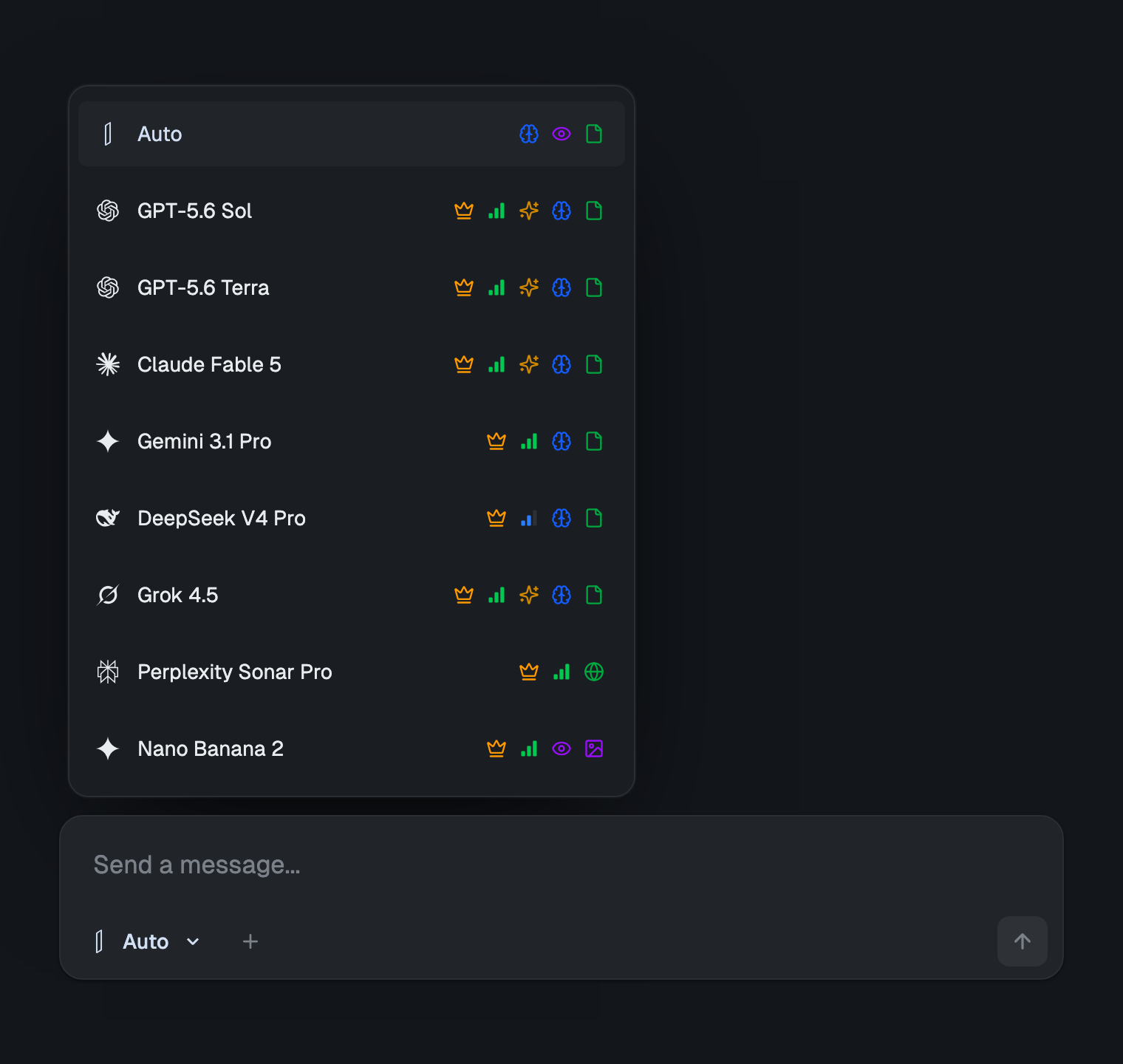
The part that matters isn't the bundle. It's that models switch inside the same conversation and inherit everything above them. So the handoff this whole comparison implies becomes one click:
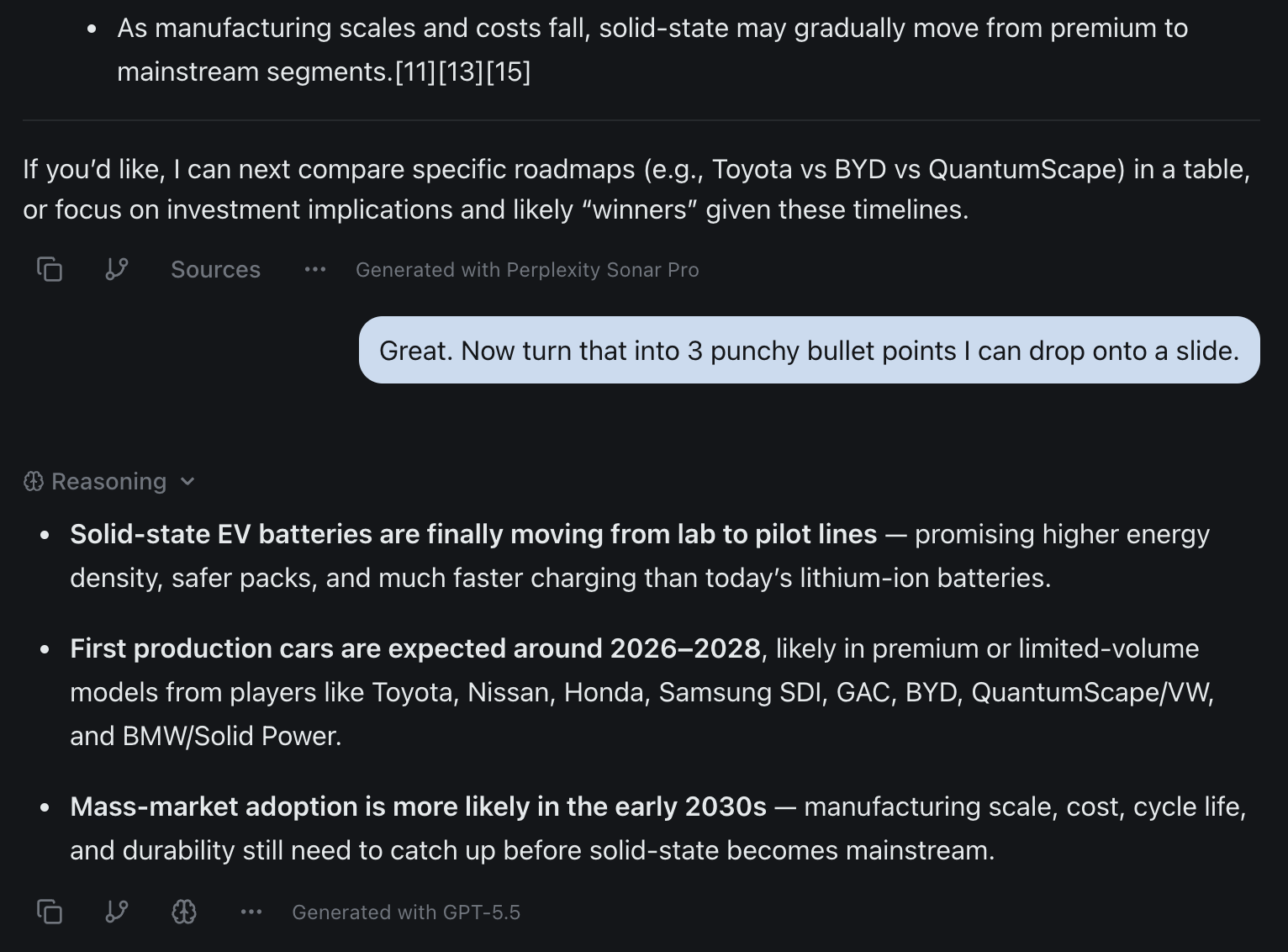
- Ask Perplexity Sonar the question that needs receipts. Sources attached, as usual.
- Switch to Claude in the same thread. It reads the sourced answer it was just handed, along with whatever you've uploaded, and does the actual work: the analysis, the draft, the argument with your evidence.
- Keep going. Follow-ups, a version for a different audience, the small questions that come up on the way.
The second opinion, without the $200 tier
Perplexity was right about disagreement being the signal. It just priced the feature like a luxury. Putting the same question to two models and comparing is native here, on every paid plan, and it takes a click rather than a subscription upgrade. Agreement is mild reassurance. Disagreement is a flare over the one claim worth checking before it goes anywhere public.
That habit is the one-minute routine behind most of what's useful about running more than one model.
The Bottom Line
Perplexity answers questions. Claude does work. Almost everything else in this comparison follows from that one sentence, including the file limits, the pricing meters, and why people who buy the wrong one feel like they wasted $20.
If you must choose, choose by the shape of your week rather than by which model tops a leaderboard, because on a Perplexity Pro query the model on top might be the one you didn't buy. And if the honest answer is that you need the sourced answer and the deep read, which it usually is, stop buying two subscriptions that refuse to talk to each other and put both in the same thread.
Want Perplexity's sourced answers and Claude's deep reading in one conversation, on one $6 plan? Try izzedo chat free with no card required.
Topics
- perplexity vs claude
- Perplexity
- Claude
- AI model comparison
Start on the free plan. Pay when you want the premium models.
Free
$0
Claude Haiku, Gemini Flash, Grok and more, with agent mode and 50+ connectors
Hobby
$6/mo
Every chat and image model
Pro
$12/mo
Higher limits, 400k context and more video models
Max
from $50/mo
5x or 10x Pro's usage, and every video model
Frequently asked questions
Is Perplexity better than Claude?
Only at its own job. Perplexity is better whenever the answer has to be current and checkable, because it searches the live web and puts numbered sources under every claim. Claude is better whenever there is real work to do: reading a long document closely, writing something you will publish, or reasoning through evidence that doesn't agree with itself. Perplexity produces answers. Claude produces drafts, analyses and decisions. Pick by which of those two things you actually need today.
Can you use Claude inside Perplexity?
On the paid tier, yes. Perplexity Pro lets you choose which model answers a given query, and the selectable list includes frontier models from other labs alongside Perplexity's own Sonar family. So the two products overlap more than the comparison suggests. What you don't get that way is Claude as a working environment, with your projects, your uploaded files and a conversation that remembers what came before. You get one cited answer from it.
Perplexity Pro vs Claude Pro: which $20 is better value?
They meter completely different things, so the value depends on your week. Perplexity Pro meters questions, extending the Pro Search and research allowances that the free plan keeps very limited, and unlocking the advanced models that Free has no access to. Claude Pro meters work, on a session that resets every five hours plus a weekly ceiling, with progress bars in Settings under Usage. If you ask forty small questions a day, Perplexity is the better $20. If you spend three hours inside one document, Claude is.
Is Claude good for research?
For the reading half of research, it's the stronger of the two. Claude takes up to 20 files per chat at 500MB each and analyses the visual content of PDFs up to 100 pages, which means you can put the actual sources in front of it rather than a summary of them. Where it is weaker is the finding half. It can search the web, but its instinct is to reason from what it already has, which is exactly the wrong reflex when the answer changed last week.
Can I use Perplexity and Claude together?
Yes, and it's the setup most research work wants. In a multi-model workspace you ask Perplexity Sonar for the sourced answer, switch to Claude inside the same thread, and it picks up with every source already in front of it. No copy-paste, no re-explaining. izzedo chat runs both plus ChatGPT, Gemini, Grok and DeepSeek in one workspace for $6/month, with a free plan that asks for no card.