Veo vs Kling vs Seedance: Seedance Wins the Blind Votes, and Veo's $0.40 Tier Scores Like Its $0.10 One
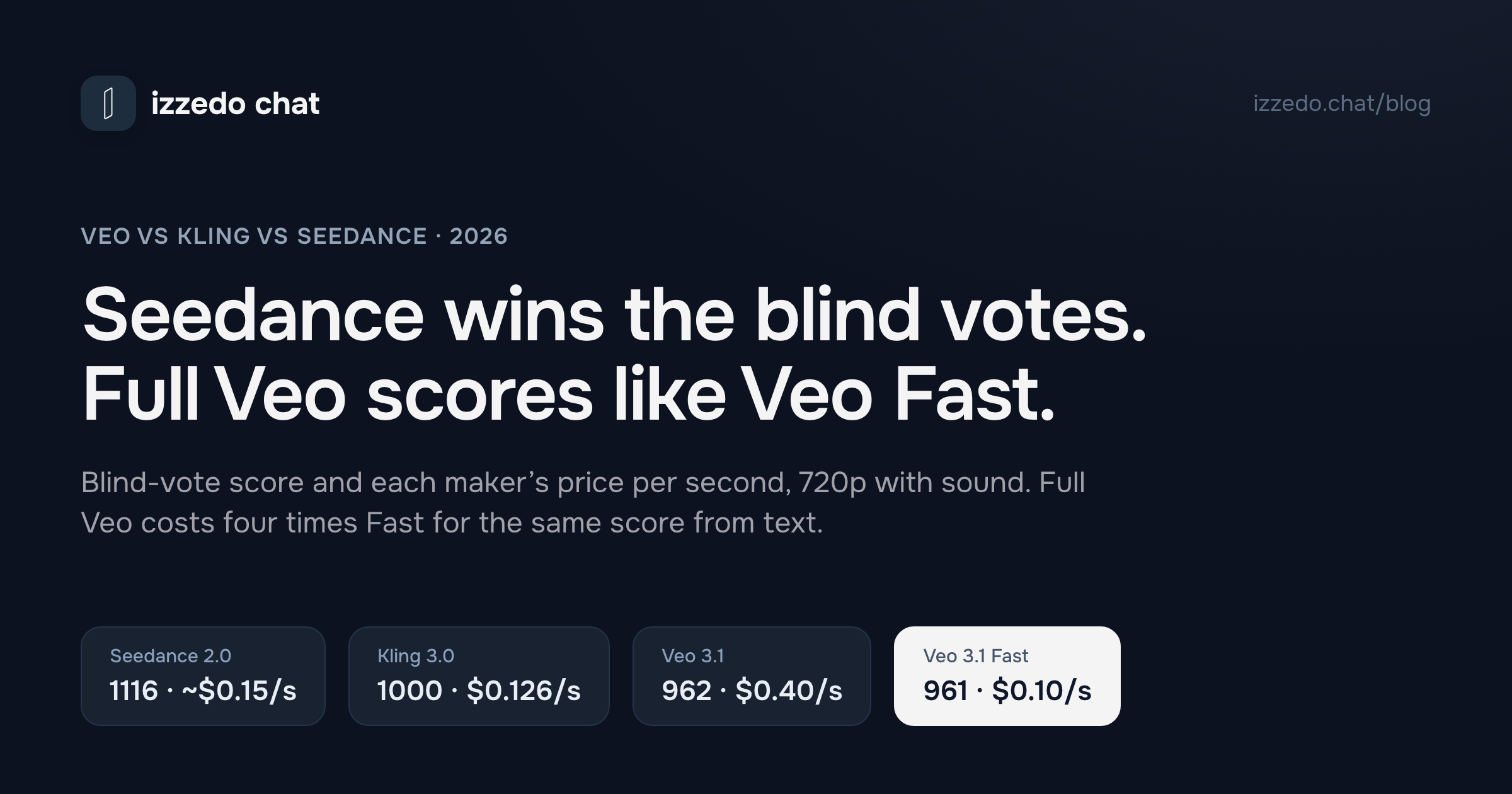
In blind votes Seedance beats Kling and Veo whether you start from text or a photo. Full-price Veo 3.1 costs four times its Fast tier for the same score from text, and Seedance costs twice as much through the API hosts most apps use as it does from ByteDance.
I sent the same prompt to all three: a barista in a sunlit café pouring latte art, close on the milk forming a heart, with the espresso machine hissing in the background. Kling 3.0 came back in about a minute with the cleanest pour. Veo 3.1 came back in about a minute with a soft swirl where the heart should have been. Seedance 2.0 took a little over four minutes, and it was the only one that drew a heart.
One prompt proves very little, so I went to a bigger sample. Artificial Analysis runs a video arena where people watch two clips made from the same prompt, without knowing which model made which, and vote for the better one. Thousands of those votes put Seedance first by a wide margin, with Kling and Veo well behind it and close to each other. Then I priced all three from their makers' own pages, and the order there doesn't match.
I read Google's, Kling's and ByteDance's pricing pages, help centres, developer docs and release notes on 7 and 8 October 2026, plus both of Artificial Analysis's video leaderboards. The figures below come from those pages.
The Short Answer
| If you want | Pick | Why |
|---|---|---|
| The best clip from a text prompt | Seedance 2.0, or 2.5 | Top of the three in blind votes, by a wide margin |
| To animate a product photo | Seedance 2.0, or Veo 3.1 Lite on a budget | Seedance leads. Veo's cheapest tier scores level with Kling, at 40% of Kling's price |
| The lowest price per second with sound | Veo 3.1 Lite or Fast, then Kling 3.0 | $0.05 and $0.10 a second from Google, $0.126 from Kling, at 720p |
| One long take | Seedance 2.5 | Up to 30 seconds in one generation. Kling 3.0 stops at 15 and Veo at 8 |
| Veo specifically | Veo 3.1 Fast, not full Veo 3.1 | The same blind-vote score from text, at a quarter of the price |
Which Versions You're Actually Comparing
Each of these names covers several models, and two of the three makers already have the next one out or on the way. The blind votes rank versions, not brands, so it's worth being precise.
Veo 3.1 is Google's current Veo, sold in three tiers: full Veo 3.1, Fast and Lite. Google's developer docs still label all three "Preview", and list the last update to Veo 3.1 and Fast as January 2026. The same docs now tell developers to use Gemini Omni Flash "as your default model for video generation" and to reach for Veo 3.1 for scene extension, last-frame control or "integration with legacy pipelines". The Gemini app's video maker runs Gemini Omni too. Google now sells Veo through Flow and its API.
Kling 3.0 finished rolling out at the end of January, with an Omni variant for reference-heavy work and a cheaper Turbo added in June. Kling 4.0 comes next. Kling's release note says it "will officially launch in October", and its blog says Kling 4.0 Flash went to Ultra Yearly subscribers on 28 September. Kling's API packages say they "currently don't support Kling 4.0", and there's no 4.0 price yet.
Seedance 2.0 arrived early this year alongside a cheaper Fast variant, and a Mini variant followed in June. Seedance 2.5 followed in the summer and is already on sale, in ByteDance's Dreamina app and through its API.
So the fair comparison today is Veo 3.1, Kling 3.0 and Seedance 2.0, with Seedance 2.5 as a step up you can already buy and Kling 4.0 as one most people can't.
Blind Votes: How the Three Rank
Artificial Analysis keeps two leaderboards that matter here, one for clips made from a text prompt and one for clips made from a starting image. The scores are Elo ratings, the system chess uses, so the gap between two models tells you more than either number. Both tables are the with-audio boards, since all three models generate sound. I read them on 7 October.
| Model | From a text prompt | From a starting image |
|---|---|---|
| Seedance 2.5 | 1143 | not on the board yet |
| Seedance 2.0 | 1116 | 1176 |
| Kling 3.0 Omni | 1015 | 1036 to 1044 |
| Kling 3.0 | 1000 | 1051 to 1055 |
| Veo 3.1 | 962 | 1082 |
| Veo 3.1 Fast | 961 | 1066 |
| Veo 3.1 Lite | 948 | 1071 |
The Kling 3.0 text score is its 1080p Pro mode, which the board uses as its fixed 1000 reference point. On the image board, Standard mode at 720p and Pro mode at 1080p score 1051 and 1055, and I've used Standard for the win rates below because it's what most people run.
A points gap is easier to read as a win rate. The standard Elo formula converts one into the share of head-to-head votes the higher model would be expected to win. This is my arithmetic from the published scores, not a figure Artificial Analysis publishes:
| Head-to-head | From text | From an image |
|---|---|---|
| Seedance 2.0 over Veo 3.1 | 71% | 63% |
| Seedance 2.0 over Kling 3.0 | 66% | 67% |
| Kling 3.0 over Veo 3.1 | 55% | 46% |
| Veo 3.1 over Veo 3.1 Fast | 50% | 52% |
Two things stand out. Seedance's lead isn't a rounding error, since it wins about two head-to-heads in three against either rival. And the Veo tiers barely separate. From a text prompt, voters couldn't tell full Veo 3.1 from Fast at all, and from an image the gap is 16 points. Veo 3.1 Lite, the cheapest tier, scores level with Kling 3.0 from an image.
There's a third thing, which Google probably wouldn't put this way. Its own newer model, Gemini Omni Flash, scores 1113 from text and 1178 from an image, level with Seedance 2.0 and well clear of every Veo tier. If Google is why you're looking at Veo, try Omni first.
The usual caveats apply. A leaderboard averages thousands of prompts that aren't yours. The scores carry error margins of about 10 points either way, so treat gaps under 20 as a tie. And votes say nothing about waiting time, which in my test was the biggest practical difference of all.
One Prompt, Three Models
Here's that test, for what a single prompt is worth. I sent it to the three models one after another in one izzedo chat thread, at each model's default length, and paused each clip near its end.
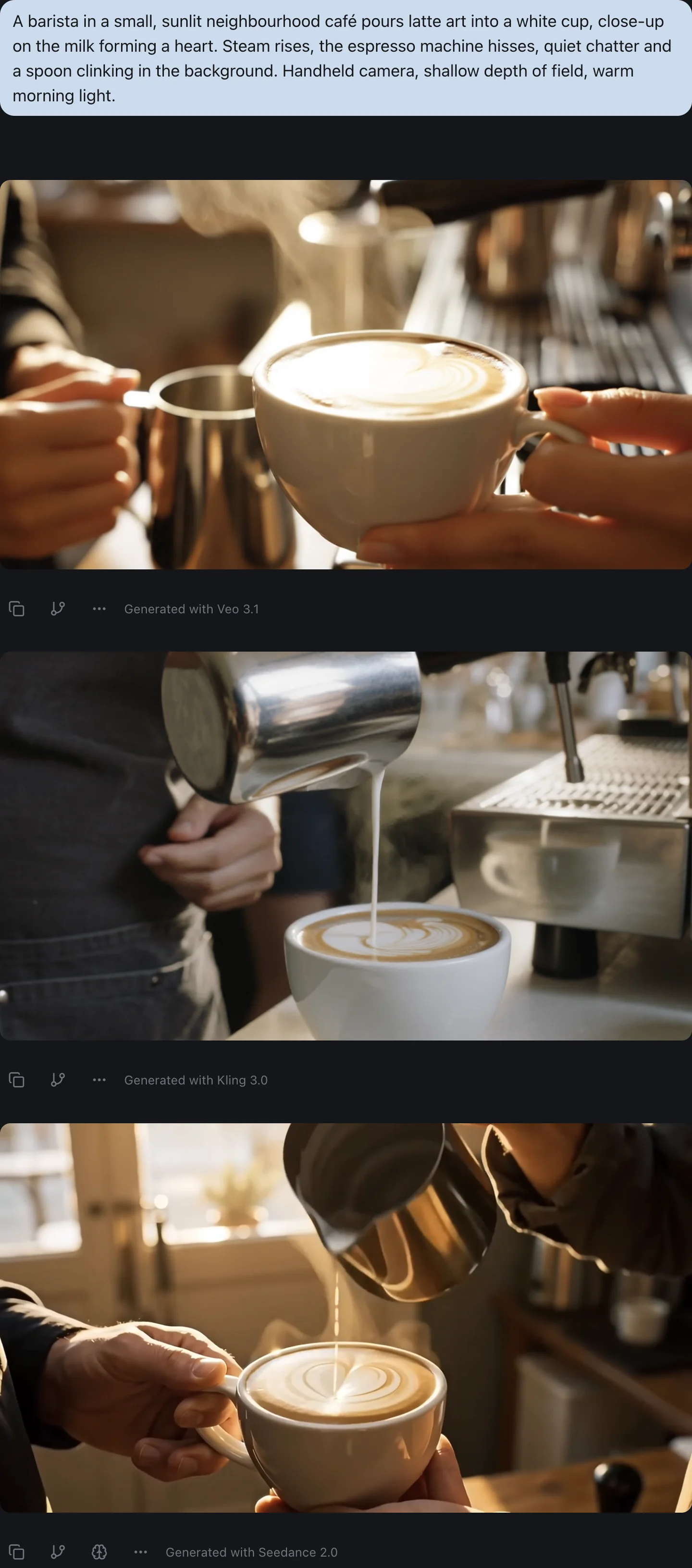
Veo 3.1 made a 6-second clip in about a minute. It's tight and warm, with steam rising past the machine, but the milk settles into a soft swirl and the last two seconds show the barista putting the pitcher down. Kling 3.0 made 5 seconds in about a minute, with the steadiest pour of the three, a thin stream drawing a layered leaf. Its light is cool daylight, though, not the warm morning I asked for. Seedance 2.0 made 5 seconds in a little over four minutes. It had the window light, the steam and the only heart.
All three came back at 720p and 24 frames a second with a stereo soundtrack, so on paper they delivered the same thing. On screen, my one test lines up with the votes, and with the cost of waiting for Seedance.
What a Second of Video Costs
Each maker prices differently. Google and Kling charge by the second. ByteDance charges by the token and publishes the formula, which works out per second like this. All prices are for 720p with sound, at each maker's own list price.
| Model | Per second | An 8-second clip |
|---|---|---|
| Veo 3.1 | $0.40 | $3.20 |
| Veo 3.1 Fast | $0.10 | $0.80 |
| Veo 3.1 Lite | $0.05 | $0.40 |
| Kling 3.0 | $0.126 | $1.01 |
| Kling 3.0 Turbo | $0.112 | $0.90 |
| Seedance 2.0 | about $0.15 | about $1.21 |
| Seedance 2.0 Fast | about $0.12 | about $0.97 |
| Seedance 2.5 | about $0.23 | about $1.85 |
At 1080p the order changes a little. Veo 3.1 stays at $0.40 a second, Veo 3.1 Fast goes to $0.12, Kling 3.0 to $0.168, Seedance 2.0 to about $0.37 and Seedance 2.5 to about $0.57. All three makers say they only charge for videos that actually generate.
Put this table next to the votes and the most expensive model per second is one that voters, working from text, rated below both rivals and no better than its own Fast tier. Full Veo 3.1 costs four times what Veo 3.1 Fast does and three times Kling 3.0. Seedance 2.0, the clear winner, costs only a little more than Kling.
The Same Seedance Costs Twice as Much Elsewhere
Plenty of apps don't buy from each maker directly. They use API hosts such as fal, which sell dozens of models under one account and one bill. For Veo 3.1 and Kling 3.0 fal charges what the makers do, $0.40 and $0.126 a second. Veo 3.1 Fast costs a little more there, $0.15 against Google's $0.10.
Seedance is different. fal bills it at $0.014 per thousand tokens where ByteDance's BytePlus bills $0.007, so a second of 720p costs $0.3034 instead of about $0.15. Seedance 2.5 costs about $0.47 a second there against about $0.23.
Priced through a host, Seedance looks like the expensive one. I called it that myself in my Sora alternatives post, using fal's rate, and I've corrected it there.
Veo Pricing: Buy Fast, Not Full Veo
Through Google's Gemini API, Veo 3.1 generates clips of 4, 6 or 8 seconds, at 720p, 1080p or 4K, always with sound. 1080p and 4K only come at 8 seconds. 4K costs $0.60 a second on full Veo and $0.30 on Fast, and Lite doesn't do 4K. There's no free API tier for any Veo model, and new accounts prepay at least $5.
The features that justify full Veo over Fast are narrow. Both can extend a Veo clip 7 seconds at a time, up to 20 times, for a total of 148 seconds, but only at 720p. Both take a first and last frame, and up to three reference images. Google keeps the files on its servers for two days, so download them. Lite gives up extension and reference images. For a single 8-second clip from a text prompt, I can't find a reason in Google's documentation or the votes to pay four times Fast's price.
Most people won't use the API, though. They'll use Google Flow, which spends credits:
| Flow generation | Credits, non-Ultra plans | Credits, Ultra |
|---|---|---|
| Veo 3.1 Lite, 4 to 8 seconds | 10 | 5 |
| Veo 3.1 Fast, 4 to 8 seconds | 20 | 10 |
| Veo 3.1 Quality, 8 seconds | 100 | 100 |
| Gemini Omni Flash, 720p, 4 to 10 seconds | 7 to 15 | 7 to 15 |
Everyone gets 50 Flow credits a day, with or without a plan, and unused daily credits don't roll over. Without a plan, that's two Fast clips or five Lite ones a day, and never a full-Veo clip, which costs 100. Google AI Plus at $4.99 a month adds 200 credits, Pro at $19.99 adds 1,000, and Ultra adds 10,000 at $99.99 or 25,000 at $199.99. Monthly credits don't roll over either.
AI Pro is where the Fast advice pays off. Its 1,000 monthly credits buy 10 full-Veo clips of 8 seconds, or 50 Fast ones. Fifty 8-second clips is 400 seconds of video for $19.99, about 5 cents a second, which is half what Google charges for Fast through its own API. That's before the 50 daily credits, which add two more Fast clips a day.
One thing has changed that older guides won't tell you. In the Gemini app itself, "Create video" now uses Gemini Omni, not Veo, and needs a Google AI plan. If you buy AI Plus to make Veo videos in the Gemini app, you'll get Omni there, and Veo only through Flow credits. I covered the rest of Google's plans in what Nano Banana costs, since images come out of the same plans.
Kling Pricing: Credits in the App, Units in the API
Kling's own app sells monthly credits:
| Plan | Price | Credits a month |
|---|---|---|
| Basic | Free | None monthly |
| Standard | $10, or $6.99 the first month and $8.80 after | 660 |
| Pro | $37, or $25.99 the first month and $32.56 after | 3,000 |
| Premier | $92, or $64.99 the first month and $80.96 after | 8,000 |
| Ultra | $180, or $127.99 the first month and $159.99 after | 26,000 |
Yearly billing takes 34% off. Kling's credit guide says content made on the free Basic plan can't be used commercially, so a business needs at least Standard.
The membership page doesn't say how many credits a clip uses. Kling's credit guide translates Standard's 660 credits as "33 720p videos", without saying how long those videos are or whether sound is on. At $10 that's about 30 cents a video. Native 4K costs 30 credits a second. Kling says failed generations don't use credits, monthly credits don't roll over, and top-up packs last two years.
The API is better documented. Kling sells prepaid units at a list price of $0.14 each, and Kling 3.0 at 720p with sound uses 0.9 units a second, which is the $0.126 above. Most API packages run for 180 days and start at $700, which is a lot for a small business. The way in is a Trial Package of 100 units, valid for 30 days, at $9.80 the first time against a list price of $14. That's about 111 seconds of 720p video with sound.
Kling 3.0 makes single clips of 3 to 15 seconds and can cut between up to six shots inside one generation. Kling 4.0 raises that to 30 seconds, with up to 10 keyframes and up to 15 reference images, videos and voices in one generation, and stereo sound. Kling 4.0 Flash, the version Ultra Yearly subscribers have now, makes 3 to 20 seconds at 720p. Neither has a price yet.
Seedance Pricing: One Model, Two Prices
ByteDance bills Seedance through BytePlus, its cloud business, by the token. The token count comes from the clip's width, height, frame rate and length, and BytePlus publishes worked examples. These are its API prices for a 5-second clip with no reference video:
| 5 seconds, no video input | 480p | 720p | 1080p | 4K |
|---|---|---|---|---|
| Seedance 2.0 | $0.35 | $0.76 | $1.87 | $3.89 |
| Seedance 2.0 Fast | $0.28 | $0.60 | not offered | not offered |
| Seedance 2.0 Mini | $0.18 | $0.38 | not offered | not offered |
| Seedance 2.5 | $0.51 | $1.16 | $2.84 | not offered |
Feeding Seedance a reference video costs more, because the reference's length counts toward the tokens. BytePlus prices a 5-second 720p Seedance 2.0 clip with a video reference at $0.84 to $1.86, depending on how long the reference is.
Seedance 2.0 makes clips of 4 to 15 seconds, up to 4K, and takes up to 9 images, 3 videos and 3 audio clips as references, 12 files in all. That reference handling is the practical reason to pick it for a product or a recurring character. Seedance 2.5 makes 4 to 30 seconds in one generation, which ByteDance says you can extend twice, and takes up to 50 reference files. On fal it also has a draft mode that renders a cheap 480p preview first.
For people who'd rather not touch an API, ByteDance's consumer route is Dreamina, its creative app under the CapCut brand. Dreamina sells credit plans and gives free daily credits to try Seedance 2.5. It shows prices in local currency, so I can only give you mine: plans start at €17 a month for 1,575 credits. Its pricing page doesn't say how many credits a Seedance clip uses.
Which One for Which Job
Most people reading this want short clips for a business, not a film. Here's how I'd choose.
A product photo that needs to move. Seedance 2.0, which wins about two votes in three against either rival from an image. If you're making dozens of variations, Veo 3.1 Lite at $0.05 a second scores level with Kling 3.0 in the same vote, at 40% of the price.
A social clip from a written idea. Seedance 2.0 again. If the turnaround matters more than the polish, Kling 3.0 came back four times faster in my test and costs a little less per second.
One take longer than 15 seconds. Seedance 2.5, which makes up to 30. Veo 3.1 can extend a clip 7 seconds at a time up to 148, but only at 720p. Kling 4.0 will make 30 seconds once it reaches you.
The same product or character across several shots. Seedance, with 12 reference files on 2.0 and 50 on 2.5. Kling 3.0 Omni is built for this too.
A clip that has to start and end on specific frames. Veo 3.1, which takes a first and a last frame.
You already pay Google. Skip full Veo. Spend Flow credits on Veo 3.1 Fast, or try Gemini Omni, which outscores every Veo tier.
Running All Three Without Three Accounts
izzedo chat has Veo 3.1, Kling 3.0 and Seedance 2.0 in the same picker as its chat models, which is how the test above ran in one thread. Kling 3.0 comes with the Pro plan at $12 a month, alongside Gemini Omni Flash, Wan 3.0 and Grok Imagine. Veo 3.1 and Seedance 2.0 come with the Max plans, from $50. You set the length per clip: 4, 6 or 8 seconds on Veo, at 720p or 1080p, and 5 or 10 seconds on Kling and Seedance.
Video comes out of the same usage allowance as chat, charged by what each model costs us to run. At the default lengths, a Veo 3.1 clip uses about four times what a Kling 3.0 clip does, and a Seedance 2.0 clip about two and a half times. The numbers for each plan are on the pricing page.
The useful part is the thread around the clip. Write the shot list with one model, ask another to turn it into a video prompt, then send that prompt to Kling and Seedance and keep the better take. It's the same habit that makes running several models at once useful for writing, and if you're still looking at the wider field, the Sora alternatives post covers Wan, MiniMax, Grok Imagine and Runway as well.
The Bottom Line
Seedance is the best of the three by a margin people notice, from text or from an image. From ByteDance it costs about 15 cents a second at 720p, close to Kling. Through most API hosts it costs twice that, and its four-minute wait in my test is the real price. Kling 3.0 is the quick, affordable middle. With Veo 3.1, be careful which tier you buy. Full Veo costs four times what Fast does, voters can't tell them apart from text, and Google itself now points people to Gemini Omni.
All of this will move within weeks. Kling 4.0 is rolling out this month, and these leaderboards change whenever a model ships. Check the date on any comparison you read, this one included.
Try Kling 3.0 next to Gemini Omni Flash in izzedo chat from the $12 Pro plan, with Veo 3.1 and Seedance 2.0 on Max. The chat models are on the free plan, no card required.
Frequently asked questions
Which is better, Kling or Veo?
It depends where you start. From a text prompt, Kling 3.0 edges Veo 3.1 in Artificial Analysis's blind votes, 1000 to 962, which works out to Kling winning about 55% of head-to-heads. From a starting image, Veo 3.1 edges Kling, 1082 to 1051. Kling is cheaper than full Veo, at $0.126 a second for 720p with sound against $0.40, but Veo 3.1 Fast costs $0.10 a second and scores the same as full Veo from text. Kling makes single clips of up to 15 seconds. Veo makes 8 and can extend them to 148 at 720p.
Is Seedance better than Veo?
In blind votes, yes, clearly. Seedance 2.0 scores 1116 to Veo 3.1's 962 from a text prompt and 1176 to 1082 from an image, so by the standard Elo formula it would win about 7 votes in 10 from text and 6 in 10 from an image. Seedance 2.5 scores higher again, at 1143 from text. Bought from ByteDance, Seedance 2.0 is also cheaper, at about $0.15 a second for 720p against Veo's $0.40. It was the slowest of the three in my test, though, at just over four minutes for a 5-second clip.
How much does Veo 3 cost?
Through Google's Gemini API, Veo 3.1 costs $0.40 a second with sound at 720p or 1080p and $0.60 at 4K. Veo 3.1 Fast is $0.10, $0.12 and $0.30, and Veo 3.1 Lite $0.05 at 720p and $0.08 at 1080p. There's no free API tier, and new accounts prepay at least $5. In Google Flow a generation costs 10 credits on Lite, 20 on Fast and 100 on full Veo 3.1. Everyone gets 50 Flow credits a day, and Google AI Plus at $4.99, Pro at $19.99 and Ultra from $99.99 add 200, 1,000, or 10,000 and up a month. The Gemini app's video maker now runs Gemini Omni, not Veo.
How much does Kling AI cost?
Kling's plans are Standard at $10 a month for 660 credits, Pro at $37 for 3,000, Premier at $92 for 8,000 and Ultra at $180 for 26,000, with a cheaper first month and 34% off yearly. Kling's own credit guide puts Standard's 660 credits at about 33 videos at 720p. Through Kling's API, Kling 3.0 costs $0.126 a second at 720p with sound, $0.168 at 1080p and $0.42 at 4K, and the smallest purchase is a $9.80 trial package of 100 units, which covers about 111 seconds of 720p video with sound.
How much does Seedance 2.0 cost?
ByteDance sells Seedance through its BytePlus API by the token. Its worked examples put a 5-second clip with no video input at $0.35 at 480p, $0.76 at 720p, $1.87 at 1080p and $3.89 at 4K, so about $0.15 a second at 720p. Seedance 2.0 Fast and Mini cost $0.60 and $0.38 for the same 5 seconds at 720p. API hosts such as fal charge about twice ByteDance's rate, $0.3034 a second at 720p. In ByteDance's Dreamina app, Seedance runs on credit plans with free daily credits to try it.
Is Kling 4.0 out?
Only for a few people so far. Kling says Kling 4.0 is in early access with a wider rollout in October, and that Kling 4.0 Flash went to Ultra Yearly subscribers on 28 September. Kling's API packages don't support 4.0 yet, and Kling hasn't published a 4.0 price. Kling lists clips of 3 to 30 seconds, up to 10 keyframes and up to 15 reference files in one generation.
Is Seedance 2.5 available?
Yes. It's on sale in ByteDance's Dreamina app and through the BytePlus API, and API hosts such as fal carry it too. It makes clips of 4 to 30 seconds in one generation, takes up to 50 reference files, and costs about $1.16 for 5 seconds at 720p from ByteDance. In Artificial Analysis's blind votes from a text prompt it scores 1143, the highest of any model in this comparison.
Can I use Veo, Kling and Seedance in one place?
Yes. izzedo chat has Veo 3.1, Kling 3.0 and Seedance 2.0 in the same model picker as its chat models, so you can send one prompt to all three in a single thread. Kling 3.0 comes with the Pro plan at $12 a month, and Veo 3.1 and Seedance 2.0 with the Max plans from $50.
Ready to try multi-model AI workflows?
Access GPT, Claude, Gemini, Perplexity, and more — all in one place.
Start for Free →