The Best AI for Business in 2026: It's a Lineup, Not a Model
A business isn't one person doing one task, so the best AI for business was never going to be one model. Here's the lineup that actually earns its seat — matched to each function, wired into the tools your team already uses, and priced so you're not buying six subscriptions per head.
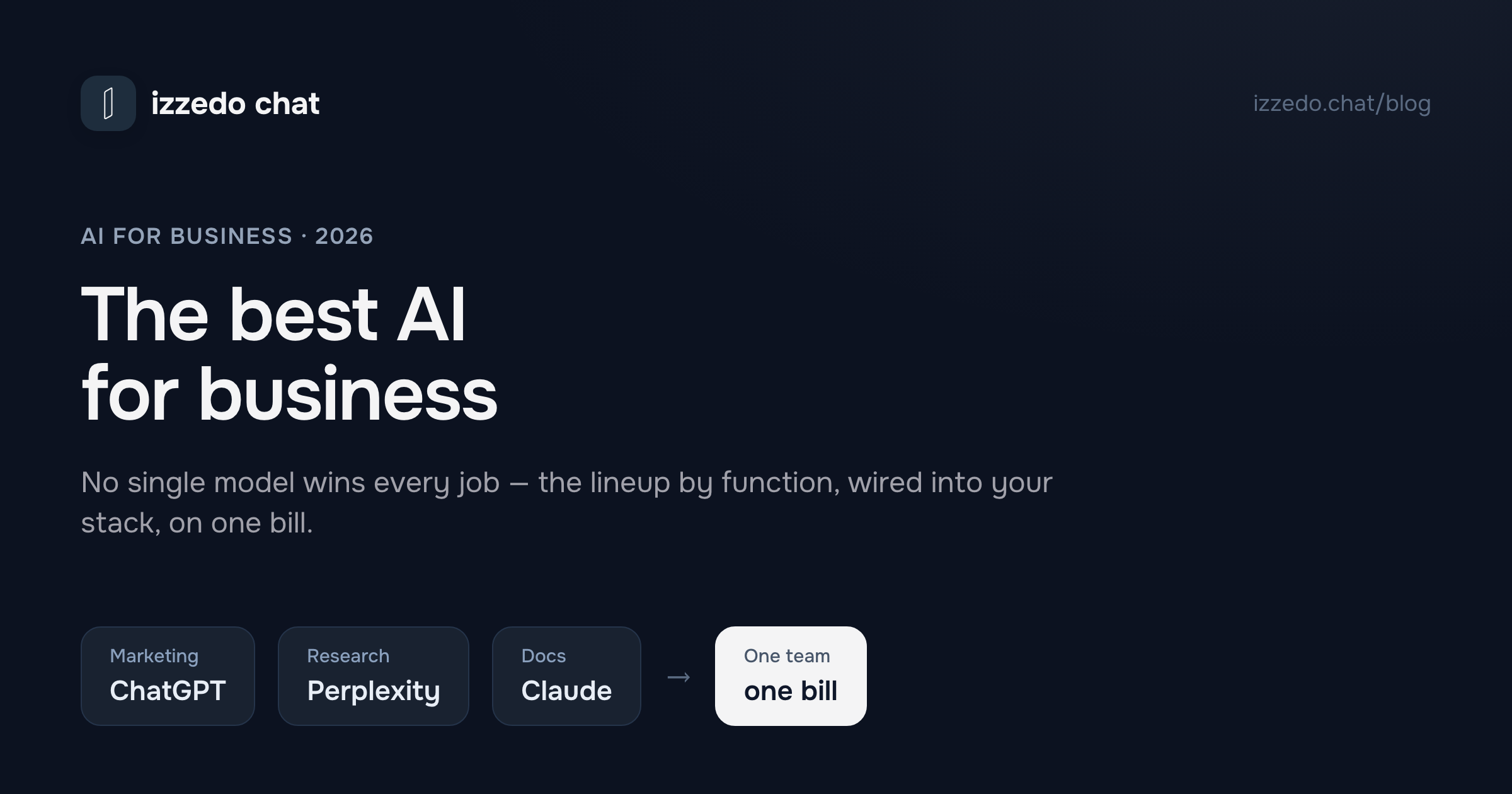
Type "best AI for business" into any search box and you'll get a list of thirty tools, most of which are the same four or five models wearing different logos. That list answers the wrong question. A business isn't one person doing one task — it's a marketing lead who needs fast, on-brand copy, an ops manager drowning in recurring busywork, a founder reading a 60-page contract at midnight, and a support team answering the same question for the hundredth time. No single model is best at all of that, and pretending one is costs you either quality or money, usually both.
I run izzedo chat as a business, and the AI does real work across every one of those jobs. So this isn't a benchmark roundup — it's the actual lineup that earns its seat, which model I reach for by function, and the three things that separate "AI for business" from "AI for a person": it has to plug into the tools you already use, it has to run without a human babysitting it, and it has to be something a whole team can share on a budget someone has to sign off on.
The Short Answer: The Best AI for Business by Function
| Business job | Best-fit model | Why it earns the seat |
|---|---|---|
| Marketing & content | ChatGPT | Fastest, widest range — social posts, ads, email, first drafts |
| Research & competitive intel | Perplexity | Answers the live web with sources you can click and check |
| Reports, proposals & careful writing | Claude | Goes deep, holds a long argument, sounds human |
| Long documents, data rooms & spreadsheets | Gemini | Reads enormous files and reasons across the whole thing |
| Everyday analysis & reasoning | ChatGPT / Grok | Reliable all-rounders for the daily "help me think this through" |
| Support & internal knowledge | Any model + Knowledge Base | Answers grounded in your own docs, not the open internet |
| Tight budget, high volume | DeepSeek | Frontier-grade reasoning at no cost |
| Anything that ships to a client | A second model | Two models rarely make the same mistake |
That last row is the one most "best AI tools for business" lists skip, and it's the one that keeps a confident, wrong number out of a client email. More on it at the end.
How I'm Judging This
Two things I'm deliberately not doing. I'm not ranking by leaderboard scores — a model that tops a reasoning benchmark can still be the wrong pick the moment the task involves your Notion workspace, your brand voice, or a spreadsheet only your finance team understands. And I'm not naming version numbers, because they're replaced every few weeks; what stays stable is each model's character — how it writes, what it's careful about, where it cuts corners — so that's what I'm describing. Every verdict below comes from running the job, not reading a spec sheet.
The Best AI Tools for Business, Function by Function
Marketing and content: the range job — ChatGPT
Marketing is where AI pays back its cost fastest, because the work is high-volume and forgiving of a rough first draft. ChatGPT is the workhorse here: it moves quickly, switches register on command — a LinkedIn post, a cold email, five ad variations, a webinar abstract — and needs the least hand-holding to produce something usable. It's rarely the best writer in the room (that's the next entry), but for getting from blank page to a draft worth editing, nothing is quicker. The deeper playbook — which model for images, which for repurposing, which for competitive research — is its own post: the best free AI tools for marketing.
Research and competitive intelligence — Perplexity
When the question is "what's actually true right now" — a competitor's new pricing, a market size, a rule that changed last quarter — a plain chatbot is a liability, because it answers confidently from stale training data. Perplexity's Sonar models search the live web and hand back an answer with its sources attached, so you can click through and verify before a number lands in a board deck. For due diligence, competitor teardowns, and "find me three suppliers who do X," it's the one I open first.
Reports, proposals and careful writing — Claude
The document that goes to a client or a board is a different job from a marketing draft. It has to hold a line of argument across several pages, get the nuance right, and not read like a machine wrote it. Claude is the strongest here: it goes deep, keeps a long structure coherent, and has the most human touch on serious prose. When the writing carries weight — a proposal, a policy, a customer-facing explanation you can't afford to get wrong — it's my default. Bids are their own discipline, though: the best AI for proposal writing covers which model to use at each stage of an RFP response, and how to score the draft before the buyer does.
Long documents, data and spreadsheets — Gemini
Business runs on enormous documents nobody wants to read: the 80-page vendor contract, the data-room dump, the quarterly export with forty tabs. Gemini's edge is appetite — hand it the whole thing and it reasons across all of it, summarizing, cross-referencing, pulling the three clauses that actually matter. For "here's everything, tell me what I need to know," it's the right tool, where a model with a smaller context window would make you feed it in pieces and lose the thread between them.
Support and internal knowledge — any model, plus your own docs
Customer support and internal Q&A come with a twist: the right answer isn't on the open web, it's in your help center, your policies, your past tickets. So this is less about which model and more about grounding it in your material — izzedo's Knowledge Base makes a project's documents conversationally searchable, so a support draft or a "what's our policy on X" answer comes from your own source of truth instead of a plausible guess. Pair that with whichever model's tone fits your brand and you have a drafting assistant that actually knows your business.
(One honest exclusion: if your team's core job is shipping software, that's a specialized world with dedicated tools built for it. This post is about the writing, research, analysis, support and operations work that every other part of a business runs on.)
What Businesses Actually Automate
Everything above is AI you drive. The bigger unlock for a business is the AI you don't — the recurring work that happens whether or not someone remembers to do it. izzedo's Automations run a saved prompt on a schedule (hourly, daily, weekdays, or weekly), on the model you choose, per project — and you can let them reach into that project's integrations so they read or act on real data, not just chat. The pattern that pays for itself:
- A Monday competitor digest — search the web for what three named rivals shipped last week, summarized into your Notion.
- A daily support triage — read yesterday's tickets, cluster them by theme, flag the ones that look urgent.
- A weekly pipeline summary — pull the CRM export and turn it into a plain-English "what moved and what stalled."
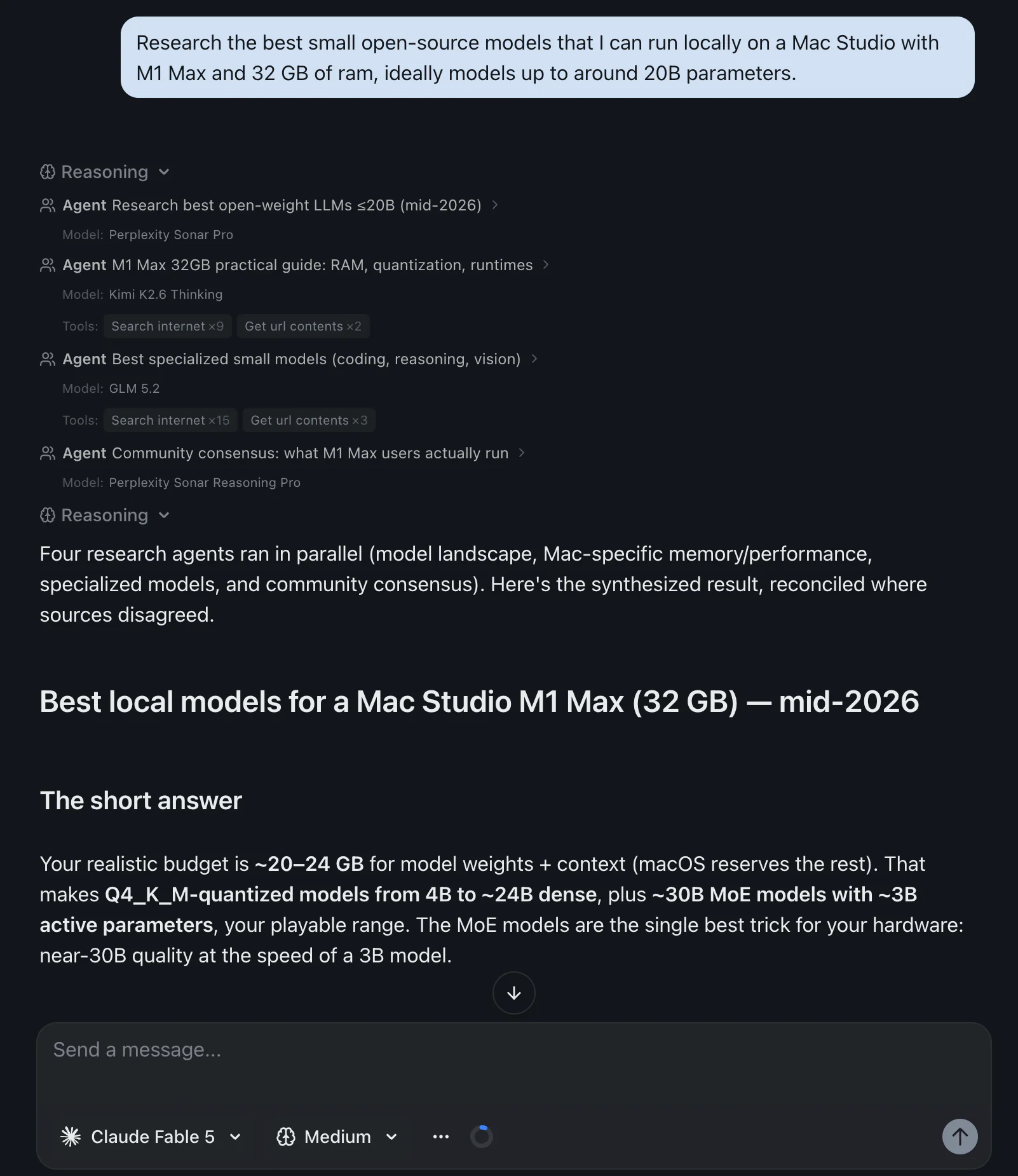
None of those need a person until the moment a decision does. And when a task is genuinely heavy — research the entire competitive landscape, not just three named rivals — the same workspace can split it across several AI agents working in parallel, each on a different model, then hand back one combined answer. That's not only faster; done right it's cheaper than making one expensive model grind through the whole thing alone, which I metered end to end in how much AI agents actually cost to run.
It Has to Live Where Your Work Does
A model in a browser tab is a demo. A model wired into the tools your team already lives in is infrastructure — and it's the line most "best AI" lists never cross. izzedo connects to 50+ business tools — Notion, Google Drive, Gmail, Google Sheets, Airtable, Calendar, Confluence and more — so the AI reads from and writes to the systems your work already sits in, instead of becoming one more place to copy-paste. Every assistant sells some version of this now, and the directories are enormous; what differs is which plan reaches them, which countries they work in, and what they're allowed to change once connected. I compared all six vendors' own documentation in the connectors guide.
The output side matters just as much. Business AI that can only talk back to you in a chat window creates work; the useful kind produces the artifact. izzedo generates finished PDFs, Word docs, Excel sheets and PowerPoint decks, builds charts from your numbers, and turns a project's files into that searchable knowledge base — so "draft the client report" ends in a document you can send, not a wall of text you still have to format.
One AI Tool or Many?
So how should a business actually buy this? There are three common routes, and only one of them ages well.
Route one: standardize on a single vendor. Give everyone one company's AI and be done. It's the simplest to administer, and for a small team with one dominant use case it's genuinely fine. The cost shows up later: you've locked every function to one model's strengths, so your marketers, your analysts and your support team all use the tool that's best at one of those jobs and merely okay at the rest — and if that vendor has a bad week, so does your whole company.
Route two: let every team expense its own. Marketing buys ChatGPT, research buys Perplexity, the writers want Claude, someone's trialing Gemini. Now each function has the right tool — and you're paying for four or five separate subscriptions per person who needs more than one, with no shared context between them, no admin oversight, and a quiet sprawl of "shadow AI" logins that IT can't see. The bill and the security surface both balloon.
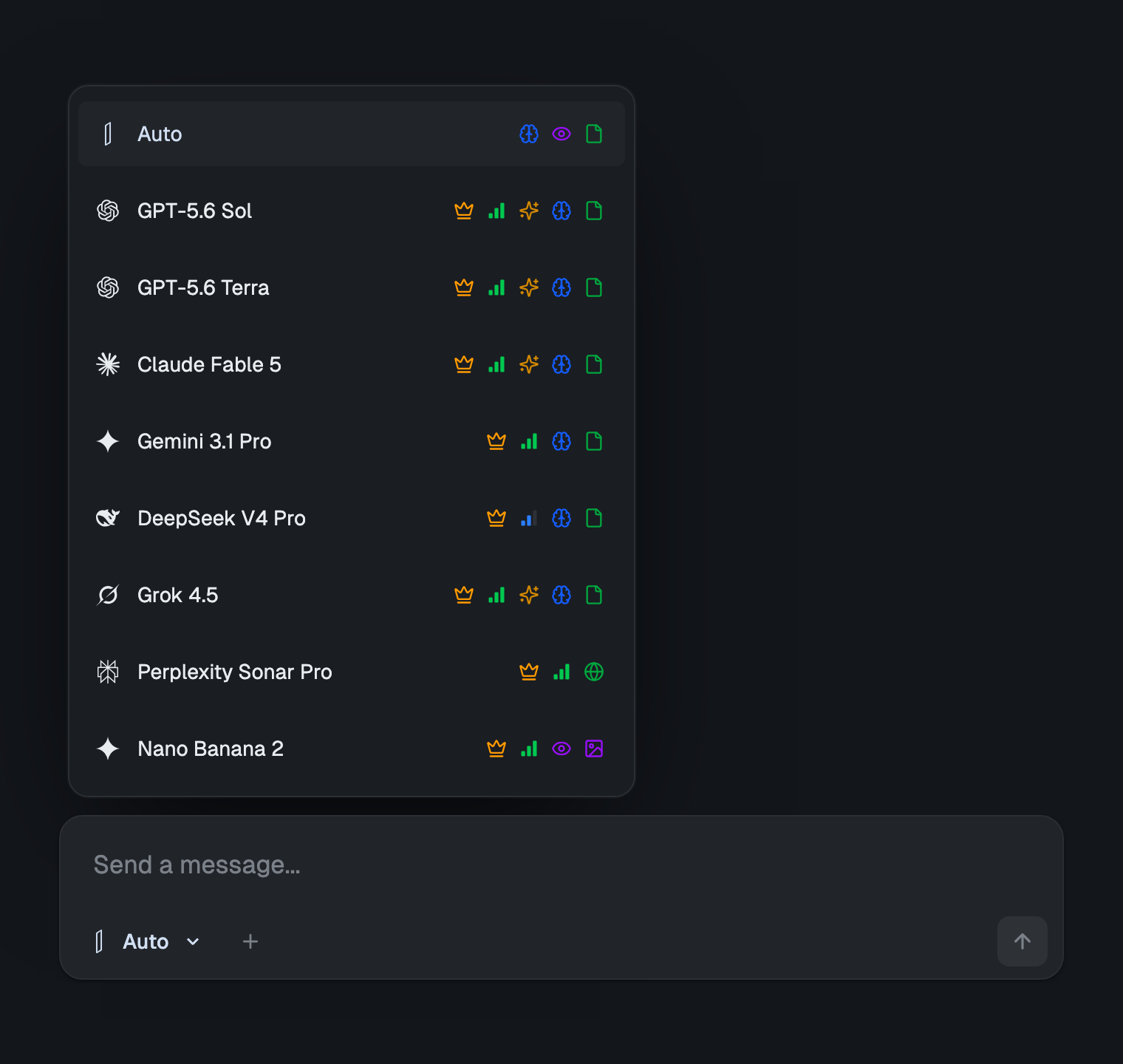
Route three: one multi-model workspace. Every model in a single place, so each function reaches for the right one; shared projects so context, prompts and knowledge travel with the team; one admin surface; one bill. That's the shape izzedo is built around — and the same model picker your team uses to switch tools mid-task is what an automation or an agent draws its lineup from too.
Worth knowing before you shop route three: most platforms in this category are sold per seat with an enterprise floor underneath them, so the right pick swings hard on how many people will genuinely use it. Comparing the team AI platforms by headcount is the fastest way to rule out the ones built for a company ten times your size. The other common shape is a workspace credit pool with unlimited seats, which sounds generous until you divide it — that math is worked through here, along with what happens when a platform narrows to a single department.
What It Costs — and How to Start Small
Route two is where the money quietly leaks, and it's worth doing the arithmetic. A single person who needs the full lineup — ChatGPT, Claude, Gemini and Perplexity at $20 each and Grok at $30, with DeepSeek free on the consumer side — is looking at about $110/month, and that's per head. Multiply by a team and "a few AI subscriptions" becomes a real line item for tools that each sit idle most of the day.
A multi-model workspace collapses that. izzedo chat puts the same lineup behind one flat bill from $6/month for an individual, with a free plan that needs no credit card to get started; teams get shared-workspace pricing with roles, management and project sharing on top. (One honest note on the plans: they're a flat monthly bill with no points or credits to ration — fair use runs quietly in the background on a short rolling window and a weekly pool rather than a fixed message count, so a sustained heavy week can reach a ceiling, and the current numbers live on the pricing page.) DeepSeek's free tier means the price-sensitive corner of the lineup stays genuinely free, too.
Rollout is the easy part, because you don't have to commit the company on day one. Start on the free plan with one project and one real workflow — a weekly report, a research task, a support-draft assistant grounded in your docs. Add an automation once you trust it. Bring in a second person when it's clearly earning its keep. The tool scales from one curious employee to a whole team without a migration — which is the opposite of how the expense-it-yourself route ends.
The Bottom Line
The best AI for business in 2026 isn't a model you pick once — it's a lineup you match to the job: ChatGPT for range and marketing, Perplexity for researched facts, Claude for writing that carries weight, Gemini for the documents nobody wants to read, and a free option like DeepSeek in the mix for the price-sensitive work. What turns that lineup from a browser full of tabs into something a business can run on is the wiring around it — automations that work while you sleep, integrations into the tools you already use, and one bill instead of one per vendor per head. And the habit that protects you where it matters most: before a number or a claim leaves the building, run it past a second model. The disagreement is the warning you were looking for.
Want every model your team needs — plus the automations and integrations to put them to work — in one workspace on one bill? Try izzedo chat free — no credit card required.
Frequently asked questions
What is the best AI for business?
There's no single winner, because a business does many different jobs. ChatGPT is the best all-rounder for marketing and everyday work, Perplexity for researched facts with sources, Claude for reports and careful writing, and Gemini for long documents and data. The most cost-effective setup is one multi-model workspace that gives every team the right model for its job on a single bill, rather than a separate subscription per tool per person.
What are the best AI tools for business?
The most useful are the frontier chat models — ChatGPT, Claude, Gemini, Perplexity, Grok and DeepSeek — matched to each function, plus the tooling that puts them to work: automations that run recurring tasks on a schedule, integrations into Notion, Google Drive, Gmail and 50+ other systems, and document generation for PDFs, Word, Excel and slides. A workspace like izzedo chat bundles all of that, so you manage one tool instead of ten.
What is the best free AI for business?
DeepSeek is the strongest genuinely-free option, giving away frontier-grade reasoning at no cost, and ChatGPT and Gemini have capable free tiers for everyday work. For a business that wants several models plus automations and integrations without a credit card, izzedo chat has a free plan; the paid plans start at $6/month if you outgrow it.
Can AI be connected to business tools like Notion or Google Drive?
Yes. izzedo chat integrates with 50+ business tools — including Notion, Google Drive, Gmail, Google Sheets, Airtable, Calendar and Confluence — so the AI can read from and write to the systems your team already uses, and automations can act on that data on a schedule instead of you copy-pasting between tabs.
Should a business use more than one AI model?
For anything beyond a single narrow use case, yes. Different models lead at different jobs — research, writing, long documents, everyday reasoning — so standardizing on one means most of your teams use a tool that's merely okay at their work. Running several models in one workspace lets each function use the best fit, and lets you check important outputs against a second model, which catches the confident mistakes a single model won't flag.
How much does AI cost for a business?
Bought separately, the major models run about $110/month per person for the full lineup ($20 each for ChatGPT, Claude, Gemini and Perplexity and $30 for Grok — DeepSeek's consumer app is free), multiplied across every employee who needs more than one. A multi-model workspace is far cheaper: izzedo chat starts at $6/month per individual and offers team pricing with shared projects and roles, replacing several per-seat subscriptions with one bill.
Ready to try multi-model AI workflows?
Access GPT, Claude, Gemini, Perplexity, and more — all in one place.
Start for Free →