Best Juma Alternatives in 2026: For Everyone Team-GPT Left Behind
Team-GPT became Juma in November 2025, and Juma is built for marketers — the name is partly an acronym for JUst MArketing. If you adopted it for cross-functional work, the product moved. Here's what to use instead, and how its credit pool actually divides.
Two very different people search for Juma alternatives, and they need opposite answers.
The first one used Team-GPT. It was a general AI workspace — shared projects, several models, whatever the team happened to be working on. Then on 19 November 2025 it became Juma, and Juma is for marketers. Not "also good for marketers": the name is partly an acronym for JUst MArketing, and the company has been unusually direct that this was a narrowing rather than an expansion.
The second is a marketer — precisely the buyer Juma now wants — who has looked at what 5,000 credits actually buys and wants to know what else is out there.
This guide answers both, because the honest answer splits cleanly along that line. I'll be specific about what happened in the rebrand, show the credit arithmetic with Juma's own published numbers, and say plainly which of the two groups izzedo chat is for — which is one of them, not both.
Every figure below came off the vendor's own pricing or documentation pages on 5 August 2026. Credit-based products re-price and re-band without much announcement, so check the live page before committing to anything.
What Happened to Team-GPT
The rename landed on 19 November 2025. "Juma" is Swahili and Arabic for Friday — the day of gathering — with the marketing pun sitting underneath it.
Credit where it's due on the mechanics: this was a clean transition. Workspaces, projects, teams and stored context all stayed put, and old logins redirect to juma.ai. Nothing was deleted, nobody was migrated into a worse plan, and on the day itself the product still did what it did the week before.
What changed is the centre of gravity. The product now leads with 700+ pre-built marketing Flows, a marketing Superagent, Brand Voice training, and connectors that pull live data out of Google Ads, Meta Ads, GA4 and Search Console. The published target user is marketing agencies first, in-house B2B marketing teams second, and solo founder-marketers third. Operations, IT, finance, support and research don't appear on that list at all.
That's a legitimate strategy, and quite possibly a smart one — a vertical product that goes deep beats a horizontal one that goes wide, and Juma's published customer list runs to names like Salesforce, Maersk and Johns Hopkins, so it's clearly working on its own terms.
But if you brought Team-GPT in as your company's general AI workspace, you are now a tertiary user of a product whose core you used to be. Nothing broke. The product simply started building for somebody else, and roadmaps compound.
What Juma Is Now, and What It's Genuinely Good At
Worth being fair here, because a lot of "alternatives" posts skip straight past the part where the incumbent is good.
- Flows — 700+ pre-built workflows across content, paid media, SEO, social, analytics and strategy, producing finished assets rather than chat suggestions. Run the same one across ten client accounts.
- Superagent — an autonomous agent that plans and executes a whole workflow, with human review gates before anything ships.
- Projects, persistent knowledge and Brand Voice — brand guidelines and reference documents loaded once, then applied automatically across every chat and Flow in that project.
- Pages — an AI-native document editor for working paragraph by paragraph alongside the model.
- Models — Claude, GPT, Gemini and Perplexity, with automatic model selection per task and bring-your-own-key on the higher tiers.
- Integrations — 40+ direct connectors, plus n8n embedded for roughly a thousand more.
- Compliance — SOC 2 Type II, ISO 27001, GDPR, HIPAA, AES-256 encryption, zero data retention and audit logs, included on every plan, free one included.
That last point deserves emphasis, because it's rare. Most products in this category hold certification behind an enterprise contract and a sales call. Juma ships it at $0. If a compliance checklist is what's blocking you, that's a genuinely strong hand.
And if your work is marketing production, the Flow library is very hard to beat with anything general-purpose. A generic AI workspace lets you build a workflow that turns GA4 data into a report. Juma already has one, and 699 others.
The Credit Pool Is the Whole Pricing Story
| Plan | Price | What you get |
|---|---|---|
| Free | $0 | 300 credits · unlimited seats · all 700+ Flows, all models, all integrations |
| Pro (Starter) | from $49 / month | 5,000 credits / month · unlimited seats · top-up packs + auto-recharge |
| Pro (higher bands) | Custom | The credit ladder runs up toward 100,000 credits / month |
| Enterprise | Custom | SSO/SAML · private cloud (AWS, Azure, GCP) · admin controls · DPA · SLA |
Now the other half of the equation — what a credit actually buys, using Juma's own published effort bands:
| Kind of work | Cost |
|---|---|
| A single task — a subject-line rewrite, a quick answer | 1–100 credits |
| A marketing Flow — an SEO article, a carousel, a campaign concept | 100–500 credits |
| A multi-system Flow — competitor research into a social post, GA4 into a report | 500+ credits |
Put the two tables together and the picture sharpens fast. $49 buys 5,000 credits a month. A Flow — the thing you're there for — costs 100 to 500 of them. That's ten to fifty finished Flows a month for the entire workspace. Lean on the multi-system Flows and you're under ten.
Here's the part that catches people. Seats are unlimited on every plan, and credits are pooled at the workspace level so the whole team draws down one balance. Those two facts are the same sentence read from opposite ends: adding a person costs nothing, and gets you nothing. Ten marketers on Pro Starter share ten to fifty Flows between them. Twenty marketers share the same ten to fifty.
So your real licence isn't the seat count — it's the pool. And a pool has no per-person ceiling in it, which means the new hire working through the Flow library on a Tuesday afternoon is spending from the same balance as the campaign that has to ship on Thursday. Most metered products at least fail one user at a time. This one fails as a commons.
Two things Juma does better than most credit systems, though, and they're worth saying plainly. A Flow that fails costs zero credits — you're billed for delivered work rather than attempts, which is the fair version of this model and not the common one. And credits are priced by the size of the deliverable rather than by tokens consumed, so your number doesn't drift because a model got chattier this quarter.
The detail to check before you plan around it: Juma's documentation says the monthly allowance resets on your billing cycle while purchased top-up packs roll over. A quiet month banks nothing toward a busy one, but credits you actually bought stay yours.
The Question That Decides Which List You Need
Juma's unit of value is a marketing deliverable — a carousel, a campaign, an article, a report. That's a deliberate and rather clever choice, because it makes an AI bill legible to a marketing manager in a way that token counts never will. It also means the product is economical exactly to the degree that your work looks like that.
So before the shortlist, do one thing: write down the ten things your team actually asked AI to do last month.
If eight of them are content, campaign or reporting deliverables, you're in Juma's market. Your alternatives are the other marketing AI platforms, and the comparison below that matters most is Jasper and Copy.ai.
If eight of them are the other stuff — a competitor teardown, a pricing model, a support macro rewritten, a spec pulled apart, a spreadsheet interrogated, a policy drafted — then you're the Team-GPT user the rebrand moved past. No marketing platform is going to serve that better than Juma already does. What you need is a general multi-model workspace back.
The 6 Best Juma Alternatives in 2026
| Alternative | Best for | What it costs |
|---|---|---|
| izzedo chat | The cross-functional work Team-GPT used to cover — every model, capacity per person | Free plan (no card) · $6/mo individual · $15/user/mo team |
| Jasper | Marketing teams wanting the long-established brand-voice content platform | $69/seat/mo, $59 billed annually; Business custom, 12-month minimum |
| Copy.ai | GTM teams automating workflows across sales and marketing data | $29/mo for a 5-seat chat plan; workflow tiers begin at $1,000/mo |
| ChatGPT Business | Standardising a mixed-function team on a single vendor | ~$25/seat/mo, ~$20 billed annually, 2-seat minimum |
| Notion AI | Teams whose documents and shared knowledge already live in Notion | Bundled into Business, ~$20/user/mo billed annually |
| n8n (self-built) | Technical teams that want the automation without the workspace | Free self-hosted, or paid cloud tiers |
Some notes that the table can't carry:
- Jasper is the incumbent Juma is challenging, and it makes the opposite trade: per-seat pricing, so cost is predictable per person and climbs with headcount instead of usage. Five marketers at $69 a seat is $345 a month against Juma's $49 pool. Whether that's worse depends entirely on how much you run — which is the same question as before, asked from the other side.
- Copy.ai is the closest thing to Juma's workflow idea, and it has the steepest cliff on this list. $29 a month for a five-seat chat plan is inexpensive; the first tier carrying real workflow credits is $1,000 a month. There is very little in between, so model which side of that gap you're on before you start.
- ChatGPT Business is worth naming mainly because it's where a lot of ex-Team-GPT teams drift by default. It's single-vendor, so it quietly removes multi-model access — and for many teams, having more than one model was the reason they were on Team-GPT rather than on ChatGPT in the first place. If you have decided one model is genuinely enough, the wider single-vendor field is worth a look first.
- Notion AI is the sleeper for the Team-GPT refugee, because a good share of what Team-GPT did was hold shared context over documents. Note the change, though: the standalone AI add-on was retired in May 2025, so AI now arrives bundled with the Business plan, and Custom Agents are metered separately at $10 per 1,000 credits. You end up back in a credit system — just a different one.
- n8n is already inside Juma, which is the tell. If your team is technical and the Flows are the only part you want, you can build them directly on n8n against your own API keys. Free as software, in the way that things are free when you supply the hosting, the maintenance and the person who owns it.
- One omission here is deliberate: there's no second credit-pooled marketing workspace on the list. They exist, but they reproduce the exact mechanic that sends most people looking in the first place, so they'd pad the list without answering the question.
If Team-GPT Was Your Cross-Functional Tool
izzedo chat is built for the brief Team-GPT used to hold — one workspace, many models, whatever the team happens to be working on this week — and it sells to individuals and small teams, which is where the gap opened up.
One login covers the models people otherwise bounce between: ChatGPT, Claude, Gemini, Grok, Perplexity Sonar, DeepSeek, Qwen and Llama, plus image models. You can change model in the middle of a conversation without restating any of the context, which is the practical reason to have more than one in the first place.
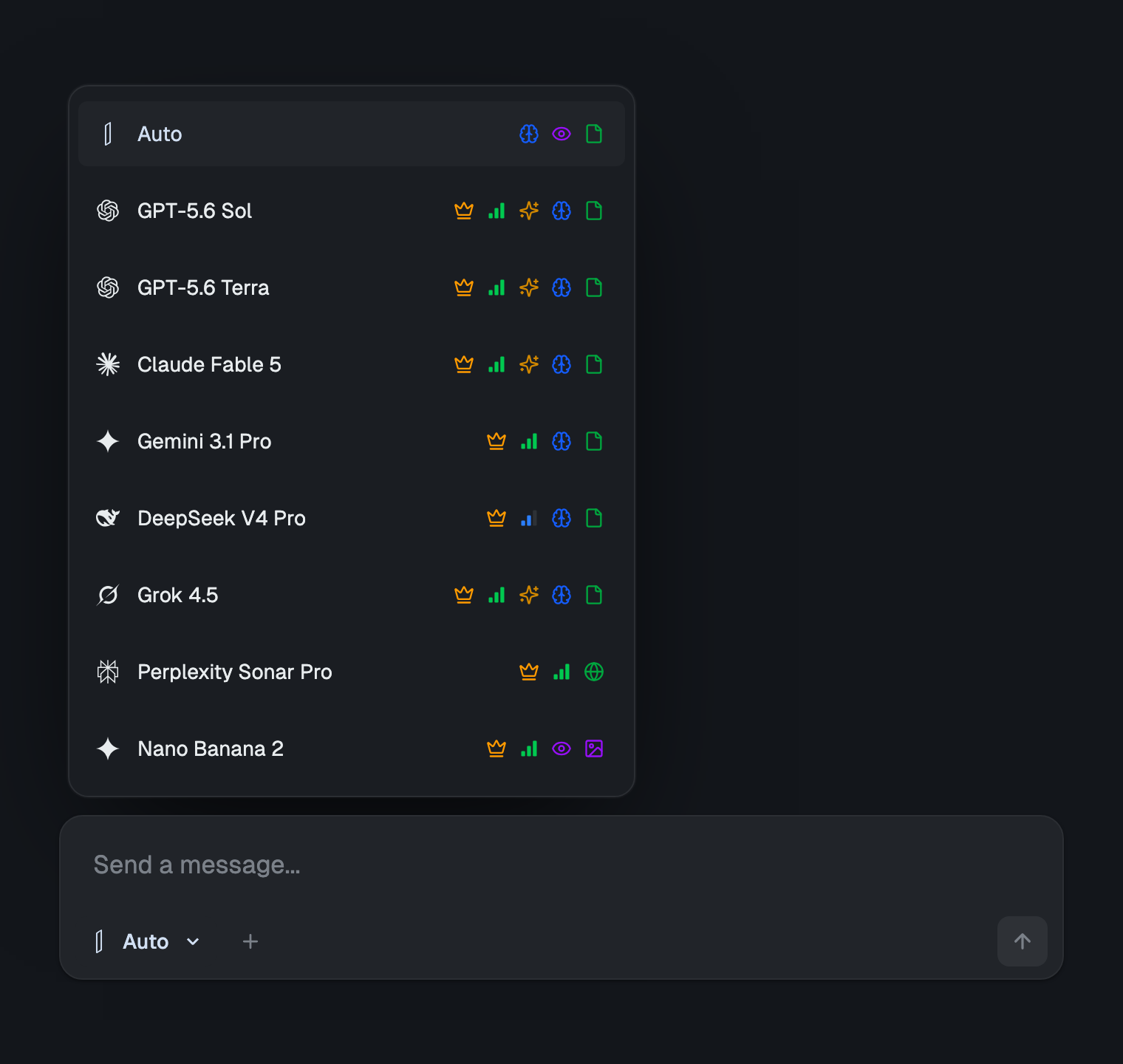
The workspace around the chat maps closely onto what you were using before:
- Projects, folders and project-level system prompts — the direct descendant of shared project context, minus the assumption that a project is a campaign. Set the instructions once and every chat inside inherits them, on any model.
- A knowledge base — load the documents in once and ask questions across all of them, instead of re-pasting context into each new chat.
- Automations — recurring tasks per project on an hourly, daily, weekly or weekday schedule, each with its own model and integrations. Closest thing here in spirit to Flows, with the difference that you write them for your own work rather than choosing from a marketing library.
- 50+ integrations — Notion, Google Drive, Gmail, Google Sheets, Airtable, Confluence and more, so the model reads from and writes to the tools already in use.
- Multiple Model Opinions — one question to several models, answers side by side. The place they disagree is the useful part.
- Parallel Agents — one model orchestrates several agents at once, each running on whichever model suits its slice of the job, then merges the findings. There's a full cost breakdown of working this way if you want the arithmetic.
The pricing difference matters more than any single feature on that list: izzedo's allowance attaches to the account, not to the workspace. A teammate joining brings their own capacity rather than drawing down yours. That's the precise inversion of a pooled balance, and it's why teams of mixed-intensity users stop quietly policing each other's usage.
The numbers: a free plan with no credit card, every model unlocked at $6/month for individuals, and team plans at $15/user/month, or $12/user/month billed annually. For scale, buying ChatGPT, Claude, Gemini, Perplexity and Grok separately runs about $110/month, with DeepSeek free — the arithmetic behind auditing what you already pay for.
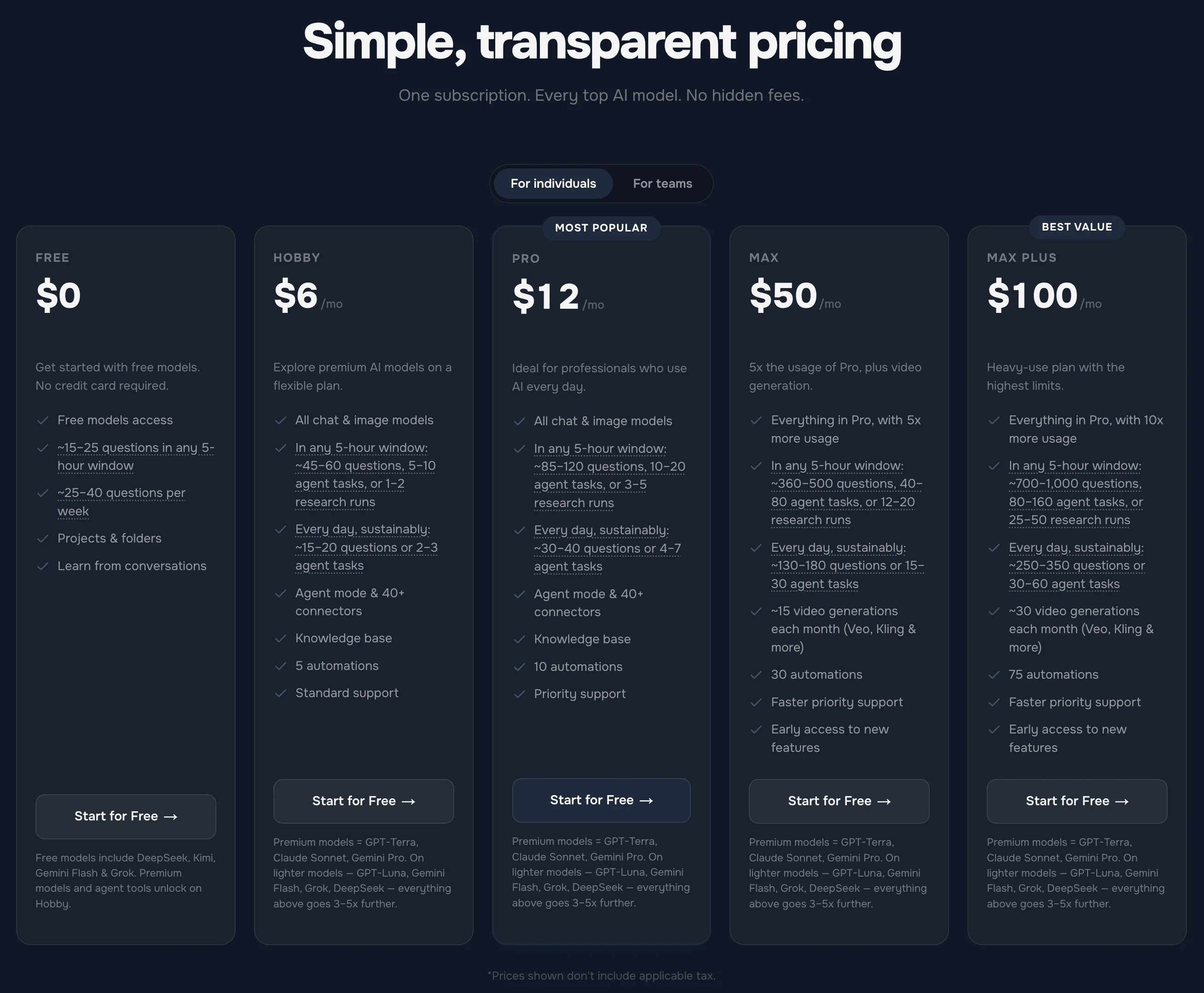
Since this post has been picky about metering, here's izzedo's version, stated straight. Nobody runs frontier models for free, so every product in this market draws a line somewhere — the only question is whether you have to do arithmetic about it. izzedo has no credits, no top-ups and no balance on screen. Fair use is handled in the background on a short rolling window that clears within hours, with a weekly pool behind it, so an unusually heavy afternoon means a brief wait and an unusually heavy week a longer one — either way a wait rather than a purchase. Current plan sizes live on the pricing page, and the free plan covers the free models with no card.
And the honest gap, since Juma sets a high bar on this one: izzedo is GDPR compliant, does not train on your inputs, passes prompts through with zero data retention, and lets you permanently delete your history. What it does not carry is Juma's certification stack — SOC 2 Type II, ISO 27001, HIPAA — or SSO. If a signed certificate is a hard procurement requirement rather than a preference, that's a real difference, and it points at Juma.
When Juma Is Simply the Right Answer
Not as a throat-clearing move before the pitch — these are the cases where shopping further wastes a week.
- Your team really is a marketing team or agency, and the work genuinely is campaigns, content and reporting. The Flow library is the product, and nothing general-purpose replicates 700 of them.
- You have a lot of light users. Unlimited seats against a shared pool is the cheapest shape in this whole category for a large team with modest per-head usage. Twenty occasional users on a $49 pool is a very good deal, and per-seat pricing punishes exactly that shape.
- Brand voice consistency across many accounts is a recurring, expensive problem for you.
- You need live ad and analytics data in the work — Google Ads, Meta Ads, GA4, Search Console — rather than pasted exports.
- You need SOC 2, ISO 27001 or HIPAA without being in a position to buy an enterprise contract. Juma including all three at every tier is unusual enough to decide the question on its own.
If three or more of those land, stay. The rebrand aimed this product at you specifically, and that focus is worth more than breadth you wouldn't switch on.
Working Out Which Side You're On
- List last month's real requests, not your job description. Ten actual things the team asked AI to do. That list settles more than any feature comparison will.
- Price them in credits using Juma's own bands — 1–100 for a single task, 100–500 for a Flow, 500+ for a multi-system Flow. Total it against 5,000 and see how much room is left over.
- Ask who spent the pool. In a shared balance it's usually one or two people. That answer tells you whether you need more credits or a different pricing shape entirely.
- Split the two jobs deliberately. Marketing production and general knowledge work aren't the same problem, and no rule says one tool has to cover both. Running a marketing platform alongside a flat general workspace is often cheaper than stretching either one to do the other's job.
- Give the non-marketing half a real week somewhere else. Not test prompts — the actual competitor teardown, the actual spreadsheet, with your own documents loaded. Then deliberately put two models on the same question. If the second one changes your answer, multi-model was the requirement all along; if it doesn't, buy the cheapest single vendor and stop thinking about it. The multi-model workflow guide maps which model tends to suit which job.
The Short Version
Juma is a better product than Team-GPT was, for a narrower group of people.
If you're in that group, you're not really looking for an alternative — you're looking for a sanity check on credits. Do the Flow math against your actual monthly output, compare it honestly against Jasper's per-seat model and Copy.ai's workflow tiers, and remember that the pool is shared no matter how many seats you add.
If you're not in that group, then "Juma alternative" was never quite the right search. What you want is what Team-GPT was before November: a workspace with every model in it, organised around projects, indifferent to which department you happen to sit in. That product still exists. It just isn't the one your old login redirects to. It's the same pattern as leaving a points-metered aggregator or bouncing off an enterprise seat floor — the tool wasn't bad, the shape stopped matching the buyer.
Starting free, $6 a month for every model, and an allowance that belongs to you rather than to the room.
Need the workspace Team-GPT used to be — every model, any kind of work, no shared credit pool? Try izzedo chat for free — no credit card required.
Frequently asked questions
Is Juma the same as Team-GPT?
Yes — Team-GPT renamed itself Juma on 19 November 2025. Existing workspaces, projects, teams and context carried over, and old logins redirect to juma.ai. What changed is the scope. Juma is built for marketing teams and agencies; the name is partly an acronym for JU-st MA-rketing. The product now centres on 700+ pre-built marketing Flows, Brand Voice training and connectors for Google Ads, Meta Ads, GA4 and HubSpot. If you originally adopted Team-GPT as a general, cross-functional AI workspace, nothing was taken away from you — but the roadmap is now aimed at a different user.
What is the best Juma alternative?
It depends on whether your work is marketing. If it is, your real shortlist is Jasper and Copy.ai, and the deciding factor is per-seat pricing versus a shared credit pool. If you're one of the cross-functional Team-GPT users the rebrand moved past, you want a general multi-model workspace instead — izzedo chat is the closest match to the original brief, with every leading model behind one login, a free plan, and usage that belongs to each account rather than a shared balance. Teams standardising on one vendor usually land on ChatGPT Business, and technical teams can build the Flows themselves on n8n.
How much does Juma cost?
As of August 2026, Juma's Free plan is $0 with 300 credits, unlimited seats, and access to all 700+ Flows, all models and all integrations. Pro starts at $49 per month for 5,000 credits, pooled at the workspace level, with top-up packs and auto-recharge; the credit ladder climbs toward 100,000 credits per month for higher-volume teams. Enterprise is custom-priced and adds SSO/SAML, private cloud deployment, admin controls, a DPA and an SLA. Seats are unlimited on every plan, including the free one, so what you're actually buying is credit volume rather than licences.
How many credits does a Juma Flow use?
Per Juma's own published effort bands: 1–100 credits for a single task such as a subject-line rewrite or a quick answer, 100–500 credits for a full marketing Flow such as an SEO article, a LinkedIn carousel or a campaign concept, and 500+ credits for multi-system Flows that cross tools — competitor research into a social post, or GA4 data into a report. That puts a 5,000-credit Pro plan at roughly 10 to 50 finished Flows a month for the entire workspace. Flows that fail cost zero credits.
Is there a free alternative to Juma?
Juma's own free plan is unusually generous — 300 credits, unlimited seats and no feature gating — so the question is usually about capacity rather than access. izzedo chat has a free plan with no credit card, covering the free models with an allowance sized to test a real multi-model workflow before paying anything. Self-hosted n8n is free as software if you want to build the workflows yourself, though you supply the hosting, the API keys and the person who maintains it.
Does izzedo use credits like Juma?
No — there are no credits, no shared balance and no prepaid top-up packs. izzedo is a flat monthly price with model usage included rather than metered on top. Fair use runs quietly in the background on a short rolling window with a weekly pool behind it, instead of a credit budget you spend down, so there is nothing to buy up front. The one thing that can move the bill is an optional usage-based setting, off by default, which charges after the fact for what you actually used past the pool, under a cap you set. The structural difference worth knowing: izzedo's usage allowance attaches to each account, while Juma's credits are pooled across the whole workspace.
Ready to try multi-model AI workflows?
Access GPT, Claude, Gemini, Perplexity, and more — all in one place.
Start for Free →