Gemini 4 Argon Is Out: Which Google Plans Get It and What It Costs
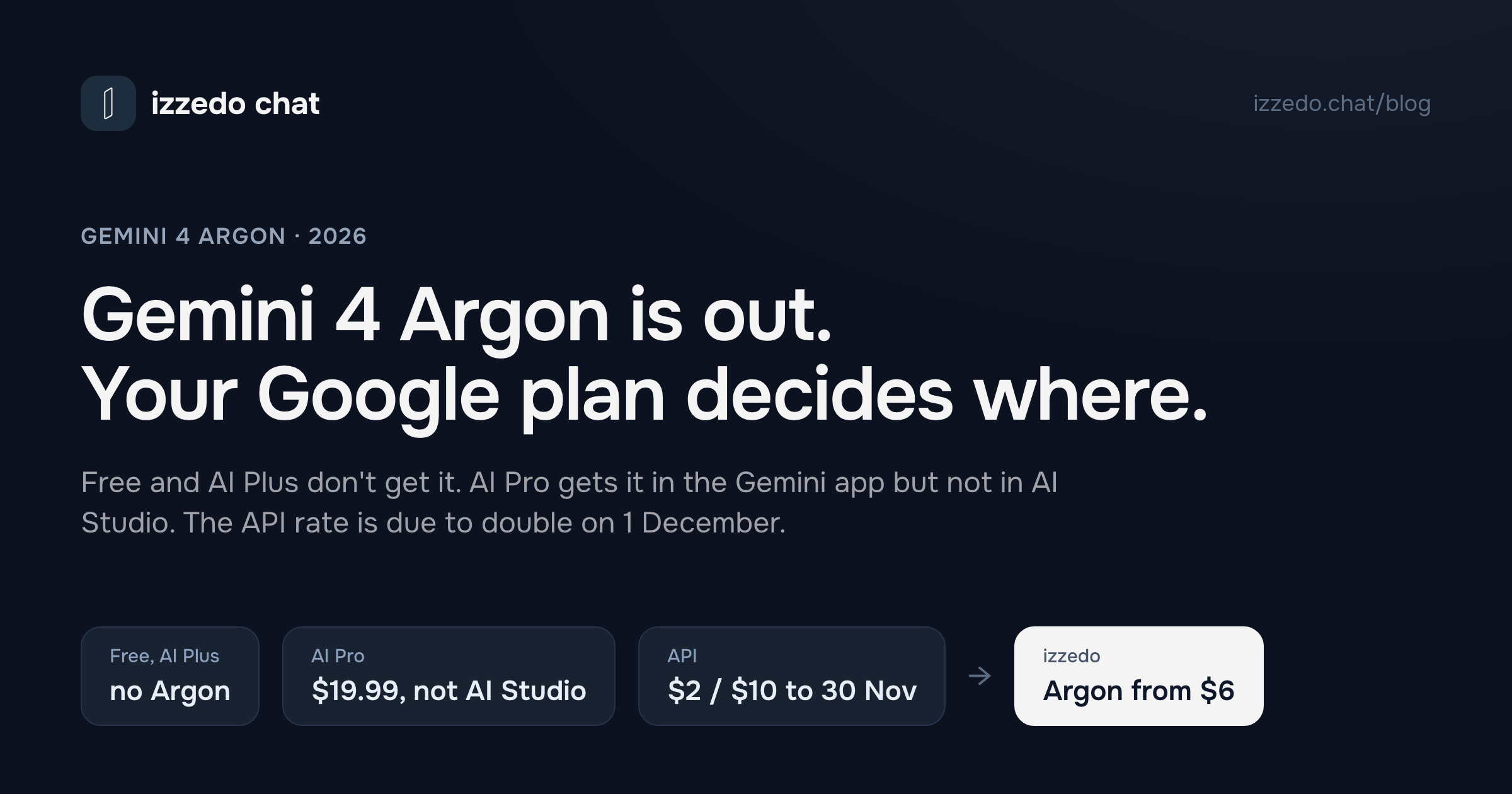
Google opened Gemini 4 Argon to paying users on 13 October. In the Gemini app it takes Google AI Pro at $19.99 or Ultra, the free plan and AI Plus don't get it, and AI Pro doesn't unlock it in AI Studio. On the API it costs $2 and $10 per million tokens until 30 November, and Google's pricing page doubles both on 1 December.
Google released Gemini 4 Argon to paying users on 13 October 2026, two weeks after announcing it as its new frontier model. It's the first model in the Gemini 4 family, and on Artificial Analysis's independent index it ties OpenAI's GPT-6 Astra.
Where you can use it depends on which Google plan you have. In the Gemini app it needs Google AI Pro at $19.99 a month or AI Ultra, and the free plan and the $4.99 AI Plus plan don't get it. AI Pro unlocks it in the app and in Google Search, but not in Google AI Studio or the Antigravity coding tool. And the API price Google launched with is introductory. Its own pricing page doubles it on 1 December.
I read Google's three launch posts, its US plan page, the Gemini help centre's articles on models and limits, the Gemini API pricing page and Artificial Analysis's model pages on 13 October 2026. Everything below comes from those.
The Short Answer
| Where | What you need | Price |
|---|---|---|
| Gemini app | Google AI Pro or AI Ultra | $19.99 a month. Ultra is $99.99 or $199.99 |
| AI Mode in Google Search | Google AI Pro or AI Ultra | The same plans |
| Google AI Studio | A paid Gemini API key, or AI Ultra | Per token, or Ultra |
| Google Antigravity | AI Ultra | From $99.99 a month |
| Gemini API | The paid tier | $2 input and $10 output per million tokens until 30 November, then $4 and $20 |
| izzedo chat | Any paid plan | From $6 a month |
There's no free way in for most people. Google's plan page lists 3.5 Flash-Lite as the free plan's model and 3.6 Flash as AI Plus's, and its API pricing page marks Argon "Not available" on the free tier. The two exceptions are application programmes, one for scientists and one for security teams, and I've put them at the end of the AI Pro section.
What Argon Is
Google pitches Argon at long, multi-step work, and its launch posts keep coming back to three kinds of it: software engineering, professional work such as legal and finance, and cyber defence. On the API it can now write up to a million tokens in one response. Google calls this a "1M unified input-output token limit", so the prompt and the answer share that million. The previous output limit was 64,000 tokens.
The Gemini app's announcement says more about everyday use. Google says Argon "answers questions more directly with less hedging, doesn't repeat itself more than necessary, and skips clichés", and that on longer tasks it reports its progress more often. That's Google's description, and I haven't measured it. Hedging and repetition are the two habits I'd most like gone from chat models, though, so it's the first thing I'd test on my own prompts.
Google's benchmark claims are strong. It reports 77.9% on DeepSWE v1.1, a test of long software engineering tasks, first place on the Vals Index, which weights finance, coding, legal and tax work by their share of US GDP, and first place on Zapier's AutomationBench at 51.3%. Those are Google's own results. The independent scores are further down.
Who Gets It in the Gemini App
Google's help article on Gemini's models sets out which plans see Argon in the picker:
| Plan | Price | Argon in chat | Argon in Tasks |
|---|---|---|---|
| No plan | $0 | No | No |
| Google AI Plus | $4.99 | No | No |
| Google AI Pro | $19.99 | Yes | Yes |
| Google AI Ultra | $99.99 or $199.99 | Yes | Yes |
Tasks is Gemini's mode for handing it a whole job, and Google says it "can work for you even when you're not at your computer". On a work or school account, Google says the models you get depend on your organisation's Workspace licence.
Google publishes no Argon allowance. Gemini meters compute rather than counting prompts. Your limit refreshes every five hours until you hit a weekly cap, AI Pro gets four times the free plan's allowance, and Ultra gets five or twenty times AI Pro's. The models article adds that "more advanced models and higher thinking levels require more of your usage", so Argon on High uses more of it than any other choice in the picker. When a paid plan runs out, the conversation carries on with Flash-Lite until the limit refreshes.
One setting is worth changing before you judge it. Every model in Gemini's picker takes a thinking level of Low, Medium or High, and Google says it defaults to Low if you don't pick one. Artificial Analysis tested Argon on High, so a hard problem on the default setting isn't a fair test of the model.
The AI Pro Catch: Not in AI Studio or Antigravity
AI Pro is the cheapest Google plan with Argon. It covers the Gemini app and AI Mode in Search, and it stops short of Google's developer tools. The Gemini API pricing page puts it plainly: "Gemini 4 Argon is not available on the Free tier or on the Google AI Pro plan." To use Argon in Google AI Studio, an AI Pro subscriber needs a paid API key, where every token is billed, or Ultra.
Antigravity is murkier. The AI Pro card on Google's plan page lists "entry rate limits to agent model in Google Antigravity", but the launch post names only Ultra subscribers as getting Argon there. If coding with Argon in Antigravity is the reason you'd upgrade, the plan Google names is Ultra, at $99.99 a month.
The two free routes both need an application. Google is offering 10,000 scientists Antigravity's highest usage tier free for six months, "subject to eligibility, capacity, and selection", with applications open now. And security teams can apply to the Fairwind Program, which gives trusted cyber defenders Argon without its cyber guardrails. Neither is meant for everyday users.
What It Costs on the API, Before and After 1 December
| Gemini API paid tier, per million tokens | Until 30 November 2026 | From 1 December 2026 |
|---|---|---|
| Input | $2.00 | $4.00 |
| Output, thinking tokens included | $10.00 | $20.00 |
| Cached input | $0.10 | $0.20 |
A few details sit under that table on Google's page. There's no free tier for Argon at all. Caching is implicit only, so Google applies the discount when a request repeats the start of an earlier one, and you can't set up a cache yourself. Grounding answers in Google Search comes with 5,000 free requests a month, shared across every Gemini 3 and newer model, and then costs $14 per 1,000. And on the paid tier, Google says your content isn't used to improve its products.
From 1 December, Argon's rates match the $4 and $20 that Artificial Analysis lists for Claude Opus 5.5. Google calls the launch price "introductory".
Nothing Google has announced changes the price for Gemini app subscribers. The $19.99 and $99.99 are plan prices, and the 1 December date is on the API pricing page, not the plan page.
How Argon Scores Next to the Other Frontier Models
For an outside view, Artificial Analysis puts every major model through the same ten evaluations and reports a score, the bill for the run and the number of tokens written. These figures are from each model's own page, read on 13 October:
| Model, at the setting tested | Intelligence Index | Cost per index task | Output tokens across the index |
|---|---|---|---|
| Claude Opus 5.5, max | 58 | $5.98 | 260M |
| Gemini 4 Argon, high | 53 | $1.99 | 110M |
| GPT-6 Astra, max | 53 | $3.26 | 60M |
| Grok 4.7, xhigh | 46 | $3.74 | 240M |
Argon ties Astra for about 61% of the cost. Astra is the more concise model, writing 60 million tokens to Argon's 110 million, but each of its tokens costs five times as much, $10 and $50 per million against $2 and $10.
Opus 5.5 still scores highest of the four. It costs three times as much per task as Argon and writes more than twice as many tokens.
The 1 December rise changes the comparison. Google's schedule doubles every Argon rate, so on the same test its cost per task would roughly double too, to about $4. That's my arithmetic, not Artificial Analysis's. If OpenAI's prices stay where they are, it would make Argon more expensive per task than Astra for the same score, though still cheaper than Opus 5.5.
One index doesn't settle which model is best for your work. Artificial Analysis's leans toward agentic tasks, research and reasoning, and the cost figures only matter if you pay by the token. In the app, what you pay is the plan. Which of the three big chatbots to use for which job, and what each $20 plan runs, is in Claude vs ChatGPT vs Gemini.
Should You Upgrade for Argon?
- You already pay for AI Pro or Ultra. It's in your picker now. Use it, on High, for the long jobs Google built it for, like the one in its own demo, where Argon "takes an unstructured folder full of project context and formats it into a clean proposal deck for a client". Keep Flash for quick questions, because Argon draws on the same allowance faster.
- You're on the free plan or AI Plus. $19.99 buys Argon and the rest of AI Pro, including Gemini inside Docs, Sheets and Slides, a 1 million token context window in the app and 5 TB of storage. If you work in Google's apps all day, that's a fair price. Grok vs Gemini goes through what each rung of Google's ladder buys.
- You build on the API. You'll need a paid key either way. Price your product on the December rates, not the launch ones.
- You mainly want to see how it compares with ChatGPT or Claude. You don't need a Google plan to do that.
Gemini's picker has changed three times since May. How Flash, Pro and the thinking levels fit together is in Gemini Thinking vs Pro, and the head-to-head with OpenAI is in Gemini vs ChatGPT.
Using Gemini 4 Argon in izzedo
izzedo chat has Gemini 4 Argon in its model picker on every paid plan, starting with Hobby at $6 a month. It sits in the same thread as GPT, Claude, Grok, DeepSeek and the rest, so you can draft with one model and hand the conversation to Argon to check it, or the other way round, and whichever model answers sees the whole thread. Argon takes the same three reasoning levels here, low, medium and high.
Argon uses up a plan's allowance faster than lighter models like Gemini Flash, and the pricing page shows how far each plan goes. The free plan doesn't include Argon, but it does include Gemini 3.8 Flash, the Flash that Google's plan page keeps for AI Pro and Ultra, and it needs no card.
The Bottom Line
Gemini 4 Argon is Google's top model and the first of Gemini 4. For most people it costs $19.99 a month through Google AI Pro, which gets it in the Gemini app and Search but not in AI Studio or Antigravity. The free plan and AI Plus don't have it. Developers pay $2 and $10 per million tokens until 30 November and, if Google keeps to its pricing page, twice that afterwards. That would turn Argon's best number on Artificial Analysis, matching GPT-6 Astra for much less per task, into a closer call. Before you buy a plan for it, try it on a real job next to the model you already use.
Want Gemini 4 Argon in the same thread as ChatGPT and Claude? It's on every paid izzedo chat plan, from $6 a month, and the free plan needs no card.
Topics
- gemini 4 argon
- gemini argon
- gemini 4
- gemini 4 argon pricing
Start on the free plan. Pay when you want the premium models.
Free
$0
Claude Haiku, Gemini Flash, Grok and more, with agent mode and 50+ connectors
Hobby
$6/mo
Every chat and image model
Pro
$12/mo
Higher limits, 400k context and more video models
Max
from $50/mo
5x or 10x Pro's usage, and every video model
Frequently asked questions
Is Gemini 4 Argon free?
No. Google's plan page gives the free Gemini plan 3.5 Flash-Lite and Google AI Plus 3.6 Flash, and the Gemini API pricing page marks Argon as not available on the free tier. In the Gemini app it needs Google AI Pro at $19.99 a month or Google AI Ultra. The only free routes are by application: Google is giving 10,000 selected scientists six months of Antigravity's highest usage tier, and vetted security teams can apply to its Fairwind Program.
When was Gemini 4 Argon released?
Google announced it on 30 September 2026 and first gave it to cyber defenders in its Fairwind Program. It became generally available on 13 October 2026 in the Gemini app and AI Mode in Search for Google AI Pro and Ultra subscribers, on the paid tier of the Gemini API, and in Google Antigravity for Ultra subscribers.
How much does Gemini 4 Argon cost on the API?
Google's pricing page lists $2 per million input tokens and $10 per million output tokens through 30 November 2026, with thinking tokens billed as output and cached input at $0.10. From 1 December 2026 the same page lists $4, $20 and $0.20. There is no free tier for Argon.
Can I use Gemini 4 Argon with Google AI Pro?
Yes, in the Gemini app and in AI Mode in Google Search. Not in Google AI Studio, where Google's pricing page says Argon isn't available on the Google AI Pro plan, so you need a paid API key or Ultra. Google's launch post also lists Argon in Antigravity for Ultra subscribers only.
Is there a Gemini 4 Pro or Gemini 4 Flash?
Not yet. Argon is the first Gemini 4 model, and Google's launch post says it is looking forward to bringing the rest of the Gemini 4 family, without naming models or dates. The Pro in the Gemini app's model picker is still 3.1 Pro, which Google's plan page lists alongside Argon on AI Pro and Ultra.
Is Gemini 4 Argon better than Claude Opus 5.5 or GPT-6 Astra?
On Artificial Analysis's Intelligence Index, Argon at its high setting scores 53, the same as GPT-6 Astra at max and below Claude Opus 5.5 at 58. It is the cheapest of the three to run at launch prices, at $1.99 per index task against $3.26 for Astra and $5.98 for Opus 5.5. If Google's 1 December price rise goes ahead, Argon's cost per task roughly doubles, which would put it above Astra's.