What Is the Smartest AI Right Now? The Rankings, and Which One Makes the Fewest Mistakes (2026)
Claude Fable 5.2 has the highest score on Artificial Analysis's Intelligence Index and knows the most facts. It also guesses wrong 59% of the time when it doesn't know the answer. Google's best Gemini 4 models score a little lower and say "I don't know" far more often. Here's what each ranking measures, what your app actually runs, and how to get fewer wrong answers.
The smartest AI right now, by the most-quoted measure, is Claude Fable 5.2. It's Anthropic's top model, and it scores 65 on Artificial Analysis's Intelligence Index. OpenAI's GPT-6.2 Astra and Google's Gemini 4 Neon come next at 62.
That isn't the same as the AI that makes the fewest mistakes. On Artificial Analysis's knowledge test, Fable 5.2 gets more questions right than any other model, 79 out of 100. When it doesn't know, though, it usually answers anyway. Of the questions it didn't get fully right, 59% got a wrong answer. The rest got a partial answer or an admission that it didn't know. Google's Gemini 4 models know less and admit it. At their most careful settings they give a wrong answer in 4% to 14% of those cases.
So "smartest" has at least three answers. There's the model with the highest test score, the one that knows the most facts, and the one least likely to make something up. They're different models, and the app you use may run none of them on the plan you pay for.
I read the rankings on 25 November 2026. They move every few weeks, so check the date on anything you read about this, mine included.
The Short Answer
| Question | Answer on 25 November 2026 | Measured by |
|---|---|---|
| Highest score on a broad intelligence test | Claude Fable 5.2 (65), then GPT-6.2 Astra and Gemini 4 Neon (62) | Artificial Analysis Intelligence Index |
| Most preferred by people in blind votes | Gemini 4 Carbon, then Gemini 4 Argon and Gemini 4 Neon | Arena text ranking |
| Answers the most factual questions correctly | Claude Fable 5.2 (79%) | AA-Omniscience accuracy |
| Least likely to guess when it doesn't know | Gemini 4 Carbon at Medium and Gemini 4 Argon at High (about 4%) | AA-Omniscience hallucination rate |
| Stays closest to a document you give it | Small models lead. Of the larger current models, DeepSeek V4.1 Flash (4.2%) and GPT-6 Sol (6.5%) | Vectara hallucination leaderboard |
If you use AI for facts you'll act on, like rates, rules, dates and what a document says, the third, fourth and fifth rows matter more than the first.
What Is the Smartest AI Right Now?
Two rankings get quoted most, and they disagree.
Artificial Analysis runs the same set of tests on every model and combines them into one Intelligence Index. The tests have right answers, so the score measures whether a model gets hard problems right. Most models are tested at several effort settings, and the table below uses each one's best.
Arena works the other way. People type a prompt, read two answers from models they can't see, and vote for the better one. After 9.2 million votes across 427 models, it ranks which answers people prefer. That rewards clear, well-made answers as much as correct ones.
| Model | Company | Intelligence Index (best setting) | Arena text rank |
|---|---|---|---|
| Claude Fable 5.2 | Anthropic | 65 | 8th |
| GPT-6.2 Astra | OpenAI | 62 | Not in the top 15 |
| Gemini 4 Neon | 62 | 3rd | |
| Gemini 4 Carbon | 60 | 1st | |
| Claude Opus 5.5 | Anthropic | 59 | 5th |
| Gemini 4 Argon | 51 | 2nd | |
| Grok 4.7 | xAI | 35 | Not in the top 15 |
Artificial Analysis read on 25 November, Arena's ranking dated 22 November.
Google, Anthropic and Meta hold every place in Arena's top 15. OpenAI's best model is second on Artificial Analysis and nowhere near Arena's top. Arena doesn't check whether an answer is true at all. Artificial Analysis does, in one of the nine tests behind its index, but the headline number blends that test in with the rest.
Smart Isn't the Same as Accurate
That test is AA-Omniscience, and Artificial Analysis publishes its results on their own. It asks 3,000 factual questions across six areas: business, health, law, humanities and social sciences, science, engineering and maths, and software. Each answer counts as right, wrong, partly right or not attempted. Saying "I don't know" costs nothing. A wrong guess counts against the score.
Two numbers come out of it. Accuracy is the share of all questions a model gets right. The hallucination rate looks only at the questions it didn't get right and asks how often it answered wrongly instead of admitting it didn't know. A model with a 4% rate rarely bluffs. One with 90% almost always does.
| Model and setting | Questions answered correctly | Wrong answer when it didn't know | Net score (-100 to 100) |
|---|---|---|---|
| Claude Fable 5.2, Max | 79% | 59% | 67 |
| Gemini 4 Neon, Xhigh | 60% | 14% | 55 |
| Gemini 4 Carbon, High | 58% | 11% | 54 |
| GPT-6.2 Astra, Max | 69% | 59% | 50 |
| Claude Opus 5.5, Max | 66% | 50% | 48 |
| Gemini 4 Hydrogen, Xhigh | 50% | 8% | 46 |
| Gemini 4 Argon, High | 48% | 4% | 46 |
| GPT-6.2 Sol, Max | 62% | 55% | 40 |
| Grok 4.7, Xhigh | 43% | 20% | 31 |
| Claude Sonnet 5.5, Max | 51% | 43% | 30 |
| DeepSeek V4.1 Flash, Max | 40% | 64% | 1 |
| GPT-6 Luna, Max | 40% | 79% | -8 |
The table splits into two camps. Anthropic's and OpenAI's top models know a lot and guess when they don't. Google's Gemini 4 models know a bit less and stop when they're unsure. Fable 5.2 still has the best net score because it knows so much more than everyone else, but if you can't easily check an answer, a model that says "I'm not sure" is the safer one to ask.
The bottom of the table is the part worth worrying about. GPT-6 Luna, the kind of small, cheap model that free plans run on, gets 40% right and bluffs on 79% of the rest. Its net score is below zero, which means it gives more wrong answers than right ones.
The Score on the Leaderboard Isn't the One You Get
Every number above comes from a specific model at a specific effort setting. The apps don't always give you that model, and they rarely run it at its top setting.
| App and plan | What it runs, per the vendor | How it does on AA-Omniscience |
|---|---|---|
| ChatGPT Free and Go | Luna. OpenAI's model help page says GPT-5.6 Luna, its October release note says GPT-6 Luna | Its Luna entries: 30% to 40% right, wrong 79% to 92% of the time when they didn't know |
| ChatGPT Plus | GPT-6.2 at Instant, Medium and High thinking, rolling out since 23 November | GPT-6.2 Sol at Medium and High: 59% to 61% right, wrong 60% to 61% of the time |
| Claude Free | Sonnet 5.5 at Medium effort, the apps' default | 46% right, wrong 50% of the time |
| Claude Max and Ultra | Fable 5.2 included, up to half the weekly limit. On Pro it costs extra usage credits | 79% right, wrong 59% of the time |
| Gemini free | Auto, which sends most prompts to Flash-Lite, Google's fastest model. Google says Gemini 4 Hydrogen is now in every tier of the app | Google doesn't name the Flash-Lite version. Hydrogen: 46% to 48% right, wrong 9% to 19% depending on effort |
| Google AI Pro | Gemini 4 Neon and Gemini 4 Argon, with Low, Medium or High effort. Ultra adds Gemini 4 Carbon | Neon: 57% to 59% right, wrong 14% to 19%. Argon: 48% to 49% right, wrong 4% at High and 15% at Medium |
The ChatGPT Plus row needs a caveat. OpenAI calls the new chat model "a version of GPT-6.2, optimized for the chat tab", and Artificial Analysis has tested the API versions, not that one.
Effort matters more than you'd expect, and not always in the direction you'd expect. Gemini 4 Carbon bluffs 20% of the time at Low effort, 4% at Medium and 11% at High. Claude Sonnet 5.5 bluffs 48% of the time at Low, 64% at High and 43% at Max. Claude Opus 5.5 stays around two in three at every setting below Max, then drops to 50%. The effort switch isn't an accuracy switch, and a leaderboard number tells you about one setting only. I went through how Anthropic's three models differ in more detail in Claude Opus vs Sonnet vs Haiku, and what each free plan holds back is covered in is ChatGPT free, is Claude free and is Gemini free.
Which AI Is the Most Accurate With Your Own Documents?
A different job gives different winners. When you paste in a contract, a report or a long email and ask for a summary, the model doesn't need to know anything. It needs to stay inside the text.
Vectara tests exactly that. It gives each model more than 7,700 articles, from 50 words to 24,000, and asks for a summary "using only the facts presented". Its own checking model then counts summaries that add something the article didn't say. Its leaderboard was last updated on 24 November.
| Model | Summaries with something unsupported added |
|---|---|
| DeepSeek V4.1 Flash | 4.2% |
| GPT-6 Sol | 6.5% |
| GPT-6 Astra | 8.7% |
| Claude Opus 5.5 | 9.9% |
| Gemini 4 Argon | 12.1% |
Look at the two ends. DeepSeek V4.1 Flash bluffs on 64% of the factual questions it can't answer, but it's the most faithful summariser of the five. Gemini 4 Argon is the most honest about what it doesn't know and adds something unsupported to about one summary in eight. Vectara hasn't tested Fable 5.2, GPT-6.2, Sonnet 5.5, Grok 4.7 or the newer Gemini 4 models yet.
Working from a document you supply is a different, easier job than answering from memory. Every current model still slips on it sometimes.
Which AI Should You Trust? Pick by the Job
For facts you'll act on, like a tax rate, a filing deadline or what a regulation says, use a model that admits gaps and turn on web search so it reads a current page. On this test the most careful models in the big apps are Gemini 4 Argon at High effort, on Google AI Pro and Ultra, and Gemini 4 Carbon at Medium, on Ultra. Then open the source it cites.
For hard thinking, like weighing a pricing change, planning a project or writing a proposal where the argument matters more than any single fact, the top of the Intelligence Index is the right place to look. Claude Fable 5.2 and GPT-6.2 Astra are the strongest. Treat any specific number or name they give you as a claim to check.
For summarising your own files, any of the current big models will do. Check the parts you'll act on against the original, because even the best one adds something unsupported to a few summaries in a hundred.
On a free plan, be careful with ChatGPT for factual questions. Its free model answers almost everything and is wrong more often than it's right on Artificial Analysis's test. If you want a general pick by task rather than by accuracy, the best AI chatbot compares the apps by what they're attached to and what their free plans include.
How to Get Fewer Wrong Answers From Any AI
- Give it the source. Paste the document, the email thread or the web page, and ask it to answer only from that.
- Tell it that "I don't know" is an acceptable answer. The table above shows how readily models guess, and saying it costs you one line.
- Ask for sources and open one or two. A link it can't produce, or one that says something else, is the fastest tell.
- Ask a second model to check the first. Ask it to flag anything the answer adds, leaves out or gets wrong.
The last one is the easiest to skip and the most useful. I tried it on a short freelance contract clause. GPT-6 Luna summarised it in four bullets. Then I asked for a second opinion from Gemini 4 Hydrogen, both of them on izzedo's free plan.
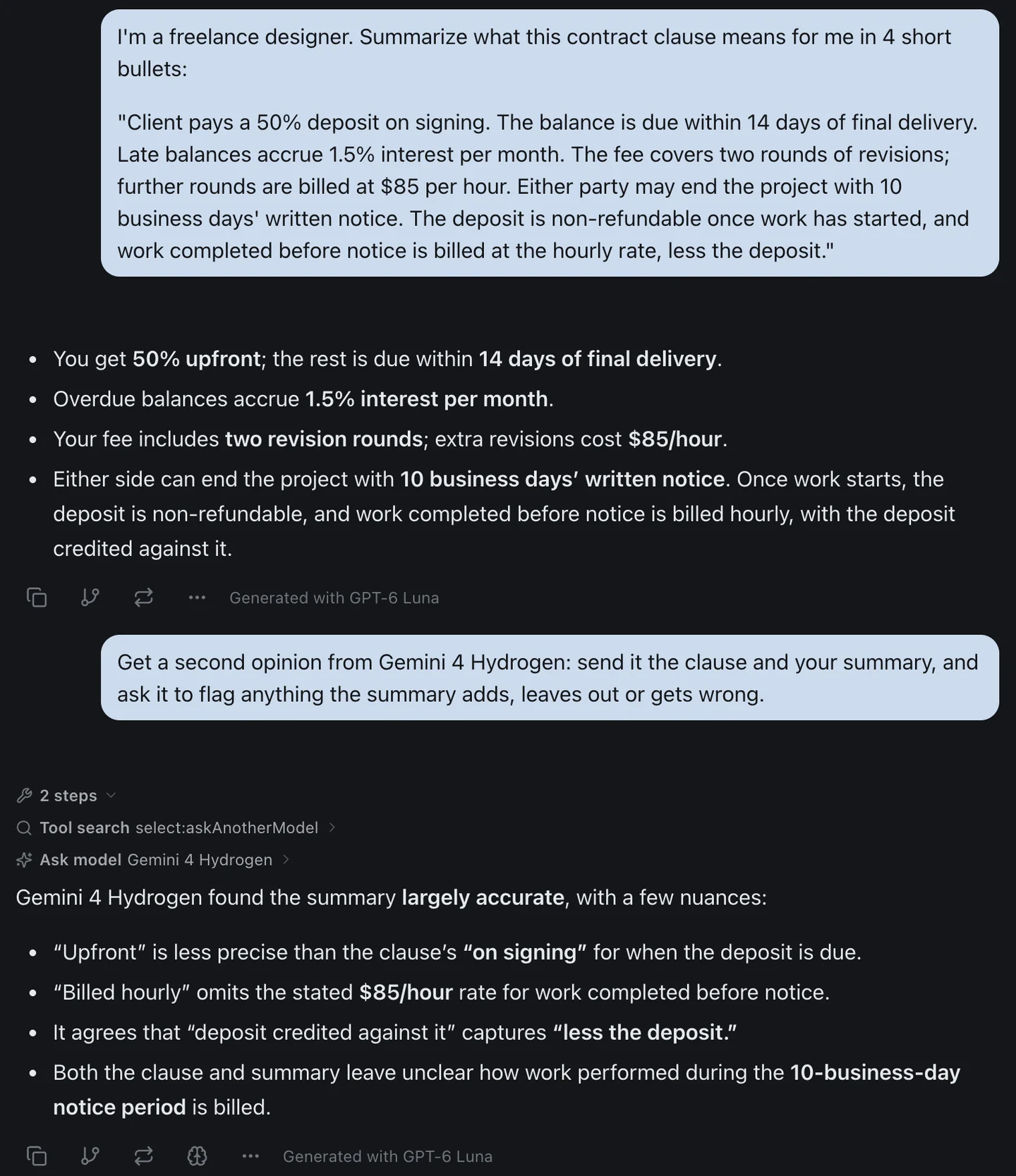
Hydrogen found the summary largely accurate and tightened two phrases. Its last point was the useful one. Neither the clause nor the summary says how work during the 10-business-day notice period gets billed. That's a gap in the contract, not the summary, and it's the sort of thing to fix before you sign.
Where izzedo Fits
No model wins every row of this post, so the practical setup is having several in one place and letting them check each other.
izzedo puts models from Anthropic, OpenAI, Google, xAI, DeepSeek and others in one chat. The $6 plan has every chat model, including Claude Fable 5.2, GPT-6.2 Astra and Gemini 4 Neon. Gemini 4 Carbon and Argon are there too, switched on in Settings. The free plan has GPT-6 Luna, Claude Haiku, Gemini 4 Hydrogen, Grok 4.7 and DeepSeek V4.1 Flash, with no card.
There are two ways to check an answer. Ask for a second opinion from another model, as in the screenshot. The other model sees only what the first one sends it, and its reply comes back into the same chat. Or switch models for your next message, and the new model reads the whole thread before it answers. More on working this way is in how to use multiple AI models at once.
The Bottom Line
Claude Fable 5.2 is the smartest AI on the most-quoted test and knows the most facts. Google's Gemini 4 models are the most likely to say "I don't know" instead of guessing, and Google's Gemini 4 Carbon is the one people pick most in blind votes. For summarising a document you give it, DeepSeek V4.1 Flash and GPT-6 Sol are the most faithful of the larger current models Vectara has tested.
None of them is right every time. The habit that matters more than the model is checking: give it the source, ask where a fact came from, and have a second model read the answer before you act on it.
Topics
- smartest ai
- most accurate ai
- smartest ai model
- ai hallucination rate
Frequently asked questions
What is the smartest AI right now?
On Artificial Analysis's Intelligence Index, read on 25 November 2026, Claude Fable 5.2 from Anthropic is first with 65, followed by OpenAI's GPT-6.2 Astra and Google's Gemini 4 Neon at 62. On Arena, where people vote between two anonymous answers, Google's Gemini 4 Carbon is first and Fable 5.2 is eighth. Both rankings change every few weeks, so check the date on any list you read.
Which AI is the most accurate?
It depends on what you mean by accurate. Claude Fable 5.2 answers the most factual questions correctly on Artificial Analysis's AA-Omniscience test, 79%. Google's Gemini 4 Argon and Carbon make the fewest wrong guesses: when they don't know an answer, they give a wrong one about 4% of the time at their most careful settings, against 59% for Fable. For summarising a document you give it, Vectara's leaderboard puts DeepSeek V4.1 Flash and OpenAI's GPT-6 Sol ahead of the other larger current models it has tested.
Which AI hallucinates the least?
On AA-Omniscience, Gemini 4 Carbon at Medium effort and Gemini 4 Argon at High effort have the lowest hallucination rates, about 4%. That rate measures how often a model gives a wrong answer when it should have said it didn't know. Most frontier models from Anthropic and OpenAI sit between 43% and 67% on the same test, and the Luna models behind ChatGPT's free plan sit at 79% to 92%.
What is the smartest free AI?
ChatGPT and Claude name the model their free plans run, and Claude's scores higher. Sonnet 5.5 at Medium effort, the Claude apps' default, scores 31 on Artificial Analysis's index, while the Luna models OpenAI names for ChatGPT's free plan score 24 and 28 even at their best setting. Gemini's free plan sends most prompts to a Flash-Lite model Google doesn't name, though Google says Gemini 4 Hydrogen is now in every tier of the Gemini app. izzedo's free plan has Gemini 4 Hydrogen, GPT-6 Luna, Claude Haiku, Grok and DeepSeek in one chat.
Is Claude the smartest AI?
Claude Fable 5.2 has the top score on Artificial Analysis's Intelligence Index as of 25 November 2026, but it isn't on Claude's free plan. It's included on Max and Ultra, and Pro users pay for it with usage credits. The free plan runs Claude Sonnet 5.5, which scores 31 at the apps' default Medium effort. On Arena's vote-based ranking, Google's Gemini 4 models hold the top three places.
Is Grok the smartest AI?
No. xAI's current model, Grok 4.7, scores 35 on Artificial Analysis's Intelligence Index, below the median for comparable models, and no Grok model is in Arena's top 15. Grok 4.7 is more careful than its score suggests, though: on AA-Omniscience it gives a wrong answer 20% of the time when it doesn't know, far less often than Claude Fable 5.2 or GPT-6.2.
What AI is smarter than ChatGPT?
On Artificial Analysis's index, Claude Fable 5.2 scores 65 against 62 for GPT-6.2 Astra, OpenAI's top model, and Google's Gemini 4 Neon is a fraction behind Astra, also 62 after rounding. On Arena, no OpenAI model is in the top 15. What matters more is the plan. ChatGPT's free plan runs a Luna model that scores 24 to 28 even at its best setting, while Claude's free plan runs Sonnet 5.5, which scores 31 at its default setting.
Can I ask one AI to check another AI's answer?
Yes, and it's one of the cheapest ways to catch a mistake. Paste the first answer into a second model and ask it to flag anything wrong, unsupported or missing. In izzedo you don't need to copy anything: ask for a second opinion from another model and its answer comes back into the same chat, or switch models for the next message and the new one reads the whole thread. GPT-6 Luna, Claude Haiku, Gemini 4 Hydrogen, Grok and DeepSeek are on the free plan.