Grok Bot vs Muse vs ChatGPT Dots: Every Agent Gets a Cloud Computer, So Compare the Rules
Grok Bot, Meta's Muse, ChatGPT's dots, Claude's Duet and Gemini's tasks all get a computer in the cloud that can keep working when yours is off. What separates them is the entry price, the country list, what each one does without asking and whether anyone sizes your allowance. I read every vendor's own pages to compare them.
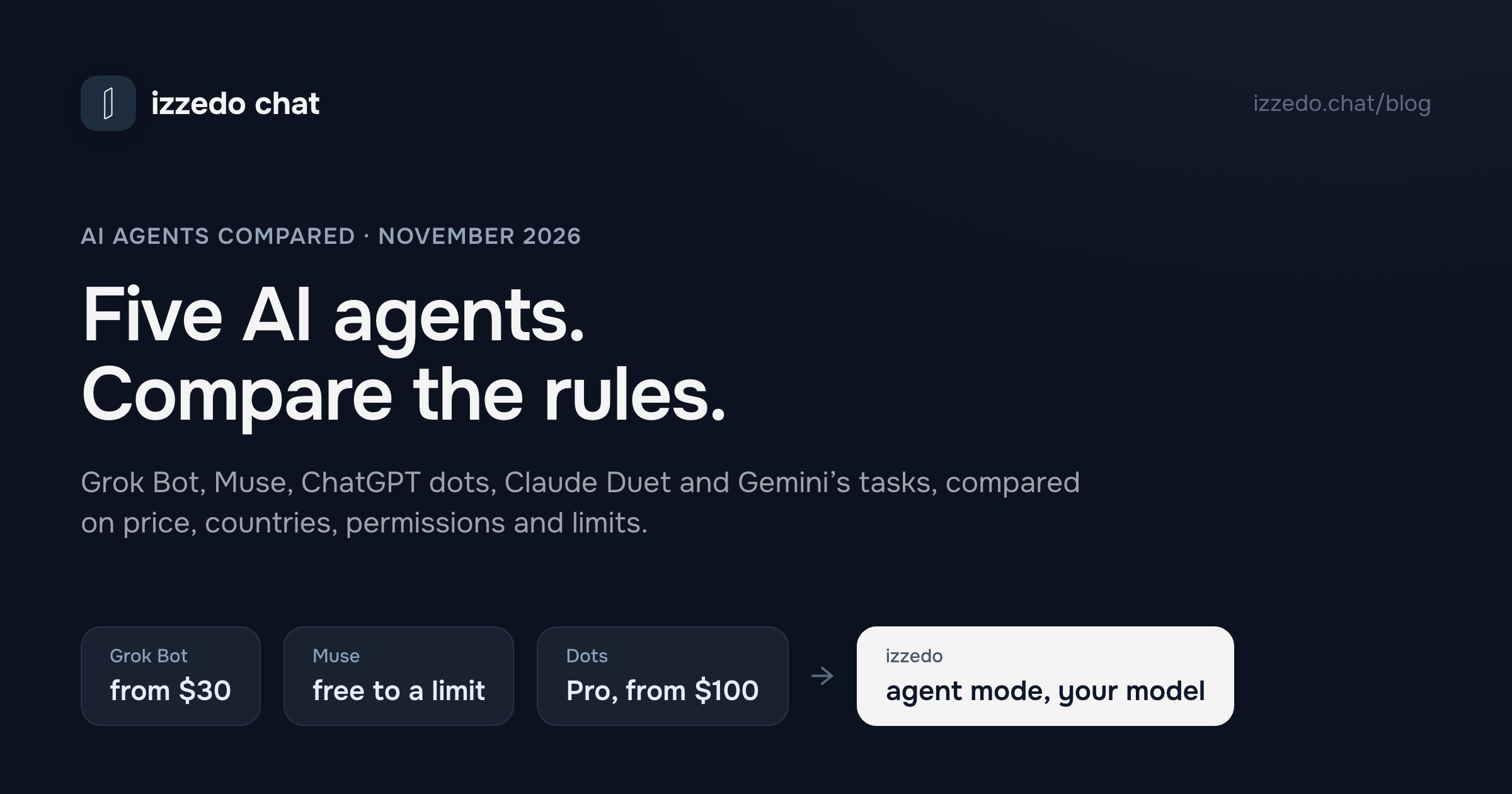
Five companies now offer a personal AI agent, and on paper it is the same one. Grok Bot, Meta's Muse, ChatGPT's dots, Claude's Duet and Gemini's tasks each get a computer in the cloud, connect to your apps and can keep working after you close the laptop.
So a feature list won't tell you which one to pick. The rules will. What it costs to get in. Whether your country is on the list. What the agent does without asking you. Whether anyone tells you how much work your plan buys. On those four the agents differ a lot, and the vendors' own pages say so.
I read the pricing page, the help centre and the launch posts for each of them on 20 November 2026. Every figure and quote below comes from the vendor's own pages. Where two pages from the same company disagree, I say which one I went with.
The Short Answer
| Agent | Cheapest way in | Where it's sold | Before it acts | Your allowance |
|---|---|---|---|---|
| Grok Bot (xAI) | Premium, $30 a month | No country list published | An automated review lets most actions go ahead | A weekly pool xAI doesn't size, shared with Grok and Cursor |
| Muse (Meta) | Free up to a weekly limit. Power is $20 | US, Canada, Singapore, Australia | Asks before important actions | 500M Muse tokens a week on Power |
| ChatGPT dots (OpenAI) | ChatGPT Pro, from $100. Reaching some Plus accounts | Not the EEA, UK or Switzerland | A review step decides whether to go ahead, ask you or hand over | An allowance OpenAI doesn't size |
| Claude Duet (Anthropic) | Claude Pro, $20, by waitlist | US only | Asks before it sends, pays, signs or deletes | Your Claude plan's limits |
| Gemini tasks (Google) | Free in six countries. A Google AI Pro plan elsewhere | Not the EEA, Nigeria, Switzerland or UK | Always asks before sending, buying or deleting | 5-hour and weekly limits shared with Gemini |
Four things follow from that table.
- Outside North America, read the country column first. Three of the five name Europe as excluded or sell in the US only.
- Muse and Gemini are the free ones. Muse is free in its four countries and Gemini's tasks in six.
- Only Meta prints a number. It sells Muse tokens by the week. Nobody says how many tasks an allowance covers, Meta included.
- Three ask by default and three let a review decide. Muse, Duet and Gemini stop before a send or a purchase. Grok Bot, dots and Cowork's Auto mode run each action past an automated check.
Anthropic has a second agent, Claude Cowork, which is on every paid Claude plan. I cover it with Duet below.
What All Five Have in Common
Each vendor describes the same machine in its own words. xAI calls Grok Bot "an agent with access to a real computer in the cloud". Meta gives Muse "a persistent, isolated Linux computer with a full browser". OpenAI says "your dot lives in the cloud and has its own computer and browser". Anthropic says Duet "has a virtual machine with its own browser, so it doesn't require your laptop or phone to be on". Google runs Gemini's tasks in "a hardware-isolated virtual machine that's dedicated to your account".
They all keep going when you leave. xAI's FAQ says "Closing the app, laptop, or phone does not stop a background turn or routine." OpenAI says a dot "can keep working even when your computer is off." Meta says Muse "keeps working after people close the app". Gemini does too when it works in its remote browser instead of your own Chrome.
They all connect to the apps your work is in. Grok Bot lists "Slack, Notion, Drive, Teams, and more" and takes any MCP server or API. Muse has connectors for Asana, Canva, Notion, QuickBooks, Slack, Stripe and others. Dots use the plugins already installed in your ChatGPT account. Duet "can use the over 6,000 connectors and plugins in the Claude Marketplace". Google says Gemini "connects with more than 60 popular apps".
Four of them run work on a schedule you set. xAI calls them routines, Meta recurring tasks, Google and OpenAI schedules. Duet works differently. It sends a brief each morning and checks your connected accounts every few hours.
If you only want to know what agent mode is and which plan has it, that post covers the wider field. This one is about choosing between these five.
Grok Bot vs Muse
Price. Muse costs nothing to start. Meta's help page says it is "available for free with a usage limit". Power is $20 a month for "500M Muse tokens per week" and "10 phone calls per day". Maximum is $100 for "3B Muse tokens per week" and 20 calls a day. Grok Bot isn't on xAI's Free or $8 Plus plans. It starts with Premium at $30 a month, then Super at $100 and Ultra at $200. I went through each Grok Bot plan and Muse's plans and tokens in separate posts.
Allowance. Meta prints a weekly number. Its page on extra tokens adds a caution: "Meta sets usage rates and doesn't guarantee a set amount of usage will produce a fixed quantity or quality of output." xAI prints no number. Premium is "4x Plus", Super "15x Plus" and Ultra "50x Plus", and Plus is never sized. That pool also pays for Grok chat and Cursor. xAI's pricing docs say Bot usage "draws from that seat's shared weekly usage pool, not a separate additive pool."
It wasn't always shared. The launch post of 11 August said Grok Bot "comes with its own usage, separate from your Grok and Cursor plans". The documentation now says the opposite.
Permission. This is the biggest gap between the two. Meta says "By default, Muse will not take many important actions, like sending an email, without your approval", and of purchases, "It will always ask for your approval". It adds that many of these checks "are enforced outside the AI model, so they don't rely only on Muse deciding whether it should ask."
Grok Bot starts from the other end. "Auto Review is on by default, and most actions go ahead on their own." For each action the review either lets it run or has the Bot ask you first. xAI's own advice is to "Keep sending, publishing, purchasing, deletion, and production changes behind approval", which you do by adding Ask first rules. Payments have their own rule. "A card saved in Vault fills in at checkout without a separate approval each time. If you want to approve every payment, don't save the card".
Model. Neither lets you choose. xAI's FAQ says "Grok Bot picks the model for each task, and there is no model picker", that the model can be a third party's, and that "Grok Bot does not show the underlying model for a request." Muse launched on Meta's Muse Spark, and Meta says its newer Muse Wonder models "will soon power more of Muse, rolling out first to subscribers."
Where you talk to it. Grok Bot has its own desktop app for macOS, Windows and Linux and a phone app. You can also reach it in X Chat, which xAI says is still rolling out, and Team Bots work in Slack and Microsoft Teams. Muse has a mobile app, a Mac app, a Chrome side panel and WhatsApp. Both can have an email address of their own.
Your data. Meta is direct about it. Using your Muse interactions for training "is on when you first use Muse", and the switch is in Settings under Data controls. xAI's pages are harder to follow. Its FAQ says the training opt-out "follows the applicable Cursor account and privacy settings". Cursor's help page says its Privacy Mode is an editor setting and that Grok Bot "runs on a separate product surface with its own data flows." Since 13 November the Grok Bot app also has its own "Help us improve Grok Bot" choice. I couldn't find a page that says which way an account starts.
Which one. If you live in the US, Canada, Singapore or Australia and want to try an agent before paying, start with Muse. Choose Grok Bot if you want several Bots handing work to each other, a Team Bot in Slack, or you already pay xAI for Premium.
Muse vs ChatGPT Dots
Dots have no free tier and no cheap one. OpenAI's pricing page puts them on Pro, which costs "$100 with Pro 100, $200 with Pro 200, or $500 with Pro 500." Each member gets one dot.
Plus is changing, and OpenAI's pages disagree about it. The help article, updated this week, says dots are available "to Pro and selected Plus users" and are "gradually rolling out to Plus, so not every eligible account has access yet." The pricing page shows no dots on Plus, and a release note from 19 November says dots are "currently available to Pro users." So don't buy Plus expecting a dot.
Three differences matter next to Muse.
Dots sort actions into three tiers. OpenAI says "The most sensitive actions like changing a password or transferring money require you to take over so you can complete them yourself", and that deleting data or installing software "may require approval each time". It also says "Asking your dot to draft replies doesn't give it permission to send them." Muse has two levels, ask for some actions or always ask, plus an "Always allow" you can grant per connector.
You can't hand a dot your errands the same way. OpenAI says "Your dot cannot initiate calls to you at launch" and "you cannot give your dot its own standalone email address." Muse can have an @muse.ai address and its plans count phone calls. Dots can be reached in ChatGPT, in Slack and by voice call, and by iMessage or RCS text in a beta for a limited number of Pro users.
Dot chat is free of ChatGPT's limits, and the real work isn't sized. "For Pro and Business Premium, conversations with your dot don't count toward your ChatGPT usage limits." Beyond that, "Your plan includes an allowance for deeper work", with no figure. Work a dot hands to ChatGPT Work or Codex counts against those products' limits.
If you already pay for Pro, your dot is included and costs nothing to try. If you don't, Muse does most of the same jobs for $0 to $20 in the four countries where Meta sells it.
Grok Bot vs Claude
Anthropic sells two things under this heading, and they are easy to confuse.
Claude Cowork is agent work inside Claude itself. It is on every paid plan, and Pro is $20 a month, or $17 with a year paid up front. Since September Anthropic has been making "everything Claude Cowork does available from any conversation." It runs on Anthropic's servers, and "Work continues if you close your laptop". Scheduled tasks run hourly, daily, weekly or on weekdays.
Claude Duet is the one built like Grok Bot. It is a separate app where "Claude works as a proactive agent", with a morning brief and checks on your connected accounts. It opened on 21 October as a research preview "on a waitlist for Claude Pro, Max, and Ultra subscribers in the US", at no extra charge.
Against Grok Bot, three things stand out.
Claude costs $10 less to enter, and Cowork needs no waitlist.
You know which model is working. Anthropic says it designed Duet around Claude Opus 5.5, and a Cowork scheduled task has a field for the model you want. Grok Bot doesn't show its model.
Duet is built to interrupt you. "Before it sends a message, makes a payment, signs a document, or deletes anything, it shows you exactly what it's about to do and waits for your approval." Some things it refuses even with approval, "like trading securities or moving money between accounts." Cowork is heading the other way. Its Auto mode is "rolling out as the default" on personal plans, where "Claude keeps working without stopping to ask about each step", and Anthropic warns the automated check "can miss risky actions."
Grok Bot's case is the team. Bots share one cloud computer and hand work to each other, Team Bots sit in Slack and Microsoft Teams, and a Bot can join your video calls on the higher plans.
Both spend the same allowance as the chat product they belong to. Anthropic says Duet "checks your connected accounts every few hours, because checking nonstop would use up your plan's limits much faster." If you've hit Claude's limits in normal use, an agent checking your inbox all day will get you there sooner.
Muse vs Claude
Muse is free to start and sold in four countries. Duet needs a $20 plan, a US account and a place on the waitlist. On permissions they are close. Both stop before a send or a payment by default.
The differences are practical. Meta says you and your agent can both use Muse's cloud computer, "allowing you to intervene at any point." Anthropic says Duet "can't yet show you its browser". Muse comes to you in WhatsApp. Duet has its own app with one ongoing thread, typed or spoken. And Duet inherits what you already set up in Claude, since it "carries over your memory, skills, and connected apps from your Claude account".
If you already work in Claude every day and you're in the US, join the Duet waitlist. Everyone else in Meta's four countries can sign up for Muse, which Meta says is still in limited testing.
Muse vs Gemini
These are the two you can start for nothing, and Google's free tier is the newer one. On 17 November Google made tasks free "across the U.S., Japan, Korea, Canada, Australia, and India". In the other countries where Google offers them, tasks need a Google AI Pro or Ultra plan. Pro is $19.99 a month at US prices. If you remember Gemini Spark, this is it. Google's help page says "we renamed it Task to make it easier to understand."
Gemini's free version has tighter limits on schedules than Muse states for its own. Without a subscription you can schedule a task "up to once a day during a general time window: overnight, daytime, or evening." Hourly schedules need Pro or Ultra. Meta's page says only that recurring tasks repeat "daily, weekly, or on a custom interval" and names no cap.
Gemini is also the strictest about asking. It is "designed to always ask for your review and confirmation" before sending communications, deleting data, making purchases or submitting forms, and "Even if you update your permission preferences, very sensitive actions require your permission each time."
One condition is easy to miss. Tasks only work with Gemini's History setting on, and History is also where Google's training control lives. Google says History "is on by default" for adults, and that reviewed chats "are retained for up to 3 years, even if you delete them or turn this setting off later."
Which Agents Can You Get Where You Live?
| Agent | Where the vendor says it's available |
|---|---|
| Grok Bot | No country list. The X Subscription was to be "available to everyone globally". Bot phone calls are US only |
| Muse | US, Canada, Singapore and Australia. Meta says Muse and its subscriptions "aren't available in all locations yet" |
| ChatGPT dots | "markets excluding the European Economic Area, Switzerland, and the UK" |
| Claude Duet | "Pro, Max, and Ultra users in the US" |
| Claude Cowork | The countries on Anthropic's supported-regions list, which include the EU and the UK |
| Gemini tasks | Free in Australia, Canada, India, Japan, South Korea and the US. Paid elsewhere, "except in the European Economic Area, Nigeria, Switzerland, and the United Kingdom" |
If you're in the EU or the UK, dots, Duet and Gemini's tasks are closed to you in the vendors' own words, and Meta hasn't announced your country for Muse. That leaves Claude Cowork, which Anthropic's supported-regions list covers in the EU and the UK, and Grok Bot, for which xAI publishes no list at all.
Even inside a supported country, single features are narrower. Dot texting is a limited beta in North America. Gemini's phone calls aren't offered in five US states. Tagging a Grok Bot on X isn't available to accounts in Australia, the UK or the EU.
What Each Agent Does Without Asking
Going by the default each vendor documents, the six fall into two groups.
Three ask you by default.
- Gemini always asks before the sensitive actions, and "Always allow" doesn't cover them.
- Muse asks before important actions and before every purchase, and enforces many of those checks outside the model.
- Claude Duet asks before it sends, pays, signs or deletes. Paying, deleting an order and creating an account can't be put on a "don't ask me again" rule.
Three let an automated review decide.
- ChatGPT dots run each action through a review that decides whether the dot can proceed, needs your approval or must hand the step to you.
- Claude Cowork is moving to Auto, where automated safety checks run before most actions and Claude doesn't stop to ask about each step.
- Grok Bot has Auto Review, under which "most actions go ahead on their own." When background work does raise an approval card, the card "expires after 30 minutes."
Each has settings that loosen part of this. Dots accept custom rules, including "Take action without asking", and OpenAI is honest about how firm a rule is: "They are instructions your dot tries to follow, and it can make mistakes." Google warns that "If a schedule runs when you are offline, you may not be able to stop Gemini from completing an unintended action."
So for the first weeks, keep the stricter settings, don't save a payment card, and read what the agent did each evening. On Grok Bot, add Ask first rules for sending, purchasing and deleting before you connect anything. Meta's own help page gives the reason: "Some other actions, like sending an email, cannot be reversed, just like if you were doing them yourself."
How Each Agent Meters Your Usage
None of the five tells you how many tasks a week you're buying.
Grok Bot spends a weekly pool where, in xAI's words, "Usage rates vary by product, so different activities can draw different amounts". When it's empty you wait for the weekly reset, add prepaid credit or move up a plan. Scheduled work can empty it fast. xAI's docs warn that an hourly routine or a busy Slack trigger "can use a week of usage in a day." On 1 November a user asked Elon Musk for a reset because usage had run out quickly that week. He replied, "The cost of serving Grok Bot was unsustainably high relative to revenue".
Muse counts tokens by the week. Unused weekly usage "does not rollover". Tokens you buy separately "never expire".
Dots have "an allowance for deeper work" that OpenAI doesn't size. A change arrives in December, when Plus, Pro and Business allowances will be "shared across ChatGPT and Codex". The article announcing it doesn't mention dots.
Claude counts everything against one set of limits. "Longer agentic tasks that search the web, run code, or create files generally use more than a quick question."
Gemini has compute-based limits where "Your limit refreshes every 5 hours until you reach your weekly limit." Google adds that "Limits may change without notice, including due to capacity constraints."
The practical test is the same everywhere. Give the agent your real jobs for a week on the cheapest plan that includes it, watch the usage page, and upgrade only if it keeps running out. If you'd rather pay for chat than for an agent, the $20 plans compared covers what each of these companies sells at that price.
What About Instinct?
Instinct comes up next to Muse a lot, and it's a different kind of product. Its home page says "there are no new interfaces. You can text or call it." You don't open a chat app to use it. It's run by Spear Street Technology, a San Francisco company.
Its terms say Instinct "is currently available without charge", with the right to introduce fees. If you sign up while it is at capacity, you get a text when a spot opens. Purchases need your confirmation first. Its privacy policy says your information is used to train AI models unless you opt out in settings.
What Instinct's own pages don't give is a country list, a launch date or the name of the model. Muse has all three, plus published plans. If you want the least setup and can get a spot, Instinct is free to try. If you want to know the terms before you connect your inbox, Muse tells you more.
Which One Should You Pick?
You already pay for Claude Pro. Cowork is in your plan. Use it before you buy anything else, and join the Duet waitlist if you're in the US.
You're in the US, Canada or Australia and starting from nothing. Muse and Gemini's tasks are both free there. Try both on the same errand and keep the one that asked you the right questions.
You already pay for ChatGPT Pro. Your dot is included. Don't buy Pro for a dot alone.
You run a small team and want Bots in Slack. Grok Bot at $30 a seat is built for that. Set a monthly spending cap before you turn on Auto Top-up.
You're in the EU or the UK. Claude Cowork is on Anthropic's supported list. xAI publishes no country list for Grok Bot, so check at sign-up.
Where izzedo Fits
Look at the jobs in the vendors' own examples. Build a deck, keep a calendar in sync, send a daily check-in or a weekly summary, brief you each morning on what's in your apps. Most of that is work inside your apps on a schedule, and it doesn't depend on which company's model does it.
In every agent above, the model comes with the vendor. Grok Bot and dots have no model picker, and Duet is built around one model. izzedo chat works the other way round. You pick the model for the job and can change it on the next message. The free plan has a model from each of the five companies in this post: GPT-6 Luna, Claude Haiku 5.5, Grok 4.7, Gemini 4 Hydrogen and Meta's Muse Spark Open.
Agent mode is on the free plan too, with more than 1,400 connectors. Connect Gmail, Google Calendar, Google Sheets, Notion or Slack and the agent can read your inbox and draft replies, pull numbers from a sheet or post a summary to a channel. It also makes the file you asked for, as a Word document, a PowerPoint deck, an Excel sheet or a PDF.
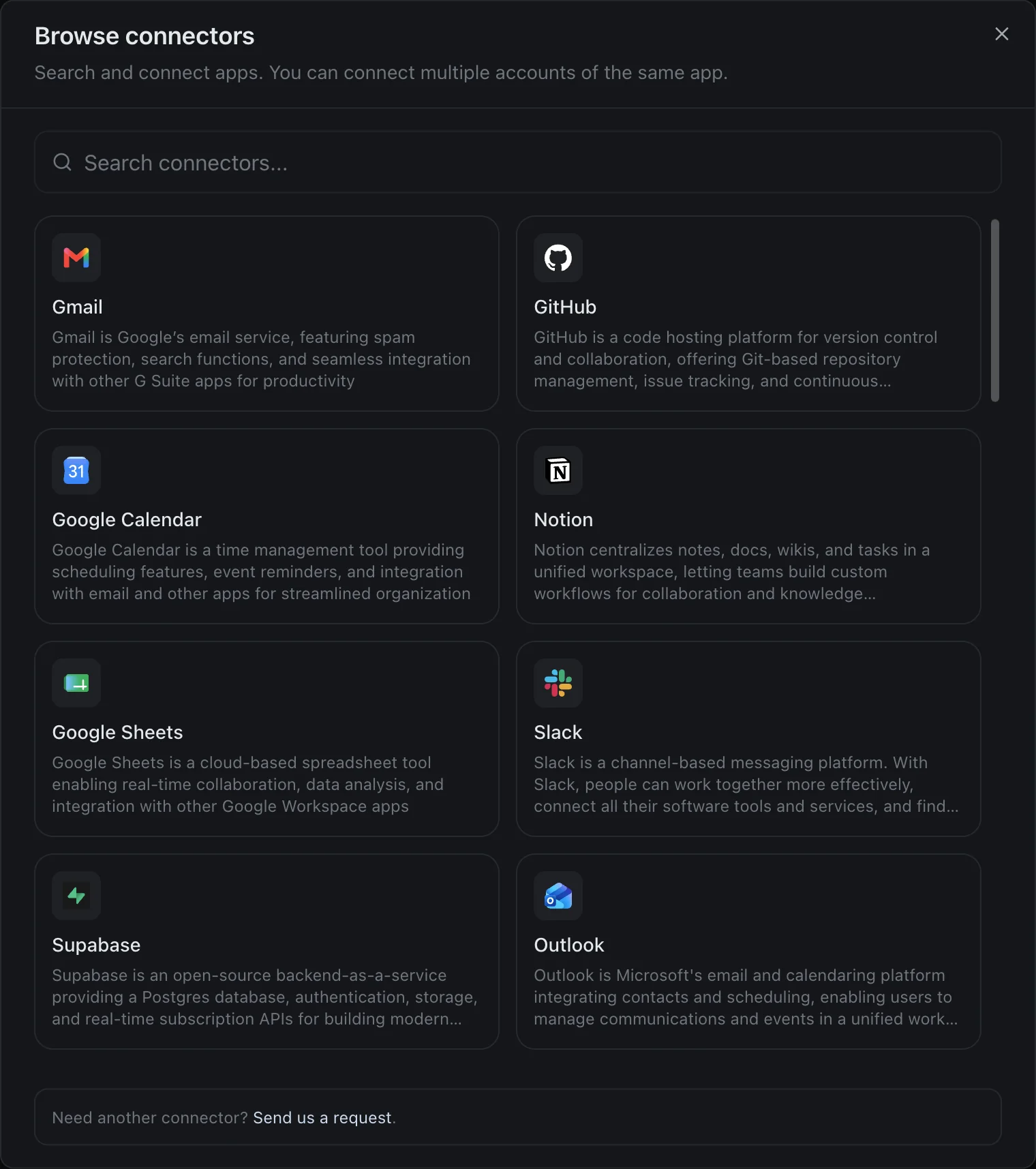
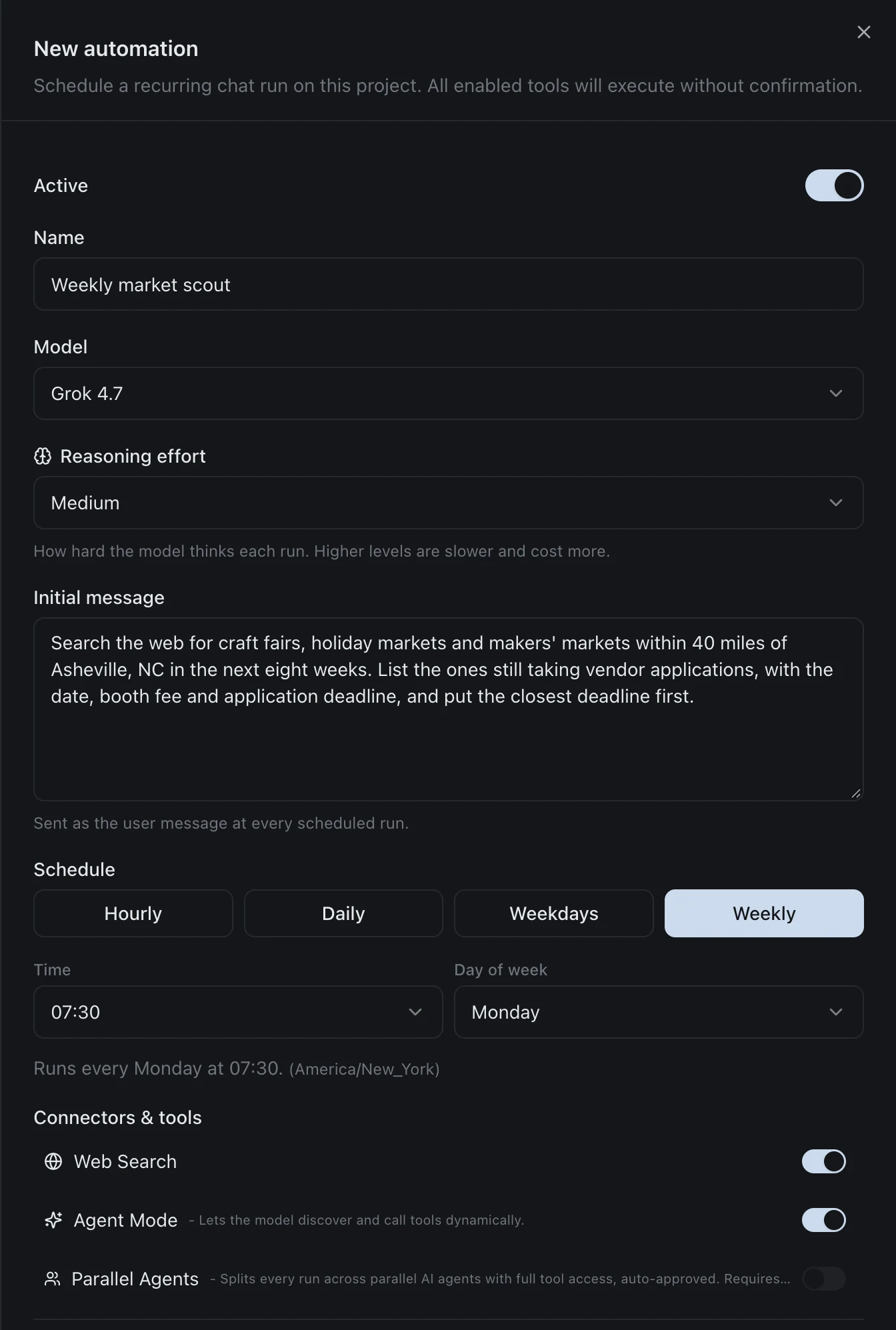
Scheduled work is called automations, and it starts on the $6 plan. Each automation has its own prompt, schedule, tools and model, so a daily inbox summary can run on a fast model and the Friday report on a stronger one.
izzedo meters usage as well, on a 5-hour and a weekly window that the pricing page sets out by plan.
The Bottom Line
These five agents are built the same way, so compare what the vendors do differently. Muse and Gemini's tasks are free to start. Claude's agents come with a $20 plan, Grok Bot with a $30 one, and dots with ChatGPT Pro at $100. Four of the five aren't on offer in the EU or the UK. Muse, Duet and Gemini ask before they send or spend. Grok Bot, dots and Cowork's Auto mode leave most of that to an automated review. Nobody says how many tasks an allowance covers.
Start with the agent that comes with a plan you already pay for, or with a free one if you live where it's offered. Keep the stricter permission settings, keep your card out of it, and give it a week of real work before you pay more.
I read all of this on 20 November 2026. These products change by the week, and OpenAI's help article on dots was edited the day before I read it. Check the vendor's own page before you subscribe, and check the date on anything you read about agents, this post included.
Want agent mode on the model you choose, with 1,400+ connectors on a free plan and scheduled automations from $6? Try izzedo chat free, no credit card required.
Topics
- grok bot vs muse
- muse vs dots
- grok bot vs claude
- muse vs claude
Frequently asked questions
Is Grok Bot better than Muse?
They do the same kind of work, so the terms decide it. Muse is free up to a weekly limit, with Power at $20 a month and Maximum at $100, and by default it asks before important actions such as sending an email. Grok Bot needs The X Subscription's Premium plan at $30 a month, lets most actions go ahead under a default called Auto Review, and draws on a weekly pool that xAI doesn't size. Muse is sold only in the US, Canada, Singapore and Australia. xAI publishes no country list for Grok Bot.
Is Meta Muse free?
Yes, up to a usage limit. Meta's help page says Muse is available for free with a usage limit, and that you can upgrade, buy extra Muse tokens once, or wait for the limit to refresh. Power costs $20 a month for 500 million Muse tokens a week and 10 phone calls a day. Maximum costs $100 a month for 3 billion tokens a week and 20 calls a day. Meta doesn't say how many tokens a task uses.
How much do ChatGPT dots cost?
For individuals, dots have no price of their own. They come with ChatGPT Pro, which starts at $100 a month, and with Business Premium. OpenAI's help article now says dots are available to Pro and selected Plus users, with a gradual rollout to Plus, while its pricing page still shows no dots on Plus. Each member can create one personal dot. Dots are not available in the European Economic Area, the UK or Switzerland.
Which AI agents are available in Europe and the UK?
Fewer than the launch posts suggest. OpenAI says dots are not available in the European Economic Area, the UK or Switzerland. Google excludes the European Economic Area, Nigeria, Switzerland and the UK from Gemini's tasks. Claude Duet is a US-only research preview, and Meta has announced Muse only for the US, Canada, Singapore and Australia. Claude Cowork is the exception. Anthropic's supported-regions list covers its apps, Cowork included, and names the EU countries and the UK. xAI publishes no country list for Grok Bot.
Do these agents keep working when my computer is off?
Yes. Each vendor says so in its own documentation. Grok Bot's work runs on a cloud computer, and closing the app, laptop or phone does not stop a background turn or routine. OpenAI says a dot lives in the cloud and can keep working when your computer is off. Meta says Muse keeps working after people close the app, Anthropic says Duet doesn't require your laptop or phone to be on, and Gemini carries on if it is using its remote browser.
Can I choose which model the agent uses?
Mostly no. xAI's FAQ says Grok Bot picks the model for each task, has no model picker and does not show which model it used. OpenAI's dots draw on different models for different parts of the work, with no picker described. Claude Duet is built around one model, Claude Opus 5.5. The exceptions are Claude Cowork, where a scheduled task has a model field, and Gemini, where Google AI subscribers can switch models in Task mode.
Which agent asks before it acts?
Muse, Claude Duet and Gemini ask by default before the actions that matter. Meta says Muse will not take many important actions, like sending an email, without your approval, and always asks before a purchase. Duet shows what it is about to do and waits before it sends a message, makes a payment, signs a document or deletes anything. Gemini always asks before sending, buying or deleting. Grok Bot, dots and Claude Cowork's Auto mode leave it to an automated review. On Grok Bot most actions go ahead by default, and a card saved in its Vault pays without a separate approval.
What is Instinct, and how does it compare with Muse?
Instinct is a personal assistant from Spear Street Technology in San Francisco. You text it or call it instead of opening a chat app. Its terms say it is currently available without charge and that fees may be introduced, and sign-ups wait for a spot when it is at capacity. Muse has an app, published plans and a published country list. Instinct's own pages give no country list, launch date or model name, and its privacy policy says your information trains its models unless you opt out.